Emperor Ashoka’s pillars and edicts transformed the Mauryan landscape into a network of imperial messaging, projecting moral governance while reinforcing the enduring power of the state.

By Matthew A. McIntosh
Public Historian
Brewminate
Introduction: Monumental Messaging and the Politics of Perception
In the ancient world, rulers relied not only on armies and administrators but also on narratives that shaped how subjects understood authority. Political legitimacy often depended upon careful management of perception. Monumental inscriptions, royal proclamations, and symbolic architecture served as tools through which states could project moral purpose, divine sanction, and political stability. Within this broader tradition, the monuments of Emperor Ashoka of the Mauryan Empire stand as one of the earliest and most sophisticated examples of state messaging embedded into the landscape itself. In the third century BCE, Ashoka ordered the erection of pillars and rock edicts across the Indian subcontinent, inscribing messages that proclaimed his commitment to ethical governance, compassion, and the moral doctrine he described as dhamma (dharma).
These inscriptions did more than communicate policy. They created a carefully structured narrative about imperial rule. The pillars appeared in strategic locations along trade routes, administrative centers, and pilgrimage corridors, ensuring that imperial messages reached populations across a vast and culturally diverse empire. Their physical form reinforced the authority of the words they carried. Carved from highly polished sandstone and often crowned with elaborately sculpted animal capitals, the pillars conveyed permanence, power, and technological sophistication. Through this fusion of monumentality and ethical language, Ashoka presented himself not merely as a conqueror or administrator but as a ruler whose authority derived from moral responsibility and concern for the welfare of his subjects.
Yet Ashoka’s messaging also contained an important tension. His inscriptions repeatedly emphasized restraint, compassion, and the renunciation of aggressive warfare following the devastating conquest of Kalinga. In these proclamations, the emperor depicted himself as a ruler transformed by the moral consequences of violence, dedicated thereafter to the promotion of peace and humane governance. In the thirteenth of the Major Rock Edicts, Ashoka openly reflected upon the suffering caused by the Kalinga campaign, describing the deaths, deportations, and grief that accompanied imperial victory. Such passages constructed a powerful image of moral introspection rarely expressed so explicitly in ancient royal inscriptions. The ruler’s authority was reframed as ethical guardianship rather than martial dominance. Yet this moral posture did not dissolve the structural realities of empire. The Mauryan state remained a vast administrative organism governed through provincial officials, taxation systems, intelligence networks, and a standing military capable of enforcing imperial policy. Classical accounts of the Mauryan administration, alongside archaeological and textual evidence, suggest a highly organized state apparatus that maintained order across immense distances. Ashoka’s renunciation of expansionist warfare did not signal the abandonment of coercive capacity but rather its rhetorical repositioning. The language of compassion and moral duty served to reinterpret imperial authority, allowing the emperor to present strength as disciplined restraint rather than naked force.
Understanding Ashoka’s monuments requires viewing them not only as expressions of religious conviction but also as instruments of political communication. By inscribing a vision of ethical kingship into durable stone monuments distributed across his empire, Ashoka effectively embedded imperial ideology into the physical environment of administration. These pillars and edicts transformed geography into a medium of state messaging, shaping how subjects encountered and interpreted the authority of the Mauryan ruler. Ashoka’s monumental inscriptions represent an early example of controlled perception as a strategy of governance, where moral language and architectural permanence worked together to stabilize imperial legitimacy.
Imperial Context: The Mauryan Empire and the Problem of Legitimacy

The Mauryan Empire emerged in the late fourth century BCE as the first political authority to unify much of the Indian subcontinent under a single imperial administration. Founded by Chandragupta Maurya following the collapse of Nanda power in Magadha, the Mauryan state expanded rapidly through military conquest and political consolidation. By the time Ashoka ascended the throne in the third century BCE, the empire stretched from the Afghan highlands in the northwest to the eastern regions of Bengal and deep into the Deccan plateau. Governing such a vast territory required administrative innovation, bureaucratic coordination, and mechanisms capable of maintaining authority across regions characterized by linguistic, cultural, and religious diversity. The Mauryan rulers confronted not only the challenge of conquest but also the problem of sustaining legitimacy over populations that had been incorporated into Mauryan rule through force.
Early Mauryan governance relied heavily on centralized authority supported by provincial administration. Regional governors oversaw taxation, judicial functions, and local order, while a network of officials communicated with the imperial center in Pataliputra. Classical descriptions of Mauryan governance suggest a complex bureaucratic structure designed to monitor economic production, trade, agriculture, and public works. Such administrative sophistication allowed the Mauryan state to maintain political cohesion despite the immense geographic distances that separated its provinces. Yet bureaucratic systems alone could not guarantee loyalty. The empire required ideological frameworks capable of presenting Mauryan authority as not merely dominant but legitimate.
This challenge became particularly acute during the reign of Ashoka. According to later Buddhist traditions, Ashoka’s early years as ruler were marked by political ruthlessness and consolidation of power following a contested succession. Whether or not these traditions reflect historical events in detail, they underscore the fragile nature of imperial authority during transitions of rule. The Mauryan throne represented not only political power but also a focal point for competing elite interests. Maintaining stability required Ashoka to reinforce the perception that his authority was both lawful and morally justified.
The conquest of Kalinga in the eighth year of Ashoka’s reign became a defining moment in this political landscape. Located along the eastern coast of the Indian subcontinent, Kalinga controlled important trade routes and maritime access. Its incorporation into the Mauryan Empire represented a strategic victory, yet the campaign was accompanied by extensive violence and population displacement. Ashoka’s own inscriptions describe the scale of suffering produced by the conquest, emphasizing the deaths, deportations, and anguish experienced by both combatants and civilians. The emperor later invoked this event as the catalyst for his transformation toward moral governance, presenting the conquest as a turning point that reshaped his understanding of kingship.
From a political perspective, the Kalinga War also intensified the question of imperial legitimacy. The expansion of Mauryan authority through warfare could produce resentment among newly conquered populations and unease among existing subjects who witnessed the destructive consequences of imperial ambition. Ashoka’s subsequent emphasis on dhamma offered a means of reframing imperial rule within a moral vocabulary that transcended conquest. Through proclamations that encouraged compassion, restraint, and respect among religious communities, the emperor sought to reposition the Mauryan state as a guardian of ethical order rather than merely an instrument of domination.
The monuments and edicts that followed this transformation must be understood within the context of imperial consolidation. Ashoka’s inscriptions did not operate in isolation from the administrative and military structures of the Mauryan state. Instead, they complemented these structures by shaping how imperial authority was perceived across the empire. By presenting himself as a ruler committed to moral responsibility, Ashoka attempted to stabilize the legitimacy of Mauryan governance while preserving the institutional mechanisms that sustained imperial power.
The Pillars and Edicts: Architecture as Imperial Communication
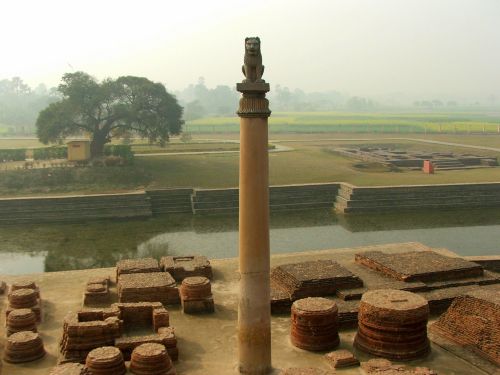
The pillars and rock edicts commissioned by Emperor Ashoka represent one of the earliest known systems of imperial communication inscribed directly into the landscape. Rather than relying solely on court proclamations or elite scribal networks, Ashoka distributed messages across his empire through permanent monuments placed in visible and strategic locations. These inscriptions appeared along major trade corridors, near population centers, and in areas frequented by pilgrims and travelers. Their placement ensured that imperial statements were encountered repeatedly by diverse audiences, transforming the physical geography of the Mauryan state into a medium through which the emperor’s authority and ideals were continuously communicated.
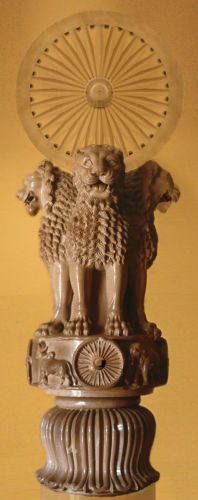
The architectural form of the pillars amplified this communicative function. Carved primarily from highly polished sandstone quarried at Chunar near Varanasi, the pillars were monumental in both scale and craftsmanship. Many stood between twelve and fifteen meters high and were crowned with sculpted capitals depicting animals such as lions, bulls, elephants, and horses. These capitals were not merely decorative elements but symbolic representations of authority and sovereignty. The famous lion capital from Sarnath, for example, displays four lions facing outward in different directions, suggesting vigilance and universal oversight. Such imagery conveyed the impression that imperial authority extended across the four quarters of the world, a visual metaphor that reinforced the idea of the Mauryan ruler as a universal sovereign. The extraordinary polish of the stone surfaces, often described as mirror-like, also contributed to their visual impact, signaling technical mastery and aesthetic refinement. Achieving such finishes required specialized artisans and careful labor, reflecting the resources and organizational capacity of the Mauryan state. In addition, the transportation of these monolithic pillars across great distances required coordinated logistics involving quarrying, river transport, and land movement, demonstrating the administrative reach of imperial power. The very existence of the pillars communicated more than their inscriptions alone; they stood as material evidence of a centralized authority capable of mobilizing labor, technology, and artistic skill on a monumental scale.
Equally significant was the textual content inscribed upon these monuments. Ashoka’s edicts were written in several regional scripts and languages, including variations of Prakrit rendered in the Brahmi and Kharosthi scripts. This linguistic adaptability indicates a deliberate attempt to reach populations across different cultural zones of the empire. The inscriptions addressed subjects ranging from moral conduct and religious tolerance to administrative directives and the responsibilities of imperial officials. By speaking directly to his subjects through written proclamations, Ashoka created an unusual form of communication in which the emperor’s voice appeared to address the population without intermediary elites.
The rock edicts complemented the pillars by extending this messaging into areas where monumental construction was less practical. Carved into natural rock faces across the subcontinent, these inscriptions often appeared along routes connecting administrative and commercial centers. Their presence signaled the reach of Mauryan authority into regions that may have lacked permanent imperial architecture. The combined system of pillars and rock inscriptions formed a distributed network of political communication that reached across the territorial breadth of the empire.
The content of the inscriptions reveals that Ashoka understood the persuasive power of repetition and visibility. Many edicts emphasize the emperor’s personal concern for the welfare of his subjects and his commitment to promoting ethical conduct. They encourage kindness toward animals, respect for parents and teachers, and tolerance among religious communities. These messages projected an image of the ruler as a moral guide whose authority extended beyond governance into the ethical life of society. The edicts consistently emphasize the emperor’s active involvement in supervising officials and ensuring that the principles of dhamma were implemented throughout the empire. Several inscriptions describe the appointment of special officers known as dhamma-mahamattas, whose responsibility was to oversee moral administration and encourage ethical behavior among both elites and commoners. Through such measures, Ashoka presented moral governance not as abstract philosophy but as a practical component of imperial administration. The recurrence of these themes across multiple edicts reinforced the message that the emperor personally monitored the moral welfare of his realm. In this way, the inscriptions constructed an image of a ruler whose authority combined administrative vigilance with ethical responsibility, strengthening the perception that imperial governance operated under the guiding principles of compassion and justice.
The pillars and rock edicts functioned as an integrated system of architectural communication. Their durability ensured that imperial messages would persist long after the initial moment of proclamation, while their geographic distribution created a shared framework through which subjects could interpret Mauryan authority. The monuments served both practical and symbolic purposes: they disseminated policy, articulated moral principles, and simultaneously demonstrated the reach and stability of the imperial state. Through stone, inscription, and strategic placement, Ashoka transformed architecture into a powerful instrument for shaping how imperial power was perceived across his realm.
Dharma as Political Language: Moral Governance and Imperial Ideology

Vital to Ashoka’s imperial messaging was the concept of dhamma, a term that he repeatedly invoked throughout his inscriptions as the moral foundation of governance. Although the word drew upon religious traditions circulating in the Indian subcontinent, Ashoka’s usage reflected a broader and more pragmatic meaning. Rather than presenting dhamma as a narrowly sectarian doctrine, the emperor framed it as a universal ethical code emphasizing compassion, moderation, respect for elders, and harmonious relations among communities. By articulating these principles in public inscriptions, Ashoka sought to promote a shared moral vocabulary that could transcend the empire’s cultural and religious diversity. In doing so, dhamma became not only a philosophical concept but also a political language through which imperial authority could be justified and understood.
Ashoka’s inscriptions demonstrate a deliberate effort to portray governance as a moral responsibility rather than merely an exercise of power. The emperor repeatedly described his role as that of a paternal guardian concerned with the welfare of his subjects. In several edicts, he declared that all people were his “children,” emphasizing that their prosperity and moral improvement were central concerns of his rule. This language served to humanize imperial authority while simultaneously reinforcing the hierarchical relationship between ruler and subject. By presenting himself as a moral caretaker rather than a distant autocrat, Ashoka attempted to cultivate loyalty grounded in ethical legitimacy rather than fear alone.
The articulation of dhamma also addressed the religious diversity of the Mauryan Empire. The Indian subcontinent during Ashoka’s reign contained a wide array of spiritual traditions, including Brahmanical practices, Buddhist communities, Jain teachings, and various regional cults. Ashoka’s inscriptions consistently encourage mutual respect among these traditions, warning against sectarian hostility and praising the value of moderation in religious expression. Such statements did not eliminate religious differences, but they did promote an imperial framework within which diverse beliefs could coexist under the authority of the Mauryan state. The language of tolerance functioned as a stabilizing principle that supported political cohesion across culturally varied regions.
The emperor’s promotion of dhamma was accompanied by institutional mechanisms intended to translate moral rhetoric into administrative practice. Ashoka established officials, the aforementioned, dhamma-mahamattas, whose duties included supervising moral welfare, mediating disputes, and encouraging ethical conduct among both elites and commoners. These officers operated alongside existing administrative structures, indicating that the moral language of dhamma was integrated into the machinery of governance rather than existing separately from it. Their responsibilities extended beyond simple moral instruction. In several edicts, Ashoka describes these officials as traveling throughout the empire to monitor the behavior of provincial authorities, communicate imperial policies, and ensure that the principles of dhamma were understood among different communities. In some cases, they were also tasked with addressing the needs of marginalized populations, including prisoners and religious minorities, reinforcing the image of an administration concerned with ethical oversight. This system effectively transformed ethical discourse into a component of bureaucratic governance. By embedding ethical supervision within the administrative hierarchy, Ashoka reinforced the perception that imperial authority was actively committed to the welfare of society rather than concerned solely with revenue and order.
The moral framework articulated in the edicts also served to redefine the purpose of kingship itself. Traditional models of royal authority in many ancient societies emphasized conquest, tribute, and martial glory. Ashoka’s inscriptions, however, place far greater emphasis on restraint, compassion, and the welfare of subjects. The emperor frequently urged officials to administer justice with patience and fairness, even granting periods of delay before the execution of certain punishments so that appeals or acts of mercy might be considered. These policies reinforced the image of a ruler who prioritized moral responsibility over aggressive displays of power, thereby reshaping the ideological foundations of imperial leadership.
Despite this ethical emphasis, Ashoka’s use of dhamma did not represent a rejection of political authority. Instead, it reframed imperial power within a moral vocabulary capable of strengthening the legitimacy of the Mauryan state. By presenting ethical governance as the defining characteristic of his rule, Ashoka constructed a narrative in which imperial authority appeared as both morally grounded and socially beneficial. The language of dhamma functioned simultaneously as philosophical teaching and political strategy, allowing the emperor to stabilize his rule while promoting an enduring vision of moral kingship.
The Empire of Peace and the Machinery of Power

Ashoka’s inscriptions repeatedly present his reign as one guided by restraint, compassion, and the renunciation of aggressive conquest. Following the devastation of the Kalinga War, the emperor declared that the true conquest worthy of a ruler was the conquest achieved through dhamma, a victory obtained not by violence but by moral influence. This rhetorical shift marked a striking departure from the martial language commonly associated with ancient imperial power. In Ashoka’s proclamations, the ideal ruler was no longer celebrated primarily for battlefield success but for the ethical governance of his realm and the moral improvement of his subjects.
Yet the Mauryan Empire did not cease to function as an imperial state. Beneath the language of moral governance remained an extensive administrative and military apparatus capable of enforcing authority across the subcontinent. The Mauryan state relied upon provincial governors, tax collectors, judicial officials, and intelligence networks to maintain order and coordinate economic activity. Classical descriptions of Mauryan governance, particularly those preserved in administrative treatises and later historical accounts, describe a state deeply involved in regulating agriculture, commerce, infrastructure, and urban life. Such oversight required an elaborate bureaucratic hierarchy capable of monitoring economic production and ensuring the flow of revenue to the imperial center. Archaeological and textual evidence also suggests that the empire sustained a large standing army, a necessity for defending borders and suppressing potential rebellions within its territories. The emperor’s renunciation of expansionist warfare did not eliminate the structures of coercive power that supported Mauryan rule. Instead, the existing administrative and military institutions remained essential components of governance, ensuring that the empire’s territorial integrity and internal stability could be maintained.
This coexistence of ethical messaging and institutional force reflects a broader pattern in the politics of empire. Ashoka’s emphasis on moral authority helped transform the public image of imperial rule without dismantling the practical mechanisms that sustained it. The language of dhamma reframed the purpose of imperial power, presenting the Mauryan state as a guardian of social harmony rather than merely a conqueror of territory. By promoting compassion, religious tolerance, and humane administration, Ashoka sought to cultivate loyalty among subjects who might otherwise view imperial authority with suspicion or resentment. In effect, moral rhetoric served to soften the visible face of imperial governance while preserving the operational structures necessary for control. The empire could project an image of benevolence even as it retained the administrative discipline and coercive potential required to govern a vast and diverse population.
The emperor’s inscriptions reveal an awareness that moral authority alone could not maintain order across such a vast realm. Ashoka frequently addressed the conduct of officials, urging them to administer justice fairly and to remain attentive to the welfare of the population. These instructions indicate that the machinery of governance remained essential to the stability of the empire. Ethical principles were expected to guide administrative practice, but they operated within an institutional framework capable of enforcing compliance when necessary. The ethical language of the edicts complemented rather than replaced the practical realities of imperial rule.
The resulting image was one of controlled strength. Ashoka’s empire projected the appearance of peace while retaining the capacity to exercise authority when required. By emphasizing moral restraint while preserving the institutional foundations of power, the emperor constructed a narrative in which the Mauryan state appeared both benevolent and formidable. This combination of ethical messaging and administrative strength allowed Ashoka to stabilize imperial legitimacy while presenting his reign as a model of moral kingship.
Monumental Propaganda: Controlling Perception through Infrastructure
The monuments commissioned by Ashoka can be understood not only as expressions of personal belief or moral reform but also as instruments for shaping how imperial authority was perceived throughout the Mauryan realm. By inscribing ethical proclamations into durable stone pillars and rock surfaces, the emperor ensured that his ideological message would remain visible across generations. These structures did not function as isolated statements but as a distributed network of imperial communication embedded within the geography of the empire. Their presence transformed landscapes, roads, and civic spaces into locations where subjects repeatedly encountered the narrative of Ashoka’s moral kingship.
Infrastructure played a crucial role in this process of perception management. The pillars were placed in areas where movement and exchange were already concentrated, including trade routes, pilgrimage pathways, and administrative centers. Travelers, merchants, and local populations encountered the inscriptions in contexts where imperial authority was already part of daily life. Because the monuments were immovable and visually imposing, they conveyed the impression of a permanent and omnipresent state presence. The physical endurance of stone inscriptions also allowed the emperor’s message to outlast temporary proclamations or oral announcements, embedding the ideological language of dhamma into the built environment of governance.
This combination of monumentality and messaging created a powerful political effect. The pillars and edicts presented Ashoka not merely as a ruler issuing orders but as a moral authority guiding the ethical life of society. The inscriptions encouraged compassion, religious tolerance, and restraint, projecting the image of a benevolent sovereign whose power was exercised for the welfare of his subjects. The monuments themselves demonstrated the technical and organizational capacity of the Mauryan state. The ability to quarry, transport, and erect massive pillars across distant regions was itself a visible demonstration of imperial capability, bolstering the perception that the emperor possessed both moral legitimacy and practical strength. Monumental architecture has historically served rulers as a means of communicating stability and permanence, and Ashoka’s pillars exemplified this dynamic in particularly direct form. Their polished surfaces, imposing height, and distinctive capitals drew the attention of those who encountered them, making the imperial message difficult to ignore. By pairing these striking visual elements with carefully composed inscriptions, the Mauryan state created a system in which political authority was communicated through both symbolic form and written proclamation. The monuments functioned simultaneously as aesthetic statements, administrative markers, and instruments of ideological persuasion.
Their durability further strengthened the political impact of these structures. Unlike proclamations delivered by officials or preserved within administrative archives, Ashoka’s inscriptions were designed to endure within the landscape itself. Their permanence ensured that the imperial narrative of moral governance would remain accessible to future generations long after the original political context had passed. In this way, the monuments operated simultaneously as instruments of contemporary communication and as tools for shaping historical memory. They preserved the image of Ashoka as a ruler defined by ethical reform, even as the institutional structures of the Mauryan Empire eventually declined.
Ashoka’s pillars and edicts illustrate how infrastructure can serve as a medium of political narrative. By embedding ideological messages within durable architectural forms distributed across his territory, the emperor transformed the architectural environment of the empire into a vehicle for imperial identity. The monuments functioned as a form of monumental propaganda, not in the sense of deception but in the sense of carefully structured messaging designed to guide how subjects understood the nature of imperial rule. Through stone, inscription, and strategic placement, Ashoka shaped a lasting perception of his authority as both morally grounded and politically secure. This strategy reveals a sophisticated understanding of how political narratives can be stabilized through material forms that persist beyond the lifespan of individual rulers. Even after the Mauryan Empire fragmented, the pillars remained standing across the subcontinent, continuing to broadcast the ideals of Ashoka’s kingship. Their survival illustrates how infrastructure can extend the reach of political messaging across time, allowing rulers to shape historical memory long after the institutions that originally supported their power have disappeared.
Legacy and Historical Memory
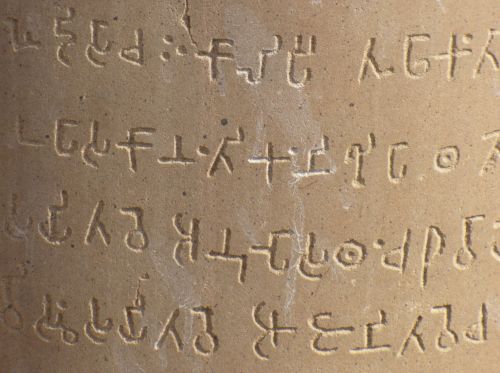
The monuments of Ashoka outlived the Mauryan Empire itself, continuing to shape collective memory long after the political structures that created them had disappeared. Following the decline of Mauryan authority in the second century BCE, the imperial administrative system fragmented and regional kingdoms emerged across the subcontinent. Yet the pillars and rock edicts remained standing in the landscape, silent witnesses to an earlier imperial order. Over centuries, many of these inscriptions were gradually forgotten as the scripts in which they were written fell out of common use. The physical monuments survived, but their original messages faded from collective understanding until they were rediscovered and deciphered in the modern era.
The nineteenth-century decipherment of the Brahmi script by the British scholar James Prinsep marked a decisive turning point in the modern interpretation of Ashoka’s reign. Working through a painstaking process of comparison among inscriptions found across northern India, Prinsep gradually identified repeating patterns in the characters and began to reconstruct the phonetic structure of the script. His breakthrough in the 1830s revealed that many of the inscriptions referred to a ruler described as “Devanampiya Piyadasi,” meaning “Beloved of the Gods, He Who Looks with Affection.” Initially, the identity of this ruler remained uncertain, but subsequent scholarship connected the name with the Mauryan emperor Ashoka described in Buddhist chronicles such as the Mahavamsa. Once this connection was established, the inscriptions could be interpreted as direct proclamations of Ashoka himself. This discovery fundamentally altered the study of early Indian history. The edicts became some of the earliest deciphered historical documents from the subcontinent, providing historians with firsthand evidence of Mauryan governance, imperial ideology, and the language through which Ashoka articulated his concept of dhamma. Through Prinsep’s work and the scholarship that followed, the silent pillars scattered across the landscape were restored as voices from the third century BCE.
Ashoka’s reputation underwent a further transformation in the twentieth century as scholars and political leaders reinterpreted his legacy within modern historical narratives. His emphasis on ethical governance, religious tolerance, and restraint in warfare resonated strongly with emerging discussions of political morality and national identity in South Asia. When India achieved independence in 1947, the symbolism of Ashoka’s rule acquired renewed prominence. The Lion Capital from the Sarnath pillar was adopted as the national emblem of India, while the Ashoka Chakra, a wheel originally depicted in Mauryan art, became a central element of the Indian national flag. Through these symbols, the memory of Ashoka was integrated into the visual language of the modern state.
The survival and reinterpretation of Ashoka’s monuments illustrate the enduring power of political narratives embedded in physical infrastructure. What began as a system of imperial messaging intended to shape perception within the Mauryan Empire eventually became a source of historical identity for later generations. The pillars and edicts, once instruments of governance, now function as historical artifacts that illuminate the relationship between moral rhetoric and political authority in the ancient world. Their continued presence in the landscape reminds modern observers that monuments designed to influence contemporary audiences can also shape how future societies interpret the past.
Conclusion: Stone, Power, and the Politics of Narrative
The monuments commissioned by Emperor Ashoka demonstrate how political authority can be reinforced not only through administrative institutions and military power but also through carefully constructed narratives embedded in physical space. By erecting pillars and carving edicts across the Mauryan Empire, Ashoka transformed the landscape into a medium for communicating the moral framework of his rule. These inscriptions presented the emperor as a ruler committed to compassion, restraint, and ethical governance, offering subjects an interpretation of imperial authority grounded in the language of dhamma. The physical permanence of the monuments ensured that this narrative would endure far beyond the immediate circumstances of their creation.
The edicts reveal that the moral presentation of Ashoka’s rule coexisted with the enduring structures of imperial governance. The Mauryan state retained the administrative capacity, legal authority, and military power necessary to maintain control across a vast and diverse territory. Provincial governors continued to supervise taxation, infrastructure, and legal administration, while imperial officials monitored regional stability and reported to the central court. Although Ashoka publicly renounced further territorial conquest after the Kalinga campaign, the empire did not dismantle the institutions that had originally enabled its expansion. Instead, the emperor’s inscriptions repeatedly emphasize the responsibilities of officials, the proper administration of justice, and the moral obligations attached to positions of authority. These directives suggest that Ashoka understood the stability of the empire to depend upon disciplined administration supported by organized bureaucratic oversight. The language of dhamma functioned not as a replacement for state power but as a framework through which that power could be interpreted as morally legitimate. Through the fusion of ethical rhetoric and institutional authority, Ashoka presented the Mauryan state as both principled and capable, reinforcing the perception that Mauryan governance operated under the guiding principles.
Seen in this light, Ashoka’s monuments illustrate a broader principle in the history of political power. Rulers have frequently relied upon symbolic and architectural forms to shape how their authority is perceived by subjects and remembered by later generations. Monumental inscriptions, public architecture, and state-sponsored narratives can transform physical infrastructure into instruments of ideological communication. Ashoka’s pillars represent an early example of this strategy, demonstrating how durable structures can project political values while creating the perception of stable and benevolent rule.
The continued presence of these monuments across the Indian subcontinent underscores the lasting influence of such strategies. Long after the Mauryan Empire itself disappeared, the pillars and edicts continued to shape historical interpretations of Ashoka’s reign and the moral image associated with his rule. Stone proved capable of preserving not only words but also the political narrative those words were meant to convey. In this way, Ashoka’s monuments reveal how architecture and inscription can operate together as tools of governance, extending the reach of political messaging across both geography and time.
Bibliography
- Allen, Charles. Ashoka: The Search for India’s Lost Emperor. London: Little, Brown, 2012.
- Falk, Harry. Ashokan Sites and Artefacts: A Source-Book with Bibliography. Mainz: Philipp von Zabern, 2006.
- Gombrich, Richard. Theravada Buddhism: A Social History from Ancient Benares to Modern Colombo. London: Routledge, 1988.
- Irwin, John. “‘Aśokan’ Pillars: A Re-Assessment of the Evidence – III: Capitals.” The Burlington Magazine 117:871 (1975), 631-643.
- Nikam, N. A., and Richard McKeon, trans. The Edicts of King Ashoka. Chicago: University of Chicago Press, 1959.
- Ovhal, Maitreya Yeshwant. “Brief Overview of the Fourteen Major Rock Edicts of King Ashoka.” International Journal for Multidisciplinary Research 6:3 (2024), 1-7.
- Prinsep, James. “Interpretation of the Most Ancient of the Inscriptions on the Pillar Called Iat of Feroz Shah, Near Delhi, and of the Allahabad, Radhia and Mattiah Pillar, or Iat Inscriptions Which Agree Therewith.” Journal of the Asiatic Society of Bengal 6 (1837): 566–609.
- Ranjan, Rajeev. “The Role of Emperor Ashoka in Shaping Mauryan Art and Architecture.” International Journal of Research and Technology 1:4 (2013), 1-12.
- Salomon, Richard. Indian Epigraphy: A Guide to the Study of Inscriptions in Sanskrit, Prakrit, and the Other Indo-Aryan Languages. Oxford: Oxford University Press, 1998.
- Shelby, Karen. “The Pillars of Ashoka.” Smarthistory. August 9, 2015.
- Singh, Upinder. A History of Ancient and Early Medieval India: From the Stone Age to the 12th Century. Delhi: Pearson Longman, 2008.
- Thapar, Romila. Ashoka and the Decline of the Mauryas. Revised edition. Oxford: Oxford University Press, 1973.
- Trautmann, Thomas R. Arthashastra: The Science of Wealth. New Delhi: Penguin Classics, 2012.
Originally published by Brewminate, 03.10.2026, under the terms of a Creative Commons Attribution-NonCommercial-NoDerivatives 4.0 International license.
About the Author