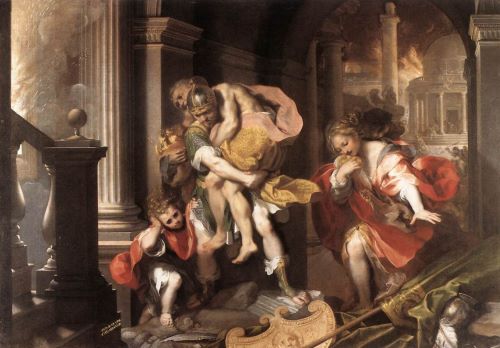
Written under the patronage of the first emperor of Rome, Virgil’s ‘Aenied’ can be understood as political propaganda.
By Kavisha Kamalananthan
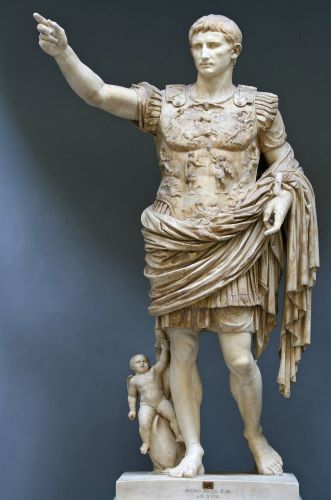
Virgil was an ancient poet who wrote his famously influential epic the Aeneid under the patronage of the first emperor of Rome, Augustus. Augustus had effectively seized the Roman Republic through a series of laws and military victories. Before he came to power in 27BC, he had essentially put an end to the civil unrest that had been prevalent in Rome. Propaganda played a significant role in Roman politics and Augustus both understood and valued its importance in gaining the favour of the populus. Alongside monuments and Augustus’s own work, the Res Gestae, Virgil’s Aeneid was one of the most influential pieces of literary propaganda in circulation. The epic focuses on the story of Aeneas: how he founded the land, the peoples that would eventually become Rome, and the great Roman Empire. Here, I aim to focus on Virgil’s presentation of Aeneas and by proxy Augustus, and how the poet made use of idealism in his depictions of character, war, love, and politics. He successfully adhered to his aim to create a piece of propaganda that poetically historicised the greatness of Augustus and how Augustus’s eventual rule over Rome was a divinely ordained fate.
To begin with, I would like to offer a discussion on Virgil’s political agenda and how writing under the patronage of Augustus affected his poetic content. In Virgil’s epic, ‘Aeneas is not a human being but a symbol. He is the embodiment of Rome and Augustus and a Stoic sapiens’. This indicates that the poet’s characterisation of Aeneas and the description of his challenging journey served a role in the greater scheme, which was to create an outstanding piece of literary propaganda. Virtus (valour/ virtue), clementia (clemency), iustia (justice) and pietas (piety) were some of the most celebrated traits that were central to Augustan ideology and values. We see on many occasions that Aeneas exhibits these qualities, making him the most idealistic individual in terms of Augustan standards. As critic Hans-Peter Stahl has pointed out, Aeneas showcases such honourable character in Book 10, where the episode in which Aeneas kills Lausus unfolds. Unlike Turnus, ‘pius Aeneas leaves dead Lausus in his arms’; by showing Turnus’s and Aeneas’s course of action parallelly, ‘Virgil, by way of contrast, throws into relief the compassion shown by the Julian ancestor’. Here the poet’s presentation is idealistic, not just in terms of courage, divinity and valour. By highlighting the compassionate nature of Aeneas, and in turn the Julian line, he humanises the character, subtly suggesting that Augustus too has it in his capacity to be a righteous and gracious leader.
We find many examples spread throughout the poem, which make use of the idealist technique as Virgil sought to venerate and legitimise Augustus’s rule. The three most significant passages that support the argument that Virgil was an idealist are found in Books 1, 6, and 8. These passages contain Jupiter’s prophecy of the future of Rome, Anchises’s showcase of the future descendants of Aeneas, and lastly Virgil’s use of ekphrasis as he describes the shield of Aeneas, crafted by the god Vulcan, which pictorially prophesises the future of Rome from Romulus and Remus to Augustus’s victory at the Battle of Actium in 31BC. The episode in which the shield is presented to Aeneas, along with a grand verbal description of what is engraved upon it, follows another scene in Book 8 where Aeneas is guided around the future site of Rome by Evander. This idealistic view towards the future would have appealed to the Roman reader, who could look around them and be reminded that on the sites of their temples, libraries and monuments, a heroic forerunner had once walked, already on the path to founding their great land and people.
The shield is one of the best examples of Virgil’s idealistic notion in the epic. ‘Centrally placed [on the shield], fleets of bronze, the whole conflict at Actium, Opened to view…Caesar Augustus is leading the Italians to combat, Backed by the senate and the people…and the great gods’ (8.678-80). The battle’s placement at the centre of the shield reiterates that it was Augustus’s victory that was central to the founding of the new Roman imperial age. This formed the backbone of Virgil’s theme for the poem. We also see a visual representation of this in David A. West’s imagined layout for the shield of Aeneas. That Virgil specifies that Augustus was backed by the senate, the people and the gods is testament to the idea that Augustus had won the favour of the most traditionally important groups in Rome. This is then contrasted by the following lines which include a brief description of the opposition – ‘Antony who is backed by a foreigner’s wealth and international forces…Every conceivable monstrous god, even barking Anubis points weapons at counter-blasting figures of Neptune and Venus’ (8.680-704). The juxtaposition, once more, aims to point to the divinely ordained nature of Augustus’s victory, an idea that also ties in with the theme of ancestry and heritage.
The link between Aeneas and Julius Caesar, and Julius Caesar and Augustus, is continually hinted at. Virgil aims to remind readers that his emperor and patron was descended from the gods and a long line of heroic figures. This was a tool which served the idealistic and political agenda of the poem, for in Roman tradition ‘authority was derived from a deeply rooted past; the deeds of ancestors exhibited a model for rulers’. It was essential that this lineage be a prominent part of the work, for the acquisition of said authority was a ‘backward-looking process that could be traced to the very beginnings of Roman history’.

In lines 1.286 to 1.289, which make up part of Jupiter’s prophecy of the greatness of the future Romans, the god directly refers to the man who adopted Augustus, Julius Caesar, thus ensuring that he too was contained within this divine and heroic lineage. Virgil only directly refers to Augustus on a few occasions, one of the most notable being Anchises’s showcase of the parade of future Romans. ‘Here is the man whose coming you so often hear prophesized, here is Augustus Caesar, son of a god, the man who will bring back the golden years…and extend Rome’s empire…’ (6.791-794). Here, as in many other sections, the language is full of grandeur, as Virgil makes it his priority to emphasise, once again, the divine heritage of Augustus; this is one of his most obvious idealistic techniques. The idea behind this grand emphasis on Aeneas’s descendants helps the reader better understand that the Aeneid ‘was an effort to explain the extraordinary importance of the very first and divine beginning of the Romans as the ultimate source for the Emperor’s autocritas’. His use of the phrase ‘bring back the golden years’ insinuates Augustus’s victory at the naval Battle of Actium; by this decisive victory over Mark Antony, Augustus became the undisputed master of the Roman world, as he was declared emperor just four years later in 27BC. Augustus had taken Rome out of civil unrest and Virgil saw his leader ‘as the type of man who could bring peace out of fratricidal war, order from anarchy…in a sense an ‘age of gold’ from an age of iron’.
Leading on from this, we find that another significant theme which falls in line with the poet’s political motive is that of fate. As mentioned earlier, Augustus sought to legitimise his rule and his actions through propaganda. In line with Roman culture, religion and tradition, the gods and their will had a great role to play in gaining popular favour. The obvious repetition of the prophecies regarding the future of Rome and the great empire (delivered by Jupiter in Book 1, and in Book 3 when the hearth gods declare that Aeneas ‘must prepare
great walls for a great race’, 33.223) serves this purpose. ‘Augustus wished to convince the world that his success was due to the direct favour of heaven, that the principate he had established was the preordained event to which Rome and the Romans had been slowly moving during the long centuries of their history’.7 A final point to be considered is that on certain occasions, it seems as though Virgil also employed the idealistic technique to fulfil not just his patron’s vision, but also his own. Critic Mabel Gant Murphy has pointed out that ‘it was with the purpose of emphasizing the idea that Rome and Italy [Virgil’s own people] were to be united from the centre of civilisation that Virgil undertook to describe the pageant of the forces of the enemy – 7.601-817’.
Virgil was obligated to fulfil a political motive in undertaking the writing of the Aeneid. As such, it is unsurprising that many of the themes and passages in the poem are fuelled by a patriotic and idealistic inclination towards Rome and Augustus. ‘The poem helped, not only to cast Augustus’s inevitable power as heroic, but also to make this heroic power comprehensible in the contemporary idioms of political communication in the Res Publica’. He was an idealist who could offer subtle praise to his emperor through the retelling of an ancient past. Thus, Virgil was the perfect agent for Augustan propaganda, as he wrote his monumental epic at a time when the Roman people began to revere their new emperor with honour and respect.
Bibliography
- Bell, Andrew J.E. “The Popular Poetics and Politics of the Aeneid.” Transactions of the American Philological Association 129, (1999): 263-279
- Douglas, A.E ‘The realism of Virgil’, 1961
- Grebe, Sabine. “Augustus’ Divine Authority and Vergil’s ‘Aeneid.’” 35–62.
- Haarhoff, T. J. “The Element of Propaganda in Virgil.” Acta Classica 11, no. 1 (1968): 125–138. Horsfall, N.M. “Aeneid.” In A Companion to the Study of Virgil, pp. 101-216. Boston: Brill, 1995.
- Murphy, M.G. “Vergil as a Propagandist.” The Classical Weekly 19, no. 21 (1926): 169–174.
- Quinn, Kenneth. Virgil’s Aeneid: A Critical Description. London: Routledge, 1968.
- Stahl, Hans-Peter. Vergil’s Aeneid: Augustan epic and political context. London: Duckworth, 1998.
Originally published by Retrospect Journal, 10.17.2021, republished with permission for educational, non-commercial purposes.
About the Author