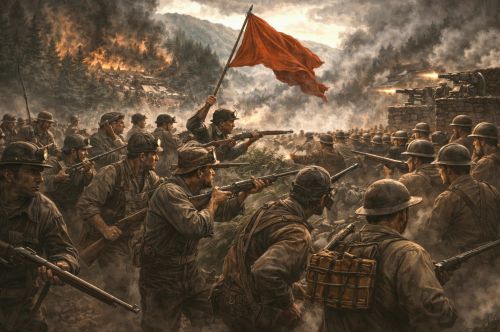
The 1921 Battle of Blair Mountain revealed the explosive tensions between coal miners seeking union rights and the corporate forces determined to control America’s industrial coalfields.

By Matthew A. McIntosh
Public Historian
Brewminate
Introduction: Industrial Power and Worker Resistance
The rapid industrialization of the United States during the late nineteenth and early twentieth centuries transformed both the national economy and the social structure of American labor. Nowhere were these changes more dramatic than in the coalfields of Appalachia, where the expansion of industrial energy demands fueled the growth of large mining operations. Coal companies consolidated land ownership, transportation networks, and production facilities, creating highly concentrated centers of industrial power in rural regions of West Virginia, Kentucky, and surrounding states. This transformation brought thousands of miners into the coalfields, many of whom were immigrants or migrants from other parts of the United States seeking employment in an expanding industrial economy. Yet the rapid growth of coal production also produced severe tensions between workers and the corporations that controlled the industry.
Coal mining communities in Appalachia were shaped by a distinctive system of corporate control known as the company town. Mining companies frequently owned not only the mines themselves but also the housing, stores, and infrastructure that supported daily life in these isolated regions. Workers were often paid in company scrip that could only be spent in company-operated stores, reinforcing their economic dependence on their employers. Coal operators also exerted influence over local law enforcement and political institutions, allowing corporations to shape the regulatory environment in which labor relations unfolded. Within this system, miners faced dangerous working conditions, irregular wages, and limited opportunities to challenge corporate authority.
Efforts to organize coal miners into labor unions developed in response to these conditions. The United Mine Workers of America (UMWA), founded in 1890, emerged as one of the most significant labor organizations in the American coal industry. Union organizers sought to improve wages, regulate working conditions, and secure recognition of collective bargaining rights for miners. In many parts of the United States, the UMWA succeeded in establishing agreements with coal operators that provided greater protections for workers. In southern West Virginia, however, Mine operators resisted unionization with unusual intensity. Mine owners relied on private security forces, legal injunctions, and political pressure to prevent union organizers from gaining a foothold in the region.
These tensions eventually culminated in one of the most dramatic labor confrontations in American history. In 1921 thousands of coal miners marched through the mountains of southern West Virginia in support of union recognition and in protest against the repression of organized labor. Their march brought them into armed conflict with coal company forces and local authorities in what became known as the Battle of Blair Mountain. The confrontation represented the largest armed labor uprising in the history of the United States and revealed the depth of conflict between organized labor and the industrial dominance of the coal companies. Examining the origins of this conflict provides important insight into the broader struggles over labor rights, corporate authority, and economic power that shaped industrial America during the early twentieth century.
Coal Company Control in the Appalachian Coalfields

By the early twentieth century, coal companies exercised extraordinary influence over the economic and social life of the Appalachian coalfields. Large corporations acquired vast tracts of land in southern West Virginia and other mining regions, often gaining control not only of mineral rights but also of surrounding property necessary for building mining infrastructure. Railroads, tipples, processing facilities, and company housing were constructed to support the rapid expansion of coal extraction. Because many of these mining operations developed in isolated mountain valleys, coal companies effectively controlled the physical and economic environment in which miners lived and worked. This concentration of land ownership allowed corporate operators to establish a system in which the boundaries between workplace authority and community life were almost entirely blurred.
Company towns formed the central institution through which this control was exercised. Coal operators constructed housing, schools, churches, and stores for miners and their families, creating settlements that were often owned entirely by the mining companies themselves. While these communities provided essential services in remote regions, they also allowed employers to regulate many aspects of daily life. Housing contracts could be revoked if miners participated in strikes or union activities, leaving families vulnerable to eviction. In addition, company management often retained authority over local policing and administrative decisions, further reinforcing corporate dominance within these communities.
Economic dependence was intensified through the widespread use of company scrip. Rather than paying miners entirely in cash, coal companies frequently issued scrip that could only be used at company-owned stores. These stores supplied basic goods such as food, clothing, and household supplies, but prices were often significantly higher than those found in independent markets. As a result, miners frequently found themselves trapped in cycles of debt that increased their reliance on company employment. The economic structure of company-owned mining settlements tied wages, consumption, and housing together under the authority of the coal operator.
Coal companies also employed a range of strategies to discourage labor organizing. Mine owners hired private security forces and labor spies to monitor worker activity and identify union sympathizers. Among the most prominent of these organizations was the Baldwin-Felts Detective Agency, whose agents were frequently deployed in the coalfields to enforce company policies and intimidate union organizers. These agents were often heavily armed and operated with broad authority granted by coal companies and sympathetic local officials. Armed guards patrolled mining camps, monitored meetings, and attempted to prevent union organizers from entering company property. Workers suspected of supporting union activity risked dismissal, eviction from company housing, and blacklisting that could prevent them from finding work at other mines in the region. The presence of these private enforcement networks created a climate of intimidation that extended beyond the workplace into everyday life. For many miners, the threat of surveillance and retaliation made participation in union activities extremely dangerous.
The dominance of coal companies in the Appalachian coalfields extended far beyond the control of industrial production. Corporate authority shaped housing, commerce, policing, and local governance within mining communities. For many miners, the company town system represented not only economic dependence but also a profound imbalance of power between workers and the corporations that controlled their livelihoods. These conditions formed the backdrop for the labor conflicts that would eventually erupt in the West Virginia coalfields during the early twentieth century.
The Rise of Organized Labor in the Coal Industry
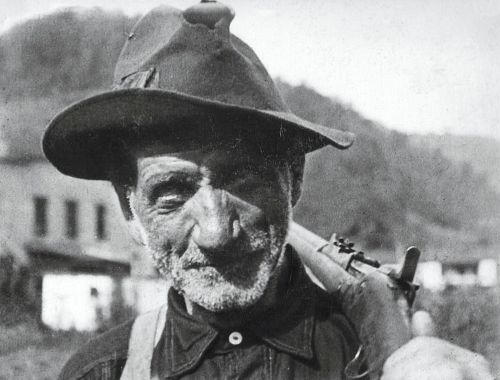
The growth of the American coal industry during the late nineteenth century produced not only immense industrial expansion but also the emergence of organized labor movements among miners. Coal mining was one of the most dangerous occupations in the industrial economy, exposing workers to cave-ins, explosions, toxic gases, and chronic health problems such as black lung disease. Miners faced unstable wages, long working hours, and limited protections against workplace hazards. These conditions encouraged workers to seek collective forms of organization that could strengthen their ability to negotiate with powerful mining corporations. Out of these struggles emerged one of the most influential labor organizations in the United States, the United Mine Workers of America (UMWA).
The UMWA, founded in 1890, quickly became a major force within the coal industry. The union sought to improve wages, reduce working hours, and establish safer conditions within the mines. It also aimed to secure recognition of miners’ right to organize and bargain collectively with employers. In several regions of the United States, including parts of Pennsylvania and the Midwest, the UMWA succeeded in negotiating agreements with coal operators that provided workers with greater protections and more stable employment conditions. These early victories helped demonstrate the potential power of organized labor within an industry that had previously been dominated almost entirely by corporate interests.
Unionization in the Appalachian coalfields proved far more difficult. Coal companies in southern West Virginia and neighboring regions were determined to prevent the spread of organized labor into their mines. Operators feared that union recognition would raise wages, reduce managerial authority, and disrupt the economic system that allowed companies to control labor costs through company towns and scrip payments. As a result, coal companies adopted aggressive strategies to suppress union activity. Workers suspected of supporting the union were often fired or evicted from company housing, and organizers faced harassment, intimidation, and violence. In many cases, miners were placed on informal blacklists that prevented them from securing employment at other mines if they were identified as union sympathizers. Company officials also collaborated with local political authorities to obtain court injunctions against strikes and organizing activity. These measures made southern West Virginia one of the most hostile environments for union organization in the American coal industry.
Despite these obstacles, miners continued to pursue union organization throughout the early twentieth century. Organizers traveled through coal camps attempting to recruit workers and establish local union chapters. Meetings were frequently held in secret to avoid detection by company officials or private security agents. The persistence of these organizing efforts reflected the widespread dissatisfaction among miners with the conditions of industrial labor in the coalfields. For many workers, union membership represented not only a practical strategy for improving wages and safety but also a broader assertion of dignity and autonomy within a system that severely restricted their independence.
Labor activism in the coalfields increasingly brought miners into direct conflict with coal companies and their allies. Strikes and protests became common as workers attempted to force operators to negotiate with the union. These confrontations sometimes escalated into violent clashes involving private security forces, local law enforcement, and striking miners. The pattern of conflict reflected the broader struggle between organized labor and corporate power that characterized many industrial regions of the United States during this period.
By the early 1920s the coalfields of southern West Virginia had become one of the most contested battlegrounds in the American labor movement. Union organizers and coal operators were locked in an escalating struggle over the future of labor relations in the region. Years of organizing efforts, failed negotiations, and repeated episodes of repression had intensified tensions between miners and mine owners. Workers increasingly believed that peaceful organizing would not succeed in the face of corporate resistance supported by private security forces and sympathetic local officials. The growing frustration within mining communities created conditions in which labor activism could evolve into large-scale confrontation. These developments laid the groundwork for the dramatic events that culminated in the Battle of Blair Mountain in 1921, when thousands of miners mobilized in one of the most significant labor uprisings in American history.
Private Security and the Suppression of Union Activity
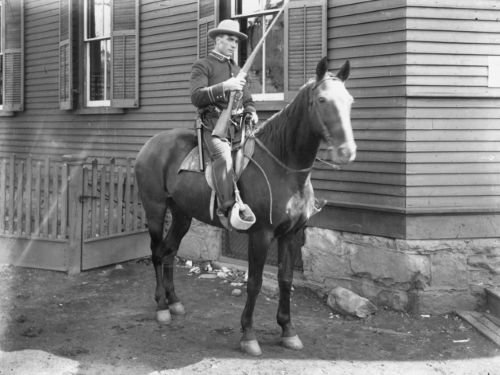
Coal companies in the Appalachian coalfields relied heavily on private security forces to suppress union organizing and maintain control over their workforce. These security agents acted as an extension of corporate authority, enforcing company policies and monitoring worker behavior both inside and outside the mines. In regions where company towns dominated the landscape, the presence of armed guards served as a constant reminder of the imbalance of power between miners and their employers. Private detectives and security officers frequently patrolled mining camps, monitored union meetings, and sought to prevent organizers from contacting workers.
Baldwin-Felts was originally established as a private investigative service, the agency became closely associated with labor conflicts in the coalfields during the early twentieth century. Coal operators hired Baldwin-Felts agents to act as guards, strikebreakers, and intelligence gatherers during labor disputes. These agents often carried rifles and sidearms and operated with broad authority granted by coal companies. Their duties included escorting replacement workers into nonunion mines, supervising company property, and removing union organizers from mining camps. Because many coal towns were built on company-owned land, Baldwin-Felts agents could enforce company orders with few legal obstacles. The agency’s reputation for aggressive tactics made it one of the most feared forces in the region, and its involvement in labor disputes contributed significantly to the climate of hostility that surrounded union organizing efforts.
The activities of private security forces frequently escalated conflicts between miners and coal companies. Baldwin-Felts agents and other company guards participated in evictions of miners who attempted to organize unions, sometimes forcing entire families from company-owned housing. In addition to evictions, agents were accused of harassment, intimidation, and violent confrontations with union supporters. Such tactics reflected the determination of coal operators to prevent unionization in regions where corporate control over labor had long remained unchallenged. The use of private armed forces in labor disputes blurred the boundary between industrial management and paramilitary enforcement.
One of the most dramatic confrontations between miners and private security forces occurred in 1920 in the town of Matewan, West Virginia. During what became known as the Matewan Massacre, Baldwin-Felts agents attempted to evict union miners and their families from company housing. The operation quickly escalated into a tense confrontation with local residents and officials, including the town’s police chief, Sid Hatfield, who was sympathetic to the miners. When violence erupted in the streets of Matewan, a gun battle left several Baldwin-Felts agents and townspeople dead. The incident reverberated across the Appalachian coalfields, becoming a symbol of resistance against corporate control. For many miners, the confrontation demonstrated that organized opposition to company authority was possible. It intensified the determination of coal operators to suppress union activity and strengthened their reliance on armed security forces. The events at Matewan deepened the cycle of conflict that would eventually culminate in the massive labor uprising at Blair Mountain the following year.
March of the Miners: The Road to Blair Mountain
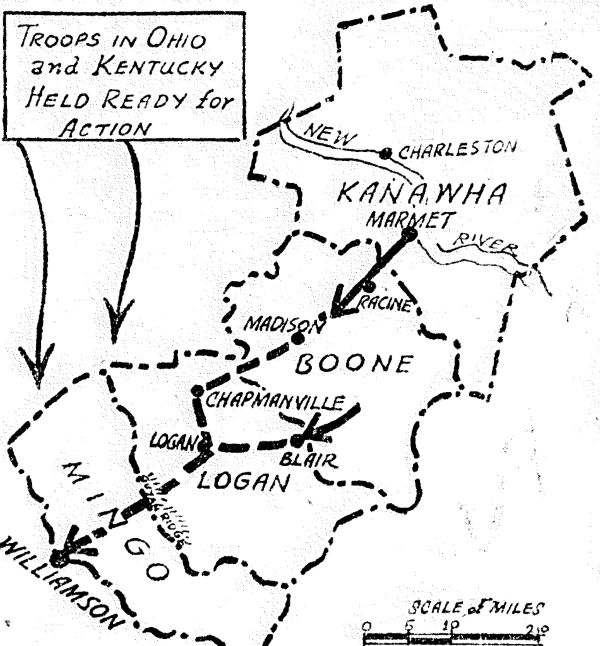
By the summer of 1921, tensions in the southern West Virginia coalfields had reached a breaking point. Years of labor disputes, violent confrontations, and aggressive anti-union campaigns had created a climate of deep hostility between miners and coal operators. The arrest of pro-union lawman Sid Hatfield and other supporters of organized labor intensified this anger among miners who believed that coal companies and local authorities were working together to suppress union activity. Within mining communities, discussions increasingly turned toward collective action as workers sought ways to challenge the system of industrial domination that governed their lives.
In late August 1921 thousands of miners began gathering in the town of Marmet, near Charleston, West Virginia. Many of these men were members or supporters of the UMWA who had grown frustrated with the inability of union organizers to secure recognition in the southern coalfields. Armed with rifles and wearing red bandanas around their necks, an identifying mark that would later give rise to the term “redneck,” the miners prepared to march southward toward Logan County. Their goal was to support unionization efforts and to confront the local authorities who had aggressively opposed organized labor in the region.
The march quickly grew into a massive mobilization. Estimates suggest that between 10,000 and 15,000 miners joined the movement as it advanced through the mountains. The miners organized themselves into loosely coordinated groups and began moving along rail lines and mountain roads toward the heavily anti-union stronghold of Logan County. Some groups marched in columns while others traveled in small bands, gathering additional participants from mining communities along the route. Many participants viewed the march as a defensive effort intended to secure basic labor rights and protect union organizers from further violence. Others saw it as a broader challenge to the entrenched authority of coal operators and local officials who had long resisted unionization. As the march progressed, the sheer size of the mobilization drew widespread public attention and heightened fears among coal companies that the movement could spiral into widespread armed conflict.
Coal operators and local officials reacted with alarm to the growing mobilization. In Logan County, Sheriff Don Chafin, an outspoken opponent of unionization, organized a defensive force composed of deputies, private guards, and volunteers loyal to the coal companies. Chafin’s forces established fortified positions along the ridges of Blair Mountain, a natural barrier that separated Logan County from the advancing miners. Machine gun nests were placed along the mountain slopes, and armed defenders prepared to block the miners’ approach.
The presence of these defensive positions transformed the miners’ march into a potential violent clash. As word spread that heavily armed forces were waiting on Blair Mountain, tensions continued to escalate among both sides. Some miners hoped that the display of mass solidarity might force authorities to negotiate or permit union organizing in the region. Others believed that the conflict had already moved beyond peaceful resolution after years of violent repression and failed negotiations. The growing concentration of armed men in the rugged mountain terrain created the conditions for a confrontation that increasingly resembled a military campaign rather than a traditional labor protest. Observers in nearby communities and in state government recognized that the situation was becoming dangerously unstable.
The march toward Blair Mountain represented the culmination of years of struggle between miners seeking union recognition and coal companies determined to maintain control over their workforce. What had begun as a labor dispute over wages, safety, and organizing rights had gradually escalated into a confrontation involving thousands of armed participants. As the miners approached the defensive lines along Blair Mountain in early September 1921, the stage was set for a large-scale conflict that would soon draw national attention and intervention by the federal government.
The Battle of Blair Mountain
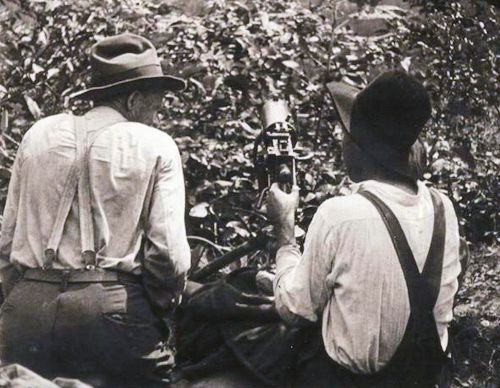
The confrontation at Blair Mountain began in early September 1921 as thousands of armed miners advanced toward the defensive positions organized by anti-union forces in Logan County. Sheriff Don Chafin had assembled a coalition of deputies, private security guards, and volunteers loyal to the coal operators who dominated the region. These defenders occupied fortified positions along the ridges and slopes of Blair Mountain, a rugged natural barrier that separated the miners from the anti-union strongholds farther south. The geography of the area favored the defenders, who established machine gun nests and observation points overlooking the approaches used by the advancing miners.
When fighting erupted, the confrontation quickly escalated into a sustained exchange of gunfire across the wooded mountainsides. Both sides were armed with rifles and other military-style weapons, reflecting the intensity of the conflict that had been building in the coalfields for years. Skirmishes broke out along multiple points of the defensive line as miners attempted to advance up the slopes while Chafin’s forces sought to hold their positions. The terrain of the region, with its steep ridges and dense forests, turned the conflict into a series of scattered engagements rather than a single concentrated battle.
The scale of the confrontation was unlike anything previously seen in American labor struggles. Estimates suggest that as many as ten thousand miners participated in the uprising, while Chafin’s defensive force numbered several thousand as well. Over the course of several days, gunfire echoed across the mountains as the opposing sides attempted to gain tactical advantage. The presence of such large numbers of armed participants blurred the line between labor protest and open armed rebellion. For observers across the country, the confrontation had escalated and revealed the depth of unrest within the American coal industry and the willingness of workers to take extraordinary risks in pursuit of union recognition. Newspapers and government officials watched the events with growing concern, recognizing that the scale of mobilization and the intensity of the fighting represented an unprecedented challenge to the established order of industrial labor relations in the United States.
One of the most unusual aspects of the battle was the use of aircraft by anti-union forces. Coal operators and their allies reportedly arranged for private planes to fly over the conflict zone and drop small explosive devices in an attempt to disrupt the miners’ advance. Although these improvised aerial attacks caused limited damage, they demonstrated the determination of coal companies and their supporters to use a wide range of tactics to suppress the uprising. The involvement of aircraft also underscored how the conflict had escalated beyond the scale of earlier labor disputes.
Despite the intensity of the fighting, neither side achieved a decisive breakthrough during the early stages of the battle. The advancing workers struggled to overcome the fortified defensive positions along the mountain ridges, while Chafin’s forces were unable to disperse the large and determined groups of workers advancing through the surrounding terrain. The rugged geography of Blair Mountain complicated coordinated movement and made communication between different groups of miners difficult. As the confrontation continued, national attention increasingly focused on the conflict, raising concerns among federal officials that the situation could spiral further out of control. Political leaders worried that the continued fighting might destabilize the region and encourage similar labor uprisings elsewhere in the country.
The turning point came when the federal government intervened to restore order. President Warren G. Harding authorized the deployment of United States Army troops to the region, signaling that the conflict had become a national concern rather than a local labor dispute. The arrival of federal forces dramatically altered the balance of power on the battlefield. Faced with the prospect of confronting the United States military, many miners chose to lay down their arms and disperse. The end of the battle marked the collapse of the uprising, but the events at Blair Mountain left a lasting imprint on the history of American labor conflict.
Federal Intervention and the End of the Uprising
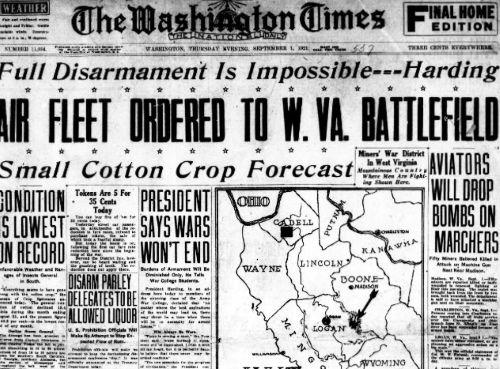
As the fighting at Blair Mountain continued into early September 1921, pressure mounted on federal authorities to intervene. Reports of armed clashes between thousands of miners and anti-union forces circulated widely through newspapers and government channels, raising fears that the conflict might escalate into a broader regional crisis. The scale of the confrontation, combined with the presence of large numbers of armed participants, made it clear that local law enforcement alone could not restore order. State officials struggled to contain the situation as the fighting spread across the rugged terrain of Logan County. Concerned that the violence threatened both public stability and the uninterrupted production of coal, an essential industrial resource, national leaders began to consider federal action. President Warren G. Harding ultimately authorized the deployment of federal troops to southern West Virginia, reflecting the growing belief that the conflict had surpassed the capacity of local authorities to resolve it.
The arrival of United States Army forces dramatically altered the dynamics of the conflict. Federal soldiers entered the coalfields with the authority of the national government behind them, signaling that the uprising had moved beyond the realm of a local labor dispute. For many miners, the prospect of confronting federal troops was fundamentally different from fighting private guards or local deputies. Although the miners had been willing to challenge coal company forces, few wished to engage in open conflict with the United States military. As troops advanced into the region, union leaders and community figures began urging the miners to disperse in order to avoid further bloodshed.
Federal intervention was accompanied by additional displays of military power intended to demonstrate the government’s determination to end the conflict. Army aircraft conducted reconnaissance flights over the region, and troops moved to secure key transportation routes and mountain passes. These actions reinforced the message that the federal government would not tolerate continued armed resistance in the coalfields. Faced with overwhelming military authority, many miners gradually laid down their weapons and returned to their homes and mining communities.
In the aftermath of the uprising, legal proceedings were launched against a number of miners and union leaders who had participated in the march. Hundreds of individuals were arrested and charged with offenses ranging from conspiracy to murder to treason against the state of West Virginia. Authorities sought to use these prosecutions not only to punish those directly involved in the conflict but also to discourage future large-scale labor mobilization in the coalfields. Court proceedings stretched on for months, drawing national attention and revealing the deep divisions that existed over labor rights and corporate authority in the region. Although many of the accused miners were eventually acquitted or saw charges reduced, the legal campaign created significant strain on the labor movement by diverting resources and weakening organizational networks.
The suppression of the Blair Mountain uprising marked a decisive moment in the struggle between organized labor and coal operators in southern West Virginia. In the years that followed, union membership in the region declined sharply as coal companies reinforced their control over the coalfields. The events of 1921 nevertheless remained a powerful symbol within the broader history of American labor conflict. The miners who marched toward Blair Mountain had demonstrated both the depth of worker dissatisfaction and the extraordinary lengths to which laborers were willing to go in pursuit of union recognition and economic justice.
Historical Interpretation and the Legacy of Blair Mountain
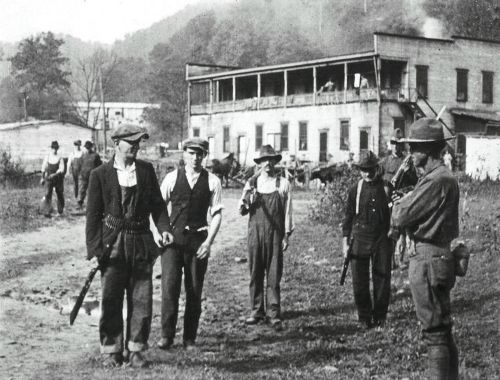
Historians have long debated how the Battle of Blair Mountain should be understood within the wider history of struggles in American labor. Early interpretations often framed the uprising as an episode of disorder in which armed miners challenged the authority of local government and private property. Such portrayals reflected the perspectives of many contemporary observers who viewed the confrontation primarily through the lens of law and order. More recent scholarship, however, has emphasized the structural conditions that produced the uprising, highlighting the role of corporate power, economic inequality, and labor repression in shaping the miners’ decision to mobilize.
Modern historians have increasingly placed Blair Mountain within the larger context of the American labor movement during the early twentieth century. Scholars have argued that the uprising represented the culmination of years of organizing, strikes, and violent confrontations between miners and coal operators in the Appalachian coalfields. Rather than a spontaneous outbreak of violence, the conflict can be understood as the result of sustained tensions generated by the company town system, the use of private security forces, and the persistent refusal of coal operators to recognize unions. Historians have emphasized how the uprising reflected the desperation of miners who faced systematic barriers to peaceful unionization. In this interpretation, the armed march toward Blair Mountain represented not simply rebellion but a last resort in a prolonged struggle over labor rights and economic survival. When examined within the broader trajectory of American labor activism, the battle appears as one of the most dramatic moments in a nationwide contest between organized labor and industrial capital.
The legacy of Blair Mountain has also been shaped by the ways in which the event has been remembered within labor history and regional culture. For many participants and their descendants, the uprising became a symbol of worker resistance against corporate domination. Oral histories and regional narratives often portray the miners who marched toward Blair Mountain as individuals who were willing to risk their lives in pursuit of economic justice and collective dignity. These interpretations have helped transform the battle into a powerful emblem of labor activism in the United States.
In recent decades the site of Blair Mountain itself has become an important focus of historical preservation and public memory. Efforts by historians, labor organizations, and community activists have sought to recognize the mountain as a landmark in the history of American labor struggles. These campaigns have emphasized the significance of the conflict not only for understanding the coal wars of the early twentieth century but also for examining the broader tensions between industrial corporations and organized labor in modern American history. Preservation debates have also revealed the continuing economic and political importance of the region’s coal industry, as proposals for mountaintop removal mining threatened to damage portions of the historic battlefield. As a result, Blair Mountain has become a site where questions about labor history, environmental policy, and regional identity intersect. Through scholarship, public history projects, and commemorative efforts, the battle continues to occupy a central place in discussions of labor rights, economic power, and social justice in the United States.
Conclusion: Industrial Capitalism and the Limits of Worker Power
The Battle of Blair Mountain represents one of the most dramatic confrontations between organized labor and corporate authority in the history of the United States. The events that unfolded in the coalfields of southern West Virginia were not the result of a single dispute but rather the culmination of decades of tension generated by industrial expansion, harsh working conditions, and the systematic suppression of union organizing. Coal companies had constructed an economic and social system that placed immense power in the hands of corporate operators while leaving miners with limited avenues to challenge that authority. When traditional methods of labor negotiation failed, thousands of workers chose to mobilize in one of the most extraordinary acts of collective resistance in American labor history.
The uprising revealed both the strength and the limitations of organized labor during the early twentieth century. The ability of miners to mobilize thousands of participants across the Appalachian coalfields demonstrated the depth of worker solidarity and the widespread dissatisfaction with the conditions imposed by coal operators. Yet the outcome of the conflict also underscored the structural disadvantages facing labor movements in an era when corporations possessed substantial economic resources and political influence. Coal companies were able to rely on private security forces, sympathetic local officials, and ultimately the authority of the federal government to maintain control over the industry.
Federal intervention at Blair Mountain illustrated the decisive role that state power could play in shaping the outcome of industrial conflicts. Although the miners had demonstrated remarkable determination in their efforts to secure union recognition, they were unable to overcome the combined authority of corporate interests and the national government. The arrival of United States Army troops brought the uprising to an end and reinforced the existing balance of power within the coal industry. The decision to deploy federal forces reflected broader concerns among national leaders about the potential consequences of a prolonged armed confrontation between workers and industrial operators. Officials feared that the conflict could destabilize the region and disrupt the supply of coal that was vital to the nation’s industrial economy. By intervening decisively, the federal government signaled its commitment to restoring order and preserving existing structures of authority within the coalfields. In doing so, the state played a central role in determining the outcome of the uprising and shaping the future trajectory of labor relations in southern West Virginia.
The legacy of Blair Mountain continues to resonate within the broader history of American labor activism. The miners who marched across the Appalachian mountains in 1921 left a powerful example of collective worker resistance against economic inequality and corporate domination. Their struggle revealed the deep structural tensions within the industrial economy and highlighted the challenges faced by workers attempting to secure fair wages, safe working conditions, and the right to organize. Blair Mountain stands as both a cautionary episode in the limits of worker power and a lasting symbol of the enduring struggle for labor rights in modern industrial society.
Bibliography
- Bloom, Arthur. “Back to Blair Mountain: Labor Unions’ Unsettled Future.” American Affairs 6:1 (2022).
- Corbin, David Alan. Life, Work, and Rebellion in the Coal Fields: The Southern West Virginia Miners, 1880–1922. Urbana: University of Illinois Press, 1981.
- Dubofsky, Melvyn, and Warren Van Tine. John L. Lewis: A Biography. Urbana: University of Illinois Press, 1986.
- Dubofsky, Melvyn, and Foster Rhea Dulles. Labor in America: A History. 8th ed. Wheeling, IL: Harlan Davidson, 2010.
- Foner, Philip S. History of the Labor Movement in the United States, Volume 7: Organized Labor and the Black Worker, 1619–1973. New York: International Publishers, 1976.
- Green, James. The Devil Is Here in These Hills: West Virginia’s Coal Miners and Their Battle for Freedom. New York: Atlantic Monthly Press, 2015.
- Lewis, Ronald L. Black Coal Miners in America: Race, Class, and Community Conflict, 1780–1980. Lexington: University Press of Kentucky, 1987.
- Nyawalo, Mich. “Multiculturalism in the Coal Mines: Re-interpreting the Battle of Blair Mountain in the Age of Black Lives Matter.” Journal of Appalachian Studies 30:1 (2024), 29-41.
- Savage, Lon. Thunder in the Mountains: The West Virginia Mine War, 1920–21. Pittsburgh: University of Pittsburgh Press, 1990.
- Shogan, Robert. The Battle of Blair Mountain: The Story of America’s Largest Labor Uprising. Boulder, CO: Westview Press, 2004.
- Stern, Theodore. “Fire on the Mountain: Violence and Repression in the West Virginia Coal Wars.” Vanderbilt Undergraduate Research Journal 15:1 (2026).
- Williams, John Alexander. West Virginia: A History. Morgantown: West Virginia University Press, 1984.
Originally published by Brewminate, 03.11.2026, under the terms of a Creative Commons Attribution-NonCommercial-NoDerivatives 4.0 International license.
About the Author