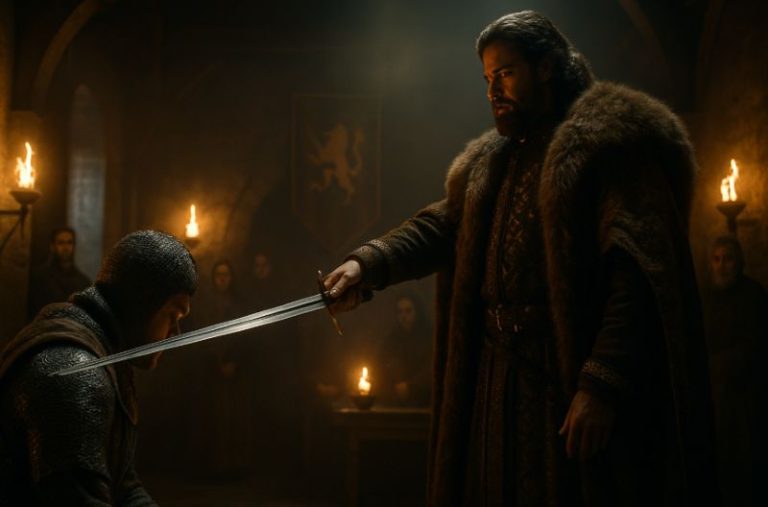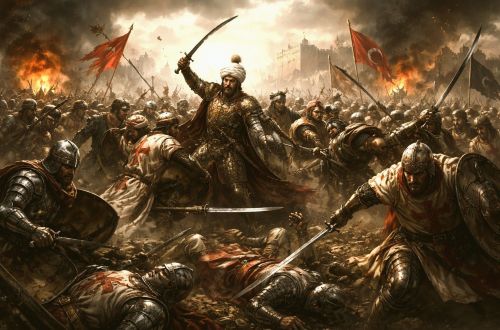
At Nicopolis in 1396, crusader confidence and chivalric ambition collapsed when Ottoman discipline and strategy turned a bold assault into catastrophe.

By Matthew A. McIntosh
Public Historian
Brewminate
Introduction: Confidence before Catastrophe
In the late fourteenth century, the political and military balance of southeastern Europe was undergoing profound transformation. The Ottoman Empire, emerging from its Anatolian base earlier in the century, had expanded steadily across the Balkans, bringing large portions of the region under its authority. Victories over regional powers and the gradual integration of Balkan territories into Ottoman administrative structures placed increasing pressure on neighboring Christian states. For many rulers in Central and Western Europe, the Ottoman advance was not merely a regional concern but a challenge to the broader political order of Christendom. The resulting sense of urgency contributed to renewed calls for crusade, reviving an older tradition of religiously framed warfare even as the political realities of the late medieval world had grown far more complex.
The crusading expedition launched in 1396 represented one of the most ambitious efforts to halt Ottoman expansion. A coalition army assembled under the leadership of King Sigismund of Hungary, drawing support from across Europe. French and Burgundian nobles joined the campaign in significant numbers, attracted by the prestige and spiritual promise associated with crusading warfare. To many participants, the campaign offered an opportunity not only to defend Christian territory but also to achieve personal honor and renown on the battlefield. The arrival of heavily armored Western knights reinforced confidence that the coalition possessed the military strength necessary to defeat the Ottoman forces and restore stability along the Danube frontier.
Yet beneath this outward display of unity and confidence lay deeper structural tensions. Coalition armies in the late medieval period often struggled with divided command structures, conflicting strategic priorities, and differing military traditions. The Hungarian leadership possessed extensive experience confronting Ottoman tactics along the Balkan frontier, while many Western knights approached the campaign through the lens of chivalric warfare shaped by aristocratic expectations of decisive battle. These differing perspectives were not merely theoretical disagreements but reflected fundamentally different experiences of warfare. Hungarian and Balkan commanders had fought the Ottomans repeatedly and understood the importance of caution, reconnaissance, and disciplined coordination when confronting their armies. Many of the Western knights, by contrast, came from regions where warfare still emphasized aristocratic cavalry charges and the pursuit of individual martial reputation. Their confidence in the shock power of heavy cavalry often led them to underestimate the tactical flexibility and organizational discipline of the Ottoman forces. As the campaign unfolded, these contrasting military cultures contributed to disagreements over strategy and battlefield leadership, undermining the unity that the crusader coalition needed most.
The Battle of Nicopolis in 1396 would reveal the consequences of these assumptions with devastating clarity. The combined crusading host entered the campaign convinced that its numbers, prestige, and battlefield traditions would guarantee success against Ottoman forces. Instead, the army of Sultan Bayezid I demonstrated a capacity for discipline, coordination, and strategic planning that many of the crusader leaders had underestimated. The resulting defeat was catastrophic, destroying much of the coalition army and reshaping the balance of power in southeastern Europe. The events surrounding Nicopolis illustrate how confidence rooted in cultural expectations and aristocratic military traditions could obscure the realities of changing warfare in the late medieval world.
The Ottoman Expansion into Southeastern Europe

The rise of the Ottoman state in the fourteenth century transformed the political landscape of southeastern Europe and western Anatolia. Originating as a small frontier principality in northwestern Anatolia during the late thirteenth century, the Ottoman polity initially developed within the complex frontier environment that emerged after the decline of Byzantine authority in the region. Early Ottoman rulers such as Osman I and his successor Orhan cultivated a flexible system of military organization and political alliances that allowed their expanding state to incorporate both Muslim and Christian populations. Rather than relying solely on conquest, the Ottomans often secured control of territories through negotiated submission, dynastic marriages, and the integration of local elites into their governing structures.
By the mid-fourteenth century, the Ottomans had begun crossing into southeastern Europe, taking advantage of internal divisions within the Byzantine Empire and among the Balkan kingdoms. The capture of Gallipoli in 1354 marked a decisive moment in this expansion, providing the Ottomans with a permanent foothold on the European side of the Dardanelles. From this base, Ottoman forces gradually extended their influence into Thrace and the surrounding regions. The conquest of Adrianople, later known as Edirne, soon followed and became one of the principal administrative and military centers of the growing empire. Control of this city allowed the Ottomans to project power deeper into the Balkans while establishing a stable logistical base for future campaigns. Edirne’s position along key overland routes linking the Balkans with Anatolia made it an ideal political capital and staging ground for military operations. From this location, Ottoman rulers could coordinate campaigns into Bulgaria, Serbia, and other neighboring territories while maintaining communication with their Anatolian heartlands. The establishment of a durable administrative center in Europe marked a turning point in Ottoman expansion, signaling that their presence in the Balkans would be permanent rather than temporary.
Ottoman expansion was not simply the product of opportunistic raids but reflected a developing political and military system capable of sustaining long-term growth. Under rulers such as Murad I, the Ottoman state expanded its administrative structures and military institutions. New forms of organization allowed the empire to mobilize resources more effectively across its territories. Frontier warriors, provincial cavalry, and disciplined infantry units contributed to a military force capable of adapting to different battlefield conditions. These institutions allowed the Ottoman leadership to maintain pressure on neighboring states while consolidating newly acquired territories into a coherent political structure.
The victories achieved by Ottoman armies during this period profoundly reshaped the balance of power in southeastern Europe. Battles such as the confrontation on the Maritsa River in 1371 and the later struggle at Kosovo in 1389 demonstrated the ability of Ottoman forces to defeat coalitions of Balkan rulers. These encounters weakened the political independence of several regional powers and expanded Ottoman influence across much of the peninsula. Many local rulers were compelled to accept vassal status, paying tribute while maintaining limited autonomy under Ottoman oversight. This system enabled the Ottomans to extend their authority without requiring the complete destruction of existing political institutions.
When Bayezid I came to power in 1389 following the death of Murad I, he inherited an empire that had already established a strong presence in the Balkans. Bayezid moved quickly to strengthen Ottoman authority across the region, pursuing campaigns aimed at consolidating control over strategic territories along the Danube frontier. His rule was characterized by a combination of military aggression and administrative consolidation. Fortified cities, trade routes, and river crossings became critical elements in the struggle between the expanding Ottoman state and the Christian kingdoms that sought to resist its advance. These developments brought the Ottomans into increasingly direct confrontation with Hungary, whose rulers viewed the Danube frontier as a vital defensive boundary.
The growing Ottoman presence in southeastern Europe generated deep concern among neighboring Christian powers. Reports of Ottoman victories and the steady expansion of their influence circulated widely across Europe, contributing to renewed calls for a coordinated military response. For many rulers and nobles in Western Europe, the Ottoman advance appeared to threaten not only regional stability but also the broader security of Christendom. Sermons, diplomatic correspondence, and courtly chronicles increasingly described the Ottomans as a formidable and expanding power whose advance required a unified response. The crusading expedition of 1396 emerged within a context shaped by decades of Ottoman expansion and Balkan conflict. By the time the coalition army assembled to confront Bayezid I, the Ottomans had already demonstrated a capacity for military effectiveness and political resilience that many European leaders still underestimated. The experience of Balkan rulers who had already faced Ottoman armies suggested that defeating them would require careful coordination and strategic discipline, yet these warnings were not always fully appreciated by Western knights who approached the coming campaign with expectations shaped by earlier crusading traditions.
The Crusading Coalition and the Culture of Knightly Warfare
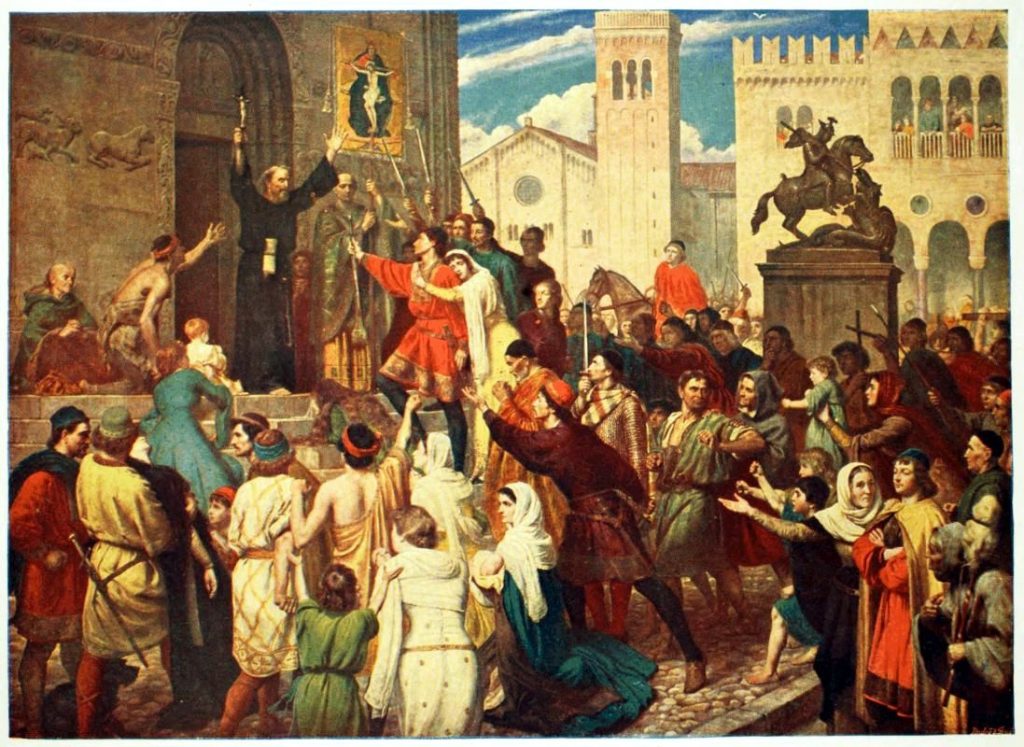
The crusading expedition of 1396 emerged from a convergence of political concern and religious enthusiasm across Europe. The steady advance of Ottoman forces into the Balkans had alarmed rulers in Central and Western Europe, particularly those whose territories bordered the Danube frontier. King Sigismund of Hungary played a central role in organizing resistance, recognizing that his kingdom stood directly in the path of Ottoman expansion. Appeals for assistance circulated through diplomatic channels and ecclesiastical networks, framing the conflict as both a political struggle for regional stability and a religious duty to defend Christian lands. The resulting response brought together a coalition that included Hungarian forces alongside contingents from France, Burgundy, the Holy Roman Empire, and several other regions.
The participation of French and Burgundian nobles gave the expedition a distinctly aristocratic character. Many Western knights who joined the campaign viewed the crusade as an opportunity to demonstrate their courage and earn renown within the chivalric culture that shaped elite society in late medieval Europe. Crusading warfare carried powerful symbolic meaning, combining religious devotion with the ideals of knightly honor and martial achievement. For these nobles, the campaign against the Ottomans promised not only the defense of Christendom but also the possibility of personal glory. This cultural framework encouraged confidence that the coalition’s heavily armored cavalry would prove decisive on the battlefield.
Yet the composition of the coalition also introduced significant challenges for effective command. The crusader army was not a unified national force but rather a collection of contingents led by their own aristocratic commanders. Each group brought its own expectations, military traditions, and assumptions about leadership. King Sigismund possessed direct experience confronting Ottoman armies and understood the importance of disciplined coordination when facing an opponent known for tactical flexibility. Many Western nobles, however, arrived with limited familiarity with Balkan warfare and often approached strategic planning through the lens of chivalric combat traditions developed in Western Europe. These contrasting perspectives created subtle but important divisions within the coalition’s leadership. Commanders who had fought along the Hungarian frontier tended to emphasize caution, reconnaissance, and the careful management of battlefield formations. Western nobles, by contrast, frequently viewed such caution as unnecessary hesitation. Their experience in aristocratic warfare encouraged a belief that bold action and personal bravery would ultimately determine the outcome of battle. As a result, strategic discussions within the coalition often reflected not only differing military assessments but also broader cultural assumptions about how warfare should be conducted.
These differences became particularly evident in attitudes toward battlefield tactics. Western knights generally emphasized the offensive power of heavy cavalry charges, which had long been associated with decisive victories in European warfare. The cultural prestige attached to such charges reinforced the belief that bold action could overwhelm opposing forces. In contrast, commanders from the Hungarian frontier had observed the effectiveness of Ottoman tactics that relied on mobility, layered formations, and the careful use of reserves. From their perspective, caution and coordination were essential when confronting an army capable of absorbing and countering an initial cavalry assault. Ottoman armies frequently deployed light cavalry and archers in ways designed to absorb the shock of a charge while gradually weakening their opponents through maneuver and attrition. Frontier commanders understood that premature attacks could easily become disorganized and leave attacking forces exposed to counterattack. Their warnings reflected hard-won experience gained through years of fighting along the Balkan frontier, where Ottoman forces had repeatedly demonstrated an ability to adapt their tactics and exploit the weaknesses of opponents who underestimated them.
The structure of the crusading coalition also complicated the decision-making process during the campaign. Aristocratic status carried considerable weight within the army, and prominent nobles often expected to exercise independent authority over their own forces. This arrangement could create tension between the overall strategic leadership and individual commanders seeking to maintain their personal prestige. Disagreements over strategy were not merely technical matters but also reflected questions of hierarchy, honor, and reputation within the aristocratic culture of the crusading army.
As the coalition advanced toward the Ottoman frontier, these structural and cultural dynamics shaped the expectations of many participants. The presence of large numbers of elite knights reinforced the belief that the army possessed overwhelming military strength. Faith in the traditions of chivalric warfare combined with the symbolic authority of crusading rhetoric to produce a powerful sense of momentum within the expedition. Yet this same confidence also masked the risks inherent in confronting an opponent whose military organization had evolved through decades of warfare in the Balkans. The campaign that followed would reveal how the culture of knightly warfare, while central to the identity of the crusading elite, could also contribute to strategic miscalculation when confronting a disciplined and adaptive enemy.
Strategy, Logistics, and the March toward Nicopolis

The crusading campaign of 1396 unfolded along the Danube frontier, a region that had become one of the principal fault lines between the expanding Ottoman Empire and the Christian kingdoms of southeastern Europe. King Sigismund of Hungary viewed the Danube as both a defensive barrier and a strategic route for projecting military power into territories threatened by Ottoman control. The assembled crusader coalition advanced down the river with the intention of confronting Ottoman forces and restoring Christian authority over contested strongholds. River transport allowed the army to move supplies and equipment more efficiently than overland routes alone, and the presence of allied naval support along the Danube initially strengthened the coalition’s logistical position. Early successes along the frontier reinforced confidence among the crusading leadership that their campaign was progressing according to plan.
As the coalition advanced deeper into contested territory, the campaign increasingly depended on coordination among its diverse contingents. The crusader army included forces from Hungary, France, Burgundy, and several other European regions, each operating under its own commanders and traditions of warfare. Maintaining a clear operational direction under these circumstances required careful planning and discipline. King Sigismund and several experienced frontier commanders recognized that confronting the Ottoman army would require patience and attention to logistics. Supply lines, communication along the river, and the careful positioning of troops all played critical roles in sustaining the campaign. The Danube provided an essential logistical artery, but the army’s growing distance from its base of operations gradually increased the risks associated with prolonged operations in hostile territory.
The crusader army eventually laid siege to the fortified city of Nicopolis, a stronghold controlling an important crossing along the lower Danube. The siege appeared at first to confirm the coalition’s momentum. Control of Nicopolis would weaken Ottoman authority along the river and strengthen the defensive position of Hungary and its allies. Yet the siege also created new strategic challenges. The crusader army became increasingly concentrated around the city, reducing its ability to maneuver and making it vulnerable to relief forces approaching from other directions. Reports began to circulate that Sultan Bayezid I was rapidly advancing toward the Danube with a large army to relieve the fortress.
Bayezid’s response demonstrated the advantages of centralized command and operational mobility within the Ottoman military system. Moving swiftly across the Balkans, his forces converged on Nicopolis with the intention of confronting the crusader coalition before it could consolidate its position. Ottoman commanders had already gained considerable experience fighting against both Balkan rulers and European knights, and they understood the importance of controlling the timing and conditions of battle. By advancing quickly toward the Danube, Bayezid aimed to force the crusader army into a confrontation before it could adapt its strategy or withdraw to more defensible positions. This rapid mobilization reflected the increasingly sophisticated logistical capabilities of the Ottoman state, which was able to coordinate troop movements across large distances while maintaining supply and communication networks. Bayezid’s march also demonstrated the strategic advantage of operating within territories that had already been integrated into Ottoman political structures. Local allies, vassal states, and established administrative centers allowed the Ottoman army to move with remarkable speed and cohesion. For the crusader coalition, the sudden appearance of a large and well-organized relief force dramatically altered the strategic situation surrounding the siege of Nicopolis.
As news of the approaching Ottoman army reached the crusader camp, tensions within the coalition leadership intensified. Some commanders favored caution, arguing that the army should prepare carefully for the coming engagement and coordinate its forces under unified direction. Others, particularly among the Western knights, believed that immediate action would secure a decisive victory before Bayezid could fully deploy his troops. These disagreements reflected deeper differences in military culture and strategic outlook that had been present within the coalition from the beginning of the campaign. The stage was set for a confrontation in which confidence and competing assumptions about warfare would shape the decisions that followed.
A Right Routing: The Battle of Nicopolis
The confrontation between the crusader coalition and the army of Bayezid I occurred near the fortress city of Nicopolis on September 25, 1396. The battlefield lay along a series of ridges and slopes overlooking the Danube, terrain that would prove decisive in shaping the course of the engagement. The crusader army assembled with considerable optimism, buoyed by its large contingent of heavily armored knights and the belief that decisive action would quickly defeat the Ottoman forces. Many participants viewed the coming battle through the cultural lens of chivalric warfare, expecting that a powerful cavalry assault would shatter the enemy’s lines. Yet the Ottoman army that faced them had been carefully organized to absorb and counter such attacks.
The opening stages of the battle reflected the tensions within the crusader coalition that had developed throughout the campaign. French and Burgundian knights, eager to secure the honor of the first attack, advanced ahead of the main army despite warnings from King Sigismund and other commanders familiar with Ottoman tactics. Their charge initially achieved success against lightly armed Ottoman skirmishers positioned at the front of Bayezid’s army. These forward units withdrew under pressure, a maneuver that reinforced the crusaders’ belief that victory was within reach. In reality, this apparent success drew the charging knights deeper into a carefully structured defensive formation.
Behind the Ottoman skirmishers stood disciplined infantry formations supported by obstacles designed to disrupt cavalry charges. As the crusader knights pushed forward, their momentum slowed and their formations became disorganized. The terrain further complicated their advance, forcing the heavily armored cavalry to attack uphill while contending with defensive positions prepared in advance. Once the crusader charge had lost cohesion, Ottoman infantry and archers began to counterattack, weakening the knights and preventing them from regrouping effectively. The initial momentum of the crusader assault gradually dissipated under sustained resistance. Stakes, trenches, and natural terrain features helped break the rhythm of the charge and forced the cavalry into fragmented clusters rather than a unified striking force. This disruption undermined one of the central advantages of medieval heavy cavalry, which depended on coordinated impact and momentum. As individual knights became separated from their companions, they faced concentrated attacks from infantry and missile troops who targeted both the riders and their exhausted horses. What had begun as an aggressive assault rooted in aristocratic prestige gradually devolved into a chaotic struggle for survival against increasingly organized resistance.
Bayezid held significant forces in reserve, including experienced cavalry contingents and allied troops from Balkan vassal states. When the crusader charge finally stalled, these reserves advanced against the exhausted knights. The sudden appearance of fresh forces transformed the battle into a crisis for the crusader army. Units that had advanced too far ahead of the main coalition found themselves surrounded and unable to retreat. Meanwhile, the remaining crusader forces struggled to coordinate a coherent response as the battlefield descended into confusion.
The result was a devastating defeat for the crusader coalition. Many knights were killed during the fighting, while others were captured after the collapse of their formations. Prominent nobles who had joined the campaign in search of glory now faced imprisonment or execution. The battle demonstrated the effectiveness of Ottoman tactical organization and the dangers of uncoordinated assault against a disciplined enemy. What had begun as a confident crusading expedition ended in catastrophe, revealing the consequences of overconfidence and poor coordination within the coalition army.
Catastrophe and Captivity
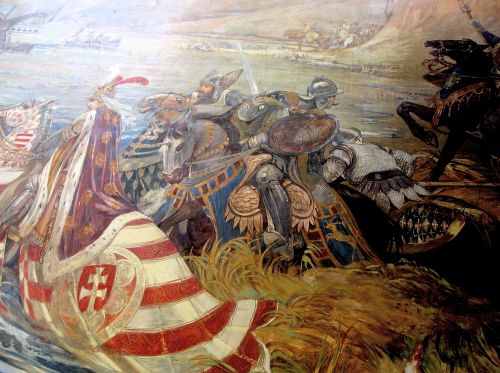
The immediate aftermath of the Battle of Nicopolis revealed the full scale of the crusader defeat. Once the coalition army’s formations collapsed, organized resistance rapidly disintegrated across the battlefield. Many soldiers attempted to flee toward the Danube, hoping to reach the river or escape to nearby ships. Others found themselves surrounded by Ottoman forces who methodically secured control of the field. The destruction of the crusader army unfolded with remarkable speed, transforming what had begun as a confident campaign into one of the most dramatic military disasters of the late medieval crusading era.
Large numbers of crusader knights and soldiers were captured during the fighting and its aftermath. Among the prisoners were many prominent members of the European aristocracy who had traveled to the Balkans expecting to earn honor through crusading warfare. Their capture carried profound political and symbolic consequences. For the Ottoman leadership, these prisoners represented both a demonstration of victory and a potential source of diplomatic leverage. Ransoms had long been a common feature of aristocratic warfare in Europe, and the presence of so many high-ranking captives created the possibility of substantial financial gain as well as opportunities to influence European politics.
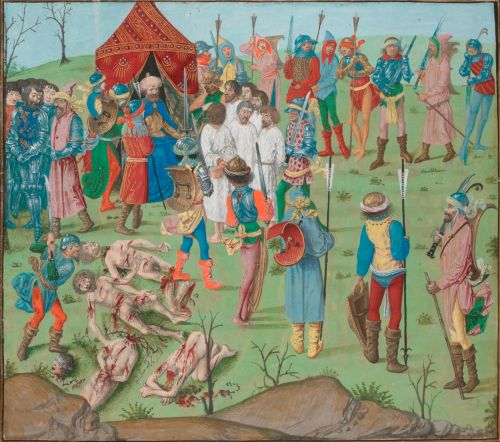
Not all prisoners, however, shared the same fate. Contemporary accounts describe how Bayezid I ordered the execution of a large number of captured crusader soldiers, particularly those of lower rank who possessed little value as hostages. Chroniclers interpreted these executions in different ways, some presenting them as acts of retaliation for earlier atrocities committed during the campaign, while others emphasized the pragmatic logic of eliminating prisoners who could not be easily guarded or ransomed. Whatever the motivations, the executions underscored the severity of the defeat and reinforced the message that the Ottoman victory had decisively broken the crusader army. The mass killing of prisoners also reflected the harsh realities of late medieval warfare when armies operated far from stable supply systems and faced logistical constraints in maintaining large numbers of captives. For Bayezid and his commanders, managing thousands of prisoners after a major battle would have posed a significant challenge, particularly when the Ottoman army remained engaged in ongoing military operations across the region. The executions carried both symbolic and practical dimensions, reinforcing Ottoman authority while removing the burden of guarding large numbers of captives.
The treatment of high-ranking captives followed a different pattern shaped by the conventions of medieval aristocratic warfare. Prominent nobles such as John the Fearless of Burgundy were held for ransom rather than executed. Their captivity became a matter of international negotiation involving courts across Western Europe. The process of securing their release required enormous financial payments and complex diplomatic arrangements, illustrating how the consequences of the battle extended far beyond the battlefield itself. The imprisonment of so many influential nobles also served as a powerful reminder of the risks associated with crusading campaigns in an era when military prestige often encouraged bold but dangerous undertakings.
The defeat at Nicopolis produced a shock that reverberated across Europe. News of the disaster spread through diplomatic correspondence, chronicles, and courtly reports, transforming what had begun as an ambitious crusading expedition into a cautionary tale about the limits of aristocratic confidence. The destruction of the coalition army weakened coordinated resistance to Ottoman expansion and reinforced the growing reputation of Bayezid I as a formidable military leader. For many observers, the events at Nicopolis demonstrated that the military balance in southeastern Europe had shifted decisively, challenging assumptions that had long shaped European attitudes toward warfare against the Ottoman Empire. The scale of the defeat also forced European rulers to reconsider the effectiveness of traditional crusading strategies when confronting a rapidly evolving imperial power. While calls for renewed crusades continued in subsequent decades, the events at Nicopolis exposed the dangers of launching large-scale expeditions without unified leadership and careful strategic planning. The catastrophe served as a stark warning that the cultural ideals of knightly warfare could no longer guarantee success against disciplined and adaptable opponents.
Strategic Consequences for Europe and the Ottoman Empire

The defeat of the crusader coalition at Nicopolis carried immediate strategic consequences for the regional distribution of power in southeastern Europe. With the destruction of one of the largest European armies assembled against the Ottomans during the late medieval period, the Danube frontier became significantly more vulnerable to further Ottoman pressure. The defeat weakened Hungary’s capacity to organize coordinated resistance and removed many of the experienced nobles who had participated in the campaign. In practical terms, the battle ensured that Ottoman authority in the Balkans would face far fewer organized challenges in the years that followed.
For the Ottoman Empire, the victory represented both a military triumph and a powerful demonstration of imperial strength. Sultan Bayezid I was able to consolidate Ottoman influence across much of southeastern Europe, reinforcing the system of vassal relationships that had already emerged among Balkan rulers. The defeat of the crusader coalition also enhanced Bayezid’s reputation as a formidable military leader, strengthening his political authority within the expanding empire. Ottoman forces continued to exert pressure on neighboring territories, and the empire’s control over key strategic routes in the Balkans became more firmly established in the aftermath of the battle. The victory also carried symbolic significance within the broader political culture of the Ottoman state. By defeating a coalition of Western European crusaders, Bayezid demonstrated that the Ottoman military system could successfully confront armies drawn from across Latin Christendom. This outcome strengthened the legitimacy of Ottoman rule among both Muslim and Christian populations living within the empire’s expanding territories. In addition, the victory helped secure the Danube frontier as a zone of Ottoman influence, providing a foundation for future campaigns that would continue to shape the political geography of southeastern Europe.
In Western Europe, the news of the disaster generated widespread shock and political reflection. The campaign had been promoted as a major crusading effort intended to halt Ottoman expansion and defend Christian territory. Instead, the defeat exposed the limitations of large aristocratic expeditions that lacked unified command and strategic coordination. The capture and ransom of many prominent nobles also imposed significant financial burdens on European courts. Although calls for renewed crusading efforts continued, the defeat at Nicopolis contributed to a growing recognition that confronting the Ottomans required more sustained political cooperation and more effective military organization than had been achieved in 1396.
Over the longer term, the consequences of Nicopolis shaped the trajectory of conflict between European states and the Ottoman Empire for generations. The battle reinforced the Ottomans’ position as the dominant military power in southeastern Europe during the late fourteenth and early fifteenth centuries. Although later campaigns and shifting political circumstances would alter the regional balance of power, the destruction of the crusader army at Nicopolis marked a decisive moment in the consolidation of Ottoman authority in the Balkans. The defeat demonstrated that traditional crusading armies built around aristocratic cavalry could no longer assume superiority over a a well-organized imperial army.
Conclusion: Aristocratic Confidence and Strategic Failure
The Battle of Nicopolis stands as one of the most striking demonstrations of how assurance shaped by aristocratic military culture could produce disastrous strategic consequences. The crusading coalition that assembled in 1396 possessed impressive numbers, distinguished leadership, and the symbolic authority of a campaign framed as a defense of Christendom. Many participants entered the expedition convinced that their martial traditions and heavily armored cavalry would ensure victory against Ottoman forces. Yet the events surrounding the battle revealed the limitations of these assumptions. Confidence based on social prestige and inherited military traditions proved insufficient when confronted with an opponent whose tactical organization and strategic planning had been shaped by decades of warfare in the Balkans.
A central lesson of Nicopolis lies in the difficulty of managing coalition warfare among competing aristocratic leaders. The crusader army was composed of contingents drawn from multiple regions of Europe, each led by nobles who possessed both military authority and strong expectations regarding personal honor. These structural realities complicated the development of a unified command system and made it difficult to impose disciplined coordination on the battlefield. Disagreements over tactics, particularly the decision to launch an early cavalry assault, reflected deeper tensions between experienced frontier commanders and Western knights eager to claim the prestige of leading the attack. The cultural expectations of chivalric warfare often took precedence over careful operational preparation. The prestige attached to leading a decisive charge created powerful incentives for individual commanders to seek prominence on the battlefield, sometimes at the expense of broader strategic coordination. Because aristocratic reputation was closely tied to visible displays of courage and initiative, restraint could be interpreted as weakness or hesitation. These cultural pressures made it difficult for coalition leaders to enforce a disciplined strategy that required patience and unified command. As a result, the crusader army entered battle with internal divisions that would prove costly once the fighting began.
The Ottoman victory at Nicopolis also demonstrated the growing effectiveness of military systems built on discipline, coordination, and strategic patience. Bayezid I’s army successfully absorbed the initial crusader assault and then deployed reserves at a decisive moment to overwhelm the exhausted attackers. This approach reflected a broader pattern in Ottoman warfare that emphasized adaptability and careful management of battlefield conditions. By contrast, the crusader coalition relied heavily on the assumption that bold cavalry charges could determine the outcome of battle. The events at Nicopolis showed that such assumptions could become dangerous when confronted by a well-organized opponent capable of exploiting their weaknesses.
In the decades that followed, the memory of Nicopolis remained a powerful reminder of the risks associated with overconfidence in warfare. The destruction of the crusader army weakened organized European resistance to Ottoman expansion and reinforced the empire’s growing dominance in southeastern Europe. More broadly, the battle illustrated how cultural ideals of martial honor could obscure the practical demands of strategy, logistics, and disciplined coordination. Nicopolis occupies an important place in the history of warfare in the later Middle Ages, not only as a dramatic military defeat but also as a cautionary example of how aristocratic confidence could undermine the effectiveness of even the most ambitious crusading expeditions. The battle also influenced later European thinking about warfare against the Ottomans. Subsequent campaigns increasingly emphasized stronger coordination among allied forces and greater attention to the tactical flexibility of Ottoman armies. Although such lessons were not always consistently applied, the disaster at Nicopolis served as a powerful historical reference point when European rulers debated how best to confront Ottoman expansion in the centuries that followed.
Bibliography
- Ágoston, Gábor. The Last Muslim Conquest: The Ottoman Empire and Its Wars in Europe. Princeton: Princeton University Press, 2021.
- Ágoston, Gábor, and Bruce Masters, eds. Encyclopedia of the Ottoman Empire. New York: Facts on File, 2008.
- Blaydes, Lisa and Christopher Paik. “The Impact of Holy Land Crusades on State Formation: War Mobilization, Trade Integration, and Political Development in Medieval Europe.” International Organization 70 (2016), 551-586.
- Delbrück, Hans. History of the Art of War, Volume III: Medieval Warfare. Lincoln: University of Nebraska Press, 1990.
- Finkel, Caroline. Osman’s Dream: The History of the Ottoman Empire, 1300–1923. New York: Basic Books, 2006.
- Froissart, Jean. Chroniques. Translated selections in Geoffrey Brereton, Froissart: Chronicles. Harmondsworth: Penguin, 1968.
- Halecki, Oskar. The Crusade of Varna: A Discussion of Controversial Problems. New York: Columbia University Press, 1943.
- Housley, Norman. The Later Crusades, 1274–1580: From Lyons to Alcazar. Oxford: Oxford University Press, 1992.
- Imber, Colin. The Ottoman Empire, 1300–1650: The Structure of Power. New York: Palgrave Macmillan, 2002.
- Kaçar, Hilmi. “The Battle of Nicopolis (1396), Burgundian Catastrophe and Ottoman Fait Divers.” Revue belge de Philologie et d’Histoire 91:4 (2013), 905-934.
- Kafadar, Cemal. Between Two Worlds: The Construction of the Ottoman State. Berkeley: University of California Press, 1995.
- Nicolle, David. Nicopolis 1396: The Last Crusade. Oxford: Osprey Publishing, 2001.
- Setton, Kenneth M. The Papacy and the Levant, 1204–1571. Philadelphia: American Philosophical Society, 1976.
- Tuchman, Barbara W. A Distant Mirror: The Calamitous Fourteenth Century. New York: Alfred A. Knopf, 1978.
- Turnbull, Stephen. The Ottoman Empire 1326–1699. Oxford: Osprey Publishing, 2003.
- Usta, Aydin. “The Crusades in Turkish Historical Writing.” Tarih Dergisi – Turkish Journal of History 81:3 (2023), 309-336.
Originally published by Brewminate, 03.09.2026, under the terms of a Creative Commons Attribution-NonCommercial-NoDerivatives 4.0 International license.
About the Author