
Analyzing how historical, legendary, and mythological elements are woven through the text of Beowulf?
Originally published by Newberry Digital Collections for the Classroom, 05.18.2018, Newberry Library, republished with permission for educational, non-commercial purposes.
Introduction
Although acknowledged as a foundational work of English literature, the complicated and allusive style of the longest epic poem in Old English often intimidates teachers and students alike. This digital collection will help educators to read and teach the work in a new way by illuminating the fascinating mixture of historical, legendary, and mythological material that come together in the poem. It turns to the literary heritage of Scandinavia and continental Europe to help us understand material that the Beowulf poet assumed the audience would already know, and it examine the historical events and figures that appear in the work.
Those reading Beowulf for the first time may be confused where and when the central action of the Old English poem takes place. Despite being composed in Anglo-Saxon England sometime after 500 CE and before 1000 CE, the tales recorded in Beowulf take place in Denmark, Sweden, and Frisia (an area now divided between Germany and the Netherlands) during the sixth century or before. To be clear, the poem deals with neither Anglo-Saxons (wrong location) nor Vikings (wrong time period).
The mixture of pagan and Christian elements in the poem can also be confusing. When the Anglo-Saxons first came to England from continental Europe in the early fifth century, they were polytheists who worshiped gods, goddesses, and other supernatural figures analogous to those known from Norse mythology. Our modern weekday names still show evidence of Anglo-Saxon paganism; Wednesday is from the Anglo-Saxon Wōdnesdæg (“Woden’s day,” named for the god parallel to the Norse Odin), and Thursday derives from Þūnresdæg(“Thunor’s Day,” for the god Icelanders called Thor).
After the conversion of the Anglo-Saxons to Christianity began in earnest with Pope Gregory I’s mission to England in 596, the last dynasty to hold on to old pagan ways converted in 686. By the time Beowulf was written down around the year 1000, the English had been Christians for over three hundred years. The poet, writing in a Christian age about ancient happenings, tells of the actions and speeches of his pagan subjects in a setting of Christian theology and morality. The two systems are often in conflict, and the tension between them provides some of the interest in reading the poem today.
This collection approaches Beowulf from four angles. First, the fascinating tale of the text itself is discussed. Second, historical elements in the poem are considered along with a mapping of its action. Third, legendary elements in Beowulf are discussed in relation to their appearances in other texts. Fourth, the poem’s mythological elements are examined in light of some literary parallels.
A Manuscript in Flames
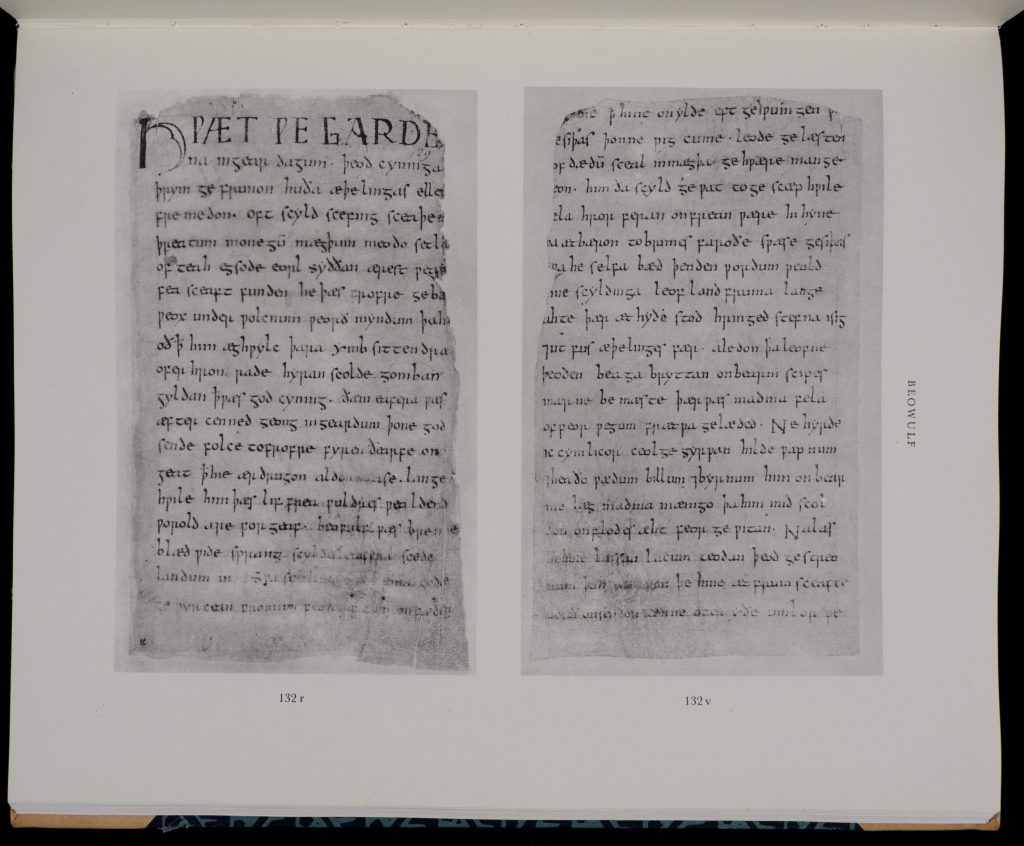
The text of the Beowulf poem is preserved in a single source. It is now known as the Nowell Codex after the sixteenth-century antiquarian Laurence Nowell, who wrote his name and the year 1563 at the head of the manuscript formally titled Cotton Vitellius A.xv of the British Library in London. The poem begins on folio 132r of the manuscript, which also contains three prose texts (a homily on Saint Christopher, The Marvels of the East, and Alexander’s Letter to Aristotle) and the poem Judith.
Before the acquisition by Nowell, the early years of the manuscript’s history are unknown. In 1567, Nowell gave his collection of manuscripts to fellow antiquarian William Lambarde. Lambarde’s larger collection seems to have been acquired by yet another antiquary, Sir Robert Bruce Cotton, whose own collection became the foundation of the British Museum’s manuscript archive. The designation Cotton Vitellius A.xv comes from the codex’s connection to this collector, whose other acquisitions included the Lindisfarne Gospels, two original manuscripts of the Magna Carta, the only manuscript of Sir Gawain and the Green Knight, and many other important works.
In 1731, the location of the British Library collection of Cotton’s manuscripts was deemed a fire hazard, and the texts were temporarily stored at Ashburnham House in London. On the night of October 23, a fire occurred in this new location. Around twenty-five percent of the works in the collection were damaged or destroyed by the fire and the water used to fight it. The codex containing Beowulf was set ablaze, and the poem may have been forever lost had not a heroic librarian grabbed the smoking text and thrown it out of the window. The top and outer edges of the book’s pages were destroyed by the fire, as can be seen in photographs and reproductions of the text. The damage resulted in the loss of letters and words along the edges of the surviving codex.

In 1787, more than half of a century after the disastrous fire, Icelandic historian Grímur Jónsson Thorkelín commissioned a transcript of Beowulf for his research into Danish history as part of his service as National Archivist of Denmark. The person who made the copy – possibly James Matthews of the British Museum staff – was unfamiliar with the Anglo-Saxon (Old English) language. This was actually a benefit, since he faithfully copied the text by rote rather than following the contemporary scholarly practice of “correcting” the text to what he thought it should say.
Thorkelín subsequently made a copy of the manuscript himself. The codex seems to have crumbled further even as the first copy was being made, since the first copy includes text from the page edges that are missing in the second. Scholars have used these two copies in conjunction with the surviving manuscript and nineteenth-century copies to reconstruct the parts of the text lost through the fire and subsequent damage.
The manuscript can be dated to around the year 1000, but the poem is generally believed to have been composed much earlier. It cannot have been created in its final form before the sixth century, when the latest historical events that it describes took place. Scholars from various related fields continue to forward arguments for one particular period of composition or another, with some favoring the early Anglo-Saxon period and some asserting a date as late as the tenth century. The various theories have great learning and evidence behind them, but the past can be as much of an undiscovered country as the future.
Of Halls and Kings

Although composed in Anglo-Saxon England, the action of Beowulf takes place in Denmark, Sweden, and Frisia. In the poem, Beowulf himself is a hero of the Geats (Old English Gēatas), a group with a name cognate to the Old Norse Gautar. They inhabit what is now southern Sweden yet are a distinct people in conflict with the Swedes (OE Swēon) to the north.
Hrothgar’s hall Heorot, where Grendel makes his bloody attacks, is now considered to have been located in the town of Lejre on the Danish island of Zealand. Parallel descriptions in multiple medieval Scandinavian texts line up with recent archaeological work that uncovered remains of halls and burial mounds in Lejre dating back to the mid-sixth century, around the time of the last historical events described in Beowulf.
These events center on the failed raid led by Hygelac, the hero’s Geatish king. According to lines 1202-1214 of the poem, Hygelac is killed in battle after he and his troops attacks Frisia. The account describes Hygelac’s defense of the treasures he had won and borne over the sea, his death at the hands of the Franks, and his and the other Geats’ corpses being looted of their booty on the field of battle by their enemies.

A strikingly similar passage appears in the Frankish history of Gregory of Tours, a sixth-century historian and bishop. In the third book of his history, he briefly describes the fatal raid of the Danish king Chlochilaich on Frankish territory. This figure has long been associated with the Geatish king Hygelac of Beowulf, and the details of both accounts indeed run in parallel. When the raiders attempt to flee back over the sea with their raided goods, the king is defeated on the shore by the Franks, and the stolen treasures are recovered.
The historical raid and death of Chlochilaich, despite his identification as a Dane by Gregory, has been linked with Hygelac’s raid in Beowulf since the discovery of the parallel by Danish scholar N.F.S. Grundtvig in 1815. The events Gregory describes are thought to have occurred sometime between the years 516 and 531, and it is this dating that establishes the earliest point of composition for the poem; it logically could not have been composed before the historical event it describes took place. Recent scholarship, however, has questioned the identification of Hygelac and Chlochilaich even as it has challenged the idea that the poem records details of discrete historical events.
On the other hand, Beowulf does recurrently refer to historical and semi-historical people. The appearance of a large cast of secondary characters is largely due to what has been called the “interlace” structure of the poem. In this analysis, the multiple asides and digressions from the main storyline weave through the text in a manner analogous to the way that interlace designs weave in and out of Anglo-Saxon visual art in metal, stone, and manuscript illumination.
Approximately seven hundred of the poem’s verses deal with episodes aside from the main plot; twenty-two percent of the work branches off from the story of Beowulf and the monsters. This branching into tales that explain, illuminate, comment, or otherwise add to the central focus of the poem shows a technique strongly reminiscent to that of the Mahābhārata and Rāmāyaṇa, great heroic epics of India, which likewise take regular detours into side-stories and related tales.
In addition to the story of Hygelac’s death, Beowulf tells of the fight at Finnsburg, another seemingly historical conflict between Danes and Frisians, but one for which no clear non-literary analogue has been found. Other figures seem to be based on or otherwise connected to historical figures: Eormenric to a fourth-century king of the East Goths and Offa to a semi-historical fourth-century king of the Angles.
The presence of figures such as these and the appearance or mention of real-world peoples including Danes, Franks, Frisians, and Swedes gives the poem an air of historicity, even if the stories themselves are not demonstrably historical.
How to Kill Your Dragon
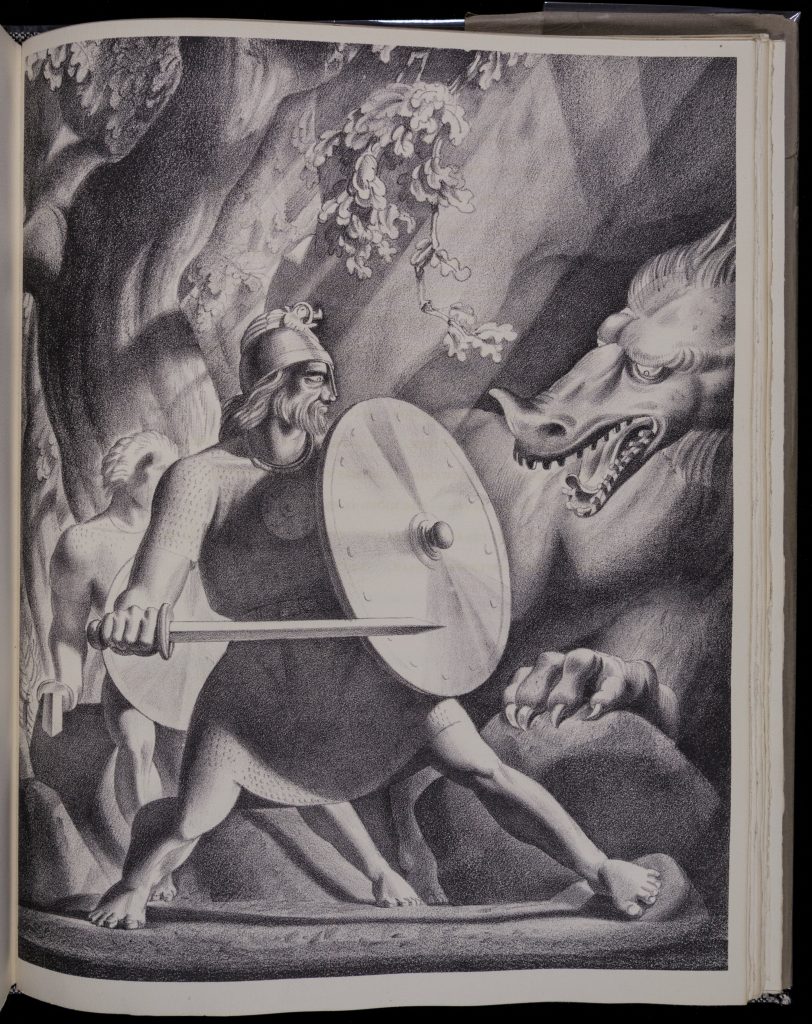
Heroes of legend are also woven into Beowulf‘s tapestry. The poem’s Finnsburg episode features a character named Hengest who many scholars have identified with Hengist and Horsa, legendary brothers credited in medieval sources as leading the fifth-century Germanic invasion of Britain and founding the Jutes’ kingdom of Kent in southeastern England. The most interesting intersection of the poem with outside legends, however, centers on Beowulf’s fight with the dragon.
The hero’s battle with the beast begins at line 2538. This passage and those directly after have been mined by generations of authors, artists, and game designers. The encounter and battle with the dragon Smaug in The Hobbit has many elements taken directly from the poem: the cup stolen from the treasure hoard, the dragon angrily searching for the thief outside his lair, the fiery flying attacks on the surrounding countryside at night, and the dispatching of the dragon by – in the words of Beowulf – striking “the violent stranger rather lower.” The similarity to the medieval source is no coincidence; J.R.R. Tolkien was a noted scholar of Old English literature.
In one of his lectures, Tolkien pointed out Beowulf’s fatal tactical mistake, calling a frontal assault on a dragon “the wrong way to do it.” The hero heads alone into the stony lair of the treasure-hoarding monster, tells the dragon he wants to fight him, and draws his sword against the beast. This is not great dragon-fighting strategy. Beowulf’s weapon fails, and the enraged dragon spews flame against him as his terrified retainers abandon him to hide in the woods.
Beowulf’s kinsman Wiglaf bravely joins the fight at line 2661. The poem’s description of the two heroes and the dragon taking turns attacking and causing damage seems a precedent for the ordered turn-taking in combat developed by Gary Gygax and Dave Arneson for their Dungeons & Dragons role-playing game in the early 1970s – a system later adopted by video games. The dragon burns Beowulf’s shield until nothing remains but the metal boss, and the aged king again attacks the creature’s head with his sword, which promptly shatters. The dragon bites him in the neck, and it is left to Wiglaf to find “the right way to do it” and strike the beast’s soft underbelly. As the dragon’s flames die down, Beowulf gives the monster a final blow with his knife “through the middle” before falling himself.

The other famous dragon of Northern European legend appears in Iceland’s thirteenth-century Saga of the Volsungs. The hero Sigurd dispatches the hoard-guarding dragon Fafnir in a clever fashion, avoiding the fatal mistake of Beowulf’s frontal assault. He does not develop the strategy himself, but is advised by “an old man with a long beard,” actually the god Odin disguised as a wanderer who irregularly appears to offer advice and help the tale’s heroes– a clear model for Tolkien’s Gandalf.
Rather than challenge the dragon directly, Sigurd follows the advice of Odin and his own foster-father, the devious dwarf Regin, and digs ditches on the heath that the dragon crosses to drink water. Sitting in the central ditch, Sigurd stabs his sword up into the soft area under the dragon’s shoulder. Blood pours into the other ditches instead of drowning Odin’s protégé. Between the two famous medieval accounts of dragon-slaying heroes, we have clear examples of the right and wrong way to fight the beasts.
The Icelandic tale appears in Beowulf, but in miniature and with significant differences from the saga version. Beginning at line 867, the Anglo-Saxon poem tells of a related dragon killer, but without the presence of god or dwarf. The action is moved back a generation, so that Sigmund – Sigurd’s father in the Icelandic saga – kills the beast. A storyteller in Heorot recites the tale at the feast celebrating Grendel’s routing. Foreshadowing Beowulf’s own battle, the episode tells of Sigmund killing a dragon guarding a treasure hoard as he fights him alone under stone, without the help of his nephew and companion Fitela.
In the Icelandic saga, Sinfjotli – Fitela’s equivalent – is both Sigmund’s nephew and son. As in Beowulf, they are companions in adventuring. Jesse L. Byock argues that “Sigmund appears to be the original dragon slayer, and Sigurd’s filial connection with the old hero is probably an expansion of the legend.” Sigmund and Sinfjotli are likewise paired in a poem on the death of the Norse ruler Eirik Bloodaxe, in which Odin tells them to greet the king on his arrival in Valhalla, the god’s home for deceased heroes.

The Anglo-Saxon Beowulf stands in an interesting relationship with Icelandic legend. The intertextuality becomes more complex with the addition of Siegfried (Middle High German Sîvrit), dragon-killing hero of the Nibelungenlied, a German poem written down around 1200. Here, Sigemunt is Siegfried’s father but – like Sigmund in the Icelandic saga – plays no role in his son’s killing of the dragon. In contrast to the Anglo-Saxon and Icelandic sources, the treasure hoard won by the hero of the German epic is unconnected to the dragon but is instead taken in a separate adventure involving princes, giants, and a dwarf with a cloak of invisibility. The Sigurd/Siegfried character may have roots in the historical Sigibert (535-575), a king of the Franks whose complicated family relationships parallel those of the literary figures. The dragon episode may have been grafted onto stories of the human hero in the centuries after his death.
Familiarity with the Icelandic and German texts can enrich understanding of Beowulf by making up in some small way for our lack of knowledge of lore that would likely have been known by the poem’s original audiences. Knowing the legend of Sigurd, the brief allusion by the Anglo-Saxon poet to the great dragon-slayer of the north – even though displaced by a generation – becomes something more than just another aside full of strange names. The weight of the foreshadowing becomes heavier for modern readers who understand the allusions.
Thor and the Ungrateful Dead
Like Beowulf, the Norse god Thor battles a serpentine enemy by choosing “the wrong way to do it.” While fighting the dragon head-on, Beowulf receives his death-wound. After the monster falls, “the wound which the earth-dragon had inflicted on him earlier began to burn and swell; straight away he found that the poison within welled up with deadly evil in his breast” (lines 2711-2715). This mutual destruction parallels a key passage in what we now call the Norse myths, which were once religious tales that were the common inheritance of the Scandinavian tribes portrayed in the Beowulf poem and of the poet’s pagan Anglo-Saxon ancestors.

The Old Norse mythological poems of the Poetic Edda mostly come from the Codex Regius, a manuscript compilation of mythological and heroic poems written down in Iceland in the 1270s. The collection’s first poem is Völuspá (“Prophecy of the Seeress”), arguably the single most important surviving composition recording Norse cosmological concepts. It contains an account of Ragnarök (“Doom of the Powers”), the last battle between various forces in the mythological universe.
In verse 53, Thor faces his great enemy, the World Serpent. The god is referred to as the child of Odin and the earth goddess (Old Norse Hlóðyn and Fjörgyn). Like Beowulf, he is a protector of the community – the “shrine-guarder of Midgard” (Old Norse miðgarðr, cognate with Beowulf’s Old English middengeard, the source of Tolkien’s Middle-earth).
After he slays the enormous serpent – large enough to encircle the world of humans – Thor “steps nine paces… failing.” In his Edda of approximately 1220, Icelandic antiquarian Snorri Sturluson expands on the verse: “Thor will be victorious over the Midgard serpent and will step away from it nine paces. Then he will fall to the ground dead from the poison which the serpent will spit at him.”
As in the Anglo-Saxon poem, it is not a battle-wound that kills the hero; it is the poison of the monsters that ends both Beowulf and Thor after their enemies have fallen. Danish scholar Axel Olrik makes a distinction between two types of dragon slayers: one who fights to win a treasure hoard (Sigurd type) and one who fights to protect a people (Thor type). In both motive and manner of dying, Beowulf is aligned with the mythological archetype of the Norse god.

The dragon is not the only monster Beowulf faces. In the poem’s first part, he battles Grendel and his mother. In line 726, the younger monster glares at Heorot with gleaming eyes, filled with wicked glee at the prospect of murdering and eating the warriors inside. Before engaging Grendel, the hero publicly declares that he will use no sword. Instead, he grapples with the monster and rips his arm from its socket.
After Grendel’s mother attacks the men in the hall (1279), Beowulf follows her tracks to a serpent-infested pool (1399), dives in (1492), and fights her in her submerged hall (1518). When the sword given to him by Unferth fails, he battles the mother by hand. Facing defeat, he is saved by the discovery of an enormous ancient sword crafted by giants (1557). After he cuts off her head, he finds Grendel’s corpse and likewise decapitates it (1584).

Several elements of these encounters parallel those in Icelandic tales of draugar (singular draugr), undead corpses that attack any who enter their barrows and sometimes venture out to harass the living. In the Saga of Egil One-Hand and Asmund Berskerker-Slayer, Aran is buried in a mound that is – like the underwater hall of Beowulf – filled with weapons and other valuable goods (see images in this section). Like Grendel, Aran gorily feasts like a beast, bloodily devouring hawk, hound, and horse before ripping off the ears of his friend Aran, who unwisely keeps his dead friend company in the barrow. To permanently lay the walking corpse to rest, Asmund does as Beowulf does to both Grendel and his mother, and cuts off its head.
Further parallels to Beowulf are in the story of Thráin, recorded around 1400 in a set of rímur (Old Norse “rhymes”), long narrative poems of Iceland. After being buried with treasures in a mound, the draugr Thráin fights warriors with his nails, as Grendel and his mother do. Inside the barrow, the hero Hrómund finds “the famous sword Mistiltein [Old Norse mistelteinn, “mistletoe”] from where it was hanging on a pillar.” Like Beowulf does with his monsters, Hrómund fights Thráin hand-to-hand before cutting off his head with the sword found in the lair.
As with the legendary tales of dragon-slaying heroes, the modern reader’s understanding of the Anglo-Saxon poem can be greatly enriched by placing the work in dialogue with other texts. There are more parallels to be drawn between Grendel, his mother, and draugar, but these examples show how the strange monsters of Beowulf can be understood in light of the zombie-like creatures that inhabit burial mounds and bloodily feast upon living warriors. Both as a means of digging deeper into the ancient cultural resonances of the poem and as a corrective to postmodern retellings that portray Grendel as a sympathetic figure, knowledge of the wider mythologies can make this complex poem more meaningful to today’s audiences.
Selected Sources
- Dronke, Ursula, trans. The Poetic Edda, Volume II: Mythological Poems. Oxford: Clarendon Press, 1997.
- Byock, Jesse L., trans. Saga of the Volsungs. Berkeley: University of California Press, 1990.
- Edwards, Cyril. The Nibelungenlied. Oxford: Oxford University Press, 2010.
- Fulk, R.D., trans. The Beowulf Manuscript. Cambridge, Massachusetts: Harvard University Press, 2010.
- Fulk, R.D., Robert E. Bjork, and John D. Niles, eds. Klaeber’s Beowulf and the Fight at Finnsburg. Toronto: University of Toronto Press, 2008.
- Gould, Chester Nathan. “They Who Await the Second Death: A Study in the Icelandic Romantic Sagas.” Scandinavian Studies 9 (1926): 167, 201.
- Lavoisne, M. A Complete Genealogical, Historical, Chronological, and Geographical Atlas. Philadelphia: M. Carey and Son, 1820.
- Leonard, William Ellery, trans. and Rockwell Kent, ill. Beowulf. New York: Random House, 1932.
- Malone, Kemp, ed. The Nowell Codex: British Museum Cotton Vitellius A. XV, 2. ms. Copenhagen: Rosenkilde and Bagger, 1963.
- Snorri Sturluson. Edda. Translated by Anthony Faulkes. London: J.M. Dent, 1995.
- Tolkien, J.R.R. The Monsters and the Critics. London: Harper Collins, 2006.
By Dr. Karl E.H. Seigfried
Theology and Religious History Faculty
Cherry Hill Seminary
About the Author