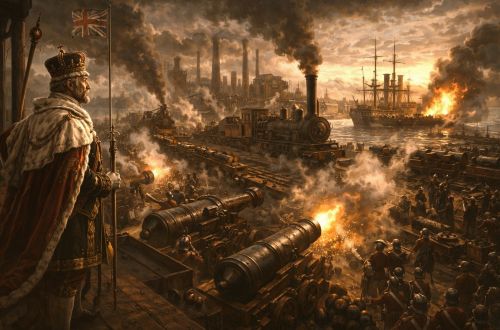
Through contracts, subsidy, and procurement power, the British Crown reshaped private industry, binding innovation in gunpowder, steam, and armaments to imperial defense.

By Matthew A. McIntosh
Public Historian
Brewminate
Introduction: Procurement as Power
In the eighteenth and nineteenth centuries, the British state did not merely wage war. It reorganized the conditions under which war-making technologies were conceived, financed, and produced. The expansion of imperial commitments, the growth of the Royal Navy, and the demands of continental conflict required sustained material output on a scale unprecedented in earlier English history. This expansion did not produce a fully nationalized industrial system. Instead, it generated a hybrid structure in which private enterprise remained formally independent while increasingly dependent upon state contracts. Procurement became a mechanism of influence. By deciding what to purchase, in what quantities, and under what specifications, the Crown shaped the trajectory of industrial innovation.
Scholastic analysis of the “fiscal-military state” provides the conceptual framework for understanding this transformation. Britain’s capacity to raise revenue and channel it into military expenditure created a feedback loop between taxation, borrowing, and defense production. The Board of Ordnance and the Admiralty did not function as passive buyers responding to market offerings. They articulated standards, imposed inspection regimes, and demanded technical modifications that aligned private manufacturing with strategic objectives. British economic performance underscores the importance of state demand in stimulating sectors tied to naval construction, metallurgy, and munitions. Military expenditure became a driver of industrial change rather than a byproduct of it.
The significance of procurement lies not only in its fiscal magnitude but in its conditional structure. Contracts stipulated design requirements, delivery schedules, and quality controls that compelled firms to adjust production methods. Industrial actors competed for government contracts that offered stability and scale unavailable in civilian markets. The Admiralty’s expectations shaped ship design and supply systems, particularly as Britain transitioned from sail to steam. The state’s purchasing power created incentives for innovation while simultaneously narrowing the range of acceptable experimentation. Innovation occurred within parameters defined by defense priorities.
The British Crown leveraged procurement as a strategic instrument to bind private technological development to imperial defense. Through ordnance factories, steam propulsion contracts, and armaments manufacturing agreements, the state exerted pressure without formal expropriation. Firms remained privately owned, yet their survival often depended upon military patronage. Technology and governance became intertwined through sustained contractual relationships. In Britain’s industrial century, procurement was not merely administrative procedure. It was a form of power.
Ordnance Factories and the Centralization of Gunpowder Production

Long before the full maturation of Britain’s nineteenth-century industrial economy, the production of gunpowder and artillery had already drawn the state into direct managerial involvement. The Board of Ordnance, whose administrative roots extended into the Tudor period, evolved into a central organ for supervising the manufacture, storage, and inspection of military materials. By the eighteenth century, the demands of continental warfare and imperial expansion required more reliable supply chains than dispersed private production alone could guarantee. Gunpowder, as both a volatile commodity and a strategic necessity, demanded standardization and oversight. The Crown responded by strengthening institutional control over production while maintaining contractual relationships with private mills.
The Royal Gunpowder Mills at Waltham Abbey illustrate this centralizing tendency. Although private manufacturers continued to operate, the state invested heavily in Crown-controlled facilities to ensure consistent output and quality. Waltham Abbey became a site of technological experimentation as well as production, where processes were refined under official supervision. Eighteenth-century warfare compelled greater bureaucratic coordination of supply. Gunpowder manufacture required careful calibration of saltpeter purification, charcoal composition, and grain sizing. Variability could compromise battlefield effectiveness. The state-imposed inspection regimes and technical standards that reduced dependence on market fluctuation.
Centralization did not eliminate private participation. Instead, it redefined it. Private powder mills operated within a framework of contracts, inspections, and pricing controls set by the Board of Ordnance. Academic work on eighteenth-century military administration demonstrates how logistical reform accompanied Britain’s rise as a European power. Contractors competed for government orders, but those orders came with stipulations that shaped manufacturing practice. Production schedules were aligned with military campaigns, and penalties for substandard goods could be severe. The state exerted leverage without absorbing the entire industry into direct ownership.
The relationship between ordnance administration and industrial development also reveals the feedback loop between war and innovation. Analysis of the Industrial Revolution situates military demand among the forces stimulating mechanization and improved production techniques. Gunpowder production, though older than steam power, required refinement in milling equipment, quality control procedures, and transportation infrastructure. State contracts created predictable demand, encouraging investment in facilities capable of meeting official specifications. Procurement functioned as both guarantee and constraint. It stabilized revenue while channeling technological advancement toward military utility.
By the late eighteenth century, Britain possessed a hybrid system in which centralized oversight and selective state ownership coexisted with private enterprise, and gunpowder production offers one of the clearest early examples of this arrangement. The Crown did not abolish private mills, but it surrounded them with inspection regimes, pricing structures, and technical directives that effectively subordinated them to national defense priorities. Facilities such as Waltham Abbey demonstrated that the state was willing to invest directly where strategic vulnerability demanded it, yet even these Crown works operated in dialogue with private suppliers whose output supplemented official production. The result was neither laissez-faire independence nor total nationalization, but a layered system of supervision and dependency. Gunpowder manufacture became a regulated strategic sector in which quality, reliability, and capacity were shaped by government authority. Through inspection, investment, and procurement leverage, the state ensured that this critical resource remained dependable under the pressures of imperial conflict. In doing so, it established a template for later interventions in steam propulsion and armaments manufacturing. The centralization of gunpowder production reveals an early phase in the broader transformation of British industry into a partner, and at times subordinate, of state power.
Steam Propulsion and Naval Transformation

The transition from sail to steam in the nineteenth century marked one of the most profound technological transformations in British naval history. Unlike incremental refinements in hull design or artillery calibration, steam propulsion altered the fundamental logic of maritime movement. Wind patterns no longer dictated maneuverability. Speed and direction became increasingly subject to mechanical control. This transformation did not emerge spontaneously from private ingenuity alone. It unfolded within a strategic environment in which the Admiralty actively evaluated, subsidized, and shaped the adoption of new propulsion systems. Steam was not simply purchased once perfected. It was developed in dialogue with state demand.
Early experiments with steam-driven vessels reveal the Crown’s cautious but deliberate involvement. The Royal Navy commissioned trials, sponsored prototype construction, and maintained sustained correspondence with engineers whose innovations carried uncertain promise. These early engagements were marked by skepticism as well as curiosity. Naval officers accustomed to sail had to be convinced that mechanical propulsion could withstand the rigors of combat and long-distance deployment. British officials recognized the geopolitical implications of propulsion technology even as they debated its reliability. Control of global trade routes, imperial communication lines, and rapid response capability required mobility independent of prevailing winds. Steam propulsion offered strategic flexibility for riverine operations, colonial policing, and blockade enforcement, particularly in theaters where wind conditions were unpredictable. Admiralty interest extended beyond simple acquisition to shaping the standards under which engines were tested, evaluated, and ultimately integrated into fleet doctrine. Trials were not neutral experiments. They were mechanisms through which the state defined the technical criteria that innovation would have to meet.
Private firms such as Maudslay, Sons and Field and other marine engineering companies became focal actors in this transformation. Yet their development was closely tied to government contracts. Naval specifications influenced engine design, fuel efficiency targets, and durability standards. Broader analysis of Britain’s technological modernity emphasizes how military demand frequently sustained industrial sectors that might otherwise have struggled in civilian markets. The Royal Navy’s purchasing power provided stable revenue streams that incentivized experimentation while narrowing acceptable design parameters. Firms innovated, but they did so within frameworks structured by Admiralty expectation.
The shift to iron hulls and screw propellers further illustrates procurement’s directive role. The adoption of the screw propeller over paddle wheels was not merely a technical adjustment but a strategic recalibration of naval architecture. Paddle wheels exposed vulnerable machinery above the waterline and limited broadside armament placement, while screw propulsion promised greater protection and efficiency. Institutional debate within the Admiralty shaped these transitions, with committees examining performance data from competing vessels and weighing operational reports from officers at sea. Engineers and shipbuilders proposed alternative configurations, but acceptance depended upon alignment with strategic doctrine and logistical feasibility. The state’s evaluative authority filtered innovation through military criteria, compelling private firms to modify designs in accordance with official assessments. Procurement contracts became instruments through which technical risk was managed and standardized solutions were enforced. By determining which experimental models would receive sustained funding, the Admiralty effectively selected the technological path along which British naval engineering would advance.
Steam propulsion also reconfigured industrial geography. The need for coal depots, repair facilities, and engine manufacturing capacity reinforced Britain’s industrial integration with its naval strategy. Ports such as Portsmouth and Devonport expanded in tandem with industrial centers capable of producing marine engines and metal components. Logistical planning became inseparable from technological adoption during the Napoleonic and post-Napoleonic eras. Steamships required not only new engines but new supply systems. State contracts influenced infrastructure development far beyond the shipyard.
By mid-century, the Royal Navy’s commitment to steam power had entrenched a system of interdependence between government and industry. Private firms remained formally independent enterprises, yet their growth was intimately tied to defense procurement cycles. Innovation flowed through contractual relationships in which the Admiralty articulated strategic need and industry translated that need into mechanical form. The naval transformation from sail to steam exemplifies procurement as leverage. The Crown did not nationalize marine engineering. It shaped it through demand, inspection, and sustained partnership. Steam propulsion became not only a technological breakthrough but a case study in how state power could guide private innovation toward imperial ends.
Armaments Manufacturing and Industrial Dependency
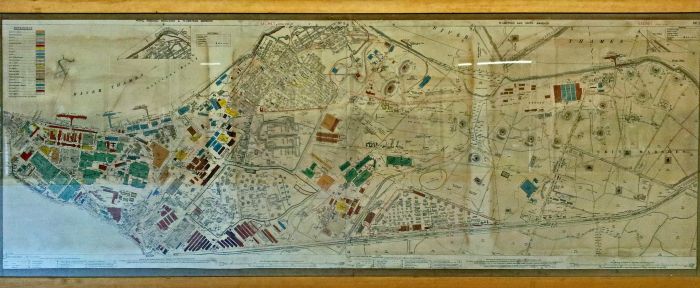
If steam propulsion reveals how procurement shaped technological trajectory, armaments manufacturing exposes how deeply private industry could become structurally dependent upon state demand. In the eighteenth and nineteenth centuries, Britain’s arms sector expanded in response to sustained warfare, imperial commitments, and naval competition. Yet the organization of this sector did not conform to a purely centralized model. Instead, it operated through a combination of Crown facilities such as Woolwich Arsenal and networks of private manufacturers concentrated in industrial centers like Birmingham. This hybrid structure created interdependence. Firms remained nominally private, but their profitability, production scale, and technological evolution were closely tied to government contracts.
The Royal Arsenal at Woolwich functioned as both production center and regulatory authority. It manufactured artillery, small arms, and ammunition while also serving as a site of inspection and experimentation. Woolwich did not eliminate private suppliers. Rather, it established benchmarks against which private output was measured. Standards of caliber, metallurgy, and reliability were defined through official testing regimes. The state positioned itself as arbiter of acceptable quality, ensuring that private firms operated within a framework structured by military necessity.
Birmingham’s small arms industry illustrates the other side of this relationship. Local workshops and larger firms produced muskets and components under contract for the Crown, particularly during periods of intense mobilization. These production networks relied upon skilled artisans organized within evolving factory systems, blending older craft traditions with emerging industrial discipline. Production was often subdivided across specialized workshops, creating a complex supply chain in which barrels, locks, and stocks were manufactured separately before final assembly. Yet these firms did not operate in an autonomous market environment. Contracts specified quantities, timelines, and detailed technical requirements that constrained variation and experimentation. Payment depended upon compliance with inspection protocols administered by state-appointed officials who possessed authority to reject substandard goods. In times of peace, reduced orders could destabilize entire regional economies, exposing manufacturers to fluctuations tied directly to imperial policy and parliamentary budgeting. The prosperity of Birmingham’s gun trade rose and fell with the rhythms of state demand, revealing how deeply private industry could become embedded within military procurement cycles.
Technological innovation within armaments manufacturing likewise followed patterns influenced by procurement priorities. The transition from flintlock to percussion systems, and later to rifled barrels and breech-loading mechanisms, did not unfold solely through private experimentation. Government trials evaluated competing designs, selecting some for large-scale adoption while rejecting others. Study of the “warfare state” helps clarify this dynamic. Military institutions often acted as selective patrons, accelerating certain technologies while constraining alternatives. Firms seeking sustained contracts adapted their research and development strategies to align with anticipated government preferences.
Pricing mechanisms and contract negotiations further entrenched this interdependence. Parliamentary scrutiny of military expenditure imposed fiscal discipline, compelling manufacturers to balance innovation with cost control while still meeting stringent quality standards. Studies of British political economy highlight how taxation policy, public debt management, and budgetary oversight shaped the financial environment within which arms producers operated. Contracts were frequently subject to competitive bidding, yet negotiation extended beyond price. Manufacturers sought assurances of volume and continuity, while officials pressed for reliability and efficiency. Disputes over defective batches or delayed delivery could lead to reputational damage that jeopardized future orders. In this environment, industrial actors cultivated relationships with procurement authorities, learning to navigate bureaucratic processes as carefully as technical challenges. Success required not only mechanical expertise but fluency in the political economy of defense spending, reinforcing the fusion of industrial strategy with state structures.
By the mid-nineteenth century, British armaments manufacturing had become inseparable from state structures of demand and regulation. The Crown did not nationalize the entire sector, yet it exercised decisive influence through contracts, standards, and testing authority. Private firms expanded under the shelter of government orders while simultaneously adjusting production strategies to meet official specifications. Armaments production exemplifies industrial dependency forged through procurement power. The boundary between independent enterprise and state instrument blurred, as technological development became increasingly responsive to the priorities of imperial defense.
Subsidy, Pressure, and Strategic Direction

If procurement established structural dependency, subsidy and strategic pressure refined the mechanisms through which the British state directed industrial innovation. Financial support did not always take the form of overt grants or direct capital transfers. It frequently operated through guaranteed contracts, advance payments for materials, preferential access to government credit, and long-term purchasing commitments that reduced market uncertainty for selected firms. In sectors tied to ordnance, shipbuilding, and marine engineering, such assurances encouraged substantial capital investment in specialized machinery, expanded workshops, and technical experimentation that might otherwise have appeared prohibitively risky in volatile civilian markets. Public credit and reliable taxation enabled sustained military expenditure, creating a financial environment in which the Crown could act as a powerful and predictable patron. This fiscal reliability mattered as much as the scale of spending itself. Manufacturers could calculate future demand with greater confidence, aligning research and infrastructure with anticipated state needs. Subsidy functioned less as benevolent encouragement and more as structured leverage that oriented industrial development toward imperial defense.
Pressure accompanied patronage. Government contracts carried detailed specifications that effectively guided research and production priorities. Admiralty and War Office officials did not simply request finished goods. They prescribed performance standards, demanded iterative improvements, and rejected designs deemed inadequate for strategic purposes. Parliamentary debates over defense expenditure reveal how procurement decisions were scrutinized for efficiency and reliability, reinforcing a culture in which manufacturers were expected to align innovation with national interest. Analysis of public finance highlights how fiscal oversight reinforced this dynamic. Budgetary accountability imposed discipline not only on officials but on contractors whose livelihoods depended upon compliance.
Strategic direction became particularly evident during moments of technological transition. The adoption of rifled artillery, ironclad warships, and improved munitions systems required coordinated experimentation. Scholarship emphasizes that Britain’s technological modernization often unfolded within military frameworks that privileged durability and imperial reach over speculative novelty. Firms seeking government favor invested in prototypes tailored to official criteria, anticipating future orders. In this process, innovation became anticipatory. Engineers calibrated their designs not solely for commercial demand but for the expectations of procurement authorities whose preferences could determine market viability.
At times, the relationship bordered on coercive dependency. Contractors who failed to meet delivery schedules, quality standards, or evolving technical specifications risked exclusion from future bids, a penalty that could devastate firms whose production capacity had been expanded in expectation of continued government patronage. Conversely, companies that demonstrated reliability secured reputational capital translating into preferential treatment and sustained orders. This dynamic fostered internal reorganization within firms, encouraging the adoption of standardized accounting practices, quality control systems, and managerial hierarchies capable of satisfying bureaucratic scrutiny. The British state did not need to monopolize industry outright to secure compliance. By concentrating purchasing power, inspection authority, and the ability to allocate or withhold lucrative contracts, it created structural incentives that reshaped corporate behavior. Pressure was embedded within competitive procedures, turning access to defense markets into a mechanism through which the state indirectly disciplined and directed industrial actors.
The interplay of subsidy and pressure reveals procurement as an instrument of strategic governance. Financial incentives encouraged expansion of capacity, while contractual stipulations directed the application of technical expertise. Private innovation remained visible, but it operated within channels shaped by imperial defense priorities. The British Crown’s leverage lay not in abolishing private enterprise but in structuring the environment in which that enterprise functioned. Through contracts, oversight, and fiscal strength, the state transformed innovation into a coordinated element of national power.
The Emergence of a Modern Military-Industrial Relationship
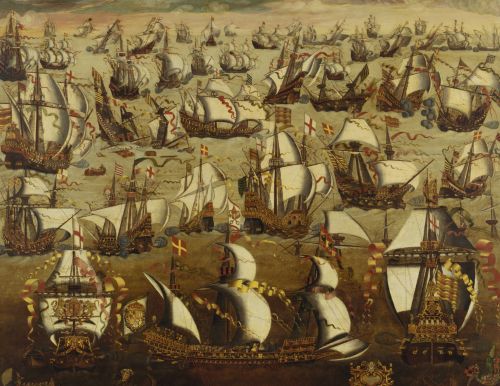
By the mid-nineteenth century, Britain had developed a durable pattern of interaction between state institutions and private industry that anticipated later descriptions of a military-industrial relationship. This was not a system of outright nationalization, nor was it a laissez-faire marketplace in which the government acted as a neutral consumer. It was a structured environment in which procurement, inspection, subsidy, and strategic planning interlocked. The War Office and Admiralty articulated long-term requirements, while firms calibrated investment and innovation to meet anticipated official demand. The relationship was iterative. Each contract generated feedback that shaped future expectations, gradually embedding defense production within the core of Britain’s industrial economy.
The scale of imperial commitments reinforced this pattern. Maintaining naval supremacy, policing trade routes, and preparing for continental conflict required steady output rather than episodic mobilization. There existed institutional continuity that supported this effort. Dockyards, inspection boards, and technical committees created channels through which military requirements flowed into industrial design. The cumulative effect was a normalization of defense-oriented production. Industrial planning and imperial strategy became mutually reinforcing components of national policy.
This emerging system also altered the balance of risk between state and enterprise. Private firms assumed significant capital costs in anticipation of government orders, investing in machinery, skilled labor, and research facilities tailored to military specifications. In return, they gained access to predictable markets backed by public credit. Academic analysis challenges narratives that portray Britain as technologically backward in the nineteenth century, arguing instead that military demand sustained advanced sectors even when civilian markets lagged. The military-industrial relationship redistributed risk. The state absorbed fiscal burdens through taxation and borrowing, while firms internalized technological risk under the shelter of procurement guarantees.
Institutional reform further consolidated this relationship. Administrative reorganization within the War Office and Admiralty sought greater coordination between design, testing, and supply. Parliamentary inquiries into inefficiencies or scandals did not dismantle the system. They refined it. Scholarship on public finance reveals how accountability mechanisms became embedded within procurement processes, enhancing oversight while preserving strategic objectives. The result was not a retreat from state involvement but a more sophisticated integration of fiscal discipline with industrial partnership.
Comparative perspective clarifies the significance of Britain’s model. Unlike the Venetian Arsenal, which centralized production within fortified state facilities, Britain relied upon contractual leverage to direct private innovation across a geographically dispersed industrial landscape. Private firms in Birmingham, Sheffield, and on the Clyde operated under civilian ownership, yet their capital investment and technological trajectory were profoundly shaped by government demand. Unlike later twentieth-century systems characterized by massive peacetime mobilization and formalized defense conglomerates, the nineteenth-century British arrangement retained the outward appearance of market pluralism. Competition among contractors persisted, and ownership remained private. Yet in functional terms, the alignment between industry and military strategy was unmistakable. Industrial capacity adapted to imperial objectives through long-term contractual dependency rather than direct bureaucratic command. This alignment became self-reinforcing. Sustained conflict and imperial rivalry strengthened fiscal institutions, which in turn expanded the state’s capacity to shape industrial priorities through procurement. Britain’s model occupies an intermediate position between centralized state arsenals and later corporate defense complexes. It demonstrates how a decentralized capitalist economy could nonetheless be systematically oriented toward strategic ends through financial leverage and administrative oversight.
By the late nineteenth century, the contours of a modern military-industrial relationship were visible. Procurement power bound private firms to imperial objectives without erasing their legal independence. Technological progress in armaments, propulsion, and metallurgy unfolded within a framework shaped by state priorities. The British Crown’s leverage resided in its ability to mobilize capital, define standards, and sustain demand across decades of global competition. The intertwining of technology and governance had become systemic. Defense contracts were no longer episodic instruments. They were structural components of Britain’s industrial and imperial architecture.
Conclusion: Innovation under Contract
The British experience in the eighteenth and nineteenth centuries demonstrates that innovation need not emerge from unregulated markets to remain dynamic. Nor does it require full state ownership to serve strategic ends. Between these poles, Britain constructed a procurement-driven system in which defense contracts became instruments of industrial direction. Gunpowder production, steam propulsion, and armaments manufacturing each reveal variations on the same structural theme. The Crown’s purchasing power reshaped technological development by defining standards, sustaining demand, and disciplining performance. Innovation flourished, but it did so within parameters set by imperial necessity.
This arrangement altered the meaning of private enterprise. Manufacturers remained independent in law, yet their operational horizons were often framed by military expectation. Capital investment, research priorities, and production schedules responded to anticipated government needs. The stability of state demand reduced certain forms of economic risk while introducing new forms of strategic dependency. Firms prospered through alignment with defense priorities, and in doing so they internalized the state’s objectives. The boundary between civilian innovation and military application became increasingly permeable, not through coercion alone but through structured incentive.
At the institutional level, procurement functioned as a form of governance. Fiscal capacity enabled sustained contracts, while inspection regimes and parliamentary oversight ensured conformity to national standards. The fiscal-military state and Britain’s technologically sustained warfare both underscore how military expenditure shaped industrial capacity. Innovation under contract was neither accidental nor incidental. It was embedded within the architecture of British state power, reinforcing the connection between imperial ambition and technological development.
The broader implication extends beyond Britain’s industrial century. Defense contracts, when backed by fiscal strength and administrative coherence, can operate as powerful levers over private innovation. They can stimulate technological advancement while channeling it toward strategic ends. Britain’s model did not abolish market competition, yet it integrated that competition into a system structured by state priorities. Innovation under contract emerges as a defining characteristic of modern military-industrial relationships. It reveals how governments can guide technological progress not by owning industry outright, but by shaping the conditions under which industry evolves.
Bibliography
- Allen, Robert C. “The British Industrial Revolution in Global Perspective.” Proceedings of the British Academy 167 (2010), 199-224.
- Ashworth, William J. “The British Industrial Revolution and the Ideological Revolution: Science, Neoliberalism and History.” History of Science 52:2 (2014), 178-199.
- Brewer, John. The Sinews of Power: War, Money and the English State, 1688–1783. Cambridge, MA: Harvard University Press, 1989.
- Brown, David K. Before the Ironclad: Development of Ship Design, Propulsion and Armament in the Royal Navy, 1815–1860. London: Conway Maritime Press, 1990.
- Brown, G. I. The Big Bang: A History of Explosives. Stroud: Sutton Publishing, 1998.
- Chandler, David. The Art of Warfare in the Age of Marlborough. London: Batsford, 1976.
- —-. The Campaigns of Napoleon. London: Weidenfeld & Nicolson, 1973.
- Cocroft, Wayne D. Dangerous Energy: The Archaeology of Gunpowder and Military Explosives Manufacture. Swindon: English Heritage, 2000.
- Daunton, Martin. Trusting Leviathan: The Politics of Taxation in Britain, 1799–1914. Cambridge: Cambridge University Press, 2001.
- Edgerton, David. England and the Aeroplane: Militarism, Modernity and Machines. London: Penguin, 1991.
- —-. Warfare State: Britain, 1920–1970. Cambridge: Cambridge University Press, 2006.
- Hobsbawm, Eric. Industry and Empire: The Birth of the Industrial Revolution. London: Weidenfeld & Nicolson, 2000.
- Knight, Roger. Britain against Napoleon: The Organization of Victory, 1793–1815. London: Allen Lane, 2013.
- —-. The Pursuit of Victory: The Life and Achievement of Horatio Nelson. London: Allen Lane, 2005.
- Lambert, Andrew. The Challenge: Britain Against America in the Naval War of 1812. London: Faber & Faber, 2012.
- McNeill, William H. “The Industrialization of War.” Review of International Studies 8:3 (1982), 203-213.
- O’Brien, Patrick K. “The Britishness of the First Industrial Revolution and the British Contribution to the Industrialization of ‘Follower Countries’ on the Mainland, 1756-1914.” Diplomacy & Statecraft 8:3 (1997), 48-67.
- —-. “The Political Economy of British Taxation, 1660–1815.” Economic History Review 41, no. 1 (1988): 1–32.
- —-. “Was the British Industrial Revolution a Conjuncture in Global Economic History?” Journal of Global History 17:1 (2022), 128-150.
- Rodger, N. A. M. The Command of the Ocean: A Naval History of Britain, 1649–1815. London: Allen Lane, 2004.
- Tilly, Charles. Coercion, Capital, and European States, AD 990–1992. Cambridge, MA: Blackwell, 1990.
- Trebilcock, Clive. The Industrialization of the Continental Powers, 1780–1914. London: Longman, 1981.
- Western, J. R. The English Militia in the Eighteenth Century: The Story of a Political Issue, 1660–1802. London: Routledge & Kegan Paul, 1965.
Originally published by Brewminate, 03.03.2026, under the terms of a Creative Commons Attribution-NonCommercial-NoDerivatives 4.0 International license.
About the Author