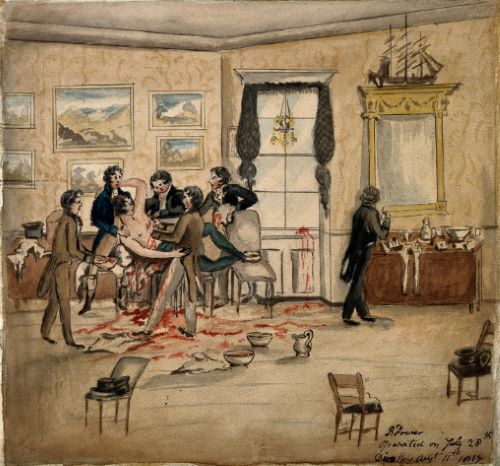
Hippocrates is credited with naming “cancer” as “karkinoma”.
Since the earliest medical records were kept, cancer as a disease has been described in the history of medicine. The earliest known descriptions of cancer appear in seven papyri, discovered and deciphered late in the 19th century. They provided the first direct knowledge of Egyptian medical practice. Two of them, known as the “Edwin Smith” and “George Ebers” papyri, contain descriptions of cancer written around 1600 B.C., and are believed to date from sources as early as 2500 B.C. The Smith papyrus describes surgery, while the Ebers’ papyrus outlines pharmacological, mechanical, and magical treatments.
Based on the information recorded on papyri and hieroglyphic inscriptions, ancient Egyptians were able to distinguish benign tumors from malignant tumors. They were also able to use different treatments, including surgery, and other various modes of medicine.
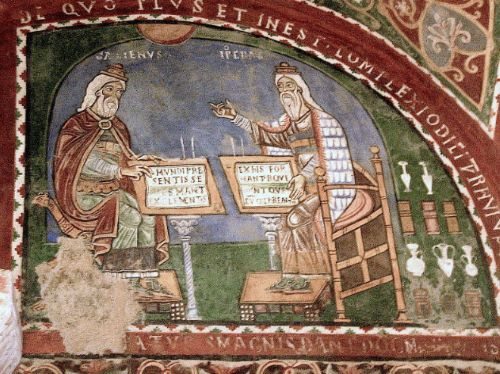
Following the decline of Egypt, the next chapters of medical and scientific history were written in Greece and Rome. The great doctors Hippocrates and Galen dominated medical thought for 1500 years. They lifted medicine out of the realms of magic, superstition, and religion. Hippocrates and Galen defined disease as a natural process, and based treatment on observation and experience. Cancers were identified, with warnings against treatment of the more severe forms. Hippocrates is credited with naming “cancer” as “karkinoma” (carcinoma) because a tumor looked like a “crab” (“karkinoma” is Greek for “crab”) in that there is a central body to a tumor and the tumor extension appeared as the legs of the “crab”.
After the fall of Rome, Constantinople became the intellectual storehouse of civilization. From there, in Arabic translations, classic Greek and Roman texts made their way back through Europe. The ancient teachings of Galen continued to inspire physicians in Constantinople, Cairo, Alexandria, Athens, and Antioch in a time when magic spells and myths dominated the West. Cancer continued to be explained as the result of an excess of black bile, curable only in its earliest stages.
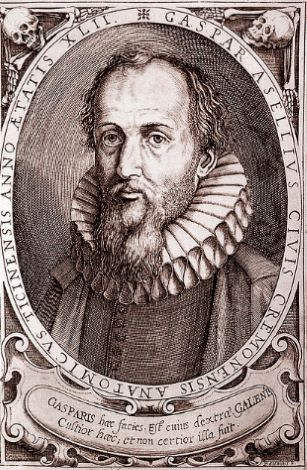
In the modern world, science and surgery advanced as physicians returned to direct observation of the human body. However, the theory that cancer was caused by an excess of black bile continued to prevail in the 16th century. Cancer was considered incurable, although a wide variety of pastes containing arsenic were formulated to treat its manifestations. In the 17th century, the old theory of disease based on bodily humors was discarded when Gaspare Aselli discovered the vessels of the lymphatic system and suggested abnormalities of lymph as the primary cause of cancer.
Rejecting the 17th-century theory about the cause of cancer was the French physician Claude Gendron. He concluded that cancer arises locally as a hard, growing mass, untreatable with drugs, and must be removed with all its “filaments.”
Two 18th-century French scientists, physician Jean Astruc and chemist Bernard Peyrilhe, conducted experiments to confirm or disprove hypotheses related to cancer. Their efforts, however absurd they seem in retrospect, established experimental oncology, the science of seeking better diagnosis, treatments and understanding of the causes of cancer. During this period, environmental cancers were reported, and hospitals specializing in cancer care were opened.
In the late 19th century, the development of better microscopes not only helped document and define disease-causing organisms, but also made possible the examination of cells and cellular activity. Study of cancer tissues and tumors revealed that cancercells were markedly different in appearance than normal cells of surrounding tissue or the cells from which they originated. Researchers began to focus on questions such as the origin of cells and the relationship of disease to the behavior of a cell. It was the invention of the microscope that revealed the cancer cell itself.
The early 20th century saw great strides made in understanding the structures, functions and chemistry of living organisms. Cancer research in cell culture, chemical carcinogens, diagnostic techniques and chemotherapy firmly established oncology as science. Researchers pursued different theories of the origin of cancer, subjecting their hypotheses to systematic experimentation. A viral cause of cancer in chickens was documented in 1911, and both chemical and physical carcinogens were conclusively identified. Chromosomal abnormalities were also investigated as possible causes of cancer.
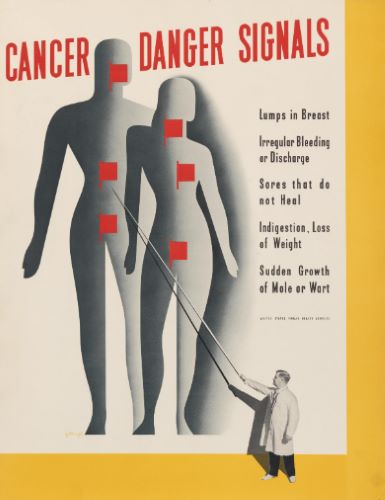
In 1913, a need to combat rising public fear and ignorance concerning cancer led to two significant events: the publication of the first known article on cancer’s warning signs in a popular woman’s magazine, and formation of a nationwide organization dedicated to public education on cancer. Cancer, as a disease, was brought into the light of day.
In 1937, the U.S. Congress made the conquest of cancer a national goal with a unanimous vote to pass the National Cancer Institute Act. This Act created the National Cancer Institute, which was expected to break new theoretical ground by conducting its own research, promoting research in other institutions and coordinating cancer-related projects and activities. In 1971, President Richard M. Nixon signed the National Cancer Act, launching a National Cancer Program administered by the National Cancer Institute. Key events in the United States’ national cancer policy legislative history, from 1937 to 1999 are available here.
Since its establishment, fundamental biomedical research supported by the National Cancer Institute has advanced the understanding of cancer. Using tools of molecular biology and molecular genetics, scientists are making great leaps in the discovery and mapping of links between chromosomes, the genes within, and cancer. In addition to traditional cancer therapies, potential solutions to the prevention and cure of cancer seem limited only by the imagination.
Originally published by the National Cancer Institute to the public domain.
About the Author