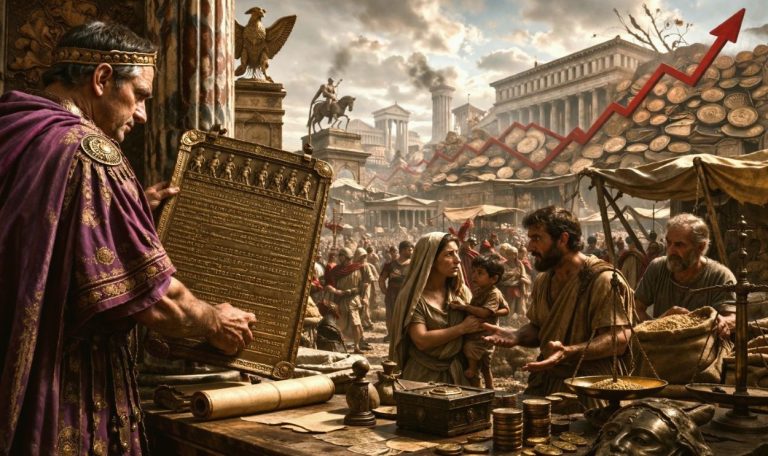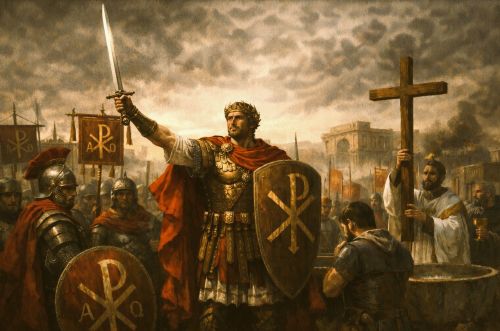
In the fourth century CE, Constantine’s embrace of Christianity reshaped the Roman army, entwining imperial loyalty with emerging Christian identity.

By Matthew A. McIntosh
Public Historian
Brewminate
Introduction: From Persecuted Sect to Imperial Symbol
In the early fourth century, Christianity stood in a paradoxical position within the Roman world. It was no longer an obscure sect confined to marginal communities, yet it remained politically vulnerable, its adherents having endured waves of persecution under emperors who regarded refusal to sacrifice as a civic threat. The Roman state did not persecute Christians primarily for their theology but for their perceived refusal to participate in rituals that signified loyalty to the empire and its gods. In this context, religious practice functioned as a public declaration of political belonging. When Constantine emerged victorious in 312 CE and subsequently aligned himself with the Christian God, the transformation that followed was not merely theological. It struck at the ritual vocabulary through which imperial authority had long been expressed.
The Roman army stood at the center of this transformation. As the decisive instrument of imperial succession and territorial control, it was also a deeply ritualized institution in which oaths, sacrifices, and standards carried sacral meaning. Soldiers swore allegiance not simply to a commander but to the emperor as divinely sanctioned ruler. Prior to Constantine, this sacral framework was religiously plural and pragmatically inclusive. Traditional cult, imperial worship, and localized practices coexisted without demanding doctrinal exclusivity. The army’s cohesion depended less on shared belief than on shared participation in ritual forms that affirmed loyalty. Any alteration to this ritual order would necessarily carry political consequences.
Constantine’s association of his military victory with the Christian God, most famously in the accounts of the vision preceding the Battle of the Milvian Bridge, introduced a new possibility into imperial culture: that a specific religious confession could serve as the sign of divine favor and of legitimate rule. Whether interpreted as sincere conversion, calculated strategy, or some combination of both, the emperor’s adoption of Christian symbols marked a departure from earlier patterns of divine patronage. Roman emperors had long claimed support from particular deities, invoking Jupiter, Mars, or Sol Invictus to frame their triumphs within an established pantheon of divine allies. Constantine’s invocation of a monotheistic God, however, carried a different structural implication. It did not simply elevate one deity among many but implicitly redefined the hierarchy of divine power itself. The chi-rho emblem placed upon military standards, if we accept the testimony of Eusebius, did more than commemorate a vision. It visually inscribed a theological claim into the apparatus of war. The battlefield became a stage upon which divine endorsement was publicly displayed, and victory itself was narrated as confirmation of the Christian God’s supremacy. In this context, imperial authority was not merely accompanied by Christian symbolism but increasingly articulated through it. The potential consequence was profound: if military success signaled divine favor, and divine favor was tied to a particular confession, then religious identity could begin to function as a marker of political legitimacy in ways previously unknown within the Roman imperial system.
Constantine did not instantly create a Christian army nor eradicate religious plurality within the ranks. Rather, he initiated a gradual reorientation of imperial symbolism in which Christian identity increasingly intersected with military legitimacy. The process moved from toleration to preference, from personal devotion to institutional expression, and from plural accommodation toward the pressures of orthodoxy. By tracing the integration of Christian rhetoric and symbols into the culture of the Roman army, we can observe an early and consequential case of military-religious entanglement. What began as the association of a victorious ruler with a once-persecuted faith became a structural shift in the grammar of imperial power.
The Roman Army before Constantine: Pluralism, Cult, and Cohesion

Before Constantine’s rise, the Roman army operated within a religious environment that was both structured and elastic. Religion in the military sphere was not primarily about interior belief but about ritual participation. Sacrifices, vows, and commemorative rites marked the calendar of military life, reinforcing solidarity and affirming the sacral character of imperial authority. The army was an institution in which religion functioned as a grammar of cohesion. To refuse participation in public sacrifice was not merely to dissent spiritually but to signal estrangement from the shared civic order that bound soldiers to one another and to the emperor.
The imperial cult stood at the center of this religious matrix. Soldiers swore the sacramentum, an oath that bound them personally to the emperor as the embodiment of Roman sovereignty. This oath was renewed annually and embedded within ceremonial practice. The emperor’s image and standards were treated with reverence that blurred the boundary between political loyalty and sacred devotion. Yet this system did not demand doctrinal exclusivity. Honoring the emperor did not require renouncing other deities. It required only public affirmation of the emperor’s divine favor and authority. Religion in this context was cumulative rather than competitive.
Alongside the imperial cult, traditional Roman deities retained prominence within military culture. Mars, Jupiter, and other gods associated with victory and protection appeared in inscriptions and dedications from legionary camps across the empire. Altars erected by officers and common soldiers alike testify to a world in which divine patronage was sought through conventional forms of piety. Dedications frequently invoked Jupiter Optimus Maximus as guarantor of triumph, while Mars symbolized martial virtue and disciplined aggression. In many instances, inscriptions combined appeals to multiple deities, reflecting a practical approach to divine assistance rather than exclusive allegiance. The army’s religious life mirrored the broader Roman assumption that the gods operated within a reciprocal framework: humans performed correct ritual, and the gods conferred protection and success. Theological coherence mattered less than ritual efficacy. What counted was that sacrifices were performed, vows fulfilled, and auspices respected. In this sense, Roman military religion reinforced continuity with ancestral custom and embedded the army within the sacred traditions of the civic past.
The army was also a conduit for religious diversity. Recruits were drawn from across the provinces, bringing with them local cults and devotional traditions that accompanied them into military service. Archaeological discoveries along the Rhine and Danube frontiers reveal shrines dedicated to Mithras, Isis, Dolichenus, and a range of regional deities whose worship spread through networks of soldiers and veterans. These cults often flourished within the semi-private spaces of barracks or nearby settlements, creating layered religious identities rather than replacing older forms. The Mithraic mysteries, in particular, attracted many soldiers, emphasizing loyalty, hierarchy, and communal initiation, themes that resonated with military structure. Rather than suppressing such plurality, the Roman state generally tolerated it, so long as these practices did not disrupt discipline or challenge imperial authority. The result was a religious ecosystem that was remarkably adaptive. Provincial traditions could be incorporated, syncretized, or coexisted with official rites. This pluralism was pragmatic rather than ideological. The empire governed through managed inclusion, and the army reflected that administrative strategy in religious form, allowing diversity within a shared ceremonial framework that affirmed Rome’s supremacy.
Cohesion depended on shared ritual moments that transcended local variation. Festivals honoring the emperor, ceremonies surrounding standards, and collective sacrifices forged a sense of common belonging. Standards themselves were treated as sacred objects, guarded with reverence and defended at all costs. To lose a standard was not merely a tactical failure but a symbolic catastrophe. In this environment, religious symbolism reinforced hierarchy and discipline. Participation in common rites reaffirmed the chain of command and the unity of purpose that made Roman military effectiveness possible.
Christianity posed a distinctive challenge even before Constantine. Its exclusivist tendencies, particularly the refusal to sacrifice to the emperor or traditional gods, clashed with the army’s ritual expectations. While evidence suggests that Christians did serve in the Roman military prior to the fourth century, their presence remained uneasy within a system that equated public sacrifice with loyalty. The issue was less about theological disagreement and more about ritual conformity. The pre-Constantinian army exemplified a plural yet structured religious order, one in which cohesion depended on shared ceremonial affirmation. It was into this environment that Constantine introduced a new symbolic alignment, one that would gradually shift the balance from cumulative pluralism toward confessional association.
The Conversion of Constantine: Vision, Victory, and Political Theology

Constantine’s conversion has long stood at the center of debates about the Christianization of the Roman Empire, not least because it occurred in explicitly military context. In 312 CE, as Constantine advanced toward Rome to confront Maxentius, the struggle was not merely political but existential. Imperial succession in the tetrarchic system had fractured into competing claims, and the army remained the ultimate arbiter of legitimacy. Within this volatile environment, the narrative of divine intervention emerged as a decisive element in Constantine’s self-presentation. Victory would determine rule, and rule required more than force. It required cosmic endorsement.
The most famous account of this endorsement comes from Eusebius, who recounts Constantine’s vision of a luminous cross in the sky accompanied by the words “In this sign, conquer.” Lactantius offers a variant tradition in which Constantine receives instruction in a dream to mark the shields of his soldiers with a heavenly symbol. The differences between these accounts have invited scrutiny, and modern scholarship has treated them with appropriate caution. Whether Constantine experienced a literal vision or later shaped a theological interpretation of victory, the crucial point is that he publicly associated his triumph with the Christian God. The narrative fused battlefield success with divine favor, collapsing the distance between military achievement and theological claim.
It is important to recognize that Roman emperors had long framed victories as proof of divine support. Triumphs were paraded through Rome under the auspices of Jupiter, and inscriptions routinely credited success to traditional gods who were believed to safeguard the state. The innovation in Constantine’s case lay not in attributing success to a deity but in linking it to a monotheistic confession whose adherents had recently been marginalized and, at times, persecuted. Earlier emperors invoked Jupiter, Mars, or Sol Invictus without excluding other divine patrons, operating within a religious system that tolerated overlapping loyalties. Constantine’s invocation of the Christian God, however, subtly altered the logic of divine sponsorship. A monotheistic framework implied singular supremacy rather than competitive plurality. If one God granted victory, that God stood above all rivals, not merely as first among equals but as sovereign over the cosmos. The theological implication carried political weight. Divine exclusivity could translate into ideological consolidation, and ideological consolidation could reinforce imperial centralization. By aligning his rule with a God understood to be universal and supreme, Constantine gestured toward a new model of authority in which theological unity underwrote political unity. In this way, the language of victory began to intersect with the language of orthodoxy.
The introduction of the labarum and the chi-rho symbol into military display gave material form to this theological claim. According to Eusebius, Constantine ordered the symbol fashioned into a standard borne before his troops. Even if one treats Eusebius’ account as embellished, numismatic and epigraphic evidence confirms the increasing appearance of Christian imagery in imperial representation during Constantine’s reign. The army, as the most visible arm of imperial authority, became a vehicle through which this symbolism circulated. Standards were not decorative objects. They embodied identity, memory, and honor. To inscribe a new symbol upon them was to alter the semiotics of loyalty.
Modern historians have resisted reducing Constantine’s conversion either to cynical calculation or to pure spiritual awakening. H. A. Drake emphasizes Constantine’s political pragmatism and his efforts to maintain civic peace even as he favored Christianity. Timothy Barnes underscores the consistency of Constantine’s Christian commitments once articulated, arguing that his policies reflect more than opportunism. Raymond Van Dam situates the emperor within a broader culture in which visions, divine signs, and sacred patronage were integral to political life. This scholarship reveals a layered reality. Constantine operated within inherited Roman traditions of divine legitimation, yet he redirected those traditions toward a new theological center. His conversion cannot be disentangled from the competitive pressures of civil war, but neither can it be dismissed as mere expedience. The vision narrative functioned as a rhetorical bridge, linking personal experience, public victory, and imperial destiny. It allowed Constantine to reinterpret his ascent not simply as military success but as providential mandate, a shift that would resonate within the institutions he governed.
The consequences of this association extended beyond Constantine’s personal piety. By narrating his ascent in explicitly Christian terms, he invited soldiers, administrators, and subjects to reinterpret the foundations of his rule through a new religious lens. The army remained religiously mixed for decades. Yet the axis of representation had shifted. Divine favor was no longer articulated solely within the plural pantheon of Roman tradition. It was increasingly linked to the Christian God whose emblem now marched at the head of imperial forces. In this fusion of vision and victory, one sees the beginnings of a political theology that would reshape the empire’s institutional life.
Legal Toleration of Imperial Preference: The Gradual Shift

The agreement commonly referred to as the Edict of Milan in 313 CE did not establish Christianity as the official religion of the empire. Rather, it proclaimed religious toleration and ordered the restoration of confiscated Christian property seized during earlier persecutions. Issued in the name of Constantine and Licinius, the decree framed religious liberty as a matter of public utility, asserting that allowing individuals to worship as they chose would secure divine favor for the state. Its language did not privilege Christianity explicitly but extended protection to “Christians and all others,” reflecting a continuation of Roman administrative pragmatism. Yet the historical weight of the decree lay less in its universal phrasing than in its immediate effect. Christianity, once criminalized in certain contexts, was now not merely permitted but restored and legally secured. Property rights, clerical organization, and communal worship were stabilized under imperial authority. In this shift from vulnerability to recognition, Christianity entered the formal legal architecture of the empire.
Legal toleration quickly interacted with imperial patronage. Constantine did not merely refrain from persecuting Christians. He funded church construction, granted privileges to clergy, and corresponded with bishops as authoritative representatives of a translocal religious network. These actions did not abolish pagan practice, but they introduced asymmetry into the religious landscape. When the emperor endowed Christian institutions with financial and political support, he signaled more than personal sympathy. He embedded Christianity within the administrative and symbolic framework of imperial governance.
This gradual shift from neutrality to preference unfolded without immediate coercion. Constantine continued to employ traditional religious language in certain contexts and did not ban pagan sacrifice outright. Coins from the early years of his reign still featured imagery associated with Sol Invictus, reflecting continuity as well as change. Christian symbolism became more prominent in imperial self-representation, appearing in inscriptions, court ceremony, and monumental architecture. The balance of emphasis altered in subtle but cumulative ways. Patronage of bishops, legal exemptions for clergy, and imperial sponsorship of basilicas reshaped the public visibility of Christianity. These measures did not criminalize paganism, but they repositioned Christianity within the hierarchy of imperial favor. What had once been one cult among many increasingly occupied privileged space in public ritual and political rhetoric. Preference did not require prohibition. It operated through accumulation, through repeated gestures that gradually reoriented the symbolic center of the state.
The emperor’s involvement in ecclesiastical disputes further intensified this alignment. Constantine convened the Council of Nicaea in 325 CE, intervening not as a distant observer but as a ruler invested in doctrinal unity. Religious disagreement threatened social cohesion, and social cohesion underwrote imperial security. By presiding over theological deliberation and enforcing conciliar decisions, Constantine extended imperial authority into the realm of belief. The boundaries between civic order and doctrinal conformity grew more porous. Orthodoxy, while still contested, began to acquire political resonance.
For the army, these developments carried subtle but significant implications. As imperial favor increasingly aligned with Christianity, loyalty to the emperor became intertwined with symbols and narratives drawn from that faith. Soldiers served a ruler who publicly identified with the Christian God and who patronized Christian institutions across the empire. The transformation was neither instantaneous nor uniform, but it was directional. Legal toleration provided the foundation. Imperial preference supplied momentum. Together they initiated a reconfiguration of religious identity within the structures of state power, setting the stage for deeper integration between military service and Christian symbolism.
The Army as a Vehicle of Religious Identity

As imperial preference for Christianity deepened, the Roman army became one of the primary institutions through which this preference was displayed and normalized. Military culture had always relied on visible symbols of authority. Standards, insignia, and ceremonial gestures were not peripheral ornaments but constitutive elements of identity. When Christian emblems began to appear within this symbolic field, they did not merely decorate the army. They reoriented the visual language through which loyalty and legitimacy were communicated. The labarum, associated with Constantine’s victory, functioned as both military standard and theological statement. Carried into battle and positioned in public ceremony, it fused imperial power with Christian signification.
The presence of Christian symbols within military display did not automatically transform every soldier into a Christian believer. Yet symbols operate institutionally even when personal conviction varies. A standard borne at the head of troops communicates authority irrespective of individual assent. The repetition of Christian imagery in martial contexts normalized the association between the emperor’s success and the Christian God’s favor. The army became a site in which religious identity intersected with professional obligation. To serve under a Christian-emblemed standard was to participate, however passively, in a redefined narrative of divine sponsorship.
Oath-taking further illustrates this gradual entanglement. The sacramentum had long bound soldiers to the emperor through a ritual act that carried sacred weight, reinforced by ceremony and communal affirmation. Under Constantine and his successors, the rhetorical framing of imperial authority increasingly invoked Christian language in public addresses and official correspondence. Although traditional oath formulas were not immediately replaced, the conceptual environment in which the oath functioned began to shift. Soldiers swore allegiance to a ruler who presented himself as chosen and sustained by the Christian God. This altered the symbolic horizon of the pledge. The sacred dimension of loyalty was no longer anchored exclusively in the imperial cult or traditional divine patronage. It now coexisted with, and was gradually overshadowed by, Christian theological claims. The oath remained formally political, but its meaning was refracted through a new religious narrative. In this context, allegiance could be interpreted not merely as fidelity to an individual emperor but as participation in a providential order that linked throne and altar. Such reinterpretation did not require explicit doctrinal assent from every soldier. It required only the steady alignment of imperial legitimacy with Christian symbolism.
This development created tension within a still religiously diverse army. Pagan soldiers, adherents of mystery cults, and Christians served side by side during the transitional decades of the fourth century. The empire did not purge non-Christians from the ranks, nor did Constantine require formal conversion as a condition of service. Yet asymmetry mattered. When imperial rhetoric and symbolism privileged one confession, others occupied a relatively diminished position. The shift was not yet coercive, but it was directional. Preference could generate pressure, and pressure could reshape expectations about conformity and advancement.
The army functioned as a conduit for the broader reconfiguration of imperial identity. Military service tied individuals from across the provinces to a shared center of authority, creating a network of loyalty that extended from frontier outposts to the imperial court. As that center increasingly articulated itself through Christian symbolism, the army transmitted this articulation outward in visible and performative ways. Standards marched bearing new emblems, victories were commemorated with references to divine favor framed in Christian terms, and imperial ceremonies staged before assembled troops reinforced the association between rule and revelation. The effect was institutional rather than instantaneous. No single decree transformed the army’s religious character. Instead, repetition and visibility cultivated expectation. Christian symbolism became embedded within the rhythms of military life, shaping how authority was imagined and how allegiance was expressed. The fusion of faith and force did not eradicate pluralism overnight, but it redefined the conceptual foundation of imperial power. The army became not only the defender of empire but also a living medium through which its emerging religious identity was enacted and displayed.
Orthodoxy, Unity, and the Problem of Plural Empire

As Constantine’s reign progressed, the question confronting the empire was no longer simply whether Christianity would be tolerated or favored. It was whether Christianity itself would be internally unified. The Roman state had long managed diversity through administrative pragmatism, permitting multiple cults so long as they did not disrupt public order. Christianity, however, introduced a distinctive challenge. It was not merely a religion but a community structured around claims of doctrinal truth. Disagreement over belief threatened not only ecclesiastical harmony but, increasingly, imperial cohesion.
The controversy surrounding Arius in the early fourth century exposed this tension with particular clarity. The dispute over the relationship between the Father and the Son was not a marginal theological quarrel confined to academic speculation. It fractured episcopal networks across the eastern Mediterranean and drew intense popular engagement in cities such as Alexandria. Sermons, letters, and theological treatises circulated widely, transforming doctrinal disagreement into public controversy. Constantine’s decision to convene the Council of Nicaea in 325 CE reflected his recognition that religious division carried political risk at a moment when imperial unity remained fragile. A fractured church could mirror and magnify the civil conflicts that had recently destabilized the state. By summoning bishops from across the empire to deliberate in a single assembly and by endorsing the council’s conclusions, Constantine positioned himself not merely as patron of Christianity but as arbiter of its unity. The council’s creed sought to articulate a common confession capable of binding disparate communities under a shared theological framework. In doing so, it marked an unprecedented collaboration between imperial authority and doctrinal formulation.
Imperial involvement in doctrinal adjudication represented a significant development. Roman emperors had traditionally overseen public cult and ritual, but they had not previously intervened to define theological orthodoxy within a single religious community. Constantine’s participation in conciliar politics extended the reach of imperial authority into realms of belief. He did not present himself as a theologian, yet his enforcement of decisions granted them coercive weight. Exile of dissenting bishops and the circulation of official creeds signaled that orthodoxy was not merely an ecclesiastical preference. It had become a matter of imperial concern.
This development intensified the structural tension between a diverse empire and emerging orthodoxy. The Roman world encompassed diverse peoples, languages, and religious traditions. Even within Christianity, regional practices and theological emphases varied. The push toward doctrinal uniformity risked narrowing the space for such variation. Unity, once achieved through ritual participation in shared civic forms, was increasingly sought through agreement in belief. The logic of confessional consolidation diverged from the older logic of cumulative pluralism. As Christianity moved toward defining its boundaries more sharply, the empire faced the challenge of governing populations whose religious commitments did not align with official formulations.
The army, as a cross-section of imperial society, reflected these pressures in subtle but consequential ways. Soldiers drawn from different provinces entered service under an emperor who publicly endorsed conciliar decisions and associated political stability with theological consensus. While ordinary troops were unlikely to debate the precise meaning of homoousios, they nonetheless operated within a system in which orthodoxy carried imperial endorsement. Advancement within administrative and command structures increasingly intersected with networks shaped by ecclesiastical alignment. Moreover, as imperial ceremonies incorporated Christian liturgical elements, soldiers participated in public rituals that presupposed a defined confession. The expectation that imperial loyalty harmonized with doctrinal alignment did not manifest as immediate coercion, but it altered the cultural atmosphere of service. The perceived connection between right belief and rightful rule filtered into military life. The army’s longstanding role as guardian of unity acquired an implicit theological dimension, reinforcing the perception that safeguarding the empire also meant upholding the religious framework that legitimized it.
In confronting the problem of plural empire, Constantine and his successors pursued a model of unity that fused religious coherence with political stability. This strategy did not eliminate diversity immediately, nor did it extinguish dissent. Instead, it established a trajectory. Orthodoxy became intertwined with imperial legitimacy, and imperial legitimacy reinforced orthodoxy. The Roman Empire had long relied on shared ritual forms to bind its subjects. In the fourth century, it increasingly relied on shared confession to secure cohesion. The integration of doctrinal unity into the architecture of rule marked a decisive stage in the entanglement of faith and state power.
Military-Religious Entanglement as Structural Precedent

By the later years of Constantine’s reign, the integration of Christian symbolism into imperial and military culture had moved beyond isolated gestures or battlefield narratives. It had begun to assume structural form within the institutions that sustained imperial authority. The Roman army, long accustomed to embodying the sacred aura of the emperor through ritual, oath, and standard, now carried within its visual and ceremonial repertoire the emblems of a specific religious confession. Christian insignia did not replace all traditional forms at once, nor did pagan practice disappear from the ranks. Yet the symbolic center of gravity had shifted. The presence of the labarum, the invocation of the Christian God in imperial rhetoric, and the emperor’s visible patronage of the church altered the interpretive framework through which military authority was understood. What had once been a religiously cumulative system now increasingly revolved around a preferred theological narrative. Christian symbolism no longer appeared as an anomaly within military life. It functioned as an authorized and increasingly normative expression of imperial identity, shaping how power was displayed and how victory was explained.
This development established a precedent whose significance extended beyond Constantine’s lifetime. When a ruler aligns military success with a particular religious framework, that alignment acquires inertia. Subsequent emperors inherited not only territory and administrative machinery but also a symbolic vocabulary that had already fused faith and force. The army’s role as guarantor of legitimacy meant that its religious markings mattered. They communicated to subjects and rivals alike the theological orientation of imperial authority. In this sense, Constantine’s policies did not merely reflect personal conviction. They altered the grammar through which power was narrated.
Structural entanglement differs from episodic patronage. Earlier emperors had favored certain cults or emphasized specific divine associations without reconfiguring the broader religious ecosystem of the state. Constantine’s alignment with Christianity, however, coincided with the faith’s increasing doctrinal consolidation and institutional expansion. As bishops organized transregional networks and councils articulated binding creeds, imperial endorsement amplified these developments. The army, positioned at the intersection of local diversity and centralized authority, became a conduit through which this consolidation was displayed. Religious symbolism embedded in military practice signaled that imperial unity and Christian identity were moving toward convergence.
This convergence also shaped expectations about loyalty. In a religiously diverse system, allegiance to the emperor required participation in civic ritual but not adherence to a singular creed. As Christianity gained privileged status, the boundary between civic conformity and confessional alignment grew thinner. Advancement within imperial structures could increasingly intersect with shared religious affiliation, even if no formal requirement existed. What began as symbolic preference could crystallize into normative expectation. The precedent lay not in immediate coercion but in the redefinition of what loyalty looked like when expressed through public forms.
The long-term consequences became more visible under Constantine’s successors, particularly as legislation and imperial rhetoric moved further toward Christian exclusivity. While Constantine himself maintained a degree of measured pragmatism, the trajectory he initiated made it easier for later rulers to legislate in explicitly Christian terms. Once the army and court were habituated to Christian symbolism, resistance to deeper integration diminished. Institutional memory matters. Practices repeated across years acquire the status of tradition, and traditions acquire authority. By embedding Christian imagery within the army’s ceremonial life, Constantine contributed to the normalization of religious alignment within state structures. This normalization did not automatically eliminate dissent or diversity, but it narrowed the range of what appeared politically central. The more often imperial victories were narrated in Christian language, the more plausible it became to imagine imperial power as inherently Christian. In this sense, the precedent established was not merely symbolic but developmental, shaping the trajectory of imperial self-understanding.
The Christianization of military culture should be understood not as a sudden revolution but as a structural recalibration. The Roman army did not cease to be Roman. It did, however, begin to operate within a transformed symbolic order. Faith became increasingly legible as a marker of imperial legitimacy. The entanglement of religion and military authority established in the fourth century would echo through subsequent centuries of imperial governance. Constantine’s legacy resides not only in the legalization of Christianity but in the durable precedent that political power and religious confession could be mutually reinforcing within the machinery of the state.
Conclusion: Standards, Symbols, and the Reorientation of Power
The transformation initiated under Constantine did not consist in the sudden replacement of one religious order with another. Rather, it involved a gradual restructuring of the institutions that undergirded imperial authority. The Roman army, long the bearer of the emperor’s sacral legitimacy, became the most visible stage upon which this shift unfolded. Christian emblems carried into battle and displayed in ceremony altered the interpretive frame through which power was understood. Standards that once signified the protective favor of a plural pantheon increasingly signaled alignment with a singular God whose patronage was invoked as guarantor of victory. In this transformation of imperial representation, one observes not merely personal devotion but institutional change.
The movement from toleration to preference, and from preference to structural entanglement, reshaped the relationship between faith and force. Constantine did not mandate universal conversion within the ranks, nor did he abolish religious plurality in a single stroke. Yet his policies embedded Christian language and imagery within the core mechanisms of rule. The army’s oaths, standards, and public rituals absorbed these elements, transmitting them across the empire’s vast territories. Military service became one of the primary channels through which the evolving religious identity of the state was enacted. What had once been a cumulative religious system increasingly centered on a preferred confession that framed imperial legitimacy.
This development also illuminated a deeper tension inherent in governing a plural empire through an emerging orthodoxy. Roman rule had historically relied on ritual participation rather than doctrinal conformity to secure unity. The civic cult did not demand interior assent to a creed, only outward participation in ceremonies that affirmed loyalty. Constantine’s alignment with Christianity introduced a different logic, one in which belief carried growing political resonance and theological precision mattered in new ways. The effort to harmonize doctrinal unity with imperial stability required novel forms of intervention, from the convening of councils to the enforcement of conciliar decisions. As Christian orthodoxy gained institutional backing, the boundaries between civic loyalty and religious alignment grew more permeable. Those who dissented from officially endorsed formulations increasingly found themselves not merely theologically marginal but politically suspect. The army, positioned at the heart of imperial cohesion, reflected and reinforced this evolution. Its visible adoption of Christian symbolism signaled that the defense of the empire was now intertwined with the defense of a particular religious identity, complicating the older equilibrium between diversity and unity that had characterized Roman governance.
The Christianization of the Roman army under Constantine stands as an early and consequential case of military-religious entanglement. It established a precedent in which religious symbolism could function as a marker of loyalty and a vehicle of state power. The empire did not cease to be diverse, nor did dissent vanish. Yet the language of authority had been rewritten. Standards bore new signs, victories were narrated through new theological lenses, and imperial legitimacy increasingly spoke in Christian terms. Through these shifts, the architecture of power itself was reoriented, setting patterns that would shape the trajectory of late antiquity and beyond.
Bibliography
- Ando, Clifford. Imperial Ideology and Provincial Loyalty in the Roman Empire. Berkeley: University of California Press, 2000.
- Ayres, Lewis. Nicaea and Its Legacy: An Approach to Fourth-Century Trinitarian Theology. Oxford: Oxford University Press, 2004.
- Barnes, Timothy D. Constantine and Eusebius. Cambridge, MA: Harvard University Press, 1981.
- Beard, Mary, John North, and Simon Price. Religions of Rome, 2 Vols. Cambridge: Cambridge University Press, 1998.
- Drake, H. A. Constantine and the Bishops: The Politics of Intolerance. Baltimore: Johns Hopkins University Press, 2000.
- Eusebius of Caesarea. Life of Constantine. Translated by Averil Cameron and Stuart G. Hall. Oxford: Clarendon Press, 1999.
- Goldsworthy, Adrian. The Complete Roman Army. London: Thames and Hudson, 2003.
- Jones, A. H. M. The Later Roman Empire, 284–602: A Social, Economic and Administrative Survey. Oxford: Blackwell, 1964.
- Lactantius. Of the Manner in Which the Persecutors Died. Translated by J. L. Creed. Oxford: Clarendon Press, 1984.
- Lenski, Noel, ed. The Cambridge Companion to the Age of Constantine. Cambridge: Cambridge University Press, 2005.
- MacMullen, Ramsay. Christianizing the Roman Empire (A.D. 100–400). New Haven: Yale University Press, 1984.
- —-. Paganism in the Roman Empire. New Haven: Yale University Press, 1981.
- Odahl, Charles Matson. Constantine and the Christian Empire. London: Routledge, 2004.
- —-. “God and Constantine: Divine Sanction for Imperial Rule in the First Christian Emperor’s Early Letters and Art.” The Catholic Historical Review 81:3 (1995), 327-352.
- Rüpke, Jörg. Religion of the Romans. Cambridge: Polity Press, 2004.
- Sengers, Erik and Ruben van Wingerden. “Between Sinner and Superhero: Military Service and Christian Life from Nicaea till Present Day.” International Journal of Philosophy and Theology 86:2-4 (2025), 268-286.
- Serrano del Pozo, Joaquin. “The Constantinian Labarum and the Christianization of Roman Military Standards.” Journal for Late Antique Religion and Culture 15 (2021), 37-64.
- Van Dam, Raymond. The Roman Revolution of Constantine. Cambridge: Cambridge University Press, 2007.
Originally published by Brewminate, 02.27.2026, under the terms of a Creative Commons Attribution-NonCommercial-NoDerivatives 4.0 International license.
About the Author