
The Constitution endures not only because it is written, but because generations of judges have debated how it should be read.

By Matthew A. McIntosh
Public Historian
Brewminate
Introduction: The Problem of Constitutional Meaning
The United States Constitution is a written charter of government, yet it does not contain instructions for how it is to be interpreted. From the early republic to the present, disagreement has centered not only on what the Constitution requires, but on how judges should determine its meaning. The text is fixed in words adopted in 1787 and amended thereafter, but its application to successive generations has generated competing theories of interpretation. The problem of constitutional meaning concerns method as much as outcome. Before courts decide whether a statute is valid or a right protected, they must decide how to read the document itself.
The framers anticipated that the judiciary would exercise judgment in interpreting law. In Federalist No. 78, Alexander Hamilton described courts as the “least dangerous” branch, entrusted with the duty to declare what the law is. Yet Hamilton did not prescribe a comprehensive interpretive methodology. The Constitution’s supremacy clause establishes the document as binding law, but it leaves unanswered questions about whether interpretation should privilege text, intent, historical practice, moral principle, or precedent. Early cases such as McCulloch v. Maryland illustrate that interpretive reasoning from structure and purpose emerged almost immediately, even as fidelity to text remained central. The absence of an explicit methodological directive has ensured that constitutional interpretation would evolve through judicial practice rather than through a single authoritative rule.
Distinct interpretive philosophies developed. Some jurists have emphasized the ordinary meaning of the text at the time of adoption, seeking constraint in linguistic fidelity. Others have argued that constitutional meaning must remain responsive to societal development and moral progress. Still others have placed decisive weight on precedent, institutional structure, or practical consequences. These approaches reflect different understandings of constitutional authority: whether it derives primarily from historical enactment, democratic legitimacy, moral principle, institutional coherence, or judicial craft. The interpretive spectrum is not merely technical; it reflects deeper theories of constitutional governance.
The durability of constitutional government depends not only on the existence of a written document, but on shared interpretive discipline. Disagreement over method is inevitable in a system committed to reasoned adjudication. Yet when interpretive debate collapses into unconstrained preference, constitutional stability is threatened. The American constitutional tradition has endured in part because judges and scholars have treated interpretation as a disciplined enterprise, grounded in text, history, structure, and precedent even when they weigh those elements differently. The problem of constitutional meaning is foundational. How judges read the Constitution shapes how the Constitution governs.
Textualism: The Primacy of the Words
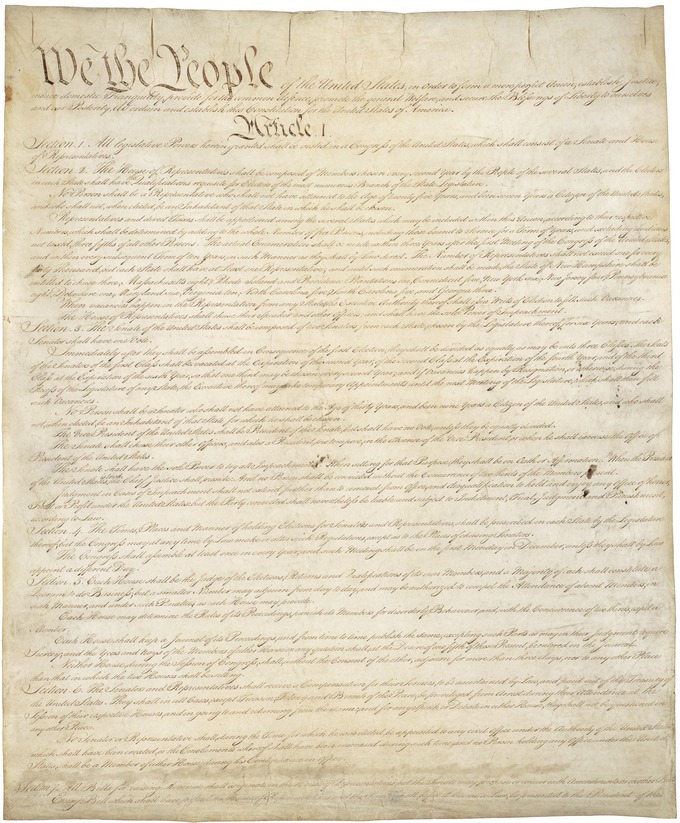
Textualism begins from the premise that the Constitution means what its words communicate. The text, as enacted and ratified, constitutes law. Judges must interpret constitutional provisions according to their ordinary meaning rather than according to speculative intent or evolving moral sensibilities. Textualism emphasizes linguistic fidelity. It treats constitutional language as binding legal instruction, not as a set of aspirational themes to be elaborated at judicial discretion. The approach seeks constraint in the semantic content of the document itself. By locating authority in the enacted words, textualism reinforces the principle of popular sovereignty: the Constitution binds because it was ratified through prescribed procedures, and its authority resides in the language that received public assent. To depart from that language, textualists argue, is to substitute judicial preference for constitutional command. The method frames interpretation as an exercise in disciplined reading rather than creative elaboration.
Modern textualism, most prominently associated with Justice Antonin Scalia, distinguishes sharply between textual meaning and legislative intent. The subjective intentions of individual framers or ratifiers are considered less authoritative than the public meaning of the words adopted. Law, in this view, is what was enacted, not what particular individuals privately hoped it would accomplish. Textualists focus on dictionaries, contemporaneous usage, and grammatical structure to determine meaning at the time of adoption. The Constitution is treated as a legal instrument whose authority flows from ratified language rather than from unwritten aspirations.
Textualism does not deny ambiguity, but it seeks to resolve uncertainty through disciplined attention to language. Structural context may inform interpretation, yet it must remain anchored to the words themselves. For textualists, constitutional provisions such as the Necessary and Proper Clause or the Commerce Clause must be interpreted according to their linguistic scope rather than through broad appeals to policy. This approach often produces arguments about semantic range, syntactic structure, and historical usage. The method aspires to judicial restraint by limiting interpretive authority to what the enacted words reasonably bear.
Critics contend that textual meaning is rarely self-evident. Language is inherently open textured, and constitutional provisions often employ general terms such as “liberty,” “due process,” or “equal protection.” Determining their “ordinary meaning” may require historical inquiry that itself introduces interpretive judgment. Moreover, critics argue that exclusive reliance on text may obscure the broader purposes of constitutional design. Even so, textualism maintains that the alternative, allowing judges to depart from textual boundaries, risks transforming interpretation into policymaking.
Textualism represents an effort to root constitutional interpretation in linguistic discipline. By privileging enacted words over inferred intentions or contemporary preferences, it seeks to preserve the Constitution as law rather than as an adaptable manifesto. Whether one views textualism as constraining or incomplete, its central claim remains clear: the primacy of the words is the starting point of constitutional meaning.
Originalism: Intent and Public Meaning
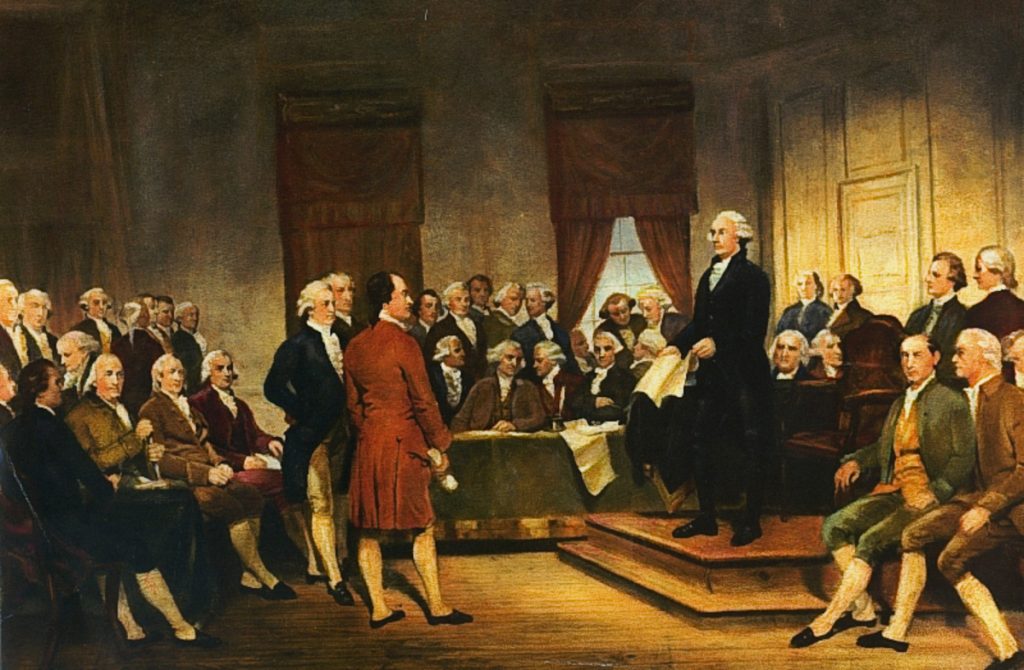
Originalism holds that constitutional meaning is fixed at the time of adoption and should be interpreted according to that original understanding. Unlike textualism, which concentrates primarily on semantic meaning, originalism situates interpretation within historical context. The approach maintains that the Constitution derives its authority from ratification in a specific historical moment. To remain faithful to that act of popular sovereignty, judges must interpret provisions according to their original meaning rather than contemporary preference. Originalism presents itself as a theory of democratic legitimacy as well as interpretive constraint.
Early forms of originalism emphasized the intent of the framers. Judges and scholars sought to reconstruct the purposes and expectations of those who drafted the Constitution. This “intent-based” originalism encountered criticism for its methodological difficulty. The framers were not a single mind, and ratification depended upon broader public assent. Modern originalism shifted toward the concept of original public meaning. Rather than probing subjective motives, contemporary originalists ask how a reasonable reader at the time of ratification would have understood the constitutional text. This shift attempts to anchor interpretation in publicly accessible historical evidence.
Original public meaning originalism emphasizes contemporaneous usage, legal conventions, and political discourse from the founding era. Historical dictionaries, ratification debates, and early judicial decisions become sources of interpretive authority. The method does not require adherence to the specific expectations of the framers regarding future applications, but it does require fidelity to the semantic content the ratifying public would have recognized. In this view, constitutional provisions establish fixed meanings that may be applied to new circumstances without altering their core content.
Proponents argue that originalism constrains judicial discretion by limiting interpretive freedom. Because meaning is anchored in historical context, judges cannot legitimately update constitutional provisions to reflect modern preferences without formal amendment. Critics respond that historical evidence is often indeterminate and that the application of eighteenth-century understandings to contemporary conditions may require interpretive leaps. Moreover, debates persist over how to reconcile original meaning with precedent when the two appear in tension. The method’s promise of constraint depends on the clarity of historical sources and the discipline of judicial adherence.
Originalism represents an effort to align constitutional interpretation with the founding act of ratification. By grounding meaning in original public understanding, it seeks to preserve continuity between past and present. Whether understood as intent or public meaning, originalism emphasizes historical fidelity as a safeguard against interpretive drift. Its influence in modern constitutional jurisprudence reflects an enduring conviction that a written constitution binds because its meaning, once fixed, cannot be altered without democratic consent.
Living Constitutionalism: Evolution and Adaptation
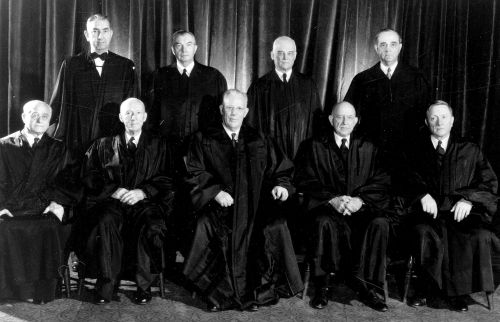
Living Constitutionalism approaches the Constitution as a document whose meaning unfolds gradually. While the text remains fixed, its application is understood to adapt to changing social, political, and moral conditions. Proponents argue that certain constitutional provisions are framed in broad principles rather than narrow rules, inviting interpretation that responds to contemporary realities. Clauses guaranteeing “equal protection,” “due process,” or “cruel and unusual punishments” are viewed not as static formulas but as commitments whose content develops as society’s understanding deepens. The Constitution endures, in this view, because it is capable of principled evolution.
This interpretive approach often emphasizes the Constitution’s aspirational character. Rather than anchoring meaning exclusively in eighteenth or nineteenth century understandings, living constitutionalists argue that constitutional language establishes enduring values. Judges must interpret those values in light of present circumstances. Justice William J. Brennan famously defended this perspective, contending that fidelity to the Constitution requires sensitivity to contemporary standards of human dignity. The authority of the document lies not merely in historical enactment but in its continuing role as a charter for a modern republic.
Living Constitutionalism has played a significant role in the development of civil rights jurisprudence. Decisions addressing racial equality, privacy, and gender discrimination frequently reflect interpretive reasoning that accounts for social transformation. In cases such as Brown v. Board of Education, the Court interpreted the Equal Protection Clause in light of twentieth century understandings of segregation’s harms rather than exclusively through nineteenth century expectations. Similarly, privacy jurisprudence and equal protection cases concerning gender have relied on assessments of evolving social norms and empirical realities. In such instances, the Court treated constitutional principles as adaptable to conditions unforeseen by the framers, reasoning that broad guarantees were designed to transcend specific historical applications. Advocates argue that without such flexibility, the Constitution would risk becoming obsolete, unable to address technological change, demographic shifts, or emerging conceptions of liberty and equality. The method presents itself as preserving constitutional relevance rather than undermining textual authority.
Critics contend that Living Constitutionalism grants excessive discretion to judges. If constitutional meaning evolves with societal change, determining the direction and content of that evolution may depend heavily on judicial judgment. Opponents argue that this approach risks substituting judicial preference for democratic amendment. They maintain that adaptation should occur through the Article V amendment process rather than through interpretive innovation. The central concern is whether dynamic interpretation blurs the distinction between constitutional adjudication and policymaking.
Living Constitutionalism frames constitutional interpretation as an ongoing dialogue between text and society. It emphasizes continuity through adaptation rather than fixity through historical anchoring. Whether viewed as necessary flexibility or as interpretive overreach, the approach reflects a conviction that a durable constitution must respond to changing conditions. Its influence demonstrates that constitutional meaning, for many jurists and scholars, cannot be confined solely to the semantic horizons of its adoption.
Stare Decisis: The Authority of Precedent
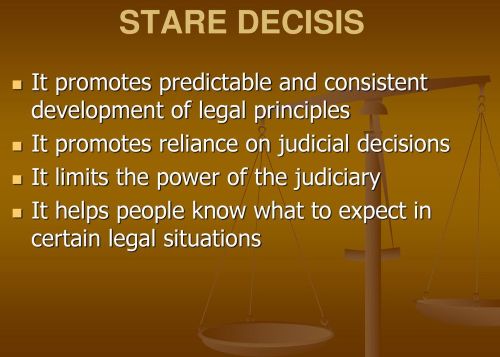
Stare decisis, the doctrine of adhering to precedent, occupies a distinctive position within constitutional interpretation. Unlike textualism or originalism, it does not begin with a theory of meaning grounded in text or history. Instead, it emphasizes institutional continuity. The principle holds that courts should generally follow prior decisions to promote stability, predictability, and fairness. In constitutional law, where amendments are rare and judicial rulings often define operative meaning, precedent assumes particular significance. Through stare decisis, interpretation becomes cumulative rather than episodic.
The doctrine functions on both vertical and horizontal levels. Vertical stare decisis requires lower courts to follow the decisions of higher courts within the judicial hierarchy, preserving uniformity in the application of law across jurisdictions. Horizontal stare decisis concerns a court’s adherence to its own past rulings, reflecting institutional self discipline. The Supreme Court has repeatedly affirmed that while it is not absolutely bound by its prior decisions, it treats precedent with respect to safeguard the Court’s legitimacy and to maintain public confidence in the stability of constitutional law. Factors such as the quality of prior reasoning, consistency with related decisions, reliance interests, and practical workability often inform determinations about whether to retain or overturn established rulings. The doctrine mediates between continuity and correction. It recognizes that error is possible, yet it cautions against frequent doctrinal upheaval that would undermine the predictability upon which individuals, governments, and institutions rely. Precedent operates not merely as habit, but as a structural commitment to ordered development of constitutional doctrine.
Stare decisis can reinforce or complicate other interpretive methods. For originalists, precedent may preserve interpretations that diverge from original meaning, creating tension between historical fidelity and institutional stability. For proponents of Living Constitutionalism, precedent may entrench evolving understandings that reflect social development. In either case, precedent constrains abrupt doctrinal shifts. It fosters continuity by recognizing that constitutional law develops through judicial elaboration. The accumulation of decisions forms a body of constitutional doctrine that guides future adjudication.
Controversies over stare decisis become especially visible when the Court revisits landmark rulings. In Planned Parenthood v. Casey (1992), the Court reaffirmed the “essential holding” of Roe v. Wade in part to protect the Court’s institutional legitimacy, emphasizing that adherence to precedent supports stability and public trust. The plurality opinion argued that overruling a central precedent without compelling justification would damage the Court’s credibility as a nonpolitical institution. Decades later, in Dobbs v. Jackson Women’s Health Organization (2022), the Court reached the opposite conclusion, determining that Roe had been wrongly decided and that its reasoning was sufficiently flawed to warrant reversal. The majority emphasized that stare decisis is not an inexorable command and that the Constitution’s meaning cannot be subordinated indefinitely to erroneous precedent. These cases illustrate the doctrine’s elasticity. They demonstrate that adherence to precedent involves weighing institutional legitimacy against interpretive correctness, and that the balance may shift across generations.
Stare decisis serves as a stabilizing architecture within constitutional interpretation. It does not resolve debates over textual meaning or historical intent, but it structures how those debates unfold. By encouraging continuity and incremental development, the doctrine reinforces the judiciary’s legitimacy and mitigates the volatility of constitutional law. At the same time, its flexibility ensures that precedent does not become immutable. The authority of precedent reflects a balance between respect for established doctrine and recognition that constitutional interpretation remains an ongoing enterprise.
Pragmatism and Consequentialism
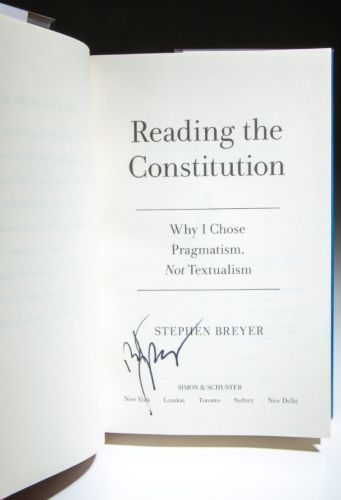
Pragmatism in constitutional interpretation emphasizes practical consequences and functional governance. Rather than beginning exclusively with text, original meaning, or precedent, pragmatic approaches ask how competing interpretations will operate in real world conditions. The method is associated with judicial reasoning that weighs institutional competence, administrative feasibility, and societal impact. In this view, constitutional adjudication cannot be abstracted entirely from its effects. Courts must consider how their rulings will shape governance, public policy, and individual rights in practice.
Justice Stephen Breyer articulated a pragmatic vision that integrates constitutional purpose with functional analysis. He argued that interpretation should promote democratic participation and effective government while respecting constitutional structure. Pragmatism does not reject text or history, but it resists rigid adherence when such adherence would produce outcomes inconsistent with the Constitution’s broader objectives. Balancing tests, proportionality analysis, and deference doctrines often reflect pragmatic reasoning. These tools allow courts to evaluate competing interests in context rather than applying categorical rules in isolation. Breyer’s emphasis on “active liberty” highlights participation and workable governance as interpretive guides, suggesting that constitutional meaning must account for how institutions actually function. In this model, judicial reasoning becomes attentive to institutional capacity and long term consequences rather than confined solely to semantic or historical inquiry.
Consequentialism, closely related to pragmatism, explicitly weighs the likely results of judicial decisions. Judges employing this approach may assess economic impact, administrative burden, or social disruption when determining constitutional meaning. The method assumes that constitutional law functions within an ongoing political and social system. Decisions that ignore practical realities risk undermining institutional stability. For some scholars, pragmatic interpretation acknowledges the judiciary’s limited capacity and seeks to craft rulings that can be implemented effectively within existing structures.
Critics argue that pragmatism can erode principled constraint. If consequences guide interpretation, the boundary between adjudication and policymaking may blur. Opponents contend that judges are not equipped to predict long term social effects and that reliance on anticipated outcomes may invite subjective judgment. The concern is that constitutional meaning could shift according to perceived desirability rather than legal authority. Textualists and originalists in particular caution that pragmatic balancing may sacrifice fidelity to enacted language in favor of flexible governance.
Pragmatism and consequentialism occupy a contested space within constitutional theory. They foreground functionality and institutional realism while raising questions about judicial limits. Their influence reflects recognition that constitutional interpretation operates within lived political contexts. Advocates contend that courts cannot ignore consequences without abdicating responsibility for workable governance, especially in areas involving complex regulatory schemes or separation of powers disputes. By contrast, critics warn that emphasizing practical outcomes may weaken the discipline that written constitutionalism demands. The tension between principle and practicality underscores the broader interpretive debate: whether constitutional meaning should be determined primarily by historical and textual fidelity or by considerations of institutional effectiveness. Whether viewed as necessary adaptability or as methodological indeterminacy, pragmatic approaches underscore that constitutional adjudication often involves more than textual exegesis. It involves judgment about how law functions in society.
Moral Reasoning and Ethical Constitutionalism

Moral reasoning in constitutional interpretation asserts that certain constitutional provisions embody ethical commitments that cannot be reduced solely to text or historical practice. Clauses protecting liberty, equality, and due process are often framed in capacious language that invites normative judgment. Ethical constitutionalism contends that judges must engage with moral principles embedded within the constitutional order, particularly when adjudicating fundamental rights. Rather than viewing the Constitution as exclusively a historical artifact, this approach understands it as expressing enduring commitments to justice and human dignity. Proponents argue that constitutional language such as “equal protection” or “cruel and unusual punishments” necessarily invokes evaluative standards that transcend narrow semantic analysis. Interpreting such provisions requires more than dictionary consultation; it demands reflection on the moral ideals that animate constitutional guarantees. In this view, constitutional adjudication involves reasoned engagement with ethical commitments that give the document normative force across generations.
Constitutional provisions, especially those concerning rights, are best understood as statements of principle rather than specific historical rules. Judges, in his account, must interpret these principles in a manner that renders the legal system morally coherent. This interpretive method, often described as “law as integrity,” emphasizes consistency with the broader ethical commitments of the constitutional tradition. The task of the judge is not merely to parse language, but to interpret it in light of political morality.
Judicial opinions invoking dignity, equality, and fundamental fairness frequently reflect elements of ethical reasoning. In cases addressing racial discrimination, gender equality, or personal autonomy, the Court has sometimes grounded its reasoning in broader conceptions of justice. Such reasoning does not necessarily disregard text or precedent, but it supplements them with normative analysis. Proponents argue that constitutional adjudication inevitably involves value judgments, and that candid engagement with moral reasoning promotes transparency rather than concealment of judicial discretion.
Critics caution that ethical constitutionalism risks expanding judicial authority beyond democratic legitimacy. If constitutional meaning turns on moral philosophy, disagreement over ethical principles may become judicially decisive. Opponents argue that moral reasoning should be mediated through the political process rather than determined by courts. They contend that grounding interpretation in abstract principles may reduce predictability and blur the distinction between adjudication and moral advocacy. Furthermore, reliance on contested ethical frameworks may invite accusations of partisanship, especially in cases involving deeply divisive social questions. The central concern is institutional competence: whether courts possess democratic warrant to define contested ethical commitments and whether moral reasoning can be sufficiently constrained to prevent interpretive drift.
Moral reasoning occupies a complex position within constitutional theory. It acknowledges that constitutional interpretation often implicates fundamental questions of justice, while raising concerns about judicial overreach. The approach underscores that constitutional law is not purely technical; it engages the ethical foundations of political community. Whether embraced as principled adjudication or criticized as subjective expansion, ethical constitutionalism reflects the enduring tension between legal authority and moral judgment within a written constitutional order.
Structuralism and Historical Practice
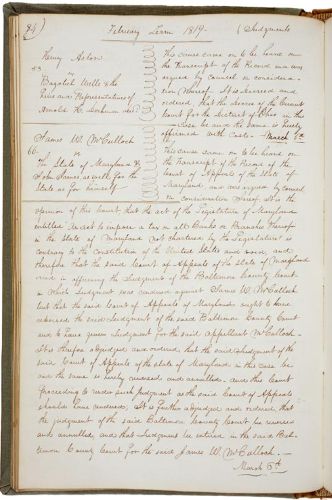
Structuralism interprets the Constitution by examining the relationships among its institutional components rather than focusing solely on individual clauses. This approach infers meaning from the architecture of the document as a whole. Separation of powers, federalism, checks and balances, and enumerated powers are not merely discrete provisions; they form an interlocking framework that shapes constitutional interpretation. Structural reasoning asks how a proposed interpretation fits within that framework. It assumes that constitutional meaning emerges not only from textual language, but from the design principles embedded in the arrangement of governmental authority.
One of the earliest and most influential examples of structural reasoning appears in McCulloch v. Maryland (1819). Chief Justice John Marshall emphasized the Constitution’s nature as a charter of government, not a detailed legal code. He interpreted the Necessary and Proper Clause in light of the broader structure of federal authority, reasoning that national powers must be adequate to their constitutional ends. Marshall rejected a narrow reading that would confine Congress to powers expressly enumerated in the most literal sense, arguing instead that the Constitution was intended to endure and to be applied to various crises of human affairs. Structural analysis supported implied powers as necessary to preserve the coherence of national governance. The opinion did not rely exclusively on textual literalism; it derived meaning from institutional design, functional necessity, and the relationship between federal and state authority. By situating interpretation within the Constitution’s overarching framework, Marshall articulated a model of reasoning that has shaped constitutional jurisprudence for generations.
Historical practice complements structural interpretation by looking to long standing governmental traditions as evidence of constitutional meaning. Justice Felix Frankfurter described such practice as a “gloss” on constitutional text. Repeated and accepted exercises of power by political branches may inform interpretation, especially when the text is ambiguous. Justice Robert Jackson’s concurrence in Youngstown Sheet & Tube Co. v. Sawyer likewise acknowledged that executive authority can derive strength from sustained historical practice. The Constitution’s application, in this view, is shaped by institutional experience as well as by original text.
Critics argue that reliance on structure and practice may entrench contested expansions of power. If constitutional meaning evolves through institutional behavior, longstanding departures from original design could become normalized. Moreover, determining which practices are constitutionally significant requires evaluative judgment. Not all historical precedents carry equal weight, and some may reflect political expediency rather than principled interpretation. Structural inference may also risk overgeneralization, drawing broad conclusions from institutional arrangements without clear textual grounding. Skeptics contend that historical gloss should illuminate ambiguity rather than override explicit constitutional limitations. Without careful discipline, appeals to structure or tradition could blur the distinction between interpretation and accommodation, allowing constitutional meaning to shift incrementally without formal amendment.
Structuralism and historical practice underscore that constitutional interpretation occurs within an institutional ecosystem. Meaning is not confined to isolated clauses but is informed by relationships among branches and by the accumulated experience of governance. This approach highlights the Constitution as an operational system, one whose coherence depends on the interaction of powers. Whether embraced as pragmatic realism or criticized as interpretive elasticity, structural reasoning affirms that constitutional law is shaped by design as well as by text.
Interpretive Pluralism: Do Judges Really Choose One Method?
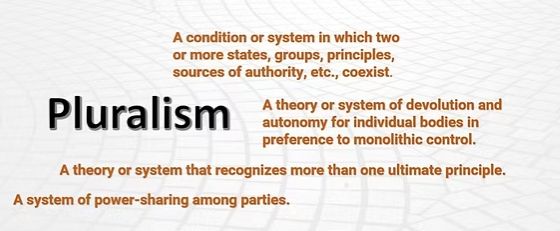
Although interpretive theories are often presented as distinct schools of thought, judicial practice rarely conforms to methodological purity. Supreme Court opinions frequently incorporate elements of text, history, precedent, structure, and consequence within a single analysis. Judges who publicly align with one interpretive philosophy may nevertheless draw upon multiple modalities in resolving complex disputes. The contrast between theoretical clarity and practical hybridity raises an important question: do judges genuinely adhere to a single method, or does constitutional interpretation operate through a form of pluralism?
Accounts of constitutional interpretation identify several “modalities” through which constitutional arguments are made, including textual, historical, structural, doctrinal, ethical, and prudential reasoning. Constitutional discourse is structured by these recurring forms of argument rather than by exclusive methodological commitments. Under this framework, judges engage in a recognized set of argumentative practices, each carrying its own internal standards and conventions. The legitimacy of constitutional adjudication, on this view, derives from the disciplined use of these modalities rather than from allegiance to a singular interpretive philosophy. Interpretive pluralism reflects the reality that constitutional meaning emerges from interaction among multiple forms of reasoning. Text may anchor analysis, history may illuminate context, precedent may guide application, and prudential considerations may temper institutional consequences. The modalities operate not as mutually exclusive categories but as complementary tools within a shared constitutional language.
Judicial opinions often illustrate this interplay. A decision may begin with textual analysis, incorporate historical evidence, assess precedent, and evaluate practical consequences before reaching a conclusion. Even self described originalists sometimes rely on precedent to preserve institutional stability, while proponents of Living Constitutionalism may invoke historical context to support evolving applications. The interpretive process appears layered rather than linear. Constitutional reasoning unfolds through overlapping considerations that collectively shape judicial judgment.
Pluralism can be defended as reflective of the Constitution’s complexity. The document contains specific rules, broad principles, structural arrangements, and historical commitments. No single interpretive approach fully captures this diversity. By drawing upon multiple methodologies, courts may better account for the Constitution’s multifaceted character and avoid reductionism. Structural reasoning may clarify institutional relationships where text is ambiguous, while precedent may supply stability in areas of contested history. Pragmatic assessment can inform application without displacing foundational principles. Pluralism is not methodological incoherence but practical realism. It acknowledges that constitutional adjudication occurs within a layered legal tradition shaped by text, historical experience, and institutional development. The Constitution’s durability may itself be evidence of interpretive pluralism functioning as a stabilizing force.
Critics of interpretive pluralism argue that methodological blending risks indeterminacy. If judges can invoke multiple approaches selectively, interpretive discipline may weaken. The absence of a prioritizing framework could allow outcomes to shape method rather than method to shape outcomes. Some scholars contend that interpretive legitimacy requires clearer hierarchies among modalities, lest constitutional adjudication become opportunistic. The tension between flexibility and constraint resurfaces in the pluralist account.
Interpretive pluralism highlights the gap between theoretical camps and judicial practice. While constitutional scholarship often emphasizes methodological divides, adjudication frequently reflects synthesis. The Constitution’s endurance may depend less on exclusive allegiance to a single philosophy than on disciplined engagement across methods. Judges rarely choose one interpretive lens to the exclusion of all others. Instead, constitutional meaning often emerges from structured dialogue among text, history, precedent, structure, and principle.
Conclusion: Shared Discipline in a Written Constitution
The American Constitution endures not merely because it is written, but because it is interpreted within a disciplined legal tradition. Textualism, originalism, living constitutionalism, stare decisis, pragmatism, moral reasoning, structuralism, and historical practice each offer distinct pathways to constitutional meaning. None commands universal allegiance, and none alone resolves every interpretive difficulty. Yet the existence of competing approaches has not dissolved constitutional governance. Instead, it has structured an ongoing debate about the sources and limits of judicial authority.
What unites these approaches is a shared premise: the Constitution binds. Even when judges disagree about method, they operate within a framework that treats the document as authoritative law. Interpretive conflict unfolds within constraints imposed by text, history, precedent, institutional design, and reasoned argument. The persistence of disagreement reflects the Constitution’s complexity rather than its fragility. Debate over method is itself evidence of commitment to the enterprise of constitutional adjudication.
The greater danger lies not in methodological diversity, but in the abandonment of interpretive discipline. When constitutional reasoning becomes untethered from recognizable standards, the legitimacy of judicial decision making may erode. The written Constitution presupposes that interpretation will be conducted through principled engagement rather than through unconstrained preference. Whether one privileges original meaning, evolving principles, or pragmatic consequences, the act of interpretation requires transparency and intellectual rigor. Shared discipline sustains constitutional authority across generations.
A written constitution does not interpret itself. Its durability depends on the fidelity with which judges, scholars, and citizens engage its text and structure. The American experience demonstrates that constitutional government can survive sustained disagreement about interpretive philosophy, provided that the disagreement remains anchored in reasoned argument and institutional respect. Competing methods need not produce instability if they operate within a shared commitment to constitutional governance. In that shared discipline lies the resilience of the constitutional order.
Bibliography
- Balkin, Jack M. Living Originalism. Cambridge, MA: Harvard University Press, 2011.
- Barnett, Randy E. Restoring the Lost Constitution: The Presumption of Liberty. Princeton, NJ: Princeton University Press, 2003.
- Barrett, Amy Coney. “Precedent and Jurisprudential Disagreement.” Texas Law Review 91, no. 7 (2013): 1711–1738.
- Bobbitt, Philip. Constitutional Fate: Theory of the Constitution. New York: Oxford University Press, 1982.
- —-. Constitutional Interpretation. Malden, MA: Blackwell, 1991.
- Bork, Robert H. The Tempting of America: The Political Seduction of the Law. New York: Free Press, 1990.
- Bradley, Curtis A., and Trevor W. Morrison. “Historical Gloss and the Separation of Powers.” Harvard Law Review 126, no. 2 (2012): 411–476.
- Brennan, William J. “The Constitution of the United States: Contemporary Ratification.” South Texas Law Review 27 (1986): 433–452.
- Breyer, Stephen. Active Liberty: Interpreting Our Democratic Constitution. New York: Alfred A. Knopf, 2005.
- Dobbs v. Jackson Women’s Health Organization, 597 U.S. ___ (2022).
- Dworkin, Ronald. Law’s Empire. Cambridge, MA: Harvard University Press, 1986.
- Fallon, Richard H., Jr. “A Constructivist Coherence Theory of Constitutional Interpretation.” Harvard Law Review 100, no. 6 (1987): 1189–1238.
- —-. “Stare Decisis and the Constitution: An Essay on Constitutional Methodology.” New York University Law Review 76, no. 2 (2001): 570–604.
- Frankfurter, Felix. Concurring opinion in Youngstown Sheet & Tube Co. v. Sawyer, 343 U.S. 579 (1952).
- Hamilton, Alexander. “Federalist No. 78.” In The Federalist Papers, edited by Clinton Rossiter. New York: Signet Classics, 2003.
- Jackson, Robert H. Concurring opinion in Youngstown Sheet & Tube Co. v. Sawyer, 343 U.S. 579 (1952).
- Manning, John F. “The Absurdity Doctrine.” Harvard Law Review 116, no. 8 (2003): 2387–2486.
- Marshall, John. McCulloch v. Maryland, 17 U.S. (4 Wheat.) 316 (1819).
- Perry, Michael J. The Constitution, the Courts, and Human Rights. New Haven, CT: Yale University Press, 1982.
- Planned Parenthood of Southeastern Pennsylvania v. Casey, 505 U.S. 833 (1992).
- Posner, Richard A. How Judges Think. Cambridge, MA: Harvard University Press, 2008.
- Rakove, Jack N. Original Meanings: Politics and Ideas in the Making of the Constitution. New York: Alfred A. Knopf, 1996.
- Scalia, Antonin. A Matter of Interpretation: Federal Courts and the Law. Princeton, NJ: Princeton University Press, 1997.
- Solum, Lawrence B. “Semantic Originalism.” Illinois Public Law Research Paper No. 07-24, 2008.
- Strauss, David A. The Living Constitution. New York: Oxford University Press, 2010.
- Sunstein, Cass R. One Case at a Time: Judicial Minimalism on the Supreme Court. Cambridge, MA: Harvard University Press, 1999.
- Whittington, Keith E. Constitutional Interpretation: Textual Meaning, Original Intent, and Judicial Review. Lawrence: University Press of Kansas, 1999.
- —-. “Originalism: A Critical Introduction.” Fordham Law Review 88:2 (2013).
Originally published by Brewminate, 03.05.2026, under the terms of a Creative Commons Attribution-NonCommercial-NoDerivatives 4.0 International license.
About the Author