

By Dr. Erich S. Gruen
Wood Professor Emeritus of Ancient History
University of California Berkeley
The year 310 B.C. witnessed the extinction of the Argead line. Cassander had ordered the murder of Young Alexander IV and his mother Roxane, widow of Alexander the Great. The kingdom of Macedonia was now without a king. Cassander’s deed cleared the way for the ambitious dynasts who controlled the armies and lands of the eastern Mediterranean. Yet no one stepped forth to claim the crown. The throne lay vacant for four years. In 306 the situation changed in dramatic fashion. Antigonus Monophthalmus took the title of King, and a chain reaction followed. Within a short span of time, Ptolemy, Seleucus, Lysimachus, and Cassander all acquired the same title. The Hellenistic world which had had no monarch for half a decade suddenly had a plethora of them. But what kind of monarchy, how viewed and how justified? The matter is important. It helped give shape to the age of Alexander’s Successors.
A consensus prevails on the subject. Antigonus, it is affirmed, conceived the nature of his kingship in a manner very different from that of his rivals. His realm would be co-extensive with the empire of Alexander, a universal monarchy that would permit no challengers. Those who declined to acknowledge his supremacy would be treated as rebels and enemies. By contrast, the other diadochoi held a more modest notion of royalty. They were content with portions of what had once been Alexander’s dominion, each asserting regal privileges within definable territories, whether Egypt, Asia, Thrace, or Macedon. On this analysis, Antigonus may have been the worthiest of Alexander’s Successors and most faithful to his aspirations, but the other dynasts had a clearer vision of the future of the Hellenistic world.[1] Yet a closer examination gives pause. The sources on assumption of the royal title by the diadochoi offer no hint that the new kings had radically different conceptions of its meanings.[2] The issue warrants renewed scrutiny.
The execution of Alexander IV was accomplished quietly and secretly. How long it remained a secret is unknown. But the news, once reported, stirred hardly a ripple. The dynasts neither grieved nor complained.[3] The silence of Antigonus One-Eyed is especially surprising. He had been vociferous in condemning Cassander earlier for the mistreatment of Roxane and her son.[4] Their assassination, however, left him dumb. None of the diadochoi issued a protest. Cassander undoubtedly denied the deed. There were always others to blame. Diodorus postulates a great sense of relief on the part of Ptolemy, Lysimachus, Antigonus, and Cassander: they no longer need fear that Alexander IV would reach majority, and each could entertain royal ambitions for himself, while holding the territory under his control as a spear-won kingdom. The historian’s analysis is anticipatory and conjectural. In fact, the dynasts made no move toward claiming the titles and prerogatives of a king.[5] All had professed loyalty to the Argead house to that point. To usurp kingly office would be more than unseemly; it would deny their own propaganda and undermine their credibility. Moreover, the appeal of the Argead dynasty remained high in Greece and Macedon. The effort to place Heracles, supposed son of Alexander by an Iranian mistress, on the throne demonstrates that clearly enough.[6] So does the scramble to seek the hand of Cleopatra, sister of Alexander the Great – a scramble that precipitated her execution in 308.[7] The diadochoi wisely refrained from pressing any public claims on the inheritance of Alexander. An anomalous situation ensued: the empire had no ruler. Yet the dynasts, the armies, and the inhabitants of what had been Alexander’s realm could evidently live with that situation. They had done so de facto, of course, ever since the death of Alexander in 323. But none was yet prepared to do so de iure. Babylonian and Egyptian records, indeed, continued to count the regnal years of Alexander IV for several years after his death.[8] That comforting fiction covered the interlude and provided a temporary screen for reality. New circumstances and new justifications were required to permit an open break with the tradition of Argead rule.
Conflicts among the leaders persisted, and renewed hostilities soon made a shambles of the peace of 311, to which they had affixed their signatures. No need to rehearse the events here. Only one item is of direct relevance: the first major military victory by any of the dynasts since the death of Alexander IV in 306. And that victory changed everything.
A great naval battle off Salamis in Cyprus seemed to hold world supremacy itself in the balance.[9] The account overdramatizes. But the victor certainly sought to portray it in that light. The forces of Antigonus, led by his dynamic son Demetrius Poliorcetes, smashed the Ptolemaic fleet at Salamis and gained a decisive triumph. Ptolemy lost 120 warships and another 100 transports, in addition to several thousand soldiers captured or surrendered. All of Cyprus was lost, and Ptolemy returned ignominiously to Egypt.[10] The Antigonid cause took a significant jump in prestige and power.
What followed carried still greater significance. Antigonus Monophthalmus was at Antigoneia on the Orontes, there supervising the plans for this new city which was to be his capital.[11] The dynast eagerly awaited word of the contest in Cyprus. Plutarch tells the tale in its fullest form. Having achieved victory, Demetrius selected a trusted officer, Aristodemus of Miletus, to deliver the news to his father. Aristodemus landed alone, leaving the crew aboard ship and keeping the outcome of the battle a secret. His journey to Antigonus’ quarters was slow and deliberate, thus to intensify the suspense. Anxious messengers from Antigonus met him en route but were turned away without a word. Aristodemus’ solemn pace and stony silence increased the anxiety, and growing numbers swelled his entourage as he approached the residence of Antigonus. Only upon arrival there and direct encounter with the dynast did Aristodemus present his announcement. And he began with a startling address: “Hail, king Antigonus”. It was the first time such a salutation had been offered to Monophthalmus. Aristodemus then reported the magnitude of the victory at Salamis, and the gathering took its cue: they declared both Antigonus and Demetrius as kings. A ceremony of sorts followed immediately thereupon. The friends of Antigonus crowned him, and the new ruler sent off a diadem to his son, accompanied by a letter which greeted him as king.[12] The Antigonids had now openly proclaimed a new monarchy.
How does one interpret the event? It can on no account be reckoned as spontaneous – or as the flourish of a flatterer. The sequence of developments precludes such inferences: Aristodemus’ slow and silent march that heightened tensions, the collecting of a crowd, Antigonus’ personal appearance, the messenger’s striking address, the immediate acclamation of the kings, the award of the diadem. Only one conclusion is possible: the whole affair was staged. Antigonus had already learned of the outcome of Salamis. And he had the time to orchestrate a drama which would culminate in his coronation.[13]
The means of legitimizing this move, however, remain very much in dispute. Salutation by the army, it has been argued, played a role, authorizing or ratifying Antigonus’ elevation.[14] Or else the φίλοι of Antigonus, acting as a form of συνέδριον, conferred legitimacy when they crowned the king.[15] Or else the coronation ceremony anticipated the future installation of Hellenistic monarchs through formal presentation to the populace.[16] Yet a search for constitutional precedent or a rite of investiture takes precisely the wrong approach. No army assembly gave sanction to the kingship of Antigonus Monophthalmus. Only Appian, among our sources, specifies a declaration by the army – and he sets it in Cyprus where the soldiers hailed both Antigonus and Demetrius. That deed, however, if it occurred at all, has no relevance for the formal assumption of royalty. Demetrius, as we know, received his kingly authority only through dispatch of the diadem by his father. Any acclamation by soldiers would lack juridical significance.[17] The same holds for the involvement of the φίλοι. Nothing in Macedonian tradition gave them official status.[18] And to regard the crowning of Antigonus as an elaborate ceremony, itself designed to set a precedent for future investitures, goes well beyond our testimony. Among other matters, it overlooks Demetrius’ acquisition of the royal title without ceremony or ritual. He needed only a letter and the diadem delivered by couriers. The entire episode is marked by measures tailored for the particular occasion – not governed by standard practice or dependent on constitutional theory.

Novelty rather than tradition stands out here. Antigonus made no appeal to the past, relied on no fixed conventions, called upon no predecessors to legitimize his ascendancy. Only his own accomplishments counted. In particular, the most recent accomplishment. The victory at Salamis broke the stalemate and shot Antigonus to a position of clear superiority, at least for the moment. Antigonus shattered the conspiracy of silence over the absence of kingship. Decisive triumph, it was claimed, proved his quality. Salamis alone justified royalty. On that the texts are consistent.[19] Modern assumptions to the contrary, Antigonus did not project himself as heir to Alexander the Great or continuator of the Argead dynasty.[20]This monarchy would take on a new character: a “personal” or “charismatic” monarchy, as it is often called.[21] But it was more than that. Antigonus created a new dynasty – explicitly and overtly. The assembled throng, no doubt carefully primed and prompted, greeted both Antigonus and Demetrius as kings. The father held precedence: he sent the diadem to Demetrius, and he was responsible for the conferring of royal privileges.[22] But a dynastic scheme had been set in place. The association of Demetrius in his rule allowed Antigonus to convey a sense of stability and endurance. The charisma of the victor authorized the elevation. The event, however, exceeded personal triumph. Inclusion of Demetrius announced a dynastic regime that would fill the gap left by the demise of the Argeads.[23] Antigonus did not present his rule as continuous with predecessors or as founded upon precedent. This was to be a new order and a new monarchy. It combined charisma and dynasty.
Antigonus Monophthalmus set a precedent rather than followed one. The other diadochoi son insisted upon royal titles for themselves – a fact that Antigonus must have anticipated. How Swift and under what circumstances they did so remains subject to debate and uncertainty. The literary sources are largely in accord: the coronation of Ptolemy followed shortly upon Antigonus’ proclamation, and those of Seleucus, Lysimachus, and Cassander not long thereafter. And there is unanimity on the motive for so rapid a response, at least with regard to Ptolemy: he would not allow his stature to be diminished by defeat and thus took the kingship, lest he be thought dispirited or inferior to his rival.[24] That testimony, however, evokes suspicion, both as to fact and to interpretation.
Ptolemy’s situation needs a closer look. The supposed motive is implausible. Antigonus justified his coronation by pointing to military success as a sign of kingly quality and divine favor. Ptolemy could hardly claim the same distinction in order to compensate for defeat, an act that would only call attention to his weakness.[25] Unanimity among our authorities is here indecisive, for it involves assessment of motive rather than presentation of fact. And the similarity of statements suggests that all may have drawn ultimately on a single source.[26] Other evidence outside the literary tradition puts matters in a rather different light. Ptolemy, it seems clear, did not assume royalty as a swift and direct response to Antigonus’ move. The chronological canon of Claudius Ptolemaeus sets the first year of Ptolemy’s reign in 305/4. By Egyptian reckoning that signifies accession some time between November 7, 305 and November 6, 304.[27] The date can be further narrowed by the evidence of the Marmor Parium which puts Ptolemy’s taking of the crown in the Attic year 305/4, that is, between July 4, 305 and July 3, 304.[28] Further specification comes from two demotic papyri, the last documents dated by the regnal years of Alexander IV: they belong in the Egyptian month of Hathyr in 305/4, which runs from January 6 to February 4, 304.[29] The combined testimony yields an accession date some time between January and July, 304.[30] As is obvious, the declaration of Antigonus, probably in spring of 306, did not trigger the response of Ptolemy – which came two years later.[31] The chronology also rules out what might seem to have been an appropriate occasion: Ptolemy’s successful resistance to the Antigonid assault on Egypt in late 306, resistance that forced an embarrassing retreat by his enemies.[32] Elation followed that triumph. Ptolemy celebrated with a public ceremony of thanks to the gods and a lavish entertainment for friends, and then fired off letters to Seleucus, Lysimachus, and Cassander, announcing his victory and the heavy losses of Antigonus.[33] Yet he still withheld any regal acclamations. More than a year would pass before he took that step. The trumpeting of victory perhaps laid the groundwork, but Ptolemy refrained from offending potential allies by jumping the gun.
A further setback for Antigonus may have given Ptolemy the incentive to grasp the kingship: the unsuccessful siege of Rhodes by Demetrius Poliorcetes. Ptolemy provided substantial aid, both men and supplies, in support of Rhodes’ struggle.[34] The islanders expressed gratitude in extravagant fashion. On advice from the oracle of Ammon, they gave Ptolemy honors due to a god.[35] The siege of Rhodes began probably in the spring of 305, and lasted approximately a year.[36] Ptolemy may have accepted elevation to monarchy during that period – or, better still, at its conclusion, when his stature had risen markedly and royal privileges could be added to divine honors.[37] In any case, the new ruler claimed his prerogatives to underscore success, not to mitigate defeat.
Comparable success provided opportunity and occasion for Seleucus to style himself as king. Diodorus places his decision in the context of recovering control over the Upper Satrapies.[38] Seleucus had previously dealt with Asiatics as a monarch, so Plutarch reports, but now donned the diadem in treating with Greeks as well.[39] When Seleucus officially took the royal title can be determined within limits. A Babylonian king – list puts his first year as ruler in the seventh year of the Seleucid era, i.e. from March to March, 305/4.[40] Confirmation comes from the earliest Babylonian document dated by Seleucus’ reign: April 16, 304.[41] Hence, Seleucus, like Ptolemy, accepted the crown nearly two years after the Antigonids had done so. For him too the designation advertised accomplishment and proclaimed ability.

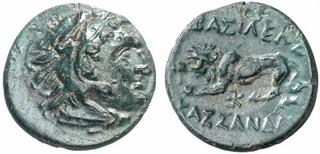
The accession dates of Lysimachus and Cassander remain unknown. Lysimachus, it can be inferred, did not lag long behind Ptolemy and Seleucus – if at all. Once news spread that certain dynasts arrogated royal titles to themselves, he could hardly have settled for lesser distinctions. Cassander waited rather longer, perhaps wary of Macedonian sensitivity regarding the Argead house and unsure of loyalties in the realm.[42] But he too yielded to temptation, possibly after shoring up support to confront Demetrius in 303/2. Cassander soon designated himself on bronze coinage and epigraphic documents as “king of the Macedonians”.[43] The maintenance of Prestige demanded the label of monarch. The Hellenistic world in short order had obtained five kings.[44]
The central question can now be addressed. How did the diadochoi and their followers perceive these monarchies? Did Antigonus alone visualize his realm as encompassing the empire of Alexander, an imposing but unrealistic ambition, while his rivals contented themselves with more strictly defined territorial kingdoms, the real harbingers of the future?
Our texts on the assumption of kingship by Antigonus’ rivals betray no suggestion that their view of its meaning differed from his. Quite the contrary. They explain the actions of the diadochoi specifically as emulation of Antigonus, lest they be considered inferior to him.[45] A conception of their rule as bounded by territorial confines would be a gratuitous admission of inferiority. Self-effacement or restraint rarely characterized the actions of the diadochoi. Whence then derives this idea that Antigonus had a more exalted notion of his rule than did his rivals of theirs, an idea shared by so many scholars?[46] A single anecdote is cited repeatedly as buttress for this conclusion. Demetrius Poliorcetes, as the tale has it, ridiculed those who called anyone but himself and his father king, and heard with pleasure those who toasted him as monarch, while giving mock-titles to his rivals: Seleucus the master of elephants, Ptolemy the naval lord, Lysimachus the treasurer, and Agathocles the island-ruler.[47] On the face of it, that seems strong testimony for Antigonus’ vision of an empire ruled by his house alone, with no room for rivals.
Closer scrutiny causes hesitation. The anecdote concerns Demetrius, not Antigonus. Revelers at a banquet and flatterers eager to please hardly represent official policy – any more than does Demetrius himself when boasting or bantering in his cups. And when did this episode occur? Plutarch appears to put it shortly after the Antigonid revival of the League of Corinth in 302, thus inducing most scholars to assign that year to the event.[48] But the inference is delusive. Plutarch quite clearly transmits the anecdote in an excursus. Demetrius’ appointment as hegemon of the League gave the biographer occasion to speak of his excessive self-laudation: he even regarded himself as superior to Philip and Alexander; whereas Alexander addressed other rulers as kings, Demetrius would put none on a par with himself. The anecdote then follows, evidently independent of any chronology. That Plutarch presents it as a digression is plain enough. He signals the fact unambiguously when he returns to the narrative: τότε δὲ.[49] Other chronological indicators point to a later date. Most particularly, the absence of Cassander from the tale suggests a time after the dynast’s death in 298/7. A toast in 302 which derided Demetrius’ adversaries but omitted Cassander, his principal antagonist in Greece, would make little sense.[50] The phraseology in one version of the anecdote is even more striking: the flatterers toasted Δημητρίου μὲν μόνον βασιλέως.[51] That will not fit easily into the lifetime of Antigonus Monophthalmus. Still another clue lends support: the inclusion of Agathocles of Syracuse as among the targets of Demetrius’ flatterers. At what point would Agathocles have sufficiently impressed Demetrius to warrant a position among the other dynasts? Surely not before his successful campaign at Corcyra ca. 299, and probably not before the marriage of his daughter to Pyrrhus in 295.[52] The evidence is consistent enough. Demetrius’ mockery of his adversaries, even if it were more than a tipsy toast, occurred some time in the 290s and is inadmissible as evidence for Antigonus’ attitude toward his monarchy.[53]
On that attitude, a better piece of testimony survives. Plutarch reports that Cassander refrained from calling himself King in letters to the other diadochoi, even though they employed the title in correspondence and direct contact with him.[54] The passage is often discussed with regard to Cassander’s kingship. But it has larger implications. The other monarchs who addressed Cassander as βασιλεύς included Antigonus Monophthalmus. The fact needs to be underscored. Antigonus, by acknowledging the royalty of his competitors, conceded that his concept of kingship did not entail exclusivity.[55]
What reason is there to believe that Ptolemy, Seleucus, Lysimachus, and Cassander perceived their royal prerogatives as tied to territorially bounded kingdoms? Certainly none of the first three identified himself in such fashion. No Greek document or coin proclaims Ptolemy as king of Egypt or Seleucus as ruler of Babylon – or indeed as ruler of Asia. And Lysimachus, eager to attract the loyalty of Greeks and Macedonians, would hardly style himself as “King of Thrace”. Cassander alone stands as apparent exception. He did adopt the title “King of the Macedonians” on bronze coins and in inscriptions.[56] But the exception is only apparent. Cassander, it should be observed projected himself as ruler of the Macedonians, not of Macedon. The designation exceeds territorial limits Cassander was king of the Macedonians as Alexander had been – at least in principle. And there were many Macedonians outside the borders of Macedon.[57]

The others too ruled Macedonians. To reckon themselves as kings of Egypt, Babylon, or Thrace would mean the transformation of what had been mere satrapies of the Macedonian crown to the status of kingdoms, an alien and doubtless unacceptable idea. Quite apart from the matter of principle, the dynasts did not in practice confine their interests and aspirations to the territory directly under their control, Ptolemy serves as prime example. His activities since the peace of 311 had included inroads into Asia Minor, the capture of cities in Lycia and Caria, the extension of influence in the Aegean, the acquisition of holdings in the Peloponnese, an endeavor to win the hand of Alexander’s sister Cleopatra, and even a plan to resurrect the League of Corinth under his hegemony. Although most of these schemes failed of accomplishment, it is plain that Ptolemy’s ambitions went well beyond the mastery of Egypt. When he took the royal title in 304, he still retained garrisons in Corinth and Sicyon.[58] The overseas aspirations of Lysimachus and Cassander were comparably ambitious. In the ultimatum delivered to Antigonus in 315/4, Cassander demanded Cappadocia and Lycia, and Lysimachus laid claim to Hellespontine Phrygia.[59] Nothing suggests that they had modified their objectives in the interim.
A single argument bolsters the view that the diadochoi contented themselves with individual kingdoms: the fact that they recognized one another’s claims by joining in coalition against Antigonus. But that coalition had yet to form at the time of the royal proclamations. Indeed, when Cassander was especially hard pressed by Antigonid forces as late as 302, he still lacked partners and felt compelled to open negotiations with Antigonus. Only when the latter proved obdurate did Cassander begin to assemble the grand Alliance that would culminate at Ipsus.[60] Insofar as there was mutual recognition in 304, it included Monophthalmus himself. The willingness of each ruler to use the royal title in addressing the others suffices to establish the fact.[61]
The supposed contrast between two conceptions of kingship evaporates. Antigonus did not define his rule by the empire of Alexander, nor did his competitors define theirs by the boundaries of what were to become Hellenistic states. Abandonment of the territorial idea clears the ground for better understanding. A different perspective governed these monarchies. Antigonus the One-Eyed created a new form of kingship when he exorcised the ghosts of the Argeads and claimed legitimacy on the basis of personal achievement and dynastic promise. His rivals could do no less. The coronation of the diadochoi held a meaning that surpassed control of lands, cities, and even populations.[62] It signified an exalted prestige, an aura of power and distinction associated with royalty. Hence it precluded neither coalition nor competition. A monarchy undefined by the territorial or institutional limits allowed for both mutual recognition and intense rivalry. The Hellenistic kingdoms had their origins in the authority of the kings – not the other way round.
Appendix
Notes
- This interpretation, or some variant thereof, is widely shared. See, e.g., GRANIER 1931, 101-103; AYMARD 1967, 94; 119-120; MANNI 1952, 29-30; 105-106; WILL 1966, I, 64-65; FORTINA 1965, 94-95; RITTER 1965, 93-94; MUSTI 1966, 95; MÜLLER 1973, 88-90; 100-101; 105-107; HAUBEN 1974, 105-106.
- Fullest testimony in Plut. Demtr. 17.2-18.1. Briefer versions in Diod. 20.53.1-2; Heid. Epit. = FGrH, 155 F 1.7; Appian. Syr. 54; Justin. 15.2.10; Oros. 3.23.40. Confused and inaccurate statements in Nepos. Eum. 13.2-3, and I Macc. 1.7-9.
- Diod. 19.105.2-3; Trog. Prol. 15; Justin. 15.2.4-5; Paus. 9.72.
- Diod. 19.61.1; Justin. 15.1.3; cf. Diod. 19.52.4.
- Diod. 19.105.3-4: οὐκέτι γὰρ ὄντος οὐδενὸς τοῦ διαδεξομένου τὴν ἀρχὴν τὸ λοιπὸν ἕκαστος τῶν κρατούντων ἐθνῶν ἢ πόλεων βασιλικὰς εἶχεν ἐλπίδας καὶ τὴν ὑφ᾽ ἑαυτὸν τεταγμένην χώραν εἶχεν ὡσανεί τινα βασιλείαν δορίκτητον. On the concept of “spear-won territory” see SCHMITTHENNER 1968, 31-39; MÜLLER 1973, 116-121; MEHL 1980-81, 187-196. Diodorus may well have found the phrase in Hieronymus of Cardia; HORNBLOWER 1981, 53. The hailing of Antigonus as king and lord of Asia by those dwelling in Persis came on their initiative, not his; Diod. 19.48.1. And Antigonus refrained from adopting the appellation.
- Diod. 20.20.1-4, 20.28.1-4; Justin, 15.2.3. On the strength of support for this effort, see, especially, Diod. 20.20.3-4, 20.28.1.
- Diod. 20.37.3-6.
- See GRAYSON 1975, 118-119; SKEAT 1954, 9.
- Plut. Demetr. 15.3: ὡς οὐ Κύπρον οὐδὲ Συρίαν, ἀλλὰ τὸ μέγιστον εὐθὺς εἶναι πάντων τῷ κρατοῦντι τῆς νίκης προστιθείσης.
- Sources on the battle: Diod. 20.47-52; Plut. Demetr. 15-16; Justin, 15.2.6; Polyaen. 4.76. See the discussion by SEIBERT 1969, 190-206.
- Diod. 20.47.5.
- Plut. Demetr. 17.2-18.1. The story presents Aristodemus as the most notorious of Antigonus’ flatterers and this episode as the most extreme of his flatteries. And he also gets his comeuppance. Antigonus berates him for generating the anxieties and prolonging the agony: he will have to wait a long time for any reward. Aristodemus’ actions are plainly misinterpreted and distorted by Plutarch’s source. He was, in fact, a high-ranking, trusted, and respected officer of Antigonus -one who had served him long and well; cf. KIRCHNER 1895, 923-24 n. 16; SCHOCH 1924, 47 n. 16. MÜLLER 1973, 80-81, suggests that Plutarch drew on a source which collected anecdotes on flatterers.
- The manipulative character of the affair has often been recognized; GRANIER1931, 99; RITTER 1965, 84; BRIANT 1973, 307-310; MÜLLER1973, 87-93; ERRINGTON 1978, 123-125.
- GRANIER1931, 98-101; RITTER 1965, 79-82, 89-91; MÜLLER 1973, 81-87.
- RITTER 1965, 82-89.
- BRIANT 1973, 307-109; endorsed by SEIBERT 1983, 138.
- The account in Appian Syr. 54 is brief and, very possibly, foreshortened: ἐφ᾽ ὅτῳ λαμπροτάτῳ γενομένῳ (the battle of Salamis) ὁ στρατὸς ἀνεῖπεν ἄμφω βασιλέας. No other source accords any role to the army. Plutarch has τὸ πλῆθος, salute father and son as kings (Demetr. 18.1). The term can be used to designate the army, but not inevitably so. In Plutarch’s narrative here it is much more naturally taken as the assemblage that had gathered before Antigonus’ residence and reacted joyously to Aristodemus’ hailing of Antigonus as king (Demetr. 17.5-18.1). That Plutarch previously characterized the crowd as ὄχλος (17.4) is irrelevant. He does not employ technical language here. Notice that Justin, 15.2.10, has the acclamation performed, on Antigonus’ orders, by the populus. BRIANT 1973, 303-10, rightly rejects the notion of the Heeresversammlung. But he substitutes a schematic series of steps: acclamation by the troops in Cyprus, a coronation at Antigoneia, and instructions to the people to regard father and son as kings.
- The council at Babylon in 323 is not a proper parallel. That was impromptu procedure. The nobles debated and expected to determine Alexander’s successor by designating a member of the Argead house. In 306, however, there were no Argeads and all the φίλοι were φίλοι of Antigonus. More important, the φίλοι did not determine the king. They acted only after the rulers had been proclaimed by τὸ πλῆθος; Plut. Demetr. 18.1. RITTER’s view (1965, 82-89), that the army hailed Antigonus as king of Macedon and the φίλοι crowned him as ruler of Asia, is fanciful.
- Diod. 20.53.2: ὁ δ᾽ Ἀντίγονος πυθόμενος τὴν γεγενημένην νίκην καὶ μετεωρισθεὶς ἐπὶ τῷ μεγέθει τοῦ προτερήματος διάδημα περιέθετο καὶ τὸ λοιπὸν ἐχρημάτιζε βασιλεύς; Plut. Demetr. 17.5 (Aristodemus speaking): ‘χαῖρε, βασιλεῦ Ἀντίγονε, νικῶμεν Πτολεμαῖον ναυμαχίᾳ καὶ Κύπρον ἔχομεν καὶ στρατιώτας αἰχμαλώτους μυρίους ἑξακισχιλίους ὀκτακοσίους; Appian, Syr. 54, quoted above, n. 17; Justin, 15.2.10: hac victoria elatus Antigonus regem se cum Demetrio filio appellari a populo iubet. Cf. The brief but trenchant remarks of WEHRLI 1968, 61.
- As is asserted, for example, by CLOCHÉ 1959, 194; RITTER 1965, 84; MÜLLER 1973, 91-93. The arguments of EDSON 1934, 213-26, that the Antigonids and Argeads did have a familial connection, are highly speculative.
- Cf. KAERST 1926-27, II, 331; WEHRLI 1968, 61; MÜLLER 1973, 86-87, 92, 108-21 –though he also lays stress on formal ratification or legitimization of the position.
- Plut. Demetr. 18.1: Δημητρίῳ δὲ ὁ πατὴρ ἔπεμψε διάδημα καὶ γράφων ἐπιστολὴν βασιλέα προσεῖπεν. Cf. Diod. 20.53.2: συγχωρήσας καὶ τῷ Δημητρίῳ τῆς αὐτῆς τυγχάνειν προσηγορίας καὶ τιμῆς.
- ERRINGTON 1978, 124-125, goes too far in suggesting that Antigonus hit upon this scheme to shore up the weakness and insecurity of his own position.
- Diod. 20.53.3: Closely comparable statements in Plut. Demetr. 18.1; Appian Syr. 54; Heid. Epit. = FGrH 155 F 1.7; Justin. 15.2.11: Ptolomeus quoque, ne minoris apud suos auctoritatis haberetur, rex ab exercitu cognominatur.
- The effort of RITTER 1965, 98-99, to defend the sources’ interpretation here is singularly unsuccessful.
- So, rightly, MÜLLER1973, 94.
- SKEAT 1954, 2-4, 28.
- FGrH 239 B 23. Cf. Porphyry, FGrH 260 F 21.
- P. Dem. Louvre, 2427, 2440; cf. VOLKMANN 1959, 1621 n. 18.
- SAMUEL 1962, 4-11, seeks to push it back to November 7, 305, to coincide with the beginning of the Egyptian year. The demotic papyri are explained by the length of time required for the news of Ptolemy’s coronation to reach Upper Egypt. The thesis does not compel assent. It assumes that the last extant documents of Alexander IV’s reign were, in fact, the last produced, a hazardous assumption. They supply, of course, only a terminus post quem. MÜLLER 1973, 97-100, expresses appropriate reservations about Samuel’s arguments but ends by adopting his position anyway. A bibliographical summary on the subject by SEIBERT 1983, 139-140.
- On the date of Salamis, which prompted Antigonos’ declaration, see MÜLLER 1973, 79.
- Diod. 20.73-76; Plut. Demetr. 19.1-2; Paus. 1.6.6. Antigonos undertook the invasion in early November, 306; Diod. 20.73.3.
- Diod. 20.76.6-7.
- Diod. 20.88.9, 20.94.3, 20.96.1, 20.98.1, 20.99.2.
- Diod. 20.100.3-4.
- Diod. 20.100.1.
- The possibility that Ptolemy’s kingship began after the siege of Rhodes has not previously been considered, though there is no decisive evidence against it. Note, especially, the testimony of the Marmor Parium, FGrH 239 B 23: ἀπὸ τῆς περὶ Ῥόδον πολιορκίας, καὶ ἀφ’ ο[ὗ Πτ]ολεμαῖος τὴν βασιλείαν πα̣ρ[έ]λ[α]β[εν…]. It can be objected that Seleucus became king by April, 304 (see below), and that Ptolemy’s proclamation preceded his. The objection is not decisive. The sources which place Ptolemy’s coronation before the others’ also set them all immediately after Antigonus’ declaration – which is demonstrably false; Plut. Demetr. 18.2; Appian. Syr. 54.
- Diod. 20.53.4: Σέλευκος μὲν προσφάτως τὰς ἄνω σατραπείας προσκεκτημένος.
- Plut. Demetr. 18.2: καὶ γὰρ Λυσίμαχος ἤρξατο φορεῖν διάδημα, καὶ Σέλευκος ἐντυγχάνων τοῖς Ἕλλησιν, ἐπεὶ τοῖς γε βαρβάροις πρότερον οὗτος ὡς βασιλεὺς ἐχρημάτιζε. RITTER’s argument (1965, 100-101), that Seleucus wore the diadem with Asiatics earlier, but was not king until 305/4 strains the evidence. He is obliged, among other things, to read οὕτως, instead of οὗτος without good reason. Cf. MUSTI 1966, 86-87. And since, as Seleucus must have known, Asiatics would regard the wearer of the diadem as king (indeed, perhaps, urged it upon him), the distinction seems pointless.
- SACHS – WISEMAN 1954, 205.
- PARKER – DUBBERSTEIN 1942, 18.
- The Heidelberg Epitome, notably, omits Cassander when listing the dynasts who took the diadem and royal title after Antigonus and Demetrius; FGrH 55 F 1.7. Plut. Demetr. 18.2 lends confirmation: Cassander did not employ the royal title in his correspondence, although the other diadochoi used it in addressing him. The rest of the sources fail to draw that distinction; Diod. 20.53.4; Appian, Syr. 54; Justin, 15.2.12; Nepos, Eum. 13.3.
- His bronze coinage displays the designation ΒΑΣΙΛΕΩΣ ΚΑΣΣΑΝΔΡΟΥ; HEAD 1887, 228. And he labels himself in epigraphic documents as βασιλεὺς Μακεδόνων; Dittenberg. SIG, 332; and a new statue base from Dium, recently announced; PANDERMALIS1977, 16: ‘ΒΑΣΙΛΕΥΣ ΜΑΚΕΔΟΝ[ΩΝ] ΚΑΣΣΑΝΔΡΟΣ ΑΝΤΙΠ[ΑΤΡΟΥ] ΔΙΙ ΟΛΥΜΠΙΩΙ. AYMARD 1967, 102-106, 120, wrongly regards the designation as official titulature of Macedonian royalty. But ERRINGTON’s argument (1974, 23-25), on the basis of Plut. Demetr. 18.27 that it was quite exceptional, is equally unpersuasive. His notion that Cassander used the title for internal consumption but avoided it in foreign policy is difficult to credit. If Cassander were willing to assert his legitimacy within Macedon, why should he shrink from that posture in dealings with the diadochoi? So peculiar a sense of modesty could only diminish his international stature. In the view of MÜLLER 1973, 103-104, Plutarch’s information is a confused reference to rejection of the diadem by Cassander. But that solution, wholly speculative, fails to explain the text. ADAMS 1983, 25-26, rightly sees that Cassander delayed his coronation, though he gives too much weight to “constitutional restraints”. But Adams’ suggested date (after Ipsus) is implausible – a view he has more recently modified in private correspondence. Cassander needed the stature which would put him on a level of equality with allies in resistance to the Antigonids in 303/2; cf. Diod. 20.106.2-107.1.
- MÜLLER 1973, 102-103, takes summer of 304 as terminus ante quem for this development, on the basis of Diod. 20.100.2: Rhodes, after the end of her siege, erected statues to “the kings Cassander and Lysimachus”. But it is risky to assume that that information stems from inscriptions on the bases of the statues. Diodorus may simply be maintaining internal consistency: he had placed all the royal acclamations shortly after Antigonus’ initiative; Diod. 20.53.2-4; cf. RITTER 1965, 107 n. 5. Lesser dynasts and tyrants evidently also took the name of king in the last years of the fourth century; for example, Agathocles of Syracuse; Diod. 20.54.1; Dionysius of Heraclea Pontica; Memnon, FGrH 3B 434 F 4.6; Eumelus of the Bosporan kingdom; see BRANDIS 1894, 761-762; GEYER 1929, 1542.
- Diod. 20.53.4: καὶ οἱ λοιποὶ δυνάσται ζηλοτυπήσαντες ἀνηγόρευον ἑαυτοὺς βασιλεῖς; Plut. Demetr. 18.2: ἐπενείματο δὲ οὕτως τὸ πρᾶγμα τῷ ζήλῳ τοὺς διαδόχους; Heid. Epit. = FGrH 155 F 1.7: ἰδόντες δέ καὶ οι ἑτεροι, οσοι οὐκ ἠλαττοῦντο αὐτοῦ, εφόρεσαν κἀκεῖνοι διάδημα καὶ ὠνόμασαν έαυτούς βασιλεῖς.
- See above n. 1.
- Plut. Demetr. 25.4: ἐκεῖνος [Demetrius] δὲ χλευάζων καὶ γελῶν τοὺς ἄλλον τινὰ πλὴν τοῦ πατρὸς καὶ αὐτοῦ βασιλέα προσαγορεύοντας, ἡδέως ἤκουε τῶν παρὰ πότον ἐπιχύσεις λαμβανόντων Δημητρίου βασιλέως, Σελεύκου δὲ ἐλεφαντάρχου, Πτολεμαίου δὲ ναυάρχου, Λυσιμάχου δὲ γαζοφύλακος, Ἀγαθοκλέους δὲ τοῦ Σικελιώτου νησιάρχου. The same anecdote reappears in Plut. Mor. 823c-d. Athenaeus gives a nearly identical version, for which he cites Phylarchus, but which omits Agathocles; Athen. 6.261b = FGrH 81 F 31.
- Plut. Demetr. 25.3-4.
- Plut. Demetr. 26.1.
- MÜLLER 1973, 89, argues that Demetrius’ flatterers left out Cassander precisely because he was the most hated rival. That needs no refutation. Similarly implausible is the suggestion of HAUBEN 1974, 112, that Cassander seemed less formidable than the other dynasts and was therefore ignored by Demetrius’ circle. He had certainly not been ignored by Demetrius himself.
- The version of Phylarchus, in Athen. 6.261b = FGrH 81 F 31.
- The campaign at Corcyra; Diod. 21.2; the marriage alliance with Pyrrhus: Plut. Pyrrh. 9.1; Diod. 21.4. Agathocles’ own marriage to Theoxena from Egypt might indicate a connection with Ptolemy; Justin, 23.2.6. But that marriage itself is almost certainly no earlier than ca. 300; WILL 1966, I, 103; SEIBERT 1967, 73-74.
- To be sure, Plutarch’s version of the anecdote in the Life of Demetrius has Demetrius berate those who give the name of king to anyone but himself and his father; Plut. Demetr. 25.4. That need not, however, imply that Antigonus was alive at the time. Demetrius simply asserted the monopoly of his line on that distinction. The argument of HAUBEN 1974, 108, that Seleucus would not have been called “elephantarch” after Ipsus is inconclusive. Such a designation could indeed be meant to diminish his accomplishment at Ipsus.
- Plut. Demetr. 18.2: Κάσσανδρος δέ, τῶν ἄλλων αὐτὸν βασιλέα καὶ γραφόντων καὶ καλούντων, αὐτός, ὥσπερ πρότερον εἰώθει, τὰς ἐπιστολὰς ἔγραφε.
- The implication, generally overlooked, is observed by ERRINGTON 1975, 250-251.
- See above, n. 43.
- WALBANK 1981, 56-57, suggests that Cassander used that title to assert a unique position not open to any of his rivals. But this puts too narrow a construction on the meaning of “king of the Macedonians”.
- It is unnecessary to detail the events here. See the summary in WILL 1966, I, 59-64. The garrisons in Corinth and Sicyon: Diod. 20.37.2; cf. Suidas, sv. “Demetrius”.
- Diod. 19.57.1; Appian, Syr. 53; Justin 15.1.2.
- Diod. 20.106.1-5; Plut. Demetr. 28.1; Justin 15.2.15-16. COHEN 1974, 177-179, points out that the diadochoi shied away from marriage alliances with one another until after Ipsus. But it does not follow, as he assumes, that they refused to recognize each other as basileis until that time.
- In the felicitous formulation of ERRINGTON 1975, 251, the monarchy was “shareable”.
- WALBANK 1981, 56, rightly points to the example of Demetrius who for several years lacked a kingdom but still asserted kingship. He recognizes that the new monarchies were “not closely linked with lands where the king ruled”. Yet his statement that the dynasts claimed “kingship within their own particular territories – though not kingship of those territories” seems to vitiate the point or render it opaque. The brief recent treatment by THOMAS 1983, 87, placed undue emphasis upon the administrative structures, institutions, and fixed territories acquired by Ptolemy, Seleucus, Lysimachus, and Cassander. The dynasts did not define their rule in such terms.
Bibliography
- ADAMS, W. L. (1983): “The Dynamics of Internal Macedonian Politics in the Time of Cassander”, Ancient Macedonia 3: 17-30.
- AYMARD, A. (1967): Etudes d’histoire anciennes, Paris.
- BRANDIS, C. G. (1894): “Bosporos”, RE 3: 761-762.
- BRIANT, P. (1973): Antigone le Borne, Paris.
- CLOCHÉ, P. (1959): La dislocation d’un empire, Paris.
- COHEN, G. M. (1974): “The Diadochoi and the New Monarchies”, Athenaeum 52: 177179.
- EDSON, C. F. (1934): “Antigonids, Heracles and Beroea”, HSCPh 45: 213-246.
- ERRINGTON, R. M. (1974): “Macedonian ‘Royal Style’ and its Historical Significance”, JHS 94: 20-37. — (1975): “[Review] O. Müller: Antigonos Monophthalmos und ‘Das Jahr der König”, JHS 95: 250-251. — (1978): “The Nature of the Macedonian State under the Monarchy”, Chiron 8: 77133.
- FORTINA, M. (1965): Cassandro, re di Macedonia, Turin.
- GEYER, F. (1929): “Spartokos”, RE III A: 1542.
- GRANIER, F. (1931): Die makedonische Heeresversammlung, Munich.
- GRAYSON, A. K. (1975): Assyrian and Babylonian Chronicles: Texts from Cuneiform Sources V, Locust Valley, NY.
- GRUEN, E. (1985): “The Coronation of the Diadochi”, in J. EADIE – J. OBER (eds.): The Craft ofthe Ancient Historian, London: 253-271.
- HAUBEN, H. (1974): “A Royal Toast in 302 B.C.”, AncSoc. 5: 105-117.
- HEAD, B.V. (1887): Historia Numorum, Oxford.
- HORNBLOWER, J. (1981): Hieronymus of Cardia, Oxford.
- KAERST, J. (1926-27): Geschichte des Hellenistischen Zeitalters, Leipzig–Berlin.
- KIRCHNER, J. (1895): “Aristodemus”, RE 2.1: 923.
- MANNI, E. (1952): Demetrio Poliorcete, Rome.
- MEHL, A. (1980-81): “ΔOPIKHTO∑ XΩPA”, AncSoc. 11-12, 187-96.
- MÜLLER, O. (1973): Antigonos Monophthalmos und das Jahr der Könige, Bonn.
- MUSTI, D. (1966): “Lo Stato dei Seleucidi”, SCO 15: 61-197.
- PANDERMALIS, D. (1977): Dion, Thessalonike.
- PARKER, A. – DUBBERSTEIN, W. H. (1942): Babylonian Chronology, 626 B.C.-A.D. 45, Chicago.
- RITTER, H. W. (1965): Diadem und Königsherrshaft, Munich.
- SACHS, A. J. – WISEMAN, D. J. (1954): “A Babylonian King List of the Hellenistic Period”, Iraq 16: 202-212.
- SAMUEL, A. E. (1962): Ptolemaii: Chronology, Munich.
- SCHOCH, P. (1924): “Aristodemus”, RE Suppl. 4: 47.
- SEIBERT, J. (1967): Historische Beitrage zu den dynastischen Verbindungen in hellenistischer Zeït, Wiesbaden. — (1969): Untersuchungen zur Geschichte Ptolemaios I, Munich. — (1983): Das Zeitalter der Diadochen, Darmstadt.
- SKEAT, T.C. (1954): The Reigns of the Ptolemies, Munich.
- THOMAS, C. G. (1983): “Philip II, Alexander III, and Hellenistic Kingship”, LCM 8: 86-87.
- VOLKMANN, H. (1959: “Ptolemaios”, RE 23.2: 1621.
- WALBANK, F. W. (1981): The Hellenistic World, London.
- WEHRLI, C. (1968): Antigone et Demetrios, Geneva.
- WILL, E. (1966): Histoire politique du monde hellénistique, II vols, Nancy.
Originally pubished by Karanos: Bulleting of Ancient Macedonian Studies 1 (2018, 109-119) under the terms of a Creative Commons Attribution 4.0 International license.
About the Author