
New open the door for questions about the right to travel to get an abortion.

By Naomi R. Cahn, J.D.
Justice Anthony M. Kennedy Distinguished Professor of Law
Armistead M. Dobie Professor of Law
Co-Director, Family Law Center
University of Virginia

By Sonia M. Suter, J.D.
The Henry St. George Tucker III Dean’s Research Professor of Law
The Kahan Family Research Professor of Law
Founding Director, Health Law Initiative
George Washington University
Introduction
Almost half of the states in the country have made it harder to get an abortion since the Supreme Court in 2022 overturned the federal right to get an abortion. Fourteen states ban abortions in almost all circumstances, and another eight in almost all cases after 6 to 18 weeks of pregnancy.
Nonetheless, the number of abortions provided in the U.S. has actually grown since the court’s Dobbs v. Jackson Women’s Health Organization decision, rising 11% since 2020, to over 1 million abortions a year.
This increase can partially be explained by the fact that the number of people who crossed state lines to get abortions more than doubled from 81,000 in 2020 to 171,000 in 2023.
Justice Brett Kavanaugh wrote in the 2022 Dobbs decision that states cannot legally prevent their residents from going to another state to get an abortion, because he believes there is a “constitutional right to interstate travel.”
The U.S. Constitution does not, however, explicitly recognize a “right to interstate travel.” But the Supreme Court has issued decisions as far back as 1867 that can be interpreted to protect this right – and some scholars are confident that such a right exists.
But that hasn’t stopped states such as Idaho and Tennessee from enacting laws that make it harder to travel for an abortion – and some people have even attempted to legally punish their own partners for traveling to end a pregnancy.
As law professors who teach about reproductive justice, we view attempts to restrict abortion travel as one of the frontiers in the anti-abortion rights movement, raising new legal questions for courts to unravel.
States Push to Stop Abortion Travel
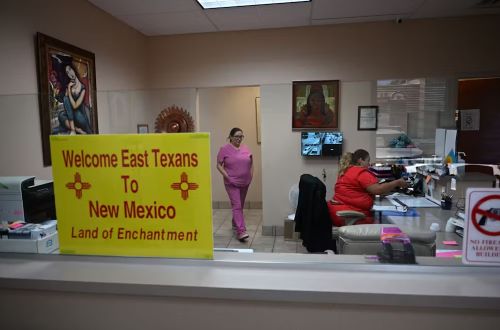
Idaho bans abortion at all stages of pregnancy. In April 2023, it also became the first state to impose travel restrictions with what it called an “abortion trafficking” law.
This law prevents people from helping minors who are not their children get abortions – without parental consent – including in another state.
Idaho’s attorney general has interpreted the law to mean that health care providers cannot refer patients to abortion clinics in other states. And based on this interpretation, the new law also means that a grandparent or teacher, for example, could not provide advice to a pregnant teenager.
An abortion access fund and a few others have challenged this law, saying that it violates the First Amendment and infringes on pregnant patients’ constitutional right to travel.
A federal district court temporarily blocked the law from going into effect in November 2023, but the case is currently being appealed at the 9th U.S. Circuit Court of Appeals.
More recently, in July 2024, Tennessee enacted copycat legislation, which is also being challenged.
Other states – Alabama, Mississippi and Oklahoma – have considered similar abortion trafficking laws but so far have not enacted any.
A Spiraling Effect
Idaho’s and Tennessee’s laws don’t directly prevent interstate travel, because they focus on people helping minors get an abortion. But some abortion rights activists still say these laws could lead to more explicit bans on interstate travel for abortion.
In the meantime, four Texas counties and a handful of Texas cities are imposing what they call “abortion trafficking laws.”
Under these laws, people can sue anyone who travels through their cities or counties to get an abortion in another state. Supporters of these laws describe “abortion trafficking” in broad terms, because as one anti-abortion activist has said, “the unborn child is always taken against their will” by a pregnant person.
This understanding of “abortion trafficking” effectively treats the fetus as a person, in line with other fetal personhood efforts by anti-abortion rights groups. They are also carefully crafted to avoid constitutional challenges.
In some cases, it is individual people, not states, who are trying to block people from traveling to get an abortion.
In February 2024, for example, a man named Collin Davis tried to prevent his ex-partner from traveling from Texas to Colorado to get an abortion.
While Davis failed to prevent the abortion, he later filed a lawsuit to investigate his ex-partner and people who assisted her in having the procedure. His goal is to “pursue wrongful-death claims against anyone involved in the killing of his unborn child.”
An Uncertain Future
As the courts consider whether it is legal to ban interstate travel for abortion, it is useful to consider the 1975 Supreme Court case, Bigelow v. Virginia.
This case materialized after a Virginia newspaper published an advertisement for an abortion clinic in New York. The state of Virginia convicted the managing editor for violating a Virginia law that made it a misdemeanor for any person “by publication, lecture, advertisement, or by the sale or circulation of any publication” to encourage getting an abortion.
The Supreme Court struck down the Virginia law as violating the First Amendment, and it also noted that Virginia could not “prevent its residents from traveling to New York to obtain” an abortion or “prosecute them for going there.” This language about the right to travel was not, however, essential to the court’s final decision, so it can’t necessarily be relied upon.
The Bigelow case was also decided just a few years after Roe v. Wade established a constitutional right to abortion. Such a right no longer exists after Dobbs.
This legal situation raises uncertainty about whether and how the Supreme Court would protect the right to travel for abortion.
States Trying to Protect Abortion Rights
There are approximately 22 states that have responded to other states’ abortion bans and other restrictive measures on interstate travel by adopting statutes called “shield” laws. These laws seek to prevent states with abortion bans from investigating their residents’ efforts to get an abortion in the shield state.
Along these same lines, the Biden administration issued a rule in 2024 that protects the privacy of people’s personal health information with respect to abortion when such care is legal.
The Dobbs decision returned the question of abortion to the states. But it has not settled many other legal issues related to abortion, such as whether there is a right to travel to get an abortion.
Originally published by The Conversation, 09.06.2024, under the terms of a Creative Commons Attribution/No derivatives license.
About the Author