Cartter played a minor-yet-not-insignificant role at two fateful moments in the life of Abraham Lincoln.

By Ann Banks
Reckoning with the ancestors on my father’s side of the family has been exhausting. I opened that Pandora’s Box and out flew: the colonizers, the slaveholders, the rebel generals, the high-ranking Confederate officials. I’ve mined this family history for truths that challenge the Lost Cause narrative, the pro-Confederate ideology that fuels white supremacy. The long-reaching consequences of that creed empowered the insurrectionists of Jan. 6th, 2021, so this has seemed worth doing.
Yet after a prolonged stint of burrowing through 19th-century Alabama archives – examining census forms itemizing human property, wills bequeathing that property, descriptions of opulent slave-built mansions – I wanted a break. I was ready to spend time with someone from my family who’d been on the right side of history, a white man “friendly to the freedom of all men,” as Frederick Douglass said of Abraham Lincoln.
I had one such ancestor that I knew of: my Ohioan great-great-granduncle David Kellogg Cartter. According to family lore, he had played a minor-yet-not-insignificant role at two fateful moments in the life of Abraham Lincoln: the day Lincoln was nominated for President of the United States and the day he was murdered.

David Kellogg Cartter’s first moment in the history books came at the 1860 Republican Convention where, as head of the Ohio delegation, he broke a deadlock. Through two rounds of balloting, neither Lincoln nor New York Senator William Seward nor Ohio Governor Salmon Chase had been able to muster a majority of votes.

A reporter on the scene described what happened next: “The crowded pine-board hall fell silent after the man from the Ohio delegation stood up.” That would be my granduncle Cartter. Another witness recalled that he “sprang upon a chair.” Seizing the delegates’ attention, he declared in a loud voice punctuated by his stutter that Ohio wanted to switch four of its votes “from Mr. Chase to Abraham Lincoln.” (The reporter judged the speech impediment entirely appropriate, considering the splintered politics of the Ohio delegation.)
Stutter or not, it was done. A minute later, the Convention burst into “storms of cheers,” as Cartter later told a Washington reporter. By defecting from the abolitionist Salmon Chase in favor of compromise candidate Lincoln, David Kellogg Cartter influenced all that came after.
Cartter’s second cameo in the history books occurred in similarly dramatic but far sadder circumstances. On the evening Lincoln was shot, Cartter, now chief justice of the District of Columbia court system, joined with Secretary of War Edwin Stanton to rush to the boarding house where the President lay dying. The two officials spent the better part of the night in the parlor, interviewing eyewitnesses to the crime.
When I began my research, the bare outlines of these two stories were all I knew of David Kellogg Cartter. Yet as I learned more, a dazzling and flamboyant figure sprang to life – brilliant, brash, profane, contradictory, notorious for his scathing wit and colorful invective.
I looked forward to tracing his unlikely trajectory from New York printer’s apprentice to Ohio lawyer; from Democratic congressman to committed anti-slavery activist and member of the radical wing of the Republican party. Lincoln, after being elected President, appointed him first an ambassador and ultimately a judge. In private life, Cartter was an inventor, and held a patent on a tent-like frame that could suspend a blanket over the bed of a burn victim, something like a chafing dish cover, warming and protecting the body without touching it.
As always, I started my research by going to the Pile, the family archive I inherited. The first item I found was a clipping from the Miami Herald, headlined “Ohio Vote Shift to Lincoln got GOP Rolling in 1860.” The story ran on May 18th, 1960 – 100 years after the event it recounted. The yellowed newspaper had been cut out with pinking shears, which leads me to suspect that it was my father wielding the scissors, as my mother did not countenance using her sewing shears to cut paper.

The same reporter who described Cartter’s decisive moment at the convention also wrote a vivid physical description: “He is a large man with rather striking features, a shock of bristling black hair, large and shining eyes and is terribly marked with the smallpox.” In pictures the judge strongly resembles his great-great-nephew, my dad Richard Banks: same bulbous nose, ungovernable hair, shining eyes.
So how did this devoted anti-slavery activist end up sharing the family tree with the plantation-owning, pro-slavery polemicist, A.J. Pickett? The common thread is my grandmother Blanche; her father was Judge Cartter’s nephew and namesake, who as a young man moved from Ohio to Alabama. There he raised his family; there his daughter Blanche met and married one of A.J. Pickett’s grandsons and settled in Montgomery. My grandmother never knew her great-uncle; he died the year she was born. But she grew up hearing about the ancestor who bore the same name as her father – and from whom she learned to be fussy about having it spelled correctly. “Anybody wishing to see the jurist in fury had only to omit the extra “t” in the spelling of his name,” wrote one journalist. When I was given Cartter as my middle name, my grandmother became the prime enforcer of the double-T spelling.
Exploring David Kellogg Cartter’s public life led me deep into the thicket of abolitionist politics in Washington D.C. during the years of Lincoln’s presidency. I found uncanny resonances with our own era. As historian Heather Cox Richardson has written, “We are today in a struggle no less dangerous to our democracy than that of the 1860s.” It was no accident, she observed, that the January 6th insurrectionists proudly waved the Confederate battle flag.

When I read Cartter’s declaration from 150 years ago that “liberty and despotism could not travel hand in hand,” I looked forward to adding his voice to my prosecutor’s brief. To the degree that history may be repeating itself, I wanted to embrace my anti-slavery ancestor, to enlist him in my campaign against these latter-day adherents of the Lost Cause.
Abolitionists were a contentious and divided bunch. For men of David Kellogg Cartter’s era, anti-slavery did not necessarily mean pro-equality. Some believed that to end white supremacy the Union itself needed to be dissolved. Others wanted to end slavery at home, with the thought of transporting freed slaves elsewhere, a solution known as colonization. (This was one of Lincoln’s positions early on, though later he abandoned the idea.) Still others, including most of the Radical Republicans, envisioned a society in which Black men had full participation as citizens.
In search of more information on David Kellogg Cartter’s beliefs, I dug back into his years in Congress. From 1849 to 1853, he served two terms as a Democratic Congressman from Ohio. Soon after, Cartter joined the many disaffected Democrats who abandoned the party over the issue of slavery and joined the newly formed Republicans.
Helped by a diligent research librarian at the National Archives, I found my way to an 1852 Congressional debate in which Cartter spoke. The issue before the House was the enforcement the Fugitive Slave Act of 1850. This controversial law allowed for the capture and return of runaway enslaved people anywhere the United States, even in states where slavery itself had been outlawed.
In the course of the debate, Cartter declared that he and his fellow abolitionists “would not be dancing attendance upon slaveholders,” even in the face of threats of disunion. If withering mockery had been sufficient to defeat the “odious” law, it would not have survived David Kellogg Cartter’s testimony. Among his choice words for “every gentleman here from the South:” “Palpable sophistry.” “Self-evident absurdity.” And, my favorite: “My ear is sickened with the ceaseless clamor.”
I found further reporting of Cartter’s views in the Cleveland Leader, an abolitionist newspaper from 1854, as Congress repealed the Missouri Compromise, enabling slavery to spread into Western territories. “Mr. Cartter has avowed that his purpose in life is to strike down the slave power and its allies. Everywhere and on all occasions he has boldly avowed the necessity of defeating the present national administration, at once the slave and puppet of the oligarchs.” (Cartter’s declaration was later reprinted in a 1941 issue of The Historian, a copy of which I found in the Pile.)
I guessed from such rhetoric that David Kellogg Cartter’s anti-slavery views were toward the radical end of the spectrum. Yet the evidence was contradictory, and I devoutly wished for a professional historian at my elbow to help evaluate some of what I was finding. Was David Kellogg Cartter truly a friend of John Brown’s and did Brown appeal to him for legal counsel following the 1859 raid at Harper’s Ferry? Yes he was and yes he did, according to “Mr. Lincoln’s White House,” a website maintained by the Gilder-Lehrman Institute of American History, part of the New York Historical Society.
In light of this, it wasn’t surprising that the moderate Lincoln was not David Kellogg Cartter’s first choice to run for President the following year – Lincoln who, on the subject of slavery, said contradictory and sometimes expedient things. As has been frequently observed, there were many Lincolns, both sequentially and on occasion simultaneously. He believed that slavery was a moral evil, and he also believed that if its western expansion were blocked, over time it would simply wither away. This position left plenty of room to the left of him, and there were abolitionists of every stripe to fill it, David Kellogg Cartter and his political circle included.
Once Cartter had helped Lincoln secure the nomination, he was not averse to the patronage that came his way. The grateful President offered him anything but a cabinet post. Cartter chose the ambassadorship to Bolivia because, he told a reporter, he had “always wanted to see the Andes.” I don’t know the motivation behind this rather flip response, but in any case, he returned to Cleveland from La Paz in less than a year, having received word that his older son had died of typhoid while serving in the Union Army. Distraught though he was, he still supported his younger son’s joining the fight, which, he said, was “not to acquire liberty, but to protect it.”
Upon Cartter’s return to Cleveland from Bolivia, the President offered him another job, one that brought him back to the nation’s capital. It was early 1863 and among the many stresses confronting Lincoln in wartime Washington was a local court system populated with judges whose loyalty to the Union was questionable. He asked Cartter to assume the position of chief justice of the Supreme Court of Washington DC. This was a brand-new court that Congress created with Lincoln’s support to replace the District’s existing civil and criminal courts.
So out went the local judges, one of whom was described as “sweltering with treason.” In came four justices hand-picked by Lincoln, led by my granduncle. Cartter fit the job description, as he had “positive and strong convictions in accord with the policies of the administration on all questions then disturbing the country.” (Early Days of the Supreme Court of the District of Columbia, Job Barnard, 1919).
A 1938 article in the American Bar Association Journal gave a rather overheated account of the sweeping away of the prior courts. “Lincoln and the Courts of the District of Columbia” set the tone with a long and attention-grabbing subhead: “The Story of How Congress Acted during the Civil War to Get Rid of Obnoxious Jurists on Circuit Court of the District of Columbia Who Were Suspected of Sympathy with the Enemy – Bill Abolishing Court and Creating Entirely New Tribunal Jammed through Both Houses of Congress . . .”

The author, a Pulitzer-Prize-winning editorial writer named F. Lauriston Bullard, described Cartter as a personal friend of Lincoln’s “who had proved himself a masterly strategist at the Chicago Convention of 1860.” Bullard characterized the new Chief Justice in contradictory terms. Cartter, he wrote, was “a character,” generally considered “able, courageous, loyal to both the Union and to the law.” On the other hand, Bullard quoted several government officials who had commented unfavorably on my granduncle. Lincoln’s Attorney General Edward Bates called him “an ill-bred vulgarian and a truculent ignoramus.” According to another member of Lincoln’s circle, he was a man of “vigorous as well as vulgar intellect” and “coarse and strong-minded.”

The study of history is full of land mines, especially when undertaken for the purpose of lionizing ancestors. I knew that David Kellogg Cartter detested the Fugitive Slave Act and had campaigned against its enforcement when he was in Congress. Yet by the time he assumed the judgeship in 1863, his view had fallen in line with the President’s: that for the states where the Fugitive Slave Act was still the law, it must be enforced. Lincoln’s recently issued Emancipation Proclamation had freed the slaves only in states that were in rebellion against the Union, and not in border states like Maryland. From Lauriston Bullard’s article I learned what this meant in concrete terms in my ancestor’s jurisdiction. “In the first year of the existence of the court,” Bullard wrote, “fifteen slaves in all were sent back to their owners.” One of that number was “an attractive Negro youth, one Andrew Hall, who had been arrested as a fugitive slave,” and who had filed a petition for a writ of habeas corpus. Judge Cartter argued against it and it was denied. (Slavery wasn’t outlawed in Maryland until 1964, the following year.)
Despite his status-quo rulings regarding runaway slaves, Cartter was deep in the fold of the Radical Republicans, the activist faction of the party. These Republicans brought to politics the moral sensibility of abolitionists, as historian Eric Foner has written, insisting that “slavery and the rights of blacks must take precedence over other political questions.”
According to a chronicle of the scene in wartime Washington, Cartter’s appointment as Chief Justice “opened opportunities [for him] to promote the extremist tendencies of the Radicals.” In a notorious case in 1863, he did just that, putting his thumb on the scale in favor of one of the most radical of abolitionists. Adam Gurowski was an exiled Polish nobleman who had made his way to Washington to lend support to the abolitionist cause. Soon his opposition to slavery “built up to a fanatical crescendo,” according to his rather unsympathetic biographer.

Gurowski managed to get hired in a minor position by the State Department, serving as a translator from 1861 to 1863. He then published a tell-all memoir that was so blistering in its criticism of members of Lincoln’s administration that he ended up getting sued for libel. The case came before Justice Cartter, who wasted no time steering the trial to an acquittal. His verdict was based on the absurd ruling that there was no evidence to prove that Gurowski had actually written the memoir published under his name. The fact that his name appeared on the title page was of zero significance, according to Justice Cartter. After all, he argued, anyone could get anything set in Roman characters. (This legal travesty beckoned me down a tempting detour. Who could resist trailing after the strange and quirky Adam Gurowski, as he swanned around the Capitol in his billowing cape and blue tinted glasses? Gurowski favored immediate total abolition and did his best to antagonize everyone. Well, not absolutely everyone – not his drinking buddy Walt Whitman, who found him “no doubt very crazy but also very sane.”)

In Washington, David Kellog Cartter joined a rotating cast of influential Radical Republicans who met almost daily at the brownstone of Zachariah Chandler, the Michigan senator who’d helped fund the Underground Railroad. These raucous activists included Benjamin Wade, Thaddeus Stevens and Salmon Chase, whose presidential prospects Cartter had dashed. Cartter appears to have been something of a ringleader. To summon a gathering, he would announce to his fellow Radicals, “Well, let’s go and swear at Lincoln a while.”
The Radical Republicans had a complicated relationship with the President – both adversarial and cooperative. In 1864, Lincoln appointed Salmon Chase as Chief Justice of the Supreme Court of the United States. Still, the Radicals did not entirely trust Lincoln. They feared he would compromise with slaveholders and be too lenient toward the South. Zachariah Chandler called him “as unstable as water.”
As the tide of the war turned, the Radicals wanted to ensure that Confederates would never again hold power, and they lobbied to bring Lincoln closer to their way of thinking. In fact, his views did change as tens of thousands of former slaves and free Blacks joined the Union military. And it can never be known what course Lincoln would have taken in the nearly four years remaining in his second term of office.
Less than a month after his inauguration a band of Confederates plotted to murder Lincoln and other high Union officials. On the night of April 14th, five days following the Confederate surrender, the conspirators launched a killing spree.
As word spread that Lincoln was shot, no one knew whether or how many other public figures were also targeted. Cartter and Secretary of War Edwin Stanton were advised as a precaution to avoid the boarding house on 10th Street where the President had been taken. Ignoring this, they summoned a carriage to the scene. When the driver saw the chaos near the address and refused to continue, Cartter took the reins himself. As doctors tried desperately to save Lincoln’s life, Cartter and Stanton set up in a room across the hall to take statements from eyewitnesses to the shooting. They worked until 1:30am. In the meantime, dozens of Washington dignitaries visited the bedside of the unconscious President to pay respects. By 7:30 the next morning, Lincoln was dead. At 10 o’clock, Andrew Johnson was sworn in as President by Salmon Chase.
Not four hours later, Judge Cartter attended a small meeting of his fellow Radical Republicans. Astonishingly, the dominant sentiment seems to have been less one of grief than anger at the President. One of those present was Indiana Senator George Washington Julian, who had declared early in his career that “hostility of slavery was the controlling principle of my politics.” Describing the gathering, he wrote in his diary: “[The Radicals’] hostility toward Lincoln’s policy of conciliation and contempt for his weakness were undisguised; and the universal feeling among radical men here is that his death is a godsend.” (Senator Julian remarked in his diary: “I like the radicalism of the members of this caucus, but have not in a long time heard so much profanity.” There is little doubt who he was referring to – David Kellogg Cartter was known for his cursing.)
If Lincoln was not resolute enough for the Radicals’ liking, they appeared to have no such doubts about Vice President Andrew Johnson, who had vigorously opposed Confederates in Tennessee while serving as military governor there. In an epic misjudgment, these abolitionists believed Johnson would be their president. The rest is the sad history of betrayed ideals and broken promises, and of Black citizens condemned to another century of slavery in all but name.
When I started keeping company with David Kellogg Cartter, who maintained that his life’s purpose was to strike down slavery, I had the notion that his case might be set against the wrongs I encountered when I took the Confederates out of the closet. Yet weighing against any such mitigation was Andrew Hall, the enslaved man who escaped from a Maryland plantation, made his way to my granduncle’s court in Washington, and petitioned for his freedom. He was returned to his owner after the court denied the petition, Chief Justice David Kellogg Cartter presiding.

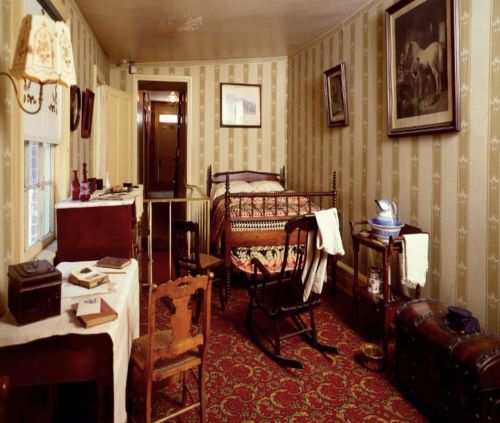
After Lincoln was shot at Ford’s Theater, he was carried across the street to a boarding house where he died the next morning. Dignitaries and family members paid their respects throughout the night, a scene recreated by painter Alonzo Chappel in a monumental canvas that now hangs in a Chicago museum. Chappel crowds all 48 notable people who attended Lincoln’s death into a single scene by stretching the small bedroom to several times its historic size.
To paint the faces, the artist worked from portraits of many of the visitors by the great Civil War photographer Matthew Brady. My granduncle David Kellogg Cartter appears (no.42) at far right. As Chief Justice of the District of Columbia courts, he spent hours that night in a room across the hall, interviewing witnesses to the assassination.
Sources
- “David Kellogg Cartter” Ruth Gertrude Curran, Ohio History Journal, 1933.
- Mr. Lincoln’s White House, the Gilder-Lehrman Institute of American History.
- “Lincoln and the Courts of the District of Columbia” F. Lauriston Bullard, American Bar Association Journal, 1938
- New York Times, Opinionator, “Whale in a Tank,” 12/5/2012
- Eric Foner, Reconstruction: America’s Unfinished Revolution, 1863 – 1877
Originally published by History News Network, 12.14.2021, reprinted with permission for educational, non-commercial purposes.
About the Author