The story of Ciappelletto, who spins his final confession into a rhetorical masterpiece narrating his own superlative virtue.

By Dr. Maggie Fritz-Morkin
Assistant Professor of Italian
University of North Carolina at Chapel Hill
In the first novella of Boccaccio’s 14th-century Decameron, Panfilo tells the story of Ciappelletto, the worst man ever to live (including his impressive catalogue of vice), who spins his final confession into a rhetorical masterpiece narrating his own superlative virtue. His confessor, Burgundy’s most venerable grand master of Scripture, hangs on Ciappelletto’s every word and, after the sick man dies, preaches Ciappelletto’s exemplary saintliness in church. The Burgundians drop everything and run to idolize Ciappelletto, adhering fast to his Christ-like character, lingering ecstatically over the relic of his body before burying it on hallowed grounds. Yet while they venerate Ciappelletto as a saint, there is no question but that the tomb is an idol, an empty fetish. It is a testament to the frisson of blind and impulsive mass piety stirred up by a lone friar who, seduced by a dazzling autobiography, neglects to “fact check” Ciappelletto’s story before publicizing it with all the tacit institutional approval inherent in his pulpit. Score an epic trolling victory for Ciappelletto.
The frame story of the Decameron offers two interpretations of the case of Ciappelletto, both focusing on the culpability of the deceived. Panfilo, introducing his story: “And yet He, from whom nothing is hidden, pays more attention to the purity of the supplicant than to his ignorance or to the damned state of his intercessor.” Neifile reflects on what she’s just heard before beginning her own tale: “In his storytelling Panfilo has shown us how the benevolence of God disregards our errors when they result from something we cannot understand.” Their glosses amount to a shocking apologia for willful ignorance. Why should anyone seek truth if God tolerates our indifference to it? Why should anyone convinced of their own pure intentions worry about committing errors, or about the harm that could follow? Why should institutions fret over what is spoken from their platforms?
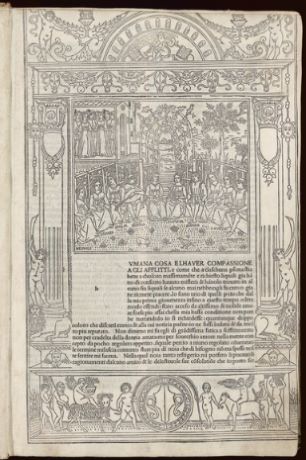
Responsible readers of the Decameron will take Panfilo and Neifile’s interpretations with a grain of salt, since Boccaccio has carefully liquidated all claims to moral authority (including his own) in the work’s Preface and Introduction. The privileged storytellers appear morally bankrupt in their civically negligent plague-time hedonism; Boccaccio subtitles his book with the name of the notorious go-between Galahad, and he declares that the novellas—“stories, or fables, or parables, or histories, or whatever you wish to call them”—may configure their relationship to objective or moral facts in any number of ways. Can any certain truth be extracted from such a book?
It cannot. And that is the one sure lesson of the Decameron: to train its readers to deal with news (novella means just that) that is “fake,” for the world has never faced a shortage of those who deliberately spread misinformation and mislead the public for political and financial gain. Boccaccio recognized the real threat of fake news, the moral hazard of being indifferent to the real and public consequences of our well-intentioned errors. Whether you are reading the Decameron, the news, or the digital publications of your favorite institution, keep in mind the advice of the International Federation of Library Associations and Institutions on how to spot fake news: consider the source, check the author, bear in mind the date of publication, check your biases, read beyond the headline, dig into any supporting sources, ask whether the text is a joke or satire, and consult relevant experts. Recognize provocation, and don’t fan its flames. We are in fact responsible for what we incite.
Resources
- Boccaccio, Giovanni. Decameron. Trans. Wayne Rebhorn. New York: Norton, 2013.
- Borchers, Callum. “‘Fake news’ has now lost all meaning.” Washington Post. February 9, 2017.
- Daston, Lorraine, and Katharine Park. “The Philosophers Against Wonder.” In Wonders and the Order of Nature: 1150-1750. New York: Zone Books, 1998.
- Kurtzleben, Danielle. “With ‘Fake News,’ Trump Moves From Alternative Facts to Alternative Language.”
- Libby Anne. “University of Chicago Professor Compares Milo Yiannopoulis to Jesus.” Patheos. February 22, 2017.
- Livingstone, Josephine. “Notes: A University of Chicago Professor has gone off on Milo Yiannopoulis’ [sic] opponents.” The New Republic. February 21, 2017.
- Perry, David M. “Milo and the University of Chicago Medievalists.” How Did We Get Into This Mess? February 22, 2017.
- Soll, Jacob. “The Long and Brutal History of Fake News.” Politico. February 19, 2017.
Originally published by The University of Chicago Divinity School, 03.02.2017, to the public domain.
About the Author