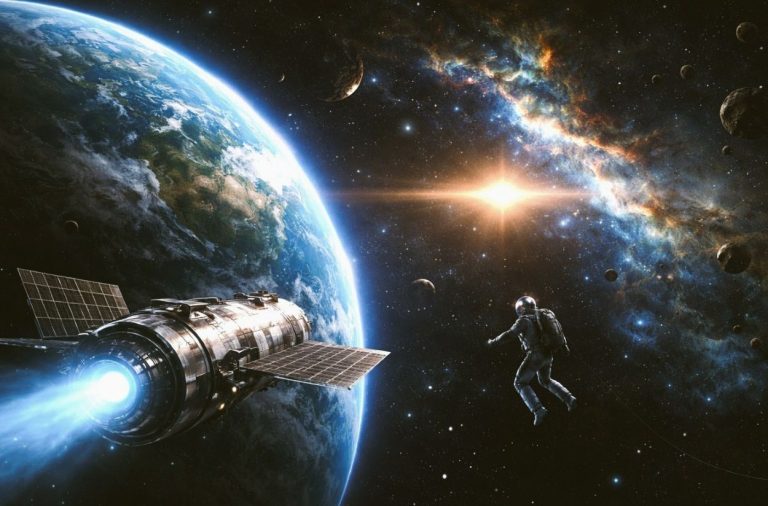
The above illustration of the newly forming exoplanet PDS 70b shows how material may be falling onto the giant world as it builds up mass. By employing Hubble’s ultraviolet light (UV) sensitivity, researchers got a unique look at radiation from extremely hot gas falling onto the planet, allowing them to directly measure the planet’s mass growth rate for the first time.
The planet PDS 70b is encircled by its own gas-and-dust disk that’s siphoning material from the vastly larger circumstellar disk in this solar system. The researchers hypothesize that magnetic field lines extend from its circumplanetary disk down to the exoplanet’s atmosphere and are funneling material onto the planet’s surface. The illustration shows one possible magnetospheric accretion configuration, but the magnetic field’s detailed geometry requires future work to probe.
The remote world has already bulked up to five times the mass of Jupiter over a period of about 5 million years, but is anticipated to be in the tail end of its formation process. PDS 70b orbits the orange dwarf star PDS 70 approximately 370 light-years from Earth in the constellation Centaurus.

The European Southern Observatory’s Very Large Telescope caught the first clear image of a forming planet, PDS 70b, around a dwarf star in 2018. The planet stands out as a bright point to the right of the center of the image, which is blacked out by the coronagraph mask used to block the light of the central star.

Hubble observations pinpoint planet PDS 70b. A coronagraph on Hubble’s camera blocks out the glare of the central star for the planet to be directly observed. Though over 4,000 exoplanets have been cataloged so far, only about 15 have been directly imaged to date by telescopes. The team’s fresh technique for using Hubble to directly image this planet paves a new route for further exoplanet research, especially during a planet’s formative years.
Originally published by Hubblesite, NASA, 04.29.2021, to the public domain.
About the Author