In the 18th-century doctors were as likely as anyone else to solve disputes by dueling with pistols.

By Dr. Russell Moul
Freelance Writer, Editor, Researcher, Project Officer, and Lecturer
Introduction
Although doctors and surgeons are usually associated with healing and the ethics of the Hippocratic Oath, the history of duelling, especially with pistols, provides fascinating instances of their involvement in organised combat. Whether it involved aiding in the organisation of a duel or pulling the trigger as a combatant, medical professionals were deeply entangled in the story of this ritualised form of violence.
The rise of the middle classes and advancements in firearms during the latter half of the 18th century brought with them many changes to the institution of duelling. Whereas traditional sword duels demanded a certain level of skill that was more common among the aristocracy, combat by pistol only required the ability to raise the weapon and pull its trigger.
At the height of the duelling craze in Britain, between around 1770 and 1820, professionals, such as politicians, lawyers, merchants and doctors, who classed themselves as gentlemen, routinely took up arms to demonstrate their rank and protect their reputations.

According to the rules of honour, a gentleman was obliged to address any stain, actual or imagined, on his name. In ‘The British Code of Duel’, 1824, a gentleman who evaded a “justifiable call” would put “himself without the pale of honour”, resulting in his expulsion from “honourable society”.
In military circles, the penalty was harsher still; failure to uphold one’s honour or that of the regiment could result in a court martial and the removal of an officer’s commission. Doctors as a gentrified class, especially those with military backgrounds, were therefore subject to this same code of honour.
Dueling Doctors
In 1719 doctors John Woodward and Richard Mead famously fought with swords outside the gates of Gresham College, London over a medical dispute. According to popular reports, at one point Woodward slipped and fell to Mead’s mercy. When asked to beg for his life, Woodward allegedly replied, “Anything but your physic.”
Woodward and Mead were by no means the only doctors to try to kill one another. In fact, young medical practitioners became so well known for their duelling exploits that The Times represented the typical duellist as a medical student in a satirical piece in 1829. As if to prove the accuracy of the image, in July 1840 two medical students duelled in a park in Edinburgh. Only five months earlier, a physician and a surgeon shot at one another over the right to claim a medical discovery.
Reluctant duellists could demonstrate their courage while not actually participating in violence by refusing to pull the trigger or deliberately aiming wide. One doctor who may have adopted this tactic was Peter Hennis, who was fatally wounded in a duel against Sir John Jeffcott, the Chief Justice of Sierra Leone, outside Exeter in May 1833.
According to a report in Trewman’s Exeter Flying Post, Hannis had “always made up his mind, if he was obliged to go out on an affair of that kind, that he never would fire at his opponent”. Perhaps this was Hennis’s attempt at reconciling his role as a healer with the demands of gentlemanly honour.
The Code of Dueling
Without formalised codes of honour, there was little to distinguish a duel from murder. For centuries, sword fighters had produced various codes that prescribed the rules for combat. The content of these guides differed across location and time, and when pistols replaced swords, a new body of literature arose that was equally numerous and contradictory. However, the new codes did agree on one thing: duels should have a medical attendant.
It is “expedient that a surgeon should attend each of the parties”, explained ‘The British Code of Duel’, and “whenever possible, a gentlemen should be selected who has had some practice in gun-shot wounds”. Gunshot wounds were usually the product of war and so lay beyond the experience of many practitioners. Nevertheless, an attending surgeon summoned by one party was expected to act impartially and come to the aid of the injured, even if they were from the opposing party.
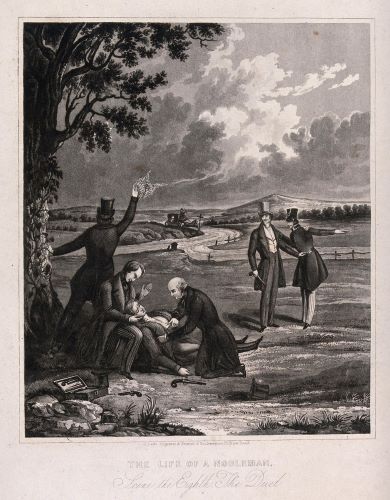
Given that duelling was illegal, the codes also advised surgeons against getting too involved in the dispute itself. ‘The British Code of Duel’ recommended surgeons “remain out of sight, though at but a small distance, till called upon by the seconds”, thus reducing the likelihood of being prosecuted as an accessory to murder.
The Mischief of a Gunshot Wound
In ‘The Art of Duelling’, 1836, the anonymous writer specified that “medical attendants” should bring “all the necessary apparatus for tying up wounds or arteries, and extracting balls”. This was a delicate procedure as, according to John Hunter, the famous Scottish surgeon, “Gun-shot wounds are often such as do much mischief to vital parts.”
There were, as Hunter explained in his ‘A Treaties on Inflammation, Blood, and Gun-shot Wounds’ in 1794, two types of gunshot wound – simple and compound. Simple wounds were caused by a ball that only passed through the muscles and tissues. Compound wounds, on the other hand, were caused by a ball that fractured bones or penetrated “some viscus, or contained part”, such as the brain, lungs, heart or abdominal organs.

Compound wounds, especially those of the abdomen, were a serious challenge for surgeons. Hunter conceded that “very often nothing can be done for the patient under such wounds”. He illustrated this point with the case of a duel between two colonels returning from the American War of Independence in 1783.
During the exchange, Lieutenant Colonel Thomas was hit by a ball that penetrated his right side and ended up lodged in his abdominal wall after damaging his colon. Although the ball was removed immediately, Thomas died of his wounds the next day and his autopsy found his abdomen contained “putrid air”, “about a quart” of fluid blood, and “coagulum upon the intestines”.

If a wounded duellist survived the initial injury caused by the ball entering their body, they were still vulnerable to infection. This was particularly the case if the ball carried a piece of clothing or wadding into the body when it entered. Although the height of the duelling craze pre-dated bacteriological explanations of infection, experienced military surgeons still recognised the risk of contaminated wounds.
The author of ‘The Art of Duelling’ noted that flannel underwear should be avoided during a duel because, “Wounds, comparatively trifling, have often become dangerous from parts of the flannel clothing being carried into them, particularly in warm climates.”
Caught between Honor and Death

The history of medical participation in duelling is complex but illustrative of how ideas about professional conduct, ethics and individual honour have changed since the 19th century. Regardless of the violent nature of duelling, doctors were expected to deliver assistance to injured duellists and to maintain their impartiality, even if they risked being charged as accessories to murder.
Yet the doctors who took up arms to defend their own honour reveal just how embedded these practitioners were in the social customs and traditions of their age. In these relatively rare instances, a doctor’s standing and value could be measured both by their willingness to save life, and their willingness to take it.
Originally published by Wellcome Library, 11.09.2021, under the terms of Creative Commons Attribution 4.0 International license.
About the Author