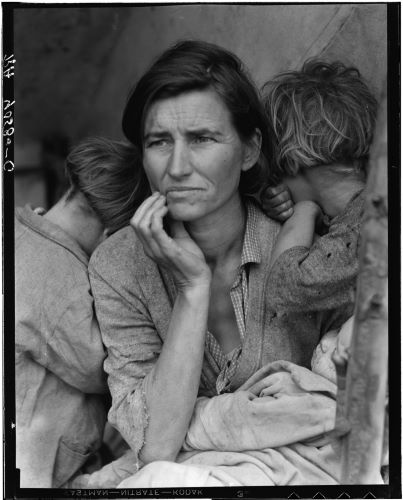
In an account written in 1960, Lange describes her interaction with the central figure of the photograph.

By Dr. Kris Belden-Adams
Associate Professor of Art History
University of Mississippi
Introduction
Writing in Popular Photography three decades after taking this photograph, Dorothea Lange explained that the making of Migrant Mother—arguably among the most famous photographs ever taken—almost did not happen.2 It was raining, and the dirt roads were flooding. Lange already had a full box of rolls of film to mail to her Washington, D.C.-based Resettlement Administration supervisor, and her work on that month-long assignment was finished. Her bags were packed in the car, and Lange was tired and eager to get home to her husband in Berkeley. Upon seeing the crude sign reading “PEA-PICKERS CAMP,” Lange confessed:
I didn’t want to stop, and didn’t. I didn’t want to remember that I had seen it, so I drove on and ignored the summons. … Having well convinced myself for twenty miles that I could continue on, I did the opposite. Almost without realizing what I was doing, I made a U-turn on the empty highway.3
She eventually did turn around, and toward the camp of 2,500 out-of-work migratory agriculture workers. At that moment, Lange noticed what she described as a “hungry and desperate mother” surrounded by her children and crowded under a makeshift tent. She took seven photographs—only five were deemed by Lange to be good enough to send to Washington, D.C., after she retouched the negative to make a thumb at the right edge of the picture plane of the Migrant Mother less apparent to viewers.4
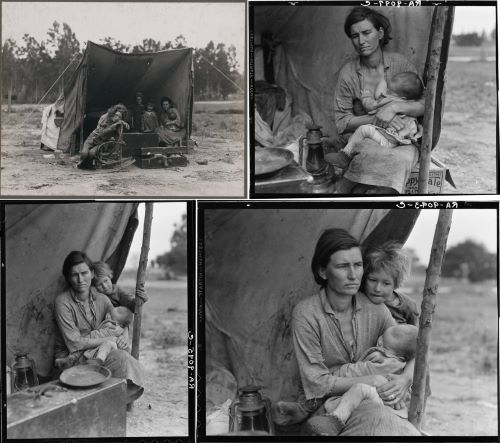
In an account written in 1960, Lange describes her interaction with the central figure of the photograph (originally titled Destitute Pea Pickers in California. Mother of Seven Children. Age Thirty-Two. Nipomo, California), a newly widowed, Cherokee woman, Florence Owens, who shortly would become known as “Migrant Mother”:
I did not ask her name or her history. She told me her age, that she was thirty-two. She said that they had been living on frozen vegetables from the surrounding fields, and birds that the children killed. She had just sold the tires from her car to buy food. There she sat in that lean-to tent with her children huddled around her, and seemed to know that my pictures might help her, and so she helped me. There was a sort of equality about it. The pea crop at Nipomo had frozen and there was no work for anybody. But I did not approach the tents and shelters of other stranded pea-pickers. It was not necessary; I knew I had recorded the essence of my assignment.5
The Making of an Iconic Photograph
The essence of Lange’s assignment—and the mission of all Resettlement Administration/Farm Security Administration photographers’ work—was to capture iconic, memorable images of agricultural workers that roused support for President Franklin Delano Roosevelt’s New Deal relief programs. Migrant Mother—which reveals an anxious mother holding a baby as two of her other children bury their heads on her shoulders—draws on the familiar trope of the Madonna and Child in Christian art as it evokes sympathy and, ideally, a spirit of humanitarian generosity toward its subjects.
The Resettlement Administration’s (RA) and Farm Security Administration (FSA) employed a team of photographers who created one of the largest and most comprehensive documentary-photography projects in U.S. history covering the Great Depression. It is housed by the Library of Congress.
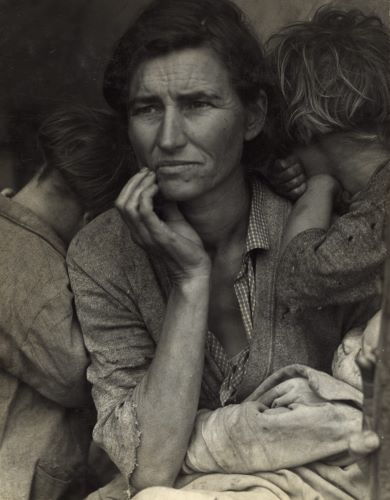
Lange’s supervisor, Roy Stryker, believed this image encapsulated the goals of RA/FSA most succinctly:
When Dorothea took that picture, that was the ultimate. She never surpassed it. To me, it was the picture of Farm Security. The others were marvelous but that was special.6
As an icon, the photograph Migrant Mother is larger than one woman’s story. Instead, the pictured mother stands for the plight of suffering, poverty, and uncertainty among rural laborers during the Great Depression. Migrant Mother immediately was (and still is) circulated by the U.S. government, free of charge, to the press and the public.7
Beyond Iconicity: Misrepresenting ‘Migrant Mother’s’ Story
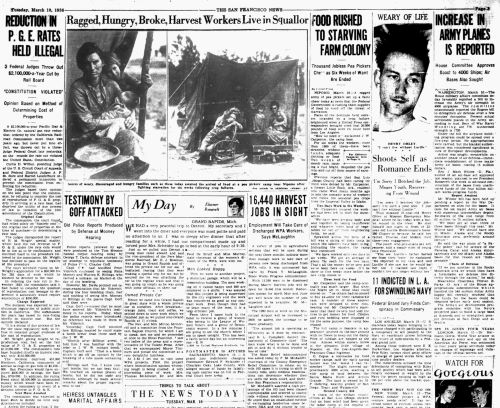
Migrant Mother provided such a persuasive, straightforward, and iconic image of a destitute, worried mother concerned about providing for her children that a sympathetic public and government sent a total of $200,000 in aid and free medical care to the pea-picker’s camp three days later.8 Sadly, by that time, Owens and her children already had moved on to find other work. She never got to take advantage of the “help” Lange promised the photograph would bring.
Despite caption information provided by Lange, Owens’s family did have a car, which her soon-to-be future husband (Jim Hill) had taken to buy parts and repair.9 That car had all of its tires, and Hill would return in it to retrieve Owens and her 6 (not 7) children, so they could leave the 2,500-person pea-picker’s camp, which would shortly be raided by locals who arrested and beat its remaining inhabitants.10
As historian Milton Meltzer noted, Lange’s caption-writing and note-taking habits were lax, and tracking the details of her subjects and their circumstances frequently took a backseat to photographing.11 Lange acknowledged these allegations of misrepresenting Owens, and claimed that the image did more good than harm.
Living in the Shadow of the Photograph’s Iconicity
Although Owens and her children were not abandoned to starve to death, and would survive the Great Depression, she resented being associated with the Migrant Mother photograph for the rest of her life, her daughter attests: “She was a very strong woman. She was a leader. I think that’s one of the reasons she resented the photo — because it didn’t show her in that light.”12 Rather, the iconic image transcended Owens’s actual story and became a part of a U.S. macro-narrative of suffering and motherly fortitude during the Great Depression.
Owens—a woman of color—felt forever stereotyped as the destitute, suffering mother, trapped in poverty by the repeated reproductions of her image that appeared in newspapers, magazines, art exhibitions, on the pages of our history books, and on postage stamps, t-shirts, parodic magazine illustrations, and trinkets. In 1958, after Migrant Mother was included in exhibitions and published widely for two decades, Owens wrote a letter to one publication, U.S. Camera, and insisted on being consulted about future plans to publish the image. She asked for all copies of that issue of U.S. Camera to be recalled.13 Because neither Lange nor any of the publications made money from the photograph, they did not offer Owens compensation. Instead, Lange apologized and offered sympathy to the woman whose individual story and likeness were co-opted to fulfill a political program’s narrative.
Appendix
Endnotes
- Roger Sprague, “Migrant Mother: The Story as Told By Her Grandson.”
- Martha Rosler, Decoys and Disruptions: Selected Writings, 1975–2001 (Cambridge, MA: The MIT Press, 2004), p. 184. In this essay, Rosler suggests that Migrant Mother was the most widely reproduced photograph in the world.
- Dorothea Lange, “The Assignment I’ll Never Forget,” Popular Photography (Feb. 1960), pp. 42–43, 128. Reprinted in Illuminations: Women Writing on Photography from the 1850s to the Present, edited by Liz Heron and Val Williams (New York: I.B. Taurus, 1996), pp. 151–52.
- Sarah Meister, “Piecing Together Dorothea Lange’s Migrant Mother,” Museum of Modern Art (Feb. 6, 2020).
- Lange, “The Assignment I’ll Never Forget” (1960), in Illuminations (1996) pp. 151–52. In many accounts, Florence Owens is identified as Florence Owens Thompson. However, she would not marry George Basil Thompson until 1949, and kept the name Owens after the death of her first husband, Cleo Owens, in 1931: “Florence Owens Hills,” April 16, 1940, Census Records, Kern County, California, Sheet 8B, S.D. No.10, E.D. Nos. 15–44, Line 75. Department of Commerce—Bureau of the Census.
- Milton Meltzer, Dorothea Lange: A Photographer’s Life (New York: Farrar, Straus, Giroux, 1978), p. 133. Italics are Meltzer’s emphasis.
- See “Dorothea Lange’s ‘Migrant Mother’ Photographs in the Farm Security Administration Collection,” Library of Congress.
- Linda Gordon, Dorothea Lange: A Life Beyond Limits (New York: W.W. Norton & Co., 2009), p. 237. The photograph was first published in The San Francisco News on March 10, 1936.
- Sprague, “Migrant Mother.”
- Gordon (2009), pp. 236–37.
- Meltzer (1978), p. 131.
- Owens’s unnamed daughter is quoted in: Geoffrey Dunn, “Photographic License,” San Jose Metro (January 19–25, 1995), p. 22.
- Gordon (2009), p. 241.
Additional Resources
- This photograph at LACMA
- This photograph at the Library of Congress
- Linda Gordon, Dorothea Lange: A Life Beyond Limits (New York: W.W. Norton & Co., 2009).
- Robert Hariman and John Louis Lucaites, No Caption Needed: Iconic Photographs, Public Culture, and Liberal Democracy (Chicago: University of Chicago Press, 2007), pp. 53–67 (excerpt here).
- Sarah Meister, Dorothea Lange: Migrant Mother (New York: Museum of Modern Art, 2019).
- Sally Stein, Migrant Mother, Migrant Gender (London: MACK Books, 2020).
Originally published by Smarthistory, 08.14.2023, under a Creative Commons Attribution-NonCommercial-ShareAlike 4.0 International license.
About the Author