“Damnation seize my soul.”

By Eli Wizevich
History Correspondent
Smithsonian Magazine
Something unthinkable happened during the summer of 1718. Edward Teach, the infamous pirate known as Blackbeard, decided to give up piracy—at least ostensibly—in exchange for a royal pardon from the governor of North Carolina absolving him and his men of all wrongdoing.
This was a great deal for the pirates, whose wrongdoing was extensive. But Blackbeard’s lawfulness—and his life—didn’t last long.
Just a few months prior, Blackbeard and his small pirate flotilla had blockaded Charleston, South Carolina, for close to a week. He plundered ships, took hostages and “struck a great terror to the whole Province of Carolina,” according to the pseudonymous author Captain Charles Johnson.
But with his new veneer of legality, Blackbeard appeared to settle down. He married the daughter of a local planter and moved into a house in Bath, North Carolina, just down the street from the governor who’d pardoned him.
Blackbeard “had bought the loyalty of a colonial governor,” writes historian Colin Woodard in The Republic of Pirates, “but had yet to accumulate the sort of fortune that would allow him to live like a king for the rest of his days. Therefore, after a few weeks of rest, he returned to work.”
Alexander Spotswood, lieutenant governor of the Colony of Virginia, had no patience for Blackbeard, especially after he trampled over the terms of his plea deal in late August to capture two unarmed French ships.
In November 1718, Spotswood issued an official proclamation offering 100 pounds to anyone who could produce evidence of having killed “Edward Teach, commonly called Captain Teach, or Blackbeard.” (The reward for any other pirate captain was just 40 pounds.)
To ensure Blackbeard was neutralized, Spotswood gave Robert Maynard, an officer in the Royal Navy, control of 60 men and two sloops—small sailboats that lacked cannons but could pursue Blackbeard in the narrow inlets and shallows of the coast.
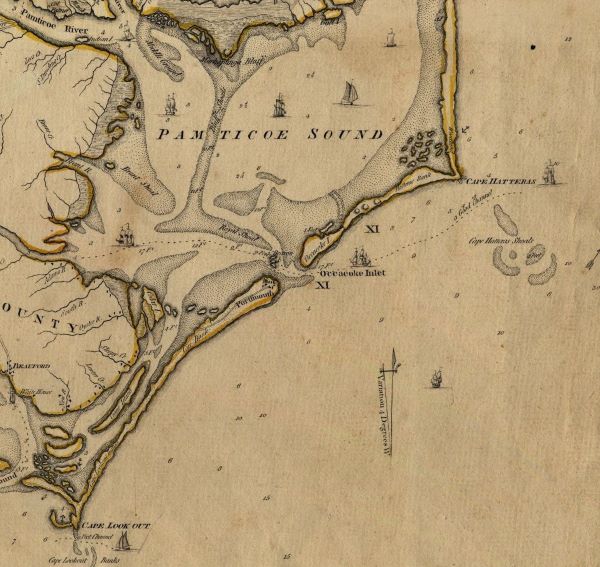
On November 17, the Ranger and the Jane made their way north from Virginia’s James River toward the barrier islands of North Carolina.
“This expedition was made with all imaginable secrecy,” Johnson wrote. On the night of November 21, Maynard and his men spotted Blackbeard’s boat near Ocracoke Island.
Although they were far outgunned, they attacked the next morning as Blackbeard’s crew slept off a night of rowdy drinking. The advantage of surprise only lasted briefly: The Jane ran aground, and once Blackbeard’s boat got going, it was deadly.
“Damn you for villains, who are you? And, from whence came you?” Blackbeard reportedly yelled as his boat pulled close to the Ranger.
“You may see by our colors we are no pirates,” Maynard, whose sloop was flying the British flag, responded. Blackbeard taunted Maynard to come aboard his boat, to which Maynard implied that he would—but only by force.
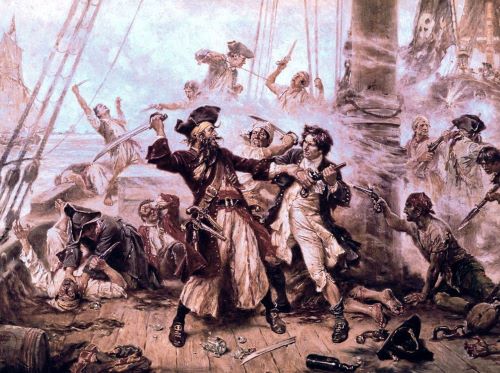
“Damnation seize my soul if I give you quarters, or take any from you,” Blackbeard said, taking a swig of liquor. Maynard then said he “expected no quarters from him, nor should he give him any.”
After pulling close enough to Maynard’s sloop to conduct this conversation, Johnson reported, Blackbeard’s better-armed boat then launched a salvo of grapeshot—“A fatal stroke to them!” Twenty men on Maynard’s sloop died, and Blackbeard presumed the rest of the crew dead. With victory at hand, he and his men boarded the Ranger to finish off the stragglers and claim the sloop.
But Maynard and his men were not dead—they were hiding on the deck and in the hold and leapt up for close combat with the pirates. In a melee of swords, daggers and pistols, Maynard’s men, most of them injured, overwhelmed Blackbeard, leaving him shot five times and cut 20.
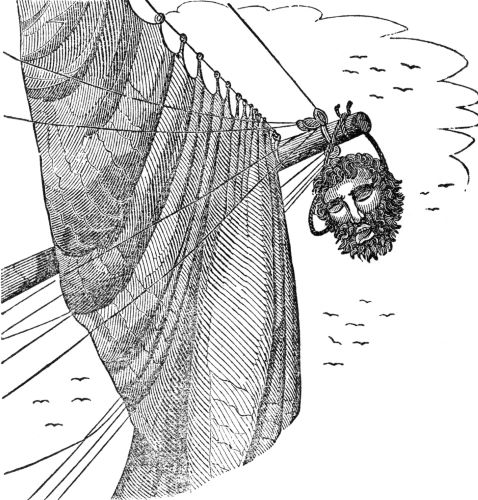
As the pistol smoke settled, Maynard “caused Blackbeard’s head to be severed from his body,” Johnson wrote. He strung the pirate’s head from the boat’s bowsprit, where it dangled as the sloop sailed back to Virginia with 14 prisoners. Blackbeard, the scourge of the seas and the Southern Colonies, was at long last dead on this day in 1718.
Originally published by Smithsonian Magazine, 11.22.2024, reprinted with permission under a Creative Commons license for educational, non-commercial purposes.
About the Author