Eventually, graphics on congressional campaign fans became less ornamental.

Curated/Reviewed by Matthew A. McIntosh
Public Historian
Brewminate
Before air conditioning, portable, collapsible, and durable handheld fans were a necessity in the hot months. For congressional candidates, summertime made fans the perfect giveaway at parades, rallies, and “any kind of places where people congregate regularly in hot weather,” as one proponent noted. The House Collection contains breezemakers from a century’s worth of sweltering campaigns.
The oldest fan in the House is Ebenezer Hill’s 1918 version, with a postcard-perfect farmhouse on one side and the Connecticut primary date on the other. Hill was in step with the national craze for advertising on fans. Between 1920 and 1930, three major firms produced 25 million fans each year for companies to use as giveaways. Candidates like Hill could buy rigid screen fans like this in any amount, with a stock image on one side, and print a campaign message on the reverse. Sometimes the same image used by congressional candidates would show up on giveaways used as advertisements by dentists or for pianos.

Joe Evins, first elected to Congress in 1946, was a fan of fans, using more than one style for his campaigns. A 1950 version closely resembled Hill’s. A colorful landscape—this time, a view of the Washington Monument—appears on one side and information about the candidate on the other. For the other design, Evins touted his sterling character as a “proven friend of the people” on one side of the fan and used the expandable panels to show the entire U.S. Capitol on the other.

Eventually, graphics on congressional campaign fans became less ornamental, abandoning pretty pictures for straightforward politicking. National party conventions drove the change. Hordes of politically minded delegates relished wielding their candidate’s photo and slogans. And wield them they did! Even with all the windows open, convention halls were swampy places, where only handheld fans rustled up wisps of breeze. In 1928, the Massachusetts Democratic Party was so nervous about scorching temperatures during the upcoming convention in Houston that they “voted to furnish 30,000 attractive souvenir fans for use of the delegates.” One example of the simpler design is Rogers C.B. Morton’s fan from 1968. Red, white, and blue are the only colors, accompanied by the simple legend, “Vote for Rogers C.B. Morton.”

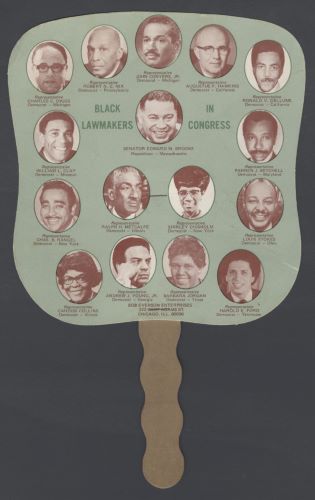
Not all fans were for campaigns, however. Two fans in the House Collection publicize the achievements of African Americans in Congress. The older of the two, from the 1950s, shows the four Black Members of Congress surrounding an image of the Capitol. By the 1970s, the number had grown to 16 and edged out any extraneous illustrations. The fans were distributed by a North Carolina insurance company with strong ties in the African-American community. They published at least three iterations of this theme over the decades it took for the Black membership in Congress to grow from the handful of the 1950s to a group large enough to found the Congressional Black Caucus and, soon thereafter, to a number so large it would never fit on a fan’s surface again.
Bibliography
- Edmund B. Sullivan, Collecting Political Americana (Hanover, MA: Christopher Publishing House, 1991)
- Charles Reagan Wilson, Judgment and Grace in Dixie: Southern Faiths from Faulkner to Elvis (Athens, Ga.: University of Georgia Press, 1995)
- Boston Daily Globe, June 6, 1928.
Originally published by the Office of the Historian, United States House of Representatives, 07.06.2016, to the public domain.
About the Author