There is no country where libertarianism has succeeded and produced general peace and prosperity.

By Thom Hartmann
The Hartmann Report
Usually it’s Republican politicians bragging that they’re “more libertarian than conservative” but this time it’s a former Democrat, Bobby Kennedy Jr., who’s reportedly thinking of running for president on the Libertarian Party ticket.
This bizarre experiment of libertarianism — now officially a political party with ballot access in all 50 states — has been promoted by the billionaire class ever since World War II. And it’s literally killing some of us, along with threatening our democratic republic.
Reporter Mark Ames documents how, back in the 1940s, a real estate lobbying group came up with the idea of creating a new political party to justify deregulating the real estate and finance industries so they could make more money.
This new “Libertarian Party” would give an ideological and political cover to their goal of becoming government-free, and they developed an elaborate pretense of governing philosophy around it.
Their principal argument was that if everybody acted separately and independently, in all cases with maximum selfishness, such behavior would actually benefit society. There would be no government needed beyond an army and a police force, and a court system to defend the rights of property owners. It was a freakish twisting of Adam Smith’s reference to the “invisible hand” that regulated trade among nations.
They pretend that things will simply run themselves, but they’re wrong: gutting government leaves a huge power vacuum that will inevitably be filled by the nation’s oligarchs. That’s how it’s worked all over the world for 7,000 or more years.
Nonetheless, they keep insisting that if we just kill off “big government,” America will become a paradise.
If that sounds bizarre, it’s because it is. Just turn everything over to the morbidly rich and let them and their companies run the entire country along profit motive lines? What could possibly go wrong?
Which is why there’s one question that always stops Libertarians dead in their tracks when they come on or call into my radio/TV program to proclaim the wonders of their political ideology:
“Please name one country, anywhere in the world, any time in the last 7000 years, where libertarianism has succeeded and produced general peace and prosperity?”
There literally is none. Nowhere. Not a single one. It has never happened. Ever.
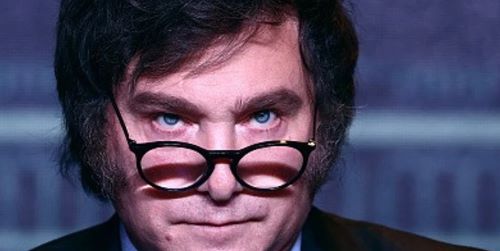
Louise and I were in Argentina during their election in November, and Javier Milei, the new president, claims he’s going to impose libertarianism on that country to fix their economic woes. So far, though, he’s just making inflation worse and causing millions to lose benefits as he shuts down the Argentine social safety net.
Again, no country in history has ever made libertarianism work.
If it had, that country would be on the tip of every Libertarian’s tongue, the way Democratic Socialists talk about Scandinavia where the full-on Social Democracy and regulated capitalism experiment has succeeded for generations.
George W. Bush and Don Rumsfeld tried to use Iraq as an experiment to prove libertarianism could work. They sent over an ideologue named L. Paul Bremmer, who shut down virtually all the nation’s government-owned businesses (about half of the nation’s GDP) and disbanded virtually all of Iraq’s regulatory agencies. He cut corporate taxes to almost zero and let foreign corporations take all the profits out of the country they wanted. He ended all government import and export controls.
The result, predictably, was chaos. As thieves made off with over 170,000 priceless artifacts from the Baghdad museum after he’d crippled the guards, libertarian Rumsfeld was reduced to blithering nonsense.
“The images you are seeing on television, you are seeing over and over and over,” he joked. “It’s the same picture of some person walking out of some building with a vase and you see it twenty times. And you think, my goodness, were there that many vases?”
After the assembled reporters finished laughing at the joke, Rumsfeld tossed in the punch line:
“Is it possible that there were that many vases in the whole country?”
Turns out there were, although not anymore. Now they’re in the private collections of billionaires all around the world.
There are, of course, examples of governments that unintentionally operate broadly along libertarian lines. In the 1980s when I was setting up international relief projects with the Salem organization based out of West Germany, I worked in several such countries.
Back in 1981, I went to Uganda and set up a famine relief program that still runs there. This excerpt from my diary, later published in my autobiography The Prophet’s Way, gives a glimpse of what we found in a country with a government whose only function at the time was police and the army, per the libertarian ideal: it was an absolute hell, filled with people literally starving to death in front of us.
Countries like Uganda at that time were places where the government’s only real function is to run the army, police and the courts, just like libertarians say America should be run. No social safety net, no Social Security, no national healthcare, no or few state-funded public schools, no publicly funded infrastructure of any consequence.
A few years back, talkshow host Joe Madison (“The Black Eagle” on SiriusXM daily) and I saw similar conditions in South Sudan on the border of Darfur as the northern Sudan government was burning people out of their homes and the group we were with was flooded by tens of thousands of refugees.
In parts of Colombia in the 1980s, after a bomb went off just a block from where I was staying, we heard stories of middle-class men in the next neighborhood over who’d organized an urban “hunt club,” complete with logos and patches, using high-powered rifles to pursue what they described as “feral children” who were “causing crime.”
Kidnapping was also a major industry in Colombia then: a friend in Bogota was kidnapped and repeatedly raped while her husband, forced to listen to her screams on the phone, frantically tried to raise enough money to pay her ransom. I later met with them both and heard the story firsthand.
In those countries that, because of corruption, civil war, or oligarchic ideology run along Ayn Rand/Rand Paul libertarian lines, the roads, utilities and housing are fine in small, wealthy neighborhoods that can provide for themselves, but the rest of the country is potholed and dark and people often have to walk miles to get firewood, food, or fresh water every day.
There are few or no taxes for the very rich in such countries, and no resources at all for the very poor except those provided by international relief agencies like the one I worked with.
We generally referred to those countries as “failed states.” Rand Paul would probably describe them as “Libertarian paradises,” as his father advocated when, during a presidential primary debate, he said people shouldn’t be let into hospital emergency rooms unless they can pay.
“That’s what freedom is all about, taking your own risks,” Paul said.
No country has ever succeeded when its government has suffered the fate that multimillionaire K Street Lobbyist Grover Norquist wished on America when he famously told NPR:
“I don’t want to abolish government. I simply want to reduce it to the size where I can drag it into the bathroom and drown it in the bathtub.”
The Libertarian Party, boosted for years by the morbidly rich, has been picking up steam in the past few decades.
In 1980, billionaire David Koch ran for vice president on the newly formed Libertarian Party ticket. His platform was to privatize the Post Office, shut down all public schools, privatize Medicare and Medicaid, end food stamps and all other forms of “welfare,” deregulate all corporate oversight, and sell off much of the federal government’s land and other assets to billionaires and big corporations.
Since then, Libertarian billionaires and right-wing media have been working hard to get Americans to agree with Ronald Reagan’s statement from his first inaugural address that, “[G]overnment is not the solution to our problem; government is the problem.”
Trump tried really hard to get us there. During his presidency, every federal agency of any consequence was run by a lobbyist or former industry insider.
The Labor Department was trying to destroy organized labor; the Interior Department was selling off our public lands; the EPA was promoting deadly pesticides and allowing more and more pollution; the FCC was dancing to the tune of giant telecom companies and even ended net neutrality; the Education Department was actively working to shut down and privatize our public school systems; the USDA was shutting down food inspections; the Defense Department was run by a former weapons lobbyist; even the IRS and Social Security agencies had been gutted, with tens of thousands of their employees offered early retirement or laid off so that very, very wealthy people are no longer being audited and the wait time for a Social Security disability claim is now over two years, which Republicans hope will justify privatizing the system like they’re doing with Medicare.
The guy Trump put in charge of the Post Office is still actively destroying the Post Office, Trump removed the United States from the Paris Climate Agreement, and fossil fuel lobbyists ran America’s response to global warming for four long years.
Our nation’s response to the coronavirus was turned over to private testing and drug companies, and the Trump administration refused to implement any official government policy, with Health and Human Services Secretary Alex Azar saying that it’s all up to “individual responsibility.”
The result was more than a million dead Americans, half of those deaths completely unnecessary and preventable had our government done its job as well as most other developed countries did.
While the Libertarian ideas and policies promoted by that real estate lobbying group that invented the Libertarian Party have made CEOs and billionaire investors very, very rich, it’s killing the rest of us.
In the 1930s and 1940s, Franklin Delano Roosevelt put America back together after the Republican Great Depression and built the largest and wealthiest middle class in the history of the world at the time.
Now, 43 years of libertarian Reaganomics have gutted the middle class, made a handful of oligarchs wealthier than anybody in the history of the world, and brought an entire generation of hustlers and grifters into public office via the GOP.
When America was still coasting on FDR’s success in rebuilding our government and institutions, nobody took very seriously the crackpot efforts to tear it all down.
Now that they’ve had 40 years to make their project work, we’re hitting peak Libertarianism and it’s tearing our country apart, pitting Americans against each other, and literally killing hundreds of people every day.
Which shouldn’t surprise us, given that Ayn Rand and her sociopathic heroes are at the core of most Libertarians’ worldview.
Reagan wasn’t just echoing the Libertarian vision; he was also endorsing Ayn Rand’s “objectivist” view of the world, which traces its roots to a murderous psychopath in 1927.
Back in 2015, Donald Trump told USA Today’s Kirsten Powers that his favorite book was Ayn Rand’s raped-girl-decides-she-likes-it novel, “The Fountainhead.”
“It relates to business, beauty, life and inner emotions,” he told Powers. “That book relates to … everything.”
Ayn Rand’s novels have informed libertarian Republicans like former Speaker of the House of Representatives and current Fox News board member Paul Ryan, who required interns to read her books when they joined his staff.
Powers added, “He [Trump],” told her that he “identified with Howard Roark, the protagonist who designs skyscrapers and rages against the establishment.”
Rand’s hero Roark, in fact, “raged” so much in her novel that he blew up a public housing project with dynamite.
Rand, in her Journals, explained where she got her inspiration for Howard Roark and the leading male characters in so many of her other novels. She writes that the theme of The Fountainhead, for example, is:
“One puts oneself above all and crushes everything in one’s way to get the best for oneself.”
On Trump’s hero Howard Roark, she wrote that he:
“…has learned long ago, with his first consciousness, two things which dominate his entire attitude toward life: his own superiority and the utter worthlessness of the world. He knows what he wants and what he thinks. He needs no other reasons, standards or considerations. His complete selfishness is as natural to him as breathing.”
It turns out that Roark and many of her other characters were based on a real person. The man who so inspired Ayn Rand’s fictional heroes was named William Edward Hickman, and he lived in Los Angeles during the Roaring Twenties.
Ten days before Christmas in 1927, Hickman, a teenager with slicked dark hair and tiny, muted eyes, drove up to Mount Vernon Junior High School in Los Angeles and kidnapped Marion Parker — the daughter of a wealthy banker in town.
Hickman held the girl ransom, demanding $1,500 from her father — back then about a year’s salary. Supremely confident that he would elude capture, Hickman signed his name on the ransom notes, “The Fox.”
After two days, Marion’s father agreed to hand over the ransom in exchange for the safety of his daughter. What Perry Parker didn’t know is that Hickman never intended to live up to his end of the bargain.
The Pittsburgh Pressdetailed what Hickman, in his own words, did next.
“It was while I was fixing the blindfold that the urge to murder came upon me,” he said. “I just couldn’t help myself. I got a towel and stepped up behind Marion. Then, before she could move, I put it around her neck and twisted it tightly.”
Hickman didn’t hold back on any of these details: like Rand, he was proud of his cold-bloodedness.
“I held on and she made no outcry except to gurgle. I held on for about two minutes, I guess, and then I let go. When I cut loose the fastenings, she fell to the floor. I knew she was dead.”
“After she was dead I carried her body into the bathroom and undressed her, all but the underwear, and cut a hole in her throat with a pocket knife to let the blood out.”
Hickman then dismembered the child piece-by-piece, putting her limbs in a cabinet in his apartment, and then wrapped up the carved-up torso, powdered the lifeless face of Marion Parker, set what was left of her stump torso with the head sitting atop it in the passenger seat of his car, and drove to meet her father to collect the ransom money.
He even sewed open her eyelids to make it look like she was alive.
On the way, Hickman dumped body parts out of his car window, before rendezvousing with Marion Parker’s father.
Armed with a shotgun so her father wouldn’t come close enough to Hickman’s car to see that Marion was dead, Hickman collected his $1,500, then kicked open the door and tossed the rest of Marion Parker onto the road. As he sped off, her father fell to his knees, screaming.
Days later, the police caught up with a defiant and unrepentant Hickman in Oregon. His lawyers pleaded insanity, but the jury gave him the gallows.
To nearly everyone, Hickman was a monster. The year of the murder, the Los Angeles Times called it “the most horrible crime of the 1920s.” Hickman was America’s most despicable villain at the time.
But to Alissa Zinovievna Rosenbaum, a 21-year-old Russian political science student who’d arrived in America just two years earlier, Hickman was a hero.
Alissa was a squat five-foot-two with a flapper hairdo and wide, sunken dark eyes that gave her a haunting stare. Etched into those brooding eyes was burned the memory of a childhood backlit by the Russian Revolution.
She had just departed Leninist Russia where, almost a decade earlier, there was a harsh backlash against the Russian property owners by the Bolsheviks. Alissa’s own family was targeted, and at the age of 12 she watched as Bolshevik soldiers burst into her father’s pharmacy, looted the store, and plastered on her Dad’s doors the red emblem of the state, indicating that his private business now belonged to “the people.”
That incident left such a deep and burning wound in young Alissa’s mind that she went to college to study political science and vowed one day she’d become a famous writer to warn the world of the dangers of Bolshevism.
Starting afresh in Hollywood, she anglicized her name to Ayn Rand, and moved from prop-girl to screenwriter/novelist, basing the heroes of several of her stories on a man she was reading about in the newspapers at the time. A man she wrote effusively about in her diaries. A man she hero-worshipped.
William Edward Hickman was the most notorious man in American in 1928, having achieved the level of national fame that she craved.
Young Ayn Rand saw in Hickman the “ideal man” she based The Fountainhead on, and used to ground her philosophy and her life’s work. His greatest quality, she believed, was his unfeeling, pitiless selfishness.
Hickman’s words were carefully recounted by Rand in her Journals. His statement that, “I am like the state: what is good for me is right,” resonated deeply with her. It was the perfect articulation of her belief that if people pursued their own interests above all else — even above friends, family, or nation — the result would be utopian.
She wrote in her diary that those words of Hickman’s were, “the best and strongest expression of a real man’s psychology I ever heard.”
Hickman — the monster who boasted about how he had hacked up a 12-year-old girl — had Rand’s ear, as well as her heart. She saw a strongman archetype in him, the way that people wearing red MAGA hats see a strongman savior in Donald Trump.
As Hickman’s murder trial unfolded, Rand grew increasingly enraged at how the “mediocre” American masses had rushed to condemn her Superman.
“The first thing that impresses me about the case,” Rand wrote in reference to the Hickman trial in early notes for a book she was working on titled The Little Street, “is the ferocious rage of the whole society against one man.”
Astounded that Americans didn’t recognize the heroism Hickman showed when he proudly rose above simply conforming to society’s rules, Rand wrote:
“It is not the crime alone that has raised the fury of public hatred. It is the case of a daring challenge to society. … It is the amazing picture of a man with no regard whatever for all that society holds sacred, with a consciousness all his own.”
Rand explained that when the masses are confronted with such a bold actor, they neither understood nor empathized with him.
Thus, “a brilliant, unusual, exceptional boy [was] turned [by the media] into a purposeless monster.”
The protagonist of the book that Rand was writing around that time was a boy named Danny Renahan. In her notes for the book, she wrote, “The model for the boy [Renahan] is Hickman.” He would be her ideal man, and the archetype for a philosophical movement that would transform a nation.
“He is born with the spirit of Argon and the nature of a medieval feudal lord,” Rand wrote in her notes describing Renahan. “Imperious. Impatient. Uncompromising. Untamable. Intolerant. Unadaptable. Passionate. Intensely proud. Superior to the mob… an extreme ‘extremist.’ … No respect for anything or anyone.”
Rand wanted capitalism in its most raw form, uncheck by any government that could control the rules of the market or promote the benefits of society. Such good intentions had, after all, caused the hell she’d experienced in the Bolshevik Revolution.
Ayn Rand, like Hickman, found peace and justification in the extremes of her economic, political, and moral philosophy. Forget about democratic institutions, forget about regulating markets, and forget about pursuing any policies that benefit the majority at the expense of the very rich — the petty political rule-makers and rule-enforcers could never, ever do anything well or good.
Sadly, most Americans are so completely unaware either of the history of libertarianism or its promises that politicians are still willing to call themselves Libertarians or consider running for president on the party’s ticket. Neither Milei nor Kennedy will ever make it work, in Argentina or America, because libertarianism is a scam.
But if America is to survive as a functioning democratic republic, we must repudiate the “greed is good” ideology of libertarianism, get billionaires and their money out of politics, and rebuild our civil institutions.
That starts with waking Americans up to the incredible damage that 40+ years of libertarianism has done to this country.
Pass it on.
Published by Common Dreams, 01.30.2024, under the terms of a Attribution-NonCommercial-NoDerivs 3.0 Unported license.
About the Author