Using the ‘Alien Enemies Act’.

By Dr. Daniel Tichenor
Professor of Political Science
University of Oregon
Introduction
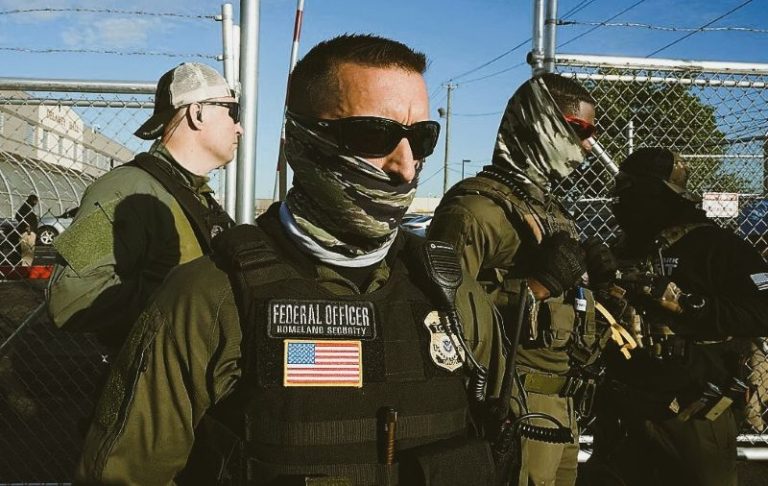
President-elect Donald Trump often said during the 2024 presidential campaign that he plans to launch the nation’s largest-ever mass deportation operation in his second term.
Trump has pledged to carry out this work by using an obscure 18th-century law called the Alien Enemies Act of 1798.
The act empowers presidents to apprehend and remove foreign nationals from countries that are at war with the United States. U.S. presidents have issued executive proclamations and invoked this law three times: during the War of 1812, World War I and World War II. All three instances followed Congress declaring war.
Why bother dusting off a 226-year-old law?
Invoking the Alien Enemies Act could make it far easier for the Trump administration to quickly apprehend, detain and deport immigrants living in the U.S. without legal authorization. That’s because the law lets presidents bypass immigration courts.

In my view, if Trump uses the Alien Enemies Act to carry out his mass deportation plans, it almost certainly would trigger major court battles in which the text, early history and previous uses of this antiquated law take center stage.
Repressive Origins and Populist Backlash
The Alien Enemies Act traces back to the late 1700s, when the Federalists, an early political party, controlled Congress. The Federalists wanted strong national government as well as harmonious diplomatic and trade relations with Great Britain.
The Federalists became outraged when the French government began seizing U.S. merchant ships in the Caribbean that were trading with Britain, which France was waging war against at that time.
The opposing Democratic-Republican Party, led by Thomas Jefferson, supported France in its fight against Great Britain.
The Federalists in Congress considered Jefferson’s pro-France position against the U.S. interests. They also were troubled that the Democratic-Republicans were backed by thousands of French and Irish immigrants who had some political clout in big cities such as Philadelphia and New York.
So in 1798 the Federalists tried to quell domestic opposition by passing the Alien and Sedition Acts, a series of controversial laws that banned political dissent by limiting free speech. The laws also made it harder for immigrants to become citizens.
One of these laws was the Alien Enemies Act, which gave presidents broad authority to control or remove noncitizens ages 14 or older if they had ties to foreign enemies during times of a declared war.
The Alien and Sedition Acts elicited a firestorm of criticism soon after they were passed, including from Jefferson and James Madison, who asserted that states have the right and duty to declare some federal laws unconstitutional. The populist backlash against the Alien and Sedition Acts helped propel Jefferson and Democratic-Republicans to victory in the 1800 presidential election. Nearly all of the Alien and Sedition Acts were then either repealed or allowed to expire.
Only the Alien Enemies Act, a law enacted without an expiration date, survived.
The History of the Alien Enemies Act
Madison, the fourth U.S. president, first invoked the Alien Enemies Act during the War of 1812 with Great Britain, which was sparked for several reasons, including trade and territorial control of North America.
Madison invoked the Alien Enemies Act in 1812 by proclaiming that “all subjects of His Britannic Majesty, residing within the United States, have become alien enemies.”
But rather than imposing mass deportations, Madison’s administration simply required British nationals living in the U.S. to report their age, home address, length of residency and whether they applied for naturalization.
More than 100 years later, President Woodrow Wilson invoked the Alien Enemies Act during World War I in April 1918.
Wilson used the Alien Enemies Act to impose sweeping restrictions on the residency, work, possessions, speech and activities of foreign nationals from places that the U.S. was at war with – Germany, Austria-Hungary, the Ottoman Empire and Bulgaria. U.S.-born women married to any people born in these places were also deemed “enemy aliens.”
The U.S. Marshals Service carefully monitored about half a million Germans in the U.S. to make sure they followed Wilson’s restrictions.
Another 6,000 German “enemy aliens” were arrested and sent to internment camps in Georgia and Utah, where they were confined until after an armistice was signed between the Allies and Germany in November 1918.
Two decades later, President Franklin D. Roosevelt notoriously used the Alien Enemies Act in World War II.
In 1941, Roosevelt authorized special restrictions on German, Italian and Japanese nationals living in the U.S. More than 30,000 of these foreign nationals, including Jewish refugees from Germany, spent the war imprisoned at internment camps because the government considered them potentially dangerous. The U.S. government released these detainees after World War II ended.
The vast majority of the 110,000 Japanese American men, women and children interned during the war were not held under the Alien Enemies Act. The government used a separate executive order during World War II to intern most people of Japanese descent, some of whom were born in the U.S.
What’s Very Old Is New Again
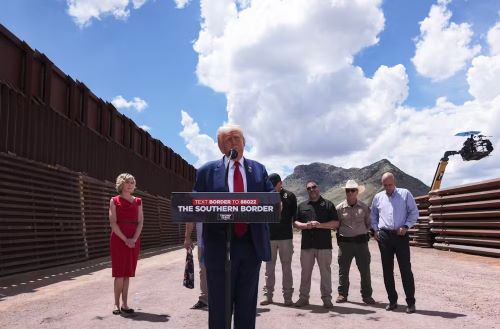
Civil liberties and immigrant rights groups have pledged to fight back by filing legal challenges if Trump forges ahead with plans to invoke the Alien Enemies Act for the fourth time in U.S. history.
The Alien Enemies Act’s text and history present formidable legal hurdles for the Trump administration.
The 1798 law is clear that an “invasion or predatory incursion” must be undertaken by a “foreign nation or government” in order for it to be invoked.
Yet Congress has not declared war on any country in over 80 years, nor has another government launched an invasion against U.S. territory.
And drug cartels are not actual national governments running Latin American countries, so they don’t meet the criteria in the Alien Enemies Act.
Trump’s senior advisers, meanwhile, say with no clear evidence that the administration can justly claim that some Latin American governments, such as Mexico and Venezuela, are run by drug cartels that are attacking U.S. security. These officials also allege that these criminal organizations are launching state-sanctioned invasions of narcotics and unauthorized migrants.
Whatever the argument, the tenacious problem that the Trump administration will face is that neither the letter of the law nor historical precedents support peacetime use of the Alien Enemies Act.
None of these textual and historical realities will matter, however, if the courts choose not to intervene on the grounds that a president simply saying that the country is being invaded by a foreign nation is sufficient and is not subject to judicial review.
This possibility makes it impossible to automatically dismiss blueprints for using an 18th-century law, however dubious. If Trump succeeds at invoking the Alien Enemies Act, it would add another chapter to the Alien Enemies Act’s sordid history.
Originally published by The Conversation, 12.11.2024, under the terms of a Creative Commons Attribution/No derivatives license.
About the Author