By Emily T. Simon
Ask a well-read individual to list the most dangerous books in history, and a few familiar titles would most likely make the cut: Hitler’s “Mein Kampf,” Marx and Engels’ “The Communist Manifesto,” Chairman Mao’s “Little Red Book.”
But what about an obscure booklet written by a Roman senator? According to Christopher Krebs, assistant professor of the classics in the Faculty of Arts and Sciences, Tacitus’ “Germania” deserves a spot on the roster.
“Tacitus’ text played a crucial role in shaping the three or four major discourses that eventually fueled National Socialism,” also known as Nazism, said Krebs. “The influence of the Germania was exerted over hundreds of years.”
The text, first published in 98 C.E., has a long legacy: Rediscovered in the 15th century, it was read widely by German humanists in the 16th. In following centuries, the aureus libellus — or “golden booklet,” as many called it — continued to fascinate readers inside and outside of Germany. The Germania was popular among nationalists in the 19th century, and became particularly dear to Nazi leaders in the 20th who adopted Tacitus’ themes and slogans to further their political and racial agendas.
While doing research on the humanists’ reception of the Germania, Krebs discovered that the distinguished historian and historiographer Arnaldo Momigliano had named Tacitus’ work “among the most dangerous books ever written.”
“I began to wonder if that statement was true,” Krebs said.
Intrigued, he dove back into the text and found a world of connection to Nazi ideology.
“Every influential National Socialist was familiar with the Germania,” said Krebs, “and many foot soldiers referred to the text as a ‘bible. ’”
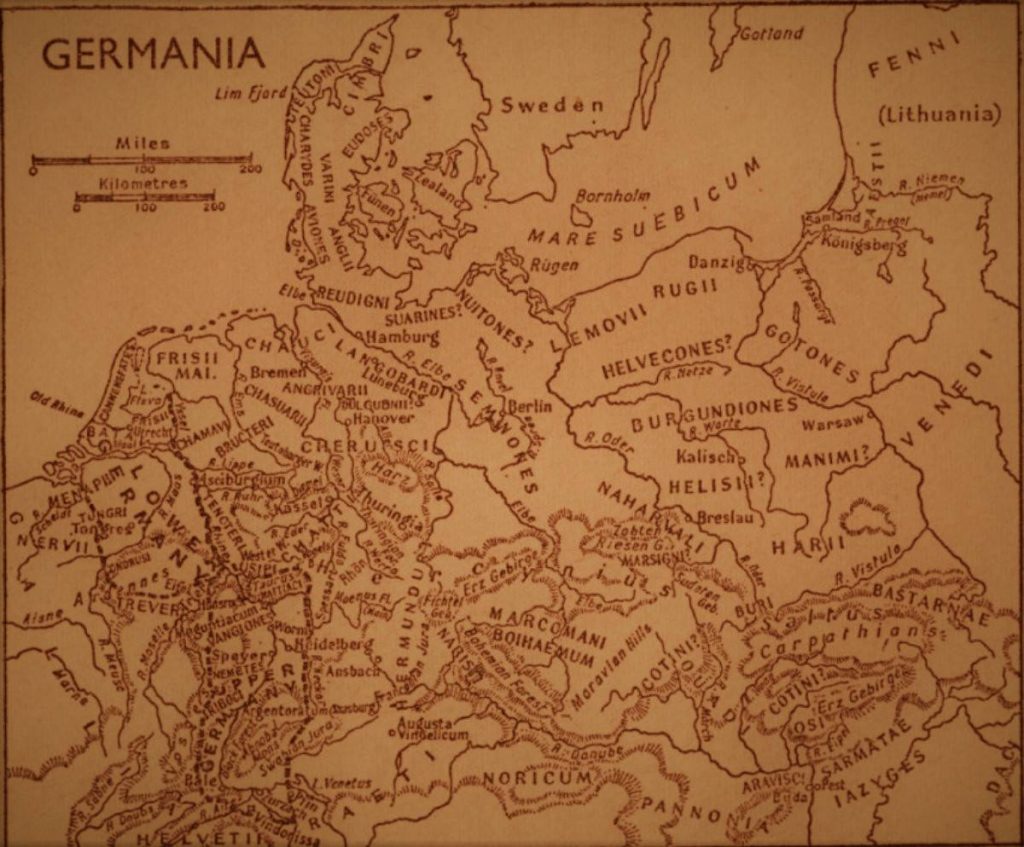
What, exactly, were they so keen to read? Krebs describes the text as a “political ethnography” of Germania, a region northeast of Gaul that remained mostly independent from Roman rule. When Tacitus wrote the ethnography, the Romans had been fighting with Germanic tribes for more than two centuries.

“Tacitus was a politician writing about one of Rome’s fiercest and worst enemies,” said Krebs, “so his ethnography is given within the framework of Roman political discourse.”
Though the Germania was an ethnographic study, it is unlikely, according to Krebs, that Tacitus saw the region firsthand. Instead, he probably constructed the account by drawing on Greek and Roman ethnographical writings about “people in the north” as well as the reports of travelers and warriors who had visited the region. As a result, Krebs noted, the text “was not an accurate depiction of reality.”
Inaccuracies aside, Tacitus’ descriptions of the tribes in Germania provided fodder for future conceptions of the “ideal” German people. Tacitus criticizes parts of the culture in Germania, but he also seems to express admiration for a certain number of its qualities — and it was those qualities that the Nazis would seize upon nearly 2,000 years later to serve their dream of an Aryan race.
According to Krebs, the Nazis stand at the end of a long interpretive tradition that began with 16th century humanists, who considered Tacitus the authoritative word on Germanic culture. These scholars also drew from the text protonationalist themes that would resonate with Nazi ideology.
“If you read the German humanists’ interpretation of the text, you find almost everything that the Nazis would come to associate with Germania,” said Krebs. “The early 16th century reception is basically a mirror image of the early 20th.”
Between 1500 and 1600, Krebs estimates, nearly 6,000 editions were reproduced for readers in German-speaking countries. And during the Nazi regime, Tacitus’ influence was pervasive, extending from party leaders to party soldiers.
According to Krebs, Nazi leaders drew upon three primary themes expressed in the Germania: nationalism, an emphasis on German culture and its origins, and a discourse of racism.
“The booklet encouraged readers to think in terms of ‘we Germans’ and ‘the German fatherland,’” said Krebs.
Tacitus’ words also helped nationalistic readers to perpetuate an image of the “ideal” German man.
“Tacitus depicts the Germanic tribes as a moral people, living a pure and simple life,” said Krebs. “His text emphasized their freedom and fortitude.”
Readers focused on these characteristics, with the result that “the Germanic people were associated with warrior qualities,” said Krebs.
In addition, the text highlighted the fact that most of the Germanic tribes were indigenous to the region, with almost no history of migration.
“He depicted the tribes as descending from an ‘earth-born god,’ and thus deeply rooted to the Germania territory,” said Krebs. “The Nazis employed that rhetoric to advance their theory that the culture of the German volk was inherently tied to the soil on which they were born.”
For Nazi ideology, the text proved an excellent propaganda tool.
In 1936, for example, the Nazi party convention in Nuremberg featured a historic “Germanic” room with walls covered in quotes by Tacitus.
And the leader of the Nazi party? Though Hitler doesn’t mention the Germania specifically in any of his writings, Krebs is “certain that he must have known about it.”
“Hitler was not extremely literate,” said Krebs, “but two books that he is known to have read made ample use of Tacitus.”
Moreover, Krebs said, Hitler’s preferred “authority” on questions of race — adviser Hans F.K. Günther — was “intimately familiar” with the text.
Originally published by Harvard Gazette, 02.21.2008, reprinted with permission for non-commercial, educational purposes.
About the Author