The two-term governor’s donors enjoy access, political appointments, and a chance to bend his ear.
By Patrick Svitek, Carla Astudillo, Zach Despart, and Kate McGee
Introduction
Since Greg Abbott first declared he would run for governor on July 14, 2013, he’s raised the equivalent of $83,793 per day to fund his pursuit of power.
That’s $20,000 more than the median Texas household earns in a year.
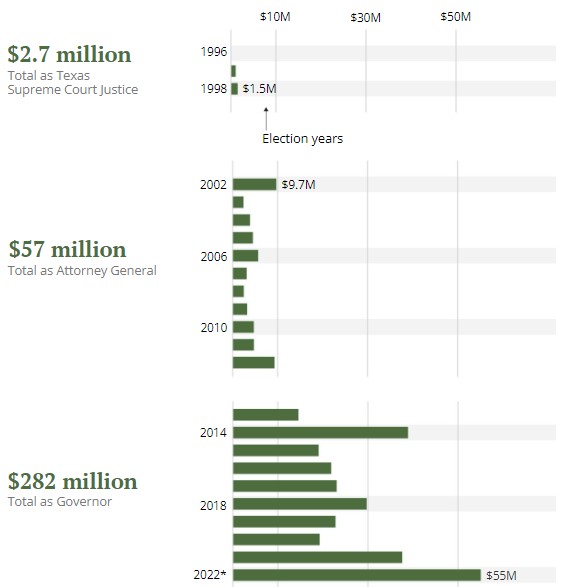
Throughout his political career, Abbott has amassed a mountain of campaign cash unrivaled in Texas. He is easily the most prolific fundraiser in state history — even compared with his two predecessors, George W. Bush, who went on to become president, and Rick Perry, who served as governor for a record-breaking 14 years. Since 1995, when Abbott made his first bid for statewide office for a seat on the Texas Supreme Court, he has raised $348 million in campaign donations when adjusted for inflation, a sum greater than the cost to build the new Longhorn basketball arena at the University of Texas at Austin.
In his 25 consecutive years in public office, Abbott’s ability to court donors has become central to his political livelihood. His robust campaign treasury has allowed him to scare off potential opponents, bulldoze those who dare to challenge him, whip a Legislature keen on passing his agenda, fund a sprawling grassroots organization and generally reshape Texas politics in his image.
“That Greg Abbott is the most successful fundraiser in the history of Texas politics is not a meaningless statement. Being more successful than Bush 43, being more successful than Perry — one was president and one had two different chances to be the nominee — is saying something,” said Matt Mackowiak, an Austin-based Republican strategist. “I think people have underestimated Greg Abbott, at their peril, for 20 years.”
The Texas Tribune reviewed 25 years of campaign finance records covering the entirety of Abbott’s political career. The Tribune also examined every political appointment he’s made while governor. Texas is one of 11 states without contribution limits, enabling Abbott to raise enormous sums from some of the nation’s richest families and individuals. His donors enjoy access to the governor; appointments to boards and commissions, including influential regulatory bodies and even a COVID-19 task force that set guidelines for reopening businesses; and a chance to bend the ear of a politician who may well harbor presidential aspirations like his two predecessors.
At its worst, critics say, Abbott’s fundraising prowess can give the appearance of a patronage system. That was the case when Kelcy Warren, co-founder of a pipeline company that made $2.4 billion off of the deadly winter storm last year, was accused of giving $1 million to thank Abbott for going easy on the oil and gas industry in 2021 as the Legislature attempted to improve the reliability of the state’s power grid. Warren, who did not respond to a request for comment, was just one of the oil industry players who gave a total of $4.6 million to the governor after that session concluded.
“If a candidate takes millions of dollars from someone, you can be sure that they know who that donor is, know what that donor wants out of state government and are at least thinking carefully about giving the donor what they want,” said Ian Vandewalker, who researches the influence of money in politics at the Brennan Center for Justice. “The people that can afford the most expensive fundraising dinners get to tell the chief executive of the state exactly what they want, whereas the person who can’t afford that doesn’t have that access.”
Abbott’s campaign declined requests for an interview for this story and did not respond to a list of emailed questions, instead issuing a statement saying people support him because they “know he will keep Texas the best place to live, work, start a business, and raise a family.” But at a news conference earlier this month in New Braunfels, a Tribune reporter asked whether his donors have an oversized influence on state government. He said the notion was “completely bogus.”
“By far, most of the people I appoint to positions have never given me a penny,” he said, adding that he had no idea who in the crowd he was speaking with that day donated to his campaign. “The people here — I’m unaware if you’ve given me anything … and so I have equal access to everybody across the state.”
Abbott’s most generous donors are often titans of the state’s oil and gas, real estate and construction industries — who stand to benefit broadly from Abbott’s posturing against business regulations and in favor of lowering corporate tax burdens. And some have wealth that is much more directly tied to the state government.
One of Abbott’s top donors is J. Doug Pitcock, chief executive of Williams Brothers Construction, who has given a total of $4.3 million. His firm is one of the top recipients of Texas Department of Transportation contracts and has been awarded $1.9 billion in work since 2020. Hunter Industries owner John R. Weisman has donated $1 million to Abbott; the firm received $464 million in TxDOT highway contracts over the past three years. Together, the two firms received 13% of all TxDOT highway work in that period. Although these types of projects are competitively bid, Abbott appoints the members of the state transportation commission, which approves TxDOT contracts.


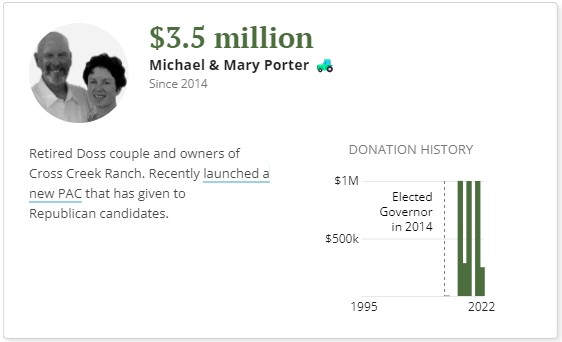
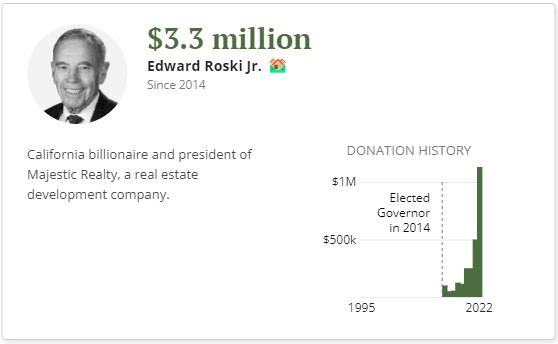
Thanks to Abbott, many other donors enjoy glamorous political appointments or serve on consequential regulatory boards. For example, oil tycoon Paul L. Foster, who was named chair of the board of the Electric Reliability Council of Texas after the 2021 freeze, has given Abbott more than $2.1 million.
But donors insist it’s not about pay for play. Mary and Michael Porter, a ranching couple from the tiny Hill Country town of Doss, have given Abbott $3.5 million, including three $1 million checks.
“So much is on the line with this election,” Michael Porter said in a statement. “Abbott is a good man who is fighting hard to keep our communities safe, our southern border secure, and our economy growing. That’s all we expect. Greg Abbott’s leadership helps keep Texas exceptional.”
A Formidable War Chest
Raising money from wealthy business people who stand to benefit from friendly policies is nothing new in American politics. And rewarding them with access and appointments is especially nothing new in Texas, where Abbott’s predecessor, Perry, was well-known for stocking his administration with political supporters.
But for Abbott, the donations by just a small number of people are notable.
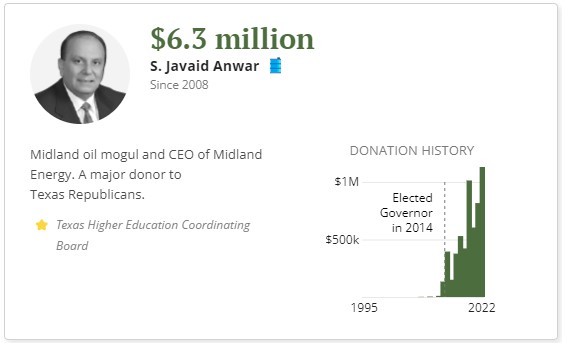
Thirty-nine donors have contributed more than $1 million each over the course of Abbott’s political career, with Midland Energy CEO S. Javaid Anwar leading the pack at $6.3 million. Although this group of seven-figure donors makes up only a tiny fraction of Abbott’s 746,742 individual donations, they have contributed more than one-fourth of his total haul.
Anwar is a Pakistani immigrant who has built an oil-and-gas production fortune in the Permian Basin. In an interview, he said the top issues that drive his support for Abbott are public safety and the economy.
“The business environment Gov. Abbott has created in this country is great,” Anwar said. “You can do business in the state of Texas without paying a lot of taxes, unlike a lot of other states.”
Anwar said he has “never asked” Abbott for anything in exchange for his financial support. Calling Abbott “very kind,” Anwar noted the governor appointed him to the Higher Education Coordinating Board in 2015 and invites him to his Christmas parties.
“That’s all I get in return,” Anwar said with a laugh.
Abbott’s prodigious fundraising has helped him win each of the seven statewide campaigns he’s mounted since 1996, none by a margin closer than 13 points. But he now faces a formidable opponent in O’Rourke, the Democratic nominee for governor and a former congressman. O’Rourke broke fundraising records in his 2018 race against U.S. Sen. Ted Cruz and outraised Abbott during two consecutive reporting periods this year — a once-unthinkable feat. O’Rourke has long crusaded against big money in politics, and he made a point of not accepting money political action committees in 2018. But he has taken PAC money in the current race. He said he did not want to contest Abbott “with a hand tied behind our backs” but has sought to distinguish between his fundraising and Abbott’s.
“If you want access to him, if you want an appointment to a position of power, if you want something for your community, you have to pay Greg Abbott to get it,” O’Rourke said in an interview.
As an El Pasoan, O’Rourke said he can appreciate how major Abbott donors — like Foster and real-estate developer Woody L. Hunt — have used their influence with the governor to bring state resources to the city, like the dental school that bears Hunt’s name. “But on the other hand,” he said, “that is pretty damn corrupt — that you have to pay the governor to do his job for your community.”
O’Rourke is not without his own large donors, even if he has far fewer of them. He has received a combined $1.5 million from George Soros, the New York-based Democratic megadonor; a $1 million contribution from the young cryptocurrency billionaire Sam Bankman-Fried; and $2 million from an Austin couple, Simone and Tench Coxe. Simone Coxe told The Texas Tribune in July that there were “no strings attached.”
If Abbott fends off O’Rourke, as polls suggest he will, the victory will be due in no small part to the decades he spent stashing away millions. His war chest topped out last year at $65 million, and even after spending that total down to $45 million, partly to crush his primary opponents, he still had more than double O’Rourke’s reserves through June. That allowed Abbott to launch TV ads more than three weeks ahead of O’Rourke.
In the final month of the race, O’Rourke has erased Abbott’s cash-on-hand advantage — and the latest filings show Abbott is leaning heavily on his large donors.
Nationally, few governors have money to spend like Abbott. Comparisons are difficult, given varying state populations, costs of travel, and advertising and campaign finance laws. A gubernatorial candidate benefits from the enormous size and wealth of Texas — the second-largest state in both area and population — as well as the absence of term limits and restrictions on donation size. But even then, Abbott is eclipsed by Gov. Ron DeSantis of Florida, a fellow Republican with a national profile and potential White House aspirations. As of early September DeSantis’ political operation had raised a staggering $177 million for his November reelection campaign — and recently received a single $10 million donation — far more than Abbott has ever gotten at once. (Florida caps contributions to campaigns, but politicians also fundraise through separate political committees that face no such limits.)
So while Abbott is well-positioned to hold on to power in Texas, his campaign fortune may not translate to a larger national profile. If he or DeSantis ran for president, they would have to start from scratch, as statewide candidates are barred from transfering over any money raised for federal campaigns.
“No Shame, Dial for Dollars”
Abbott is easily the strongest fundraiser Texas has ever seen. Most of his haul — $282 million when adjusted for inflation — was raised during his time campaigning for governor over the past decade. Adjusted for inflation, Abbott’s predecessor, Perry, raised $171 million over 14 years while the previous governor, Bush, raised $79 million over six.
Abbott is uncommonly dedicated to fundraising, a task that some politicians treat with weariness, if not disdain. But Abbott relishes the competition and the measurable success that comes with fundraising, rarely opting out of his call time — the period that he budgets in his day, which can often span hours, to call donors.
One operative who has worked with Abbott and other GOP officials said he has never seen Abbott cancel call time just because he does not feel like doing it, unlike some other candidates.
But Abbott also builds donor relationships more informally.
“He’s not the kind of politician that only calls when he needs something,” said Matt Hirsch, a former deputy chief of staff to the governor. “He regularly touches base and checks in with these folks to see what’s happening in their lives, their businesses, their communities. It’s a way to stay connected to what’s happening outside the Capitol.”
A voracious consumer of news, Abbott will often call up a donor to discuss an article he just read. He’s a night owl, known to stay up until the early morning hours catching up on news and talking with staff.
When it comes time to formally ask for money, he is unflinching.
“He’s an animal on the phone,” said one Republican operative familiar with Abbott’s fundraising, who was not authorized to speak to the media. “No shame, dials for dollars, runs through call lists like crazy.”
Abbott, other sources say, is unbothered not only to make a direct ask, but also to ask for a specific amount. People who have worked for him say it is part of a fearlessness about failure borne out of the 1984 accident that paralyzed him from the waist down and left him wheelchair-bound for the rest of his life.
At fundraisers, Abbott is known to stay on script in his remarks to donors but will often linger around for one-on-one conversations afterward even if it means running behind schedule.

Abbott’s fundraising can create perception problems. On May 24, when a gunman killed 21 people at an elementary school in Uvalde, the governor learned of the tragedy while in Abilene assessing the state’s wildfire response. He later flew from Abilene, some 210 miles northwest of Austin, to Huntsville, which is more than 150 miles east of the capital, to attend a fundraiser. Abbott portrayed the Huntsville trip as a quick stop “on the way back to Austin”; his staff said that the fundraiser had been previously scheduled and that the governor subsequently postponed events to deal with the tragedy.
James Dickey, the former chair of the Texas GOP, attributed Abbott’s fundraising prowess to hard work, practice and timing.
“He’s been attorney general and governor of Texas as Texas has grown and grown in influence and grown in the success of the economy, not coincidentally because of great Republican policies that people want to see continued,” Dickey said. “So there’s a larger donor pool.”
It also helps that Abbott has been fundraising for a long time. And it began when he was a judge, a position that carries cachet with donors, said Susan Lilly, a longtime GOP fundraiser in Texas.
“I think those core relationships back when he was on the bench … just laid the groundwork,” Lilly said.
Abbott will also take donor concerns raised in conversations to heart.
Speaking to a group of Houston business leaders in 2021, Abbott offered an example of at least one time a conversation with donors moved him to take action on a hot-button social issue.
He said a group of businesspeople, including Dick Weekley and Jeff Hildebrand, came to meet with him months earlier with their “hair on fire” over a book they had discovered was being taught in fourth grade that he said espoused “the indoctrination of critical race theory,” which explores how race is embedded in society.
“They brought this book to me, and they explained exactly what was going on in our schools, which I had heard before, but not as pointedly as I did that day,” Abbott said, adding that the meeting “catalyzed” efforts by him and other state leaders to crack down on so-called critical race theory. That year, the Legislature, with Abbott’s backing, passed a law restricting the way race and gender can be talked about in public schools.
Hildebrand and his wife have given Abbott $2 million in total, while the influential PAC that Weekley helms, Texans for Lawsuit Reform, has donated $1.1 million to Abbott over the years. Neither of them responded to requests for comment.
Coveted Board Appointments
One token of appreciation Abbott can dole out to donors is in the form of appointments to state boards and commissions, which are unpaid designations.
These include coveted assignments like the Parks and Wildlife Commission, which, among other duties, sets hunting seasons and limits on the number of fish and game animals that can be killed by hunters and fishers per year. All but one of the governor’s 12 appointees on that board donated to Abbott since 2013, contributing $923,000 on average.
The governor also selects members of professional regulatory bodies, like the Texas Medical Board, where 15 of his 22 appointees have contributed an average of $43,000 to his campaign. This group of doctors and residents develops regulations and handles discipline for the state’s medical professionals.
Donors are especially common among those Abbott has appointed to boards of regents for state universities. These boards have vital responsibilities such as overseeing university finances and growth plans, as well as selecting university presidents and hiring football coaches.
“Those are socially prestigious positions, and they are desirable for high donors,” said Craig McDonald, executive director of Texans for Public Justice, a left-leaning nonprofit with a focus on campaign finance and political corruption. “Many high donors are hunters. That’s why they like the parks job, and many of them like football ’cause they’re Texans.”
About 70% of people Abbott appointed to the Texas Higher Education Coordinating Board or one of the university systems’ boards of regents have donated individually through their political campaigns, or their spouses have donated, according to a Tribune analysis.
More than 43% of the 114 Abbott appointees to these 10 boards have given more than $25,000 since he first ran for governor in July 2013, including donations from spouses and businesses if the person is the CEO. Thirty-five appointees chipped in at least $100,000; eight of them spent more than $1 million. This includes longtime University of Houston alumnus and regent Tilman Fertitta, who owns the Houston Rockets and has donated $1.8 million, and oil and gas executive Jay Graham, a Texas A&M University graduate who has contributed nearly $1.7 million and serves on the Texas A&M System Board of Regents.
Neither Fertitta nor Graham responded to requests for comment.
The Tribune analysis shows megadonors who are appointed to university boards are often concentrated on the larger and arguably more powerful and prestigious university systems in the state.
Eight of the 11 people appointed by Abbott to the University of Texas System Board of Regents are donors who have given over $100,000 to the governor’s campaign. At the Texas A&M University System, eight of 10 regents whom Abbott has appointed have given more than $200,000. Seven of the 10 individuals appointed to the University of Houston System Board of Regents have donated at least $80,000 each, and seven of the 14 donors Abbott has appointed to the Higher Education Coordinating Board have individually given over $100,000.
Anwar, Abbott’s top donor, who sits on the statewide Texas Higher Education Coordinating Board, said his interest in higher education stems from his life story. Raised by a single mother, his family helped put him through private school in Pakistan before he bought a one-way ticket to the United States, where he attended the University of Wyoming and studied petroleum engineering.
Some state and higher education leaders say these appointees aren’t just Abbott loyalists; they are often proud alumni who have a deep interest in giving back to their universities while bringing a business acumen necessary to manage the complex finances of a university system. Indeed, the vast majority of regents Abbott has appointed are business executives in industries including energy, transportation, engineering and automobiles, but also lawyers and doctors.
Others say the positions are ego boosters.
“They simply like the prestige,” said Raymund Paredes, who served as Texas Higher Education commissioner for nearly 16 years, of board members, pointing to football tickets and VIP parking. “They care about higher education, they want to be involved, but they like the prestige.”
Democrats and Republicans emphasize that Abbott is not the first governor to appoint donors to state boards and commissions.
“I doubt that you would find that much different going back to the Connally era,” said Sen. Kel Seliger, R-Amarillo, referring to John Connally, the Democratic governor of Texas from 1963-69. Seliger said university board positions are often the most high profile and interesting among board appointments.
But in 2018, Lubbock developer George McMahan got crosswise with Abbott’s team after speaking too plainly about how to become a board member.
“You make a large donation to the governor, and in turn you are eligible for appointment to the Board of Regents,” he told a local reporter, referring to Texas Tech. According to a Tribune analysis, eight of 10 Tech regents appointed by Abbott have donated over $30,000 to his campaign since 2013. Half have donated over $165,000.
According to McMahan, Abbott’s chief of staff called him the next day and denied the governor made appointments based on donations. His check to the Abbott campaign was returned, and he was uninvited from the fundraiser.
In an interview with the Tribune in late September, McMahan said his comments had been taken out of context and blown out of proportion.
“What nobody remembers what I said was, ‘Those are all very successful businesspeople. And that’s who you want on your board.’ You don’t want the guy that’s, well, a clerk at Walmart. And I don’t mean that in a demeaning manner,” he told the Tribune. “You want the absolute best people to be on the Board of Regents.”
McMahan said he was able to clear the air with the governor at a recent campaign event in Lubbock. After years of not giving, campaign finance reports from last week show he’s again donated $10,000 to the governor in September.
Good for Business
Fertitta, the University of Houston regent, signaled how his coziness to the governor also helped his businesses in the early months of the COVID-19 pandemic, when he was given a seat on Abbott’s statewide COVID Strike Force to help advise him on reopening plans for the state. Fertitta, a Houston restaurateur, was among 41 other appointed Texans who met via Zoom throughout spring 2020.
A Tribune analysis at the time found 27 of those members were donors to Abbott’s campaign, collectively giving $6 million, including in-kind donations, since January 2015.
When Abbott decided to reopen restaurants at 25% capacity in April 2020, Fertitta — who had publicly complained that state-mandated COVID shutdowns were hurting his businesses — endorsed the decision in a local television interview and shared his involvement with the Strike Force.
“I definitely had input with the governor. I’ve been a supporter of the governor for years,” Fertitta said in an interview with KPRC, Houston’s NBC affiliate, stating that he had been involved in committee meetings and individual meetings with Abbott.
Fertitta did not respond to several requests for comment.
Another Abbott megadonor, Robert Rowling, who owns the Omni hotels and is former owner of Gold’s Gym, was also appointed to the Strike Force. Rowling has given more than $2.1 million to Abbott’s campaign.
In May 2020, the governor asked Rowling if it was OK to reopen fitness clubs. Rowling — who still owned Gold’s Gym — approved, The Dallas Morning News reported. Rowling did not respond to a request for comment.
The next month, Abbott shut down bars during a spike of COVID-19 cases and was sued by a handful of Dallas bar owners.
The judge directed Fertitta and Rowling to be deposed in place of Abbott, reasoning in case documents that the two men owned other businesses in the state that were not subject to closure under Abbott’s order, and that they were both large financial donors to his campaigns.
“In short, Rowling and Fertitta’s testimony is critical to understanding whether [the governor’s executive order] has a rational basis or was it a result of political influence or political pandering,” the presiding judge wrote.
Abbott announced in October that bars could reopen at 50% capacity, essentially making the lawsuit moot and preventing Fertitta and Rowling from being deposed.
This wasn’t the first time that questions were raised about whether donors had an influence on Abbott’s decision-making while in office. When Abbott was attorney general in 2013 — around the time he was ramping up his campaign for governor — he intervened in three federal cases on behalf of Baylor Regional Medical Center in Plano.
The hospital had been sued for allegedly protecting neurosurgeon Christopher Duntsch, nicknamed Dr. Death, who is serving a life sentence for assaulting patients, two of whom died. At the time, Abbott argued he intervened because state law grants hospitals broad legal immunity for mistakes made by doctors during an operation.
The Dallas Morning News raised questions about that intervention. It was reported that Baylor Scott & White Health hospital system chair and GOP donor Drayton McLane had given Abbott two large donations around that time even though McLane had not donated large amounts of money to Abbott previously.
First, McLane donated $100,000 to his campaign in June 2013, the day after the Texas Medical Board suspended Duntsch’s license. The second donation of $250,000 came in January 2014, just two weeks after a second malpractice lawsuit was filed against the hospital and the doctor.
Abbott and McLane denied ever discussing the lawsuits, and McLane told the Morning News at the time that he donated to Abbott before he had learned of the lawsuits against the hospital. McLane did not respond to a recent request for comment from the Tribune.
Dominating Elections
Money doesn’t guarantee victory. That was made clear when O’Rourke lost to Cruz in 2018 despite outraising him.
But for a governor, the benefits of being well funded stretch far beyond the incumbent’s own election, said John Weingart, director of the Eagleton Center on the American Governor at Rutgers University. He can use his wealth to help like-minded down-ballot candidates in primaries and general elections and to gain political control of different parts of the state.
“The money can have an impact during the campaign, and it can have an impact on governing and make a governor better able to do what he wants to do,” Weingart said.
In a state where Republican infighting is common, Abbott has easily won all three of his primaries for governor. That puts him in contrast with the state’s other most well-known Republican officials like U.S. Sens. John Cornyn and Cruz, Lt. Gov. Dan Patrick and Attorney General Ken Paxton, who have each had to endure at least one competitive primary.
With his sizable warchest, Abbott was the odds-on favorite to be the Republican nominee for governor when the seat came open in 2014, and his most credible opponent, Tom Pauken, bowed out before the filing deadline because he struggled to raise $2 million against Abbott.
Abbott got 90% in the 2014 primary, 91% in 2018 and 66% earlier this year, when he faced his most serious group of challengers yet, including a wealthy former state senator, Don Huffines.
While Huffines was not able to go toe-to-toe with Abbott financially, his ability to self-fund provided an unprecedented test for a governor used to facing primary opponents with paltry resources. The governor took no chances, protecting his right flank by embracing far-right legislation like the state’s near-total abortion ban. Warren, the oil tycoon who cut a $1 million check to Abbott in June 2021, later suggested it was because he was worried about Huffines and his “independent wealth.” Still, Abbott’s advantage was never in doubt, and Huffines conceded less than an hour after polls closed.
Democrats, who haven’t won a statewide seat since 1994 and who are routinely outspent, say Texas’ lax campaign finance laws, along with gerrymandered legislative districts, are among the tools Republicans leverage to maintain power.
Worse, Democrats say, some corporations and their principals are afraid to contribute to their candidates and causes for fear of angering Republicans who shape policy that can affect businesses’ bottom lines.
“Greg Abbott and Dan Patrick’s vindictiveness is well known inside the Texas Legislature,” said Manny Garcia, a Democratic strategist who previously served as executive director for the Texas Democratic Party. “It’s pretty clear that business voices have been very cautious to come out on certain issues.”
Chris Hollins, the outgoing finance chair for the Texas Democratic Party, who is now running for mayor of Houston, said limits on how much individuals and businesses can contribute each cycle would help level the playing field between incumbent and challengers.
“You should not be able to write a seven-figure check to the governor after he does your bidding in the Legislature,” Hollins said. “That takes power away from regular folks and puts it in the hands of the uber-wealthy and big business.”
O’Rourke said he supports “some common-sense limit” on the size of campaign contributions. He did not provide a specific threshold but promised to work with both parties in the Legislature to determine it if elected.
Additionally, O’Rourke said he would only make appointments “based on merit and the appointee’s ability to deliver for the state of Texas.”
The 2018 Democratic nominee for governor, Lupe Valdez, also said a “pay-to-play” culture is bad for democracy, making it hard for challengers to compete on a level playing field. Valdez, the former Dallas County sheriff, said it is “extremely difficult, if you want to stay decent, to go against him.”
“It’s making it impossible for good people to get into politics,” Valdez said. “Good people often choose the honest road, and they don’t take all those funds [that have strings attached].”
Abbott crushed Valdez in fundraising — her campaign never reported more than $303,000 in the bank — and beat her by 13 points in what was otherwise a challenging election for Texas Republicans.
Pursuit of the Presidency
Abbott’s fundraising prowess, combined with the Republican Party’s two decades of dominance, means that he may be able to hold power in Texas as long as he wants. His two predecessors, however, had higher ambitions. Bush was elected president in 2000; Perry tried twice but floundered, ending his campaigns in 2012 and 2015.
Abbott has not ruled out a White House bid but has waved off the speculation as he seeks reelection.
“I have one job I’m focused on, and that’s governor of Texas. Period,” Abbott said in a TV interview that aired Sunday. “My only goal is governor of Texas.”
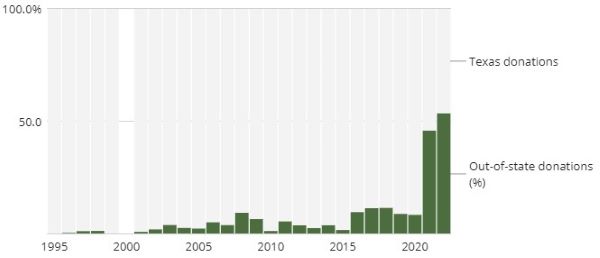
Abbott has avoided some of the moves of other potential 2024 candidates, like visiting the early-voting states of Iowa and New Hampshire. But he has joined them at some national conservative conferences, and his spike in out-of-state donations in recent years suggests a deliberate effort to build a more national base of support.
Even setting aside former President Donald Trump, who retains significant influence in the party and has hinted he will run in 2024, Abbott would likely need to best DeSantis, who is widely considered the other most viable candidate.
Mackowiak, the Republican strategist based in Austin, said conservative voters appreciate Abbott’s decorous, cautious demeanor as a former judge, and may prefer it to DeSantis’ over-the-top persona.
“Abbott is different. He doesn’t necessarily want to be on cable all the time,” Mackowiak said. “Abbott is careful, he just is. There are strengths and weaknesses to that.”
Anwar said he would like to see Abbott pursue the presidency.
“He’s a very good governor,” Anwar said. “He would be a very good president, but that’s up to him.”
Originally published by The Texas Tribune, 10.18.2022, republished with permission for non-commercial purposes.
About the Author