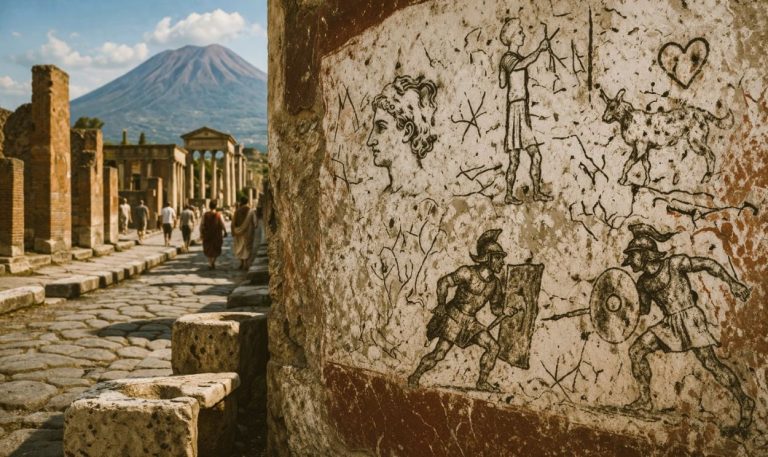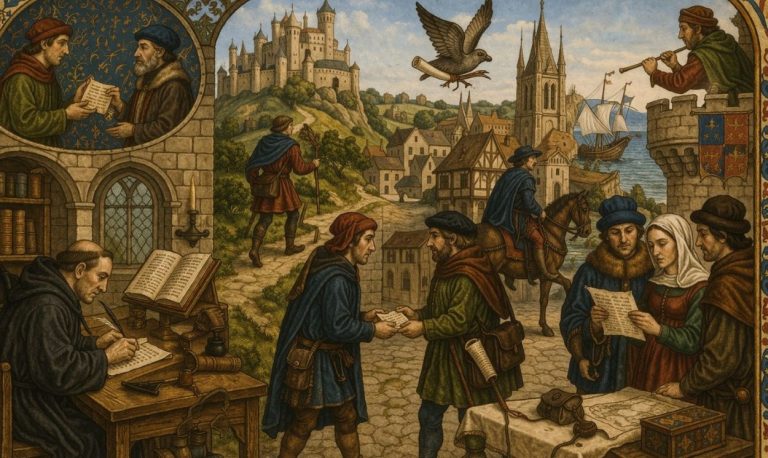
Someone had to be first. Around 3400 BCE, Sumerian scribes pressed wedge-shaped marks into wet clay — and changed everything. These weren’t poems or stories. They were grain receipts. Trade records. But they were writing, and writing meant memory could outlive the person who held it.
Egypt followed with papyrus. Lighter, easier to roll, easier to carry across deserts. The word “paper” traces back directly to that plant.
What Libraries Actually Were
The Library of Alexandria wasn’t just shelves. It was a research institution — a place where scholars from across the Mediterranean came to argue, translate, and think. At its height, it may have held 700,000 scrolls. We’ll never know exactly. It didn’t burn in one dramatic fire; it faded across centuries of neglect and war.
But here’s the real point: its existence proved something. Civilizations decided knowledge was worth storing. Worth protecting. That choice shaped everything that came after.
The Scroll Gives Way
Roll. Unroll. Find your place. Lose it. The scroll was inconvenient.
Around the 1st–4th centuries CE, the codex emerged — essentially the book as we know it today, with pages you could flip. Christians adopted it early for the Bible. By 400 CE, it had largely replaced the scroll across the Roman world. Navigation of text became possible in a completely new way. You could jump to chapter five. You couldn’t really do that with a scroll.
Gutenberg’s Disruption
In 1440, Johannes Gutenberg introduced movable types to Europe. Before him, a single Bible might take a monk two years to copy by hand. After him, the same Bible could be printed in weeks — and then copied again and again.
Numbers tell the story bluntly. In 1450, there were roughly 30,000 books in all of Europe. By 1500 — just fifty years later — there were approximately 10 million. That’s a 33,000% increase in half a century. Ideas about science, religion, and politics spread at a speed no king could fully control.
Books and Power: An Uneasy Relationship
Rulers have always feared certain books. The Roman Index Librorum Prohibitorum — the list of banned books — ran for centuries. Nazi Germany burned books publicly in 1933. The Soviet Union maintained extensive censorship throughout its existence.
Why? Because books remember things governments would rather forget. They carry dissent across borders, across generations, across death itself.
What Reading Did to the Human Mind
This is underappreciated. Reading—especially long-form reading—rewires how we think. It builds what psychologist Maryanne Wolf calls “deep reading”: the ability to infer, to reason across long chains of cause and effect, to feel empathy for people who don’t exist.
But if reading was once only a privilege of the nobility, today reading free novels online is available to absolutely everyone. Just install Fiction Me and get thousands of free novels online. The library of online novels is practically endless.
Literacy rates tell part of the story. In 1800, only about 12% of the world’s population could read. By 2023, that number had risen to over 87%. Every percentage point represents millions of people gaining access to accumulated human knowledge.
The Novel and the Birth of Interiority
Before novels, literature was mostly external — heroes, gods, battles. Then came Don Quixote in 1605. Then Richardson’s Pamela in 1740. Then Austen. Then Tolstoy. Suddenly, readers spent hours inside fictional minds, watching characters doubt themselves, fall in love badly, change their opinions.
Historians argue this helped create modern ideas of individual identity and emotional life. You learned what inner conflict felt like — by reading someone else’s.
The 20th Century Democratization
Paperbacks changed who could afford books. Penguin launched its first paperback line in 1935 at sixpence each — the price of a pack of cigarettes. Public libraries, expanding rapidly through the late 19th and early 20th centuries, meant you didn’t even need to buy them.
By 1970, an ordinary worker in most Western countries had access to more books than the greatest private libraries of the Renaissance.
Enter the Screen
E-readers arrived quietly. The first Kindle launched in 2007; it sold out in five and a half hours. By 2022, the global e-book market was valued at over $18 billion. Millions of digital books can be stored on a single FictionMe app, translated instantly, and searched in seconds. And the selection of books has become so vast that it’s impossible to navigate without additional navigation and suggestions.
But something also changed. Studies suggest reading on screens tends to be shallower — more scanning, less sustained attention. The technology is new. The habits around it are still forming.
Digital Libraries: Access Without Walls
Project Gutenberg launched in 1971 — before most people had heard of the internet. It now offers over 70,000 free e-books. The Internet Archive holds millions of digitized texts, including books that exist in no physical library still standing.
A student in rural Ukraine today can access texts that would have been locked in Oxford’s Bodleian Library a generation ago. That is extraordinary. That is worth saying plainly.
What Gets Lost. What Stays.
Physical books survive things digital files don’t. A 500-year-old printed book can still be read today without any software, power supply, or compatible device. Digital formats become obsolete. Servers go offline. Companies disappear.
The question isn’t which format wins. It’s whether we build systems that carry knowledge forward — the same impulse that drove every librarian, every scribe, every printer who ever lived.
The Long Thread
Books didn’t just record civilization. They built it — by letting each generation inherit the thinking of the last. Every scientific revolution, every philosophical shift, every poem that made someone feel less alone — these traveled through texts.
The medium keeps changing. The function never has.
About the Author