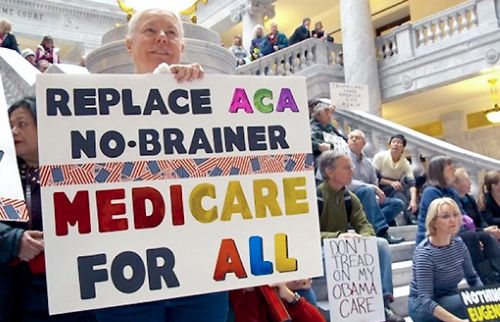
The expiration of enhanced ACA subsidies was not an accident, nor was it inevitable. It was the result of sustained opposition to the ACA.

By Matthew A. McIntosh
Public Historian
Brewminate
A Policy Outcome, Not a Surprise
The expiration of enhanced Affordable Care Act (ACA) subsidies at the end of 2025 has left millions of Americans facing sharply higher health insurance premiums, a development that is already reshaping enrollment decisions across the individual market. The subsidies, first expanded during the COVID-19 pandemic, reduced premiums for low- and middle-income enrollees and eliminated the long-standing income cutoff that had priced many people out of coverage. Their disappearance is now reviving a problem the law was designed to solve: access that exists on paper but fails in practice.
While the policy shift is often framed as a sudden rupture or a fiscal inevitability, it is neither. The expiration follows years of political signals, legislative hesitation, and structural choices that made the enhanced subsidies temporary by design. As health policy analysts have repeatedly noted, the subsidies addressed a known affordability gap in the ACA rather than introducing a new entitlement. Their effectiveness was well documented, as enrollment climbed to record levels during the years they were in effect.
That context matters, because the end of the subsidies is not an accident of calendar math. It represents the culmination of a long political trajectory, particularly among Republicans who have sought to dismantle the ACA since its passage, and a parallel failure by Democrats to convert an emergency fix into permanent policy. What is happening now is best understood not as a budgetary adjustment, but as a predictable policy outcome.
The ACA’s Survival Strategy After 2010
From the moment the ACA became law in 2010, its survival depended less on bipartisan acceptance than on political endurance. Republicans quickly made repeal a central campaign promise, voting dozens of times to overturn the law while lacking the votes to do so. Those repeal efforts functioned as symbolic opposition but laid the groundwork for later strategies.
Unable to dismantle the law outright, opponents of the ACA turned to legal challenges and administrative resistance. The Supreme Court’s 2012 decision upholding the law in National Federation of Independent Business v. Sebelius closed off one avenue of attack, but it also revealed the limits of judicial intervention. The ACA could survive legal scrutiny while remaining politically fragile.
This fragility shaped how the law was administered. Republican-led states declined to expand Medicaid, narrowing coverage for millions. Conservative lawmakers resisted funding outreach and enrollment efforts, weakening participation in the exchanges. These moves did not repeal the ACA, but they constrained its effectiveness, a pattern scholars later described as “repeal by other means.”
The result was a law that technically endured but functioned unevenly, leaving policymakers on both sides of the aisle aware that its long-term stability was unresolved. The ACA survived by adaptation, not consolidation, a distinction that would later prove decisive.
Repeal by Attrition: From Legislation to Sabotage
The most consequential weakening of the ACA came not through repeal votes but through incremental erosion. In 2017, congressional Republicans eliminated the individual mandate penalty as part of the Tax Cuts and Jobs Act. While the mandate remained on the books, its enforcement vanished, altering the risk pool that kept premiums stable.
At the same time, the Trump administration reduced funding for enrollment assistance and shortened open enrollment periods. These administrative decisions made it harder for eligible individuals to sign up, particularly those with limited resources or complex health needs.
Legal uncertainty compounded the problem. The administration declined to defend the ACA in certain court cases, signaling that its continued existence depended on political fortune rather than institutional commitment. Although the Supreme Court ultimately rejected those challenges, the damage to public confidence was real.
What emerged was a pattern of attrition rather than confrontation. The law remained intact, but participation fell in key demographics, premiums rose for some enrollees, and the individual market grew more volatile. This strategy avoided the backlash of outright repeal while producing many of the same effects.
By the time the pandemic arrived, the ACA was still standing, but it was clear that affordability, not legality, posed the greatest threat to its future.
The Pandemic Fix That Was Never Made Permanent
The COVID-19 crisis forced Congress to confront weaknesses in the health insurance system that had long been ignored. In 2021, lawmakers expanded ACA subsidies through the American Rescue Plan, increasing premium assistance and removing the income cap that had excluded many middle-income households. The policy’s impact was immediate, driving enrollment to historic highs.
When Congress later extended the subsidies through the Inflation Reduction Act, the evidence of their success was no longer theoretical. Average premiums dropped for most enrollees, while uninsured rates declined. The fix worked because it addressed the ACA’s central flaw: coverage that was technically available but financially out of reach.
Yet despite this record, the subsidies were framed as temporary. They were tied to budget reconciliation timelines and short-term legislative compromises rather than embedded as permanent law. This choice preserved political flexibility but reintroduced uncertainty into a system that depends on stability.
By treating affordability as an exception rather than a baseline, lawmakers ensured that the gains achieved during the pandemic would remain vulnerable to reversal. The expiration now underway is the direct result of that decision.
Why Expiration Functioned as a Quiet Repeal
Allowing the enhanced subsidies to expire achieves what repeated repeal votes could not. It reduces enrollment without formally dismantling the law, shifting responsibility from legislators to market forces. As premiums rise, coverage becomes optional in name only, particularly for older adults and those with chronic conditions.
This approach carries significant political advantages. There is no single repeal bill to defend, no dramatic vote to galvanize opposition. Instead, coverage erodes gradually, and responsibility becomes diffuse. Health care advocates have warned about this outcome for years, noting that affordability is the linchpin of participation.
The expiration also underscores a broader truth about American social policy. Benefits that are designed to lapse place risk on individuals rather than institutions. When they disappear, the harm is real but often invisible, distributed across households rather than concentrated in legislative chambers.
The Role of the Shutdown Deal and Political Asymmetry
The immediate legislative context of the subsidies’ expiration further illustrates this dynamic. In recent shutdown negotiations, health policy was sidelined in favor of restoring federal operations, with assurances that unresolved issues could be addressed later. Similar promises have accompanied countless budget deals, from debt ceiling standoffs to temporary funding bills.
History suggests that such assurances rarely materialize. Once the immediate crisis passes, incentives shift. Lawmakers who opposed the subsidies face no pressure to revisit them, while supporters must expend political capital to restore benefits that have already lapsed.
This asymmetry matters. Ending benefits is easier than creating them, and restoring assistance often requires overcoming procedural hurdles that never applied to expiration. As a result, “revisit later” becomes a mechanism for quiet retrenchment rather than genuine compromise.
The shutdown deal did not create the problem, but it accelerated a process already in motion, allowing a known policy cliff to arrive without resolution.
The Historical Return of the Pre-ACA Individual Market
To understand what lies ahead, it is worth recalling the individual insurance market before the ACA took effect. Coverage was expensive, exclusions were common, and medical underwriting routinely denied policies to people with preexisting conditions. Premiums rose with age, often dramatically, leaving older adults functionally uninsured.
The ACA was designed to correct these failures, but it depended on participation to function. Without affordable premiums, the market reverts to its earlier state, not through legal change but through economic pressure. Insurers remain bound by coverage rules, but consumers are priced out.
Early indicators suggest this reversion is already underway. Analysts at the Urban Institute and Kaiser Family Foundation have projected coverage losses tied directly to subsidy expiration, with older enrollees facing the steepest increases.
This is not a new experiment. It is a return to a market structure that policymakers once acknowledged was broken. Calling it a correction obscures its historical record.
Consequences That Were Always Foreseeable
The consequences of higher premiums are well documented. When coverage becomes unaffordable, people delay care, skip medications, and rely on emergency services. These patterns were observed before the ACA and persist in gaps between coverage expansions.
Research shows that uninsured and underinsured individuals experience worse health outcomes and greater financial stress. The link between coverage loss and delayed care is not speculative; it is supported by decades of evidence.
The burden does not fall evenly. Older adults, rural residents, and people with chronic conditions are disproportionately affected, precisely because they have fewer alternatives. Employer coverage is unavailable, and short-term plans offer little protection.
These outcomes were predictable. They were described repeatedly during debates over subsidy extensions. Their arrival now reflects not a failure of foresight, but a decision to proceed anyway.
How We Got Here, and Why It Matters
The expiration of enhanced ACA subsidies was not an accident, nor was it inevitable. It was the result of sustained opposition to the ACA, combined with a reluctance to make successful reforms permanent. In that sense, it represents the most effective repeal effort yet, accomplished without a single decisive vote.
Understanding how we got here clarifies what is at stake. Health policy does not fail suddenly. It erodes through temporary fixes, deferred decisions, and asymmetrical incentives that reward inaction. The subsidies’ end follows a familiar script in American governance.
What happens next will determine whether this moment marks a pause or a reversal. History suggests that reversals are harder than prevention, and that once stability is lost, rebuilding it requires more than emergency measures. The question now is whether lawmakers will treat this outcome as acceptable, or as evidence that temporary solutions to permanent problems carry a predictable cost.
Originally published by Brewminate, 01.06.2025, under the terms of a Creative Commons Attribution-NonCommercial-NoDerivatives 4.0 International license.
About the Author