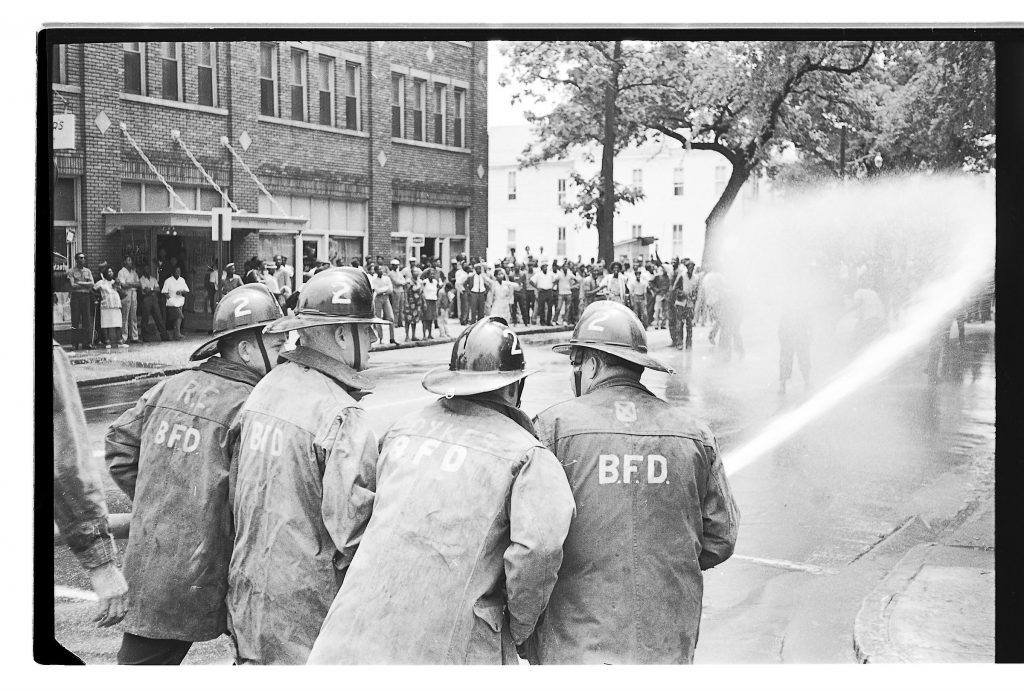
Images of young black protesters being hit with fire hoses and police dogs in 1963 Birmingham are considered iconic. Hank Klibanoff saw them too. He was a fourteen year old paperboy in Florence when the Children’s march took place. He’s a Pulitzer Prize winner now. And what strikes him is where civil rights coverage wound up in the daily paper…
“My home town newspaper and all of the national media are very much focusing attention, page one attention and lead news item attention on the Children’s Crusade and Commissioner Bull Connor’s decision to unleash the dogs and the hoses on the administrators,” says Klibanoff. “It makes page one news everywhere except in Birmingham.”

Not only was the children’s march relegated to lesser news it was delivered without many pictures.
“You know 43 Negroes were arrested yesterday during a demonstration at Kelly Ingram park very stenographic very cool,” Klibanoff recalls. “And no images of the dogs and the hoses so I couldn’t help but notice the newspaper I’m delivering didn’t put that on page one.”
By stenographic, Klibanoff means reports stated things factually. That raises a question among critics of newspapers in the 1960’s. Did the Birmingham papers not cover these events, or did they have the stories and chose not to run them? Barnett Wright is the Jefferson County reporter for the Alabama Media Group and recent author of “1963” which focuses on the civil rights movement.
“Thousands and thousands of photographs the negatives were put into a file cabinet it was uncovered by an intern,” he says. “So the photographs; the iconic images of the movement were not published by the Birmingham News. Now if they didn’t publish the photographs now that tells me a lot of the narrative was also ignored or neglected.”

But that doesn’t sit right with Donald Brown. He was a general assignment reporter for the Birmingham News during the early 60s. And when Martin Luther King, Jr. took his movement to Birmingham in April of ’63, Brown says the local paper responded.
“The news staff at the Birmingham News were just given a sort of open assignment. If we need you to cover a march, if we need you to cover a rally, if we need you to cover a bombing whatever we need you to cover be available 24/7,” says Brown.
The Birmingham News staff and photographers went out on almost everything from marches to bombings but sometimes covering an event is not enough.
“It wasn’t my call as a lowly reporter,” says Brown. “It was the editors who ran the newspaper and their call was to put it in the paper if it’s a big enough deal but let’s not make a bigger deal of it.”
S. Vincent Townsend was Brown’s boss. He was the general manger and editor for a time at the Birmingham news in the early 60s. Brown says Townsend had outside influences forcing him to keep the coverage to a minimum.
“The business community which of course were at the time were the primary advertisers of the Birmingham news and were what undergirded the Birmingham News’ influence financially kept the pressure on Mr. Townsend and the management of the news…keep it down, keep it down, keep it down,” Brown recalls.
Brown says the Birmingham News was able to do that for a few months but national news started to dictate what and how much of the civil rights movement should be covered.
“One of the turning points many believe is when Harrison Salisbury of the New York Times came down to Birmingham and he covered or he talked about the hatred, talked about the segregation, talked about the problems that was happening here in the city,” says Barnett Wright. “For many people in the city they were shocked because that wasn’t the image that they got of Birmingham reading the local papers.”

While the Birmingham News and the post herald may have kept the news off the front pages, stories about the civil rights movement made the nightly news on television. Hank Klibanoff went from his paper route to become a winner of the Pulitzer Prize for a book he and co-author Gene Roberts wrote called “Race Beat.” The book was about the role the press played in the civil rights struggle…
“If the whole nation had responded in their news organizations the way the Birmingham newspapers did by deciding this is not news this is not important. It would have been many, many, many more years of turmoil, dehumanization, and death in the south but ultimately it was the mere presence of that media coverage that led to the change.”
The media’s role in bringing many of the significant events of the civil rights movement to light helped the nation to progress towards more equality. In the coming weeks, we’ll explore the media’s involvement in other significant events in 1963 like the stand in the schoolhouse door and the 16th Street Baptist Church bombing.
Originally published by Alabama Public Radio, 04.25.2013, republished for educational, non-commercial purposes.
About the Author