Hybrid regimes may imitate a full dictatorship.

Curated/Reviewed by Matthew A. McIntosh
Public Historian
Brewminate
Introduction
A hybrid regime[a] is a type of political system often created as a result of an incomplete democratic transition from an authoritarian regime to a democratic one (or vice versa).[b] Hybrid regimes are categorized as having a combination of autocratic features with democratic ones and can simultaneously hold political repressions and regular elections.[b] Hybrid regimes are commonly found in developing countries with abundant natural resources such as petro-states.[18][8][19] Although these regimes experience civil unrest, they may be relatively stable and tenacious for decades at a time.[b] There has been a rise in hybrid regimes since the end of the Cold War.[20][21]
The term hybrid regime arises from a polymorphic view of political regimes that opposes the dichotomy of autocracy or democracy.[22] Modern scholarly analysis of hybrid regimes focuses attention on the decorative nature of democratic institutions (elections do not lead to a change of power, different media broadcast the government point of view and the opposition in parliament votes the same way as the ruling party, among others),[23] from which it is concluded that democratic backsliding, a transition to authoritarianism is the most prevalent basis of hybrid regimes.[b][24] Some scholars also contend that hybrid regimes may imitate a full dictatorship.[25][26]
Definition
Overview
Scholars vary on the definition of hybrid regimes based on their primary academic discipline.[27] “Some scholars argue that deficient democracies and deficient autocracies can be seen as examples of hybrid regimes, whereas others argue that hybrid regimes combine characteristics of both democratic and autocratic regimes.”[3] Scholars also debate if these regimes are in transition or are inherently a stable political system.[10]
In 1995 Terry Karl introduced the notion of “hybrid” regime, which was simply defined as “combining democratic and authoritarian elements”.[28]
According to professor Matthijs Bogaards hybrid types are:[29]
not diminished subtypes, since they do not lack the full development of a characteristic, but rather they exhibit a mixture of characteristics of both basic types, so that they simultaneously combine autocratic and democratic dimensions or institutions
Pippa Norris defined hybrid regimes as:[30]
a system characterized by weak checks and balances on executive powers, flawed or even suspended elections, fragmented opposition forces, state restrictions on media freedoms, intellectuals, and civil society organizations, curbs on the independence of the judiciary and disregard for rule of law, the abuse of human rights by the security forces, and tolerance of authoritarian values.
Henry E. Hale defined hybrid regimes as;[31]
a political regime that combines some democratic and some autocratic elements in a significant manner. It is not, however, a mere half-way category: hybrid regimes have their own distinct dynamics that do not simply amount to half of what we would see in a democracy plus half of what we would see in an autocracy.
Leonardo Morlino defined hybrid regimes as;[32]
a set of institutions that have been persistent, be they stable or unstable, for about a decade, have been preceded by authoritarianism, a traditional regime (possibly with colonial characteristics), or even a minimal democracy and are characterized by the break-up of limited pluralism and forms of independent, autonomous participation, but the absence of at least one of the four aspects of a minimal democracy
Professor Jeffrey C. Isaac defined hybrid regimes as:[33]
Hybrid regimes have the common feature that they all have competition, although the political elite in power deliberately rearranges state regulations and the political arena as to grant itself undue advantages
History
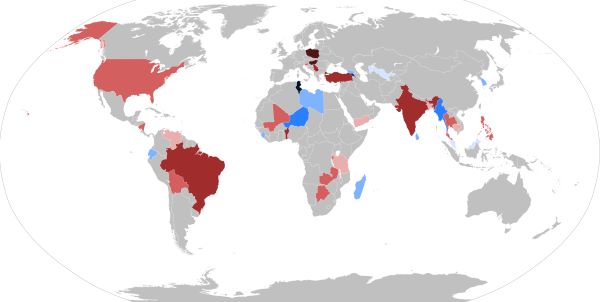
The third wave of democratization from the 1970s onward has led to the emergence of hybrid regimes that are neither fully democratic nor fully authoritarian.[35] Neither the concept of illiberal democracy, nor the concept of electoral authoritarianism fully describes these hybrid regimes.[36][37]
Since the end of the Cold War, such regimes have become the most common among undemocratic countries.[38][39] At the end of the process of transformation of authoritarian regimes, limited elections appear in one way or another when liberalization occurs. Liberal democracy has always been assumed while in practice this process basically froze “halfway”.[40]
In relation to regimes that were previously called “transitional” in the 1980s, the term hybrid regime began to be used and was strengthened according to Thomas Carothers:
the majority of “transitional countries” are neither completely dictatorial nor aspiring to democracy, and by and large they cannot be called transitional. They are located in the politically stable gray zone, changes in which may not take place for decades. Thus, he stated that hybrid regimes must be considered without the assumption that they will ultimately become democracies. These hybrid regimes were called semi-authoritarianism or electoral authoritarianism.[41]
Hybrid regimes have evolved to lean more authoritarian while keeping some democratic traits.[42] One of the main issues with authoritarian rule is the ability to control the threats from the masses, and democratic elements in hybrid regimes can reduce social tension between the masses and the elite.[43] After the third wave of democratization, some regimes became stuck in the transition to democracy, causing the creation of weak democratic institutions.[44] This results from a lack of institutional ownership during critical points in the transition period leading the regime into a gray zone between democracy and autocracy.[45]
These developments have caused some scholars to believe that hybrid regimes are not poorly functioning democracies, but rather new forms of authoritarian regimes.[46] Defective democratic stability is an indicator to explain and measure these new forms of autocracies.[47] Additionally, approval ratings of political leaders play an important role in these types of regimes, and democratic elements can drive up the ratings of a strongman leader creating a tool not utilized previously.[48] Today, ‘hybrid regime’ is a term used to explain a growing field of political development where authoritarian leaders incorporate elements of democracy that stabilize their regimes.[49]
Indicators and Transition Types
Overview
According to Guillermo O’Donnell, Philippe C. Schmitter, Larry Diamond and Thomas Carothers, signs of a hybrid regime include:[16][51]
- The presence of external attributes of democracy (elections, multi-party system, legal opposition).
- A low degree of representation of the interests of citizens in the process of political decision-making (incapacity of associations of citizens, for example trade unions, or that they are in state control).
- A low level of political participation.
- The declarative nature of political rights and freedoms (formally there is in fact difficult implementation).
- A low level of trust in political institutions by the citizenry.
Autocratization
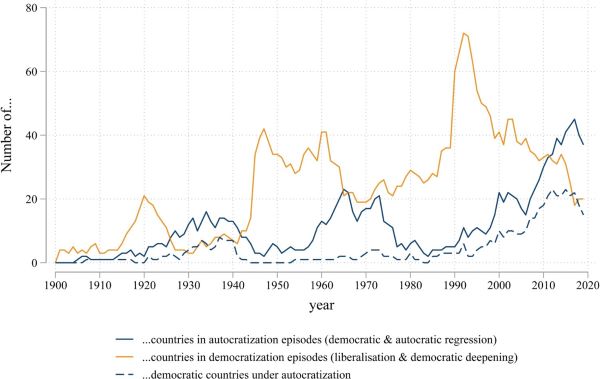
Democratic backsliding[c] is a process of regime change toward autocracy in which the exercise of political power becomes more arbitrary and repressive.[58][59][60] The process typically restricts the space for public contest and political participation in the process of government selection.[61][62] Democratic decline involves the weakening of democratic institutions, such as the peaceful transition of power or free and fair elections, or the violation of individual rights that underpin democracies, especially freedom of expression.[63][64] Democratic backsliding is the opposite of democratization.
Democratization
Democratization, or democratisation, is the structural government transition from an authoritarian government to a more democratic political regime, including substantive political changes moving in a democratic direction.[65][66]Whether and to what extent democratization occurs can be influenced by various factors, including economic development, historical legacies, civil society, and international processes. Some accounts of democratization emphasize how elites drove democratization, whereas other accounts emphasize grassroots bottom-up processes.[67] How democratization occurs has also been used to explain other political phenomena, such as whether a country goes to a war or whether its economy grows.[68]
Measurement
Overview
There are various democratic freedom indices produced by intergovernmental and non-governmental organizations that publish assessments of the worlds political systems, according to their own definitions.[69]
Democracy Index
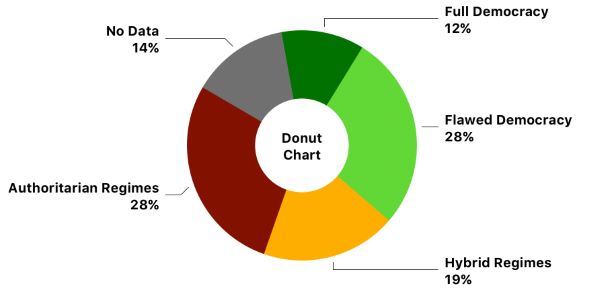
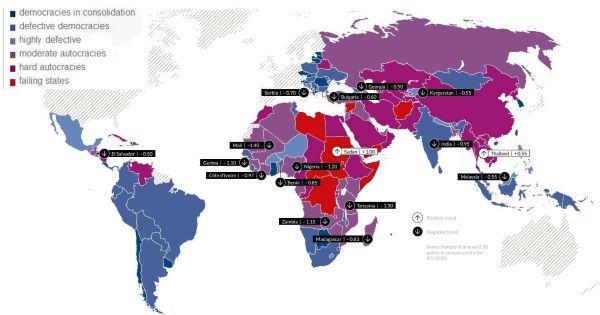
According to the Democracy Index compiled by the Economist Intelligence Unit there are 34 hybrid regimes, representing approximately 20% of countries, encompassing 17.2% to 20.5% of the world’s population.[70]
“The EIU Democracy Index is based on ratings across 60 indicators, grouped into five categories: electoral process and pluralism, civil liberties, the functioning of government, political participation and political culture.”[69] The Democracy Index defines hybrid regimes with the following characteristics:[70]
- Electoral fraud or irregularities occur regularly
- Pressure is applied to political opposition
- Corruption is widespread and rule of law tends to be weak
- Media is pressured and harassed
- There are issues in the functioning of governance
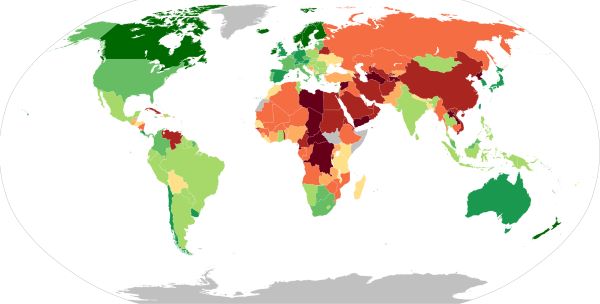
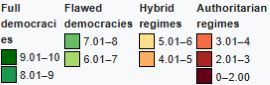
As of 2021 the countries considered hybrid regimes by the “Democracy Index” are:[70]
- Bangladesh
- El Salvador
- North Macedonia
- Ukraine
- Moldova
- Montenegro
- Malawi
- Fiji
- Bhutan
- Madagascar
- Senegal
- Hong Kong
- Honduras
- Armenia
- Liberia
- Georgia
- Nepal
- Tanzania
- Bolivia
- Kenya
- Morocco
- Guatemala
- Uganda
- Zambia
- Sierra Leone
- Benin
- Gambia
- Turkey
- Pakistan
- Haiti
- Kyrgyzstan
- Lebanon
- Ivory Coast
- Nigeria
Global State of Democracy Report
According to the “Global State of Democracy Report” by International Institute for Democracy and Electoral Assistance (IDEA), there are twenty hybrid regimes.[71] “International IDEA compiles data from 12 different data sources, including expert surveys and observational data includes the extent to which voting rights are inclusive, political parties are free to form and campaign for office, elections are free, and political offices are filled through elections.”[69] IDEA defined hybrid regimes as:[72]
Combination of the elements of authoritarianism with democracy … These often adopt the formal characteristics of democracy (while allowing little real competition for power) with weak respect for basic political and civil rights
As of 2021 the countries considered hybrid regimes by the “Global State of Democracy Report” are:[73]
- Angola
- Benin
- Côte d’Ivoire
- Democratic Republic of the Congo
- Ethiopia
- Gabon
- Jordan
- Kuwait
- Kyrgyzstan
- Libya
- Mauritania
- Morocco
- Mozambique
- Nigeria
- Serbia
- Singapore
- Tanzania
- Togo
- Tunisia
- Turkey
V-Dem Democracy Indices
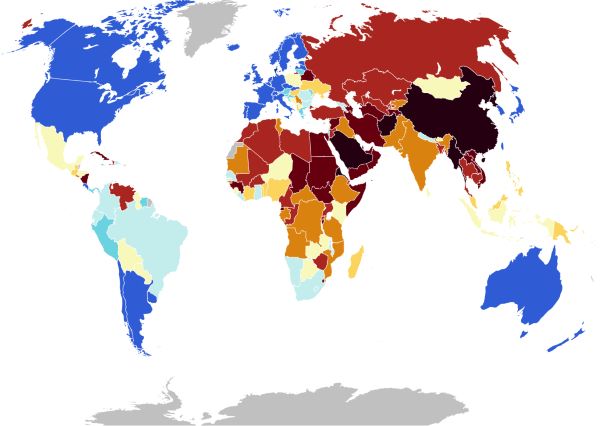
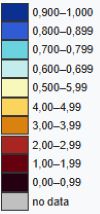
According to the V-Dem Democracy Indices compiled by the V-Dem Institute at the University of Gothenburg there are 65 hybrid regimes.[75] V-Dem’s “Regimes of the World” indicators identify four political regimes: closed autocracies, electoral autocracies, electoral democracies, and liberal democracies.[76]
According to the V-Dem Institute:[77]
In 2021, 70% of the world population – 5.4 billion people – live in closed or electoral autocracies. A mere 13% of the world’s population reside in liberal democracies, and 16% in electoral democracies.
Freedom House
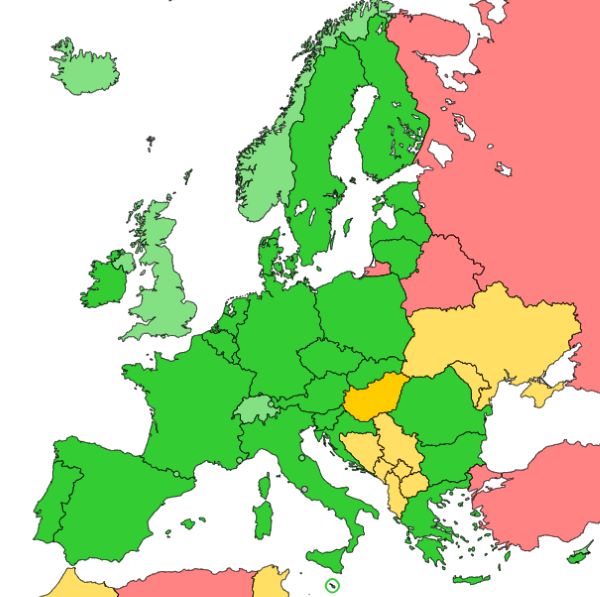
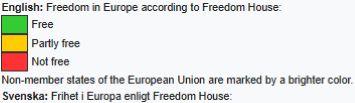
Freedom House measures the level of political and economic governance in 29 countries from Central Europe to Central Asia.[79]
“Freedom House assign scores to countries and territories across the globe on 10 indicators of political rights (e.g., whether there is a realistic opportunity for opposition parties to gain power through elections) and 15 indicators of civil liberties (e.g., whether there is a free and independent media).”[69] Freedom House classifies transitional or hybrid regimes as:[79]
Countries that are typically electoral democracies where democratic institutions are fragile, and substantial challenges to the protection of political rights and civil liberties exist
In 2022, Freedom House classified 11 of 29 countries analyzed as “Transitional or Hybrid Regimes”:[79]
- Armenia
- Georgia
- Moldova
- Bosnia and Herzegovina
- Kosovo
- Ukraine
- Hungary
- Albania
- Serbia
- North Macedonia
- Montenegro
Typology
Overview
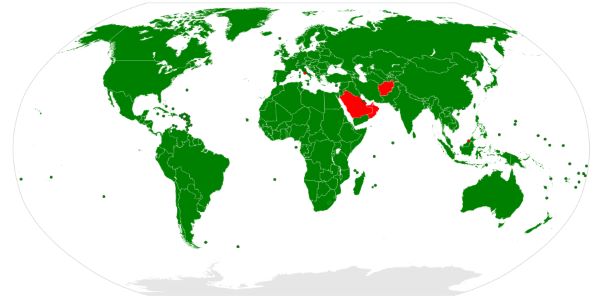
According to Yale professor Juan José Linz, there are three main types of political systems today: democracies, totalitarian regimes and, sitting between these two, authoritarian regimes with many different terms that describe specific types of hybrid regimes.[b][a][80][16][81][82][1]
Academics generally refer to a full dictatorship as either a form of authoritarianism or totalitarianism over a “hybrid system”.[83][81][84] Authoritarian governments that conduct elections are in many scholars view not hybrids, but are successful well-institutionalized stable authoritarian regimes.[b][85][86][87] Democratic elements can simultaneously serve authoritarian purposes and contribute to democratization.[88]
Electoral Authoritarianism
Electoral authoritarianism means that democratic institutions are imitative and, due to numerous systematic violations of liberal democratic norms, in fact adhere to authoritarian methods.[89] Electoral authoritarianism can be competitive and hegemonic, and the latter does not necessarily mean election irregularities.[40] A. Schedler calls electoral authoritarianism a new form of authoritarian regime, not a hybrid regime or illiberal democracy.[40] Moreover, a purely authoritarian regime does not need elections as a source of legitimacy[90] while non-alternative elections, appointed at the request of the ruler, are not a sufficient condition for considering the regime conducting them to be hybrid.[89]
Electoral Autocracy
Electoral autocracy is a hybrid regime, in which democratic institutions are imitative and adhere to authoritarian methods. In these regimes, regular elections are held, but they are accused of failing to reach democratic standards of freedom and fairness.[91][92]
Illiberal Democracy
The term “illiberal democracy” describes a governing system that hides its “nondemocratic practices behind formally democratic institutions and procedures”.[93] There is a lack of consensus among experts about the exact definition of illiberal democracy or whether it even exists.[94]
The rulers of an illiberal democracy may ignore or bypass constitutional limits on their power.[95] While liberal democracies protect individual rights and freedoms, illiberal democracies do not.[96] Elections in an illiberal democracy are often manipulated or rigged, being used to legitimize and consolidate the incumbent rather than to choose the country’s leaders and policies.[97]According to jurist András Sajó, illiberal democracy should be counted as a type of democracy because it is “democratic in a plebiscitarian sense”,[98] while political scientist Ulrich Wagrandl argues that “illiberal democracy is actually more true to democracy’s roots”.[99] Other theorists say that classifying illiberal democracy as democratic is overly sympathetic to the illiberal regimes[100] and therefore prefer terms such as electoral authoritarianism,[101]competitive authoritarianism,[102] or soft authoritarianism.[103][104]
Dominant-Party System
A dominant-party system, or one-party dominant system, is a political occurrence in which a single political party continuously dominates election results over running opposition groups or parties.[105] Any ruling party staying in power for more than one consecutive term may be considered a dominant party (also referred to as a predominant or hegemonic party).[106] Some dominant parties were called the natural governing party, given their length of time in power.[107][108][109]
Delegative Democracy
In political science, delegative democracy is a mode of governance close to Caesarism, Bonapartism or caudillismo with a strong leader in a newly created otherwise democratic government. The concept arose from Argentinian political scientist Guillermo O’Donnell, who notes that representative democracy as it exists is usually linked solely to highly developed capitalist countries. However, newly installed democracies do not seem to be on a path of becoming fully representative democracies,[110] and instead exhibit authoritarian tendencies.[111] O’Donnell calls the former delegative democracies, for they are not fully consolidated democracies but may be enduring.
For a representative democracy to exist, there must be an important interaction effect. The successful cases have featured a decisive coalition of broadly supported political leaders who take great care in creating and strengthening democratic political institutions.[110] By contrast, the delegative form is partially democratic, for the president has a free rein to act and justify his or her acts in the name of the people. The president can “govern as he sees fit” even if it does not resemble promises made while running for election. The president claims to represent the whole nation rather than just a political party, embodying even the legislature and the judiciary.[112]
O’Donnell’s notion of delegative democracy has been criticized as being misleading, because he renders the delegative model that is core to many current democratic governments worldwide into a negative concept.[113]
Dictablanda
Dictablanda is a dictatorship in which civil liberties are allegedly preserved rather than destroyed. The word dictablanda is a pun on the Spanish word dictadura (“dictatorship”), replacing dura, which by itself is a word meaning ‘hard’, with blanda, meaning ‘soft’.
The term was first used in Spain in 1930 when Dámaso Berenguer replaced Miguel Primo de Rivera y Orbaneja as the head of the ruling dictatorial government, and attempted to reduce tensions in the country by repealing some of the harsher measures that Primo de Rivera had introduced. It was also used to refer to the later years of Francisco Franco’s Spanish State,[114] and to the hegemonic 70-year rule of the Institutional Revolutionary Party (PRI) in Mexico.[115] Analogously, the same pun is made in Portuguese as ditabranda or ditamole. In February 2009, the Brazilian newspaper Folha de S.Paulo ran a controversial editorial classifying the military dictatorship in Brazil (1964–1985) as a ditabranda.[116]
Guided Democracy
Guided democracy, also called directed democracy[117] and managed democracy,[118][119] is a formally democratic government that functions as a de facto authoritarian government or, in some cases, as an autocratic government.[120] Such hybrid regimes are legitimized by elections, but do not change the state’s policies, motives, and goals.[121]
In a guided democracy, the government controls elections such that the people can exercise democratic rights without truly changing public policy. While they follow basic democratic principles, there can be major deviations towards authoritarianism. Under managed democracy, the state’s continuous use of propaganda techniques prevents the electorate from having a significant impact on policy.[121]The concept is also related to semi-democracy, also known as anocracy.
Liberal Autocracy
A liberal autocracy is a non-democratic government that follows the principles of liberalism.[122] Until the 20th century, most countries in Western Europe were “liberal autocracies, or at best, semi-democracies”.[123] One example of a “classic liberal autocracy” was the Austro-Hungarian Empire.[124] According to Fareed Zakaria, a more recent example is Hong Kong until 1 July 1997, which was ruled by the British Crown. He says that until 1991 “it had never held a meaningful election, but its government epitomized constitutional liberalism, protecting its citizens’ basic rights and administering a fair court system and bureaucracy”.[125]
Semi-Democracy
Anocracy, or semi-democracy,[126] is a form of government that is loosely defined as part democracy and part dictatorship,[127][128] or as a “regime that mixes democratic with autocratic features”.[128] Another definition classifies anocracy as “a regime that permits some means of participation through opposition group behavior but that has incomplete development of mechanisms to redress grievances.”[129][130] The term “semi-democratic” is reserved for stable regimes that combine democratic and authoritarian elements.[131][132] Scholars distinguish anocracies from autocracies and democracies in their capability to maintain authority, political dynamics, and policy agendas.[133] Anocratic regimes have democratic institutions that allow for nominal amounts of competition.[127] Such regimes are particularly susceptible to outbreaks of armed conflict and unexpected or adverse changes in leadership.[134]
Defective Democracy
Defective democracy (or flawed democracy) is a concept that was proposed by the political scientists Wolfgang Merkel, Hans-Jürgen Puhle and Aurel S. Croissant at the beginning of the 21st century to subtilize the distinctions between totalitarian, authoritarian, and democratic political systems.[135][136] It is based on the concept of embedded democracy. While there are four forms of defective democracy, how each nation reaches the point of defectiveness varies.[137] One recurring theme is the geographical location of the nation, which includes the effects of the influence of surrounding nations in the region. Other causes for defective democracies include their path of modernization, level of modernization, economic trends, social capital, civil society, political institutions, and education.
Embedded Democracy
Embedded democracy is a form of government in which democratic governance is secured by democratic partial regimes.[138][139][140] The term “embedded democracy” was coined by political scientists Wolfgang Merkel, Hans-Jürgen Puhle, and Aurel Croissant, who identified “five interdependent partial regimes” necessary for an embedded democracy: electoral regime, political participation, civil rights, horizontal accountability, and the power of the elected representatives to govern.[141] The five internal regimes work together to check the power of the government, while external regimes also help to secure and stabilize embedded democracies.[142] Together, all the regimes ensure that an embedded democracy is guided by the three fundamental principles of freedom, equality, and control.[143][144]
Competitive Authoritarian Regimes
Competitive Authoritarian Regimes (or Competitive Authoritarianism) is a subtype of Authoritarianism and of the wider Hybrid Regime regime type. This regime type was created to encapsulate states that contained formal democratic institutions that rulers viewed as the principal means of obtaining and exercising legitimate political authority with a meaningful opposition and other semblances of democratic political society. However officials violate elections frequently and interfere with opposition organisations causing the regime to miss the minimum conventional standard for democracy.[145][146][147][148]
Three main instruments are used within Competitive Authoritarian Regimes to maintain political power: the self-serving use of state institutions (regarding abuses of electoral and judicial institutions such as voter intimidation and voter fraud); the overuse of state resources (to gain influence and/or power over proportional representation media, and use legal resources to disturb constitutional change); and the disruption of civil liberties (such as freedom of speech/press and association).[146]
Currently, within the political sphere, Competitive Authoritarianism has become a crucial regime type that has grown exponentially since the Post-Soviet era in multiple world regions without signs of slowing. On the contrary, there has been growth of Competitive Authoritarianism within previously steadfast democratic regimes, which has been attributed to the recent phenomenon of democratic backsliding.[149][147]
See endnotes at source.
Originally published by Wikipedia, 02.27.2012, under a Creative Commons Attribution-ShareAlike 3.0 Unported license.
About the Author