Women are suing, asking for clarification on when medical exceptions could actually be granted.

By Naomi R. Cahn, J.D.
Justice Anthony M. Kennedy Distinguished Professor of Law
Armistead M. Dobie Professor of Law
Co-Director, Family Law Center
University of Virginia

By Sonia Suter, J.D.
Henry St. George Tucker III Dean’s Research Professor of Law
Kahan Family Research Professor of Law
Founding Director, Health Law Initiative
The George Washington University
Introduction
More than a year after the Supreme Court found there is no fundamental right to get an abortion, 21 states have laws in effect that ban abortion well before fetal viability, generally allowing it only in the first trimester.
Fourteen of these 21 states have also issued near-total bans on abortion from the point of conception. But it’s not clear when, if ever, an abortion would be permissible under these near-total bans.
Virtually all states, including Arkansas, North Dakota and Oklahoma, for example, allow an abortion when necessary to save the life of the pregnant person. But the laws don’t explain just how close to death the person must be before the abortion can be performed.
Some states, such as Georgia, Indiana and West Virginia, also include exceptions for health concerns, rape, incest or lethal fetal anomalies.

Most of these exceptions are vaguely worded, leaving physicians and pregnant patients to navigate whether a particular abortion would be legal.
As experts on reproductive health and justice, we are trying to untangle just what these different medical exceptions mean. This is an important question for legal experts, but also for doctors and caregivers, as well as people who are pregnant and their families – all trying to make sense of the various bans in effect.
Steep Penalties, Murky Legal Language
Because these different state laws use nonmedical language and threaten steep penalties – such as life imprisonment – for performing an abortion that violates the statute, some physicians have been turning to lawyers for guidance.
For example, Tennessee has an exception that allows abortions “necessary to prevent the death of the pregnant woman or to prevent serious risk of substantial and irreversible impairment of a major bodily function of the pregnant woman.” And West Virginia allows abortions for “nonviable” fetuses, defined as those with a “lethal anomaly … incompatible with life outside of the uterus.”
These exceptions are confusing to health care providers, in part because the laws assume a certainty in medicine that may not exist. The laws also do not rely on medical terms.
This means that health care providers in states where abortion is banned – apart from these limited exceptions – are reluctant to provide abortions under any circumstances, even in the face of life-threatening conditions or severe fetal anomalies.
The rate of abortions in the states where there is a near-total or total ban decreased by 100% from April 2022, just before the Supreme Court overturned the right to an abortion, through June 2023.
Legal Action for Answers
Some health care providers and their patients have sued to find out just when abortions might be permitted.
Courts in different states, from the trial court to the supreme court level, are now being forced to consider these questions and have begun to weigh in with opinions that lead to even more uncertainty. At the heart of this litigation is how to balance doctors’ conflicting obligations to provide the best medical care, which could include offering an abortion that they fear state bans may prohibit.
And because each state uses its own language to define a ban and its exceptions, one court’s opinion regarding its ban does not dictate how another state’s ban should be interpreted.
Texas’ Abortion Ban
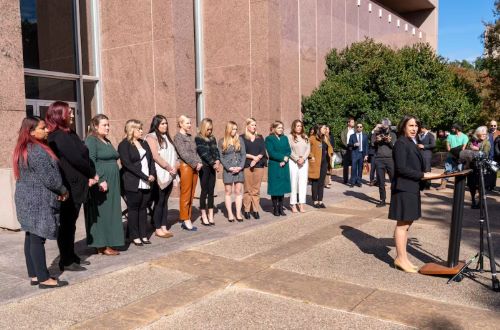
Texas is one of the states that banned nearly all abortions in 2022. Texas law allows an abortion only when there is a “medical emergency” for the pregnant person, defined as a “life-threatening physical condition” related to the pregnancy that “poses a serious risk of substantial impairment of a major bodily function.”
In March 2023, the advocacy group Center for Reproductive Rights filed a lawsuit on behalf of a group of Texas women and two obstetricians-gynecologists, seeking clarification over when Texas’ ban allows an abortion.
The Texas women, who faced serious pregnancy-related health risks or very low odds of their baby’s survival outside the womb, were denied abortions or told to wait until death was more imminent. Some of the women got abortions outside of Texas, and others gave birth to babies who lived only briefly because of serious fetal health problems.
The plaintiffs argued that the law’s confusing language – as well as the threat to physicians of 99 years in jail, $100,000 in fines and a loss of their medical license – led to delays or denials of medical treatment they needed.
In August 2023, a Texas trial court judge blocked enforcement of the state’s abortion ban when “in a physician’s good faith judgment and in consultation with the pregnant person, the pregnant person has an emergent medical condition requiring abortion care.” This could include medical conditions that make it unsafe to continue the pregnancy or diagnosis of a fetal abnormality that would not allow it to survive after birth.
Texas appealed this decision to the state Supreme Court. The lower court decision is on hold until the Supreme Court issues its final decision; the court has not said when it would rule.
Because there is still no definitive decision on how to interpret the Texas law, pregnant patients have been left in limbo.
Katie Cox, for example, is a Texas woman who was diagnosed when she was 20 weeks pregnant with a severe fetal anomaly called trisomy 18. Carrying the pregnancy to term would have threatened her fertility, potentially preventing the mother of two from birthing more children in the future.
After Cox’s doctor explained it was not an option in Texas to terminate the pregnancy, Cox and her doctor went to court seeking judicial approval for an abortion.
Travis County District Judge Maya Guerra Gamble granted permission in December 2023, finding that it would be a “miscarriage of justice” to prohibit Cox from ending her pregnancy.
But days later, the Texas Supreme Court blocked the district court ruling. It conceded that Cox’s pregnancy was “extremely complicated,” but refused to find that state law permitted the abortion. Cox left the state to get an abortion.
The Texas Supreme Court opinion in December still left many questions unanswered. The court stated that a judicial order was not required to permit a doctor to perform an abortion in the case of a medical emergency. But it also interpreted the law as setting an objective standard as to whether the exception applied.
That left open the possibility that the state could find an expert witness to challenge the physician’s judgment.
A Thread of Uncertainty
Since 2022, the Center for Reproductive Rights has also brought lawsuits in Idaho, Tennessee and Oklahoma, seeking clarity on medical emergency exceptions in the states’ abortion bans.
The lawsuit’s underlying claim is that uncertainty about the scope of the exceptions has, according to the Idaho complaint, “sown confusion, fear and chaos among the medical community, resulting in grave harms to pregnant patients whose health and safety hang in the balance across the state.”
What all of these cases and stories show is that even when abortion bans claim to allow exceptions based on medical judgment, physicians – and their patients – know their decisions can be second-guessed and challenged in court.
Originally published by The Conversation, 01.26.2024, under the terms of a Creative Commons Attribution/No derivatives license.
About the Author