

By Dr. Heather Graham
Assistant Professor of Art History
California State University, Long Beach
Ideal Representative of Masculinity and Femininity
In a pair of portraits painted by the Venetian artist Titian (see above), the Duke and Duchess of Urbino are presented as ideal representatives of their sexes. Duke Francesco Maria della Rovere, the great mercenary captain, stands upright, his body encased in shining armor. His right arm juts outward from his body, seemingly breaking through the picture plane, as his hand rests upon the war baton he carries as a reminder of his military authority as commander of Venetian troops. Francesco Maria’s prominent codpiece and piercing stare emphasize his aggressive masculinity, while his dark beard and ruddy complexion mark him as a mature man of action. The objects behind him communicate his valor and political commitments: two other war batons bearing the Papal Keys (two crossed keys, the traditional symbol of the Papacy. They refer to the keys of the kingdom of heaven belonging to the first Pope, Saint Peter, that were given to him by Christ in the Gospel of Matthew) and the Florentine lily (stylized lily is the traditional heraldic device, or symbol, of the city of Florence, Italy) lean against a wall (the lily has faded over time) next to an oak branch marking his della Rovere lineage (the della Roveres were a powerful noble family of Italy).
His wife, the Duchess Eleonora Gonzaga, makes the perfect, demure counterpoint to her virile husband. While he stands erect and linear, she sits, swathed in copious folds of costly fabric that suggest the rounded forms of her body. While he is active, she is passive, her containment within the domestic sphere affirmed by the window to her right. Eleonora’s bodily comportment is a far remove from her husband’s thrusting fist that intrudes upon the audience’s space. The small dog and the costly clock that rests upon the table beside her remind us of her loyalty and patience in reservedly awaiting her husband whose military pursuits often kept him abroad.

Internal virtues, including gender characteristics, were believed to be communicated through outward appearance. The author Pietro Aretino noted in sonnets dedicated to Titian’s portraits that Francesco Maria’s “place between his eyebrows inspires terror, his spirit in his eyes, his pride in his forehead, in which place honor and wise counsel sit. In his armored chest and ready arm valor burns….” For Eleonora, “Prudence guards her honor and counsels in beautiful silence: the internal virtues adorn her brow with every wonder.” [1] Like the portraits, Aretino’s sonnets highlight Francesco Maria’s active and awe-inspiring masculinity and Eleanora’s passive feminine charms.
Titian’s portraits help us to understand ideas that people in the past had about gender. While sex is determined by biological markers such as genitalia and other genetic differences between male or female, gender refers to the social role that a person plays based upon individual and collective ideas about identity as it relates to being a man or a woman. Different cultures define masculinity and femininity differently. These social roles are constructed by multiple factors including medical understandings of the body and mind, as well as cultural and religious ideas about the sexes.
The Feminine Ideal

Have you seen that [Virgin] Annunciation that is in the cathedral, at the altar of Sant’ Ansano, next to the sacristy?…She seems to me to strike the most beautiful attitude, the most reverent and modest imaginable. Notice that she does not look at the angel but is almost frightened. She knew that it was an angel…What would she have done had it been a man! Take this as an example you maidens!
Bernardino de Siena [2]
When the popular fifteenth-century preacher, Bernardino da Siena, wanted to impress upon his female listeners the importance of proper feminine behavior, he pointed them to the model of the Virgin Mary as painted by the Sienese artist, Simone Martini. At the moment the archangel Gabriel announces to Mary that she would bear the son of God, Mary’s reaction is exemplary: she pulls her cloak tightly around her and recoils from the angelic intrusion in her private space. So important in this patriarchal world was the regulation of women to the domestic sphere, that even an emissary of God should be considered with caution. A renaissance woman’s primary virtues were chastity and motherhood; her domain was the private world of the home. As noted by the scholar and artistic theorist Leon Battista Alberti in his treatise On the Family (1435), “It would hardly win us respect if our wife busied herself among the men in the marketplace, out in the public eye.” [3]
While gender roles were nuanced across European cultures, throughout the continent women’s relegation to the domestic sphere was rooted in Christian tradition that placed blame for humanity’s fall from grace upon Eve, the first woman. Eve was the temptress who led the first man, Adam, into breaking God’s law, sentencing humankind to toil and death. Every woman thereafter was thought to live in the shadow of Eve’s sin, justly sentenced to the pains of childbirth, the labors of motherhood, and submission to her husband.
The Four Humors
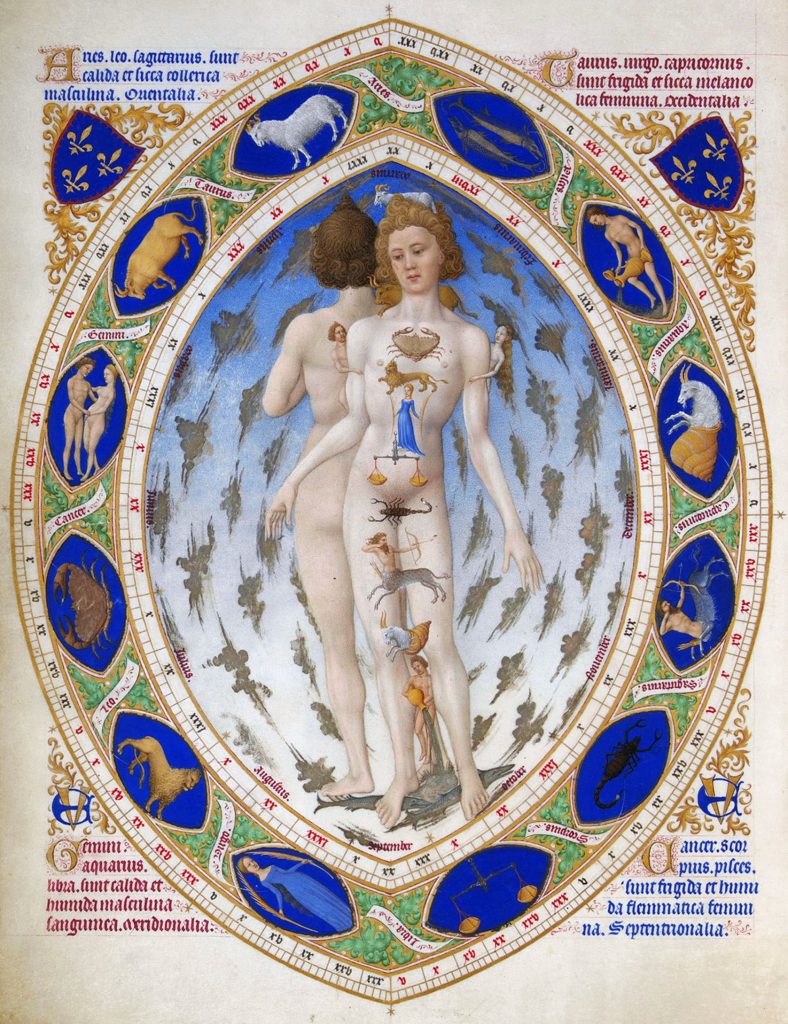
Women’s subordinate role in renaissance culture was also tied to medical understanding of the human body inherited from ancient Greek and Roman traditions. Perhaps most influential was the ancient theory of the four humors. Originating in ancient Greece, humoral theory was thoroughly developed by the Roman doctor, Galen, whose writings were important to the medieval and renaissance world. According to Galen, it was the proper balance of four fluids called humors—blood, phlegm, yellow bile, and black bile—generated through the processes of digestion that determined physical and psychological health. Each humor was associated with particular mental characteristics, making a person’s psychobiology (branch of science that deals with the biological basis of behavior and mental phenomena) a product of his or her unique humoral composition, a model further nuanced by qualities of temperature and moisture also assigned to the various humors.

German artist Albrecht Dürer’s engraving of Adam and Eve includes numerous symbols associated with the four humors: a rabbit (blood), an ox (phlegm), a cat (yellow bile), and an elk (black bile). This image captures the moment just before the first man and woman broke God’s law. All of the animals—all of the humors—are shown at rest, symbolizing humanity’s perfect internal balance before the Fall from Grace (to Adam and Eve breaking the law God had given them and their subsequent exile from paradise in the Garden of Eden. By eating the fruit of the forbidden Tree of Knowledge, the two brought sin into the world).
Generally speaking, men and women were understood to be humoral opposites. Men were physiologically characterized by superior humors associated with heat and dryness, women by inferior humors associated with cold and wetness. These perceived differences were used to justify men’s and women’s social roles: a man’s hot-dryness gave him the constancy necessary for public social and political life; a women’s cold-wetness made her inconstant, accounted for her timidity, and explained menstruation and the pains of childbirth. As Alberti also noted in his writings on the family, “Women are almost all timid by nature, soft, slow, and therefore more useful when they sit still and watch over things.” [4]
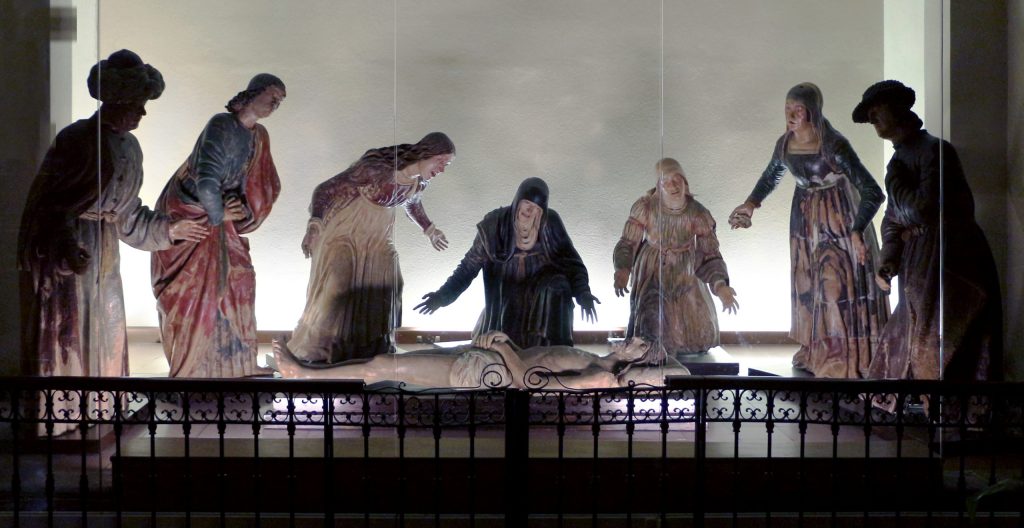
Women’s assumed physiological inferiority to men also contributed to how they were thought to experience emotions. Women’s cold-wet humoral nature made them more susceptible to emotions and less capable of managing their emotional behaviors in socially appropriate ways. In works of art like Guido Mazzoni’s terracotta Lamentation tableau created for the Duke of Ferrara, biblical characters perform their sorrow over Christ’s death in ways that reflect expectations for gendered emotional experience: the women are collectively far more violent than the men in their expressions of grief.

Titian’s composed and contained Duchess Eleonora perfectly reflects the gendered ideal for a renaissance woman. Her youthful beauty, her curvaceous form suggesting the fertility of motherhood, and her careful containment within the domestic realm all communicate renaissance expectations of and ideals for femininity. It is rare in renaissance art to encounter women whose features do not reflect standards of youthful beauty and the relationship to women’s primarily maternal role that they embody.
The Masculine Ideal

Fortune is a woman and if you wish to keep her under it is necessary to beat and ill use her; and it is seen she allows herself to be mastered by the adventurous rather than by those who go to work more coldly. She is, therefore, always woman-like, a lover of young men, because they are less cautious, more violent, and with more audacity to command her.
Machiavelli, The Prince [5]
Men, who in renaissance Christian thought were created in the image of a male God, were believed to have a natural superiority over their female counterparts. Niccolo Machiavelli’s famous text on statecraft, The Prince (1513), reflects the way gender roles were tied to notions of power: fortune is feminized, desirous of subjugation, while the worthy ruler is one who uses masculine aggressive force to subdue her. While not every man was expected to project the level of audacious dominance that bolstered princely authority, the masculine ideal was nonetheless one of forceful mastery.

While female virtue was tied primarily to sexual control and motherhood, male virtue was much more broadly defined. Men were expected to participate in all aspects of public life, to excel in learning, in their trade, in governance, and to do so with the aggressive and assertive behavior particular to their superior biological construction. Such qualities were communicated in art through figure types, costume, and movements that suggested these masculine ideals. As Alberti advised in his work on the family:
The beauty of a man accustomed to arms . . . lies in his having a presence betokening pride . . . limbs full of strength, and the gestures of one who is skilled and adept in all forms of exercise. The beauty of an old man . . . lies in his prudence, his amiability, and the reasoned judgment which permeates all his words and counsel.
Leon Battista Alberti, The Family in Renaissance Florence [6]
While Titian’s portrait of Francesco Maria might be said to embody the ideal vigorous military man, Antonio Rossellino’s marble portrait bust of the aged physician, Giovanni Chellini, presents the ideal sage elder. With his hollowed cheeks and sagging flesh, Chellini is shown aged and worn, yet the delicate veins at his temple seem to pulse with life and his posture is erect and his body robust beneath his robes. If Francesco Maria is the man of action, the venerable physician represents the contemplative man still virile in flesh.

Jesus Christ himself, whose own life-giving flesh had important associations with femininity, was overwhelmingly depicted in art in ways that emphasized his male sex and his masculine capacity to nobly endure physical and psychological pain. The stoic grace with which Christ endures the whips and torments of his torturers in Piero della Francesca’s Flagellation was a worthy model of noble, masculine strength. Indeed, even for women, the Christian imperative to model one’s life after that of Christ meant adopting qualities of temperance, constancy, and endurance that were understood to be fundamentally masculine in quality.
Gender Roles Constructed in and by Art

Images helped to communicate ideas about gender roles and to model appropriate—or expected—gendered behavior. One’s performance of femininity or masculinity was expected to conform with their age and social rank, as we see with Titian’s portraits of Francesco Maria and Eleonora. At times art could mask realities of character that were inconsistent with social ideals. Raphael’s sensitive portrait of the stooped, aged, and bearded Pope Julius II della Rovere conveys a quiet solemnity. The pontiff is shown as thoughtful, introspective, and serene. In reality, Julius was famously aggressive, nicknamed the “Warrior Pope” for his penchant for warfare. Julius was formidable in temperament, notoriously impetuous, indomitable and resolute. While these are certainly appropriate masculine qualities for some (a man in the position of his nephew duke Francesco Maria perhaps), they do not reflect characteristics expected of a pope who embodied the living image of Christ on earth.
The gender roles we encounter in renaissance art reflect ideas and ideals, not necessarily the reality of lived experience. Many women did indeed participate in public life, as the duchess Eleonora often did as ruler of Urbino during her mercenary husband’s many travels. Both Titian’s and Raphael’s portraits remind us that gender is a carefully constructed performance.
Appendix
Notes
- James Dennistoun, Memoirs of the Dukes of Urbino, vol. 3 (London: Longman, Brown, Green, and Longmans, 1851), appendix XI, p. 437.
- Quoted in Ronald Rainey, “Dressing Down the Dressed-Up: Reproving Feminine Attire in Renaissance Florence,” in Renaissance Society and Culture: Essays in Honor of Eugene F. Rice, Jr., ed. J. Monfasani and R.G. Musto (New York, 1991), p. 237 .
- Leon Battista Alberti, The Family in Renaissance Florence, trans. Renée Neu Watkins (Columbia: University of South Carolina Press, 1969), p. 20.
- Ibid., 207.
- Niccolò Machiavelli, The Prince, trans. W. K. Marriott (London, 1958), p. 143. Alberti, The Family in Renaissance Florence, p. 115.
Additional Resources
- A short annotated bibliography on gender and art in the Renaissance from Oxford Bibliographies
- Judith Butler, Gender Trouble: Feminism and the Subversion of Identity (New York: Routledge, 1999).
- Margaret Carroll, “The Erotics of Absolutism: Rubens and the Mystification of Sexual Violence,” in The Expanding Discourse: Feminism and Art History, 140–59 (New York: Icon Editions, 1992).
- Whitney Chadwick, Women, Art and Society. 5th edition (New York:Thames & Hudson, 2012).
- Margaret Ferguson et al., eds., Rewriting the Renaissance: the Discourses of Sexual Difference in Early Modern Europe (Chicago: University of Chicago Press, 1986).
- Michel Foucault, The History of Sexuality, Vol. 1, trans. Robert Hurley (New York: Vintage Books, 1990).
- Heather Graham, “Compassionate Lament: Somatic Selfhood and Gendered Affect in Italian Lamentation Imagery,” in Visualizing Sensuous Suffering and Affective Pain in Early Modern Europe and the Spanish Americas, Heather Graham and Lauren Kilroy-Ewbank, eds. (Leiden: Brill, 2018), pp. 82–115.
- Margaret L. King, Women of the Renaissance (Chicago: Chicago UP, 1991).
- Ian Maclean, The Renaissance Notion of Woman: A Study in the Fortunes of Scholasticism and Medical Science in European Intellectual Life (Cambridge: Cambridge UP, 1983).
- Lisa Rosenthal, “Manhood and Statehood: Rubens’s Construction of Heroic Virtue,” Oxford Art Journal 16 (1993), 92–111.
- Patricia Simons, “Homosociality and Erotics in Italian Renaissance portraiture,” in Portraiture: Facing the Subject, 29–47, ed. Joanna Woodall (Manchester and New York: Manchester University Press, 1997).
- Marina Warner, Alone of All Her Sex: The Myth and the Cult of the Virgin Mary (New York: Vintage Books, 1983).
- Joanna Woods-Marsden, “One Artist, Two Sitters, One Role: Raphael’s Papal Portraits,” in The Cambridge Companion to Raphael, pp. 120–140, ed. Marcia Hall (Cambridge: Cambridge UP, 2005).
Originally published by Smarthistory, 06.08.2020, under a Creative Commons Attribution-NonCommercial-ShareAlike 4.0 International license.
About the Author