Aid workers used to be considered off-limits in conflicts. Not anymore.

By Dr. Elizabeth Stites
Associate Research Professor of International Relations
Feinstein International Center
Tufts University
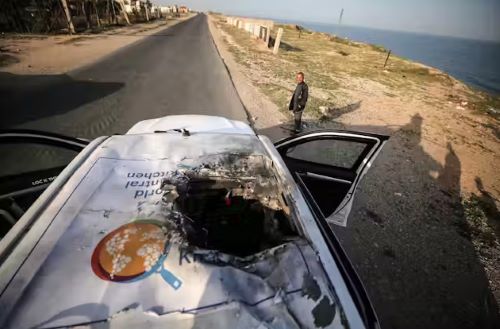
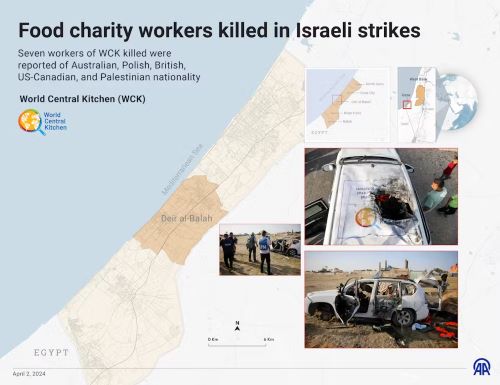
President Joe Biden said he was “outraged” by the Israeli military’s attacks that killed seven World Central Kitchen aid workers traveling in three vehicles in Gaza on April 2, 2024, and called for Israel to conduct a swift investigation into the strikes.
Israeli Prime Minister Benjamin Netanyahu said he “deeply regrets” the mistake and that Israel would undertake an investigation. World Central Kitchen, one of the few international aid groups operating in Gaza, announced shortly after the attack that it would suspend its operations in Gaza.
This attack was not, as Biden pointed out in his remarks on April 2, a “stand-alone incident.” More than 180 other aid workers have been killed since the start of the Israeli invasion in October 2023, according to the United Nations. Most of them were Palestinians working with the United Nations.
More broadly, attacks on aid workers in many wars, including those in Syria, Mali, Myanmar and Afghanistan, have been on the rise since the late 1990s, according to the nonprofit group Aid Worker Security Database. In 2023, 237 aid workers were killed, kidnapped or wounded, marking a sharp rise from the 35 humanitarians who faced the same fate in 1997.
The Conversation U.S.’s politics and society editor, Amy Lieberman, spoke with Elizabeth Stites, a scholar of conflict, violence and humanitarianism at Tufts University’s Feinstein International Center, to better understand what is behind the rise in aid worker attacks and the implications of the World Central Kitchen workers’ deaths.
Why has it become more dangerous for aid workers to operate in conflict zones?
Overall, the targeting of aid workers has expanded in war. Aid workers used to be considered off-limits. Now, many more aid workers are being killed.
But there are also many more aid workers than there used to be, and we are delivering aid in different ways.
Increasingly, in a lot of conflicts, like in Gaza, fighting is taking place within cities, where civilians live and where aid workers are based. There have also been rising numbers of attacks on hospitals, schools, internal displacement camps for civilians and other civilian places, which are supposed to be protected, humanitarian spaces.
What are humanitarian spaces, and why does this matter?
A humanitarian space is used primarily by civilians and is a place that, according to international law, should not be targeted during a war. All of this has been thrown out the window in the context of Gaza, where hospitals have been directly targeted and destroyed.
There is also the idea that aid workers are meant to be neutral and able to do their jobs without political interference, with the goal of saving lives and livelihoods. This idea of true objectivity is almost a utopian idea. In the Afghanistan War, for example, aid was funded by the U.S., which was a party to the conflict. From the Taliban’s perspective, this wasn’t neutral; this was U.S. aid, and the U.S. was one of the fighting forces.
There are only a few organizations, such as Doctors Without Borders and the International Committee of the Red Cross, which make staying out of conflict politics their modus operandi – and even they struggle. This is partially because, among other reasons, many armed actors don’t trust the neutrality of aid.
In Gaza, aid is completely politicized in terms of where food or medical supplies goes, who is taking it in and how it gets there. This makes it incredibly difficult for aid workers to do their job and for civilians to get what they need to survive.
What else has shifted about aid worker attacks and responses to them?
Aid workers are attacked in a lot of places, but the amount of attention this receives differs greatly based on the nationality of the aid workers in question. In 13 years of conflict in Syria, relatively few foreign aid workers have been killed, because most foreign donors are not willing to risk having their citizens in these places. Instead, the international organizations operate remotely, meaning it is local staff from national organizations delivering the aid and, as a result, taking the risks.
These local staff are working in war zones and trying to protect and provide for the families in these same war zones, something very few foreign aid workers ever have to contend with. It is these same local staff who are being killed while trying to provide aid to their fellow citizens, friends and neighbors.
How are aid workers typically assured they will be secure in a war zone?
This can look different in various conflicts. In a situation like Gaza, there would have been multiple levels of conversation and security protocols, likely starting with the aid workers themselves. After they finished unloading their trucks, they would likely have radioed their security officer to check if they were good to go. That security officer would then talk to his or her official Israeli military contacts, as well as with any local sources, to make sure it was safe.
It sounds like the World Central Kitchen workers were in direct contact with IDF and had clearance from them to travel. The World Central Kitchen workers were traveling along one of Israel’s preapproved aid delivery routes. We know that they were in clearly marked vehicles and were targeted anyway – whether it was intentional or not remains to be seen.
How is the Gaza conflict different from other wars in terms of aid worker attacks, and what could this mean for future humanitarian work there?
These attacks are increasingly routine, unfortunately, in war. There have been more than 180 local aid workers killed since the start of the conflict.
For me, these recent deaths raise the question of what type of aid worker we care about and why. Six of the World Central Kitchen workers who were killed were foreigners, which is one reason why I think we are paying attention. Possibly the fact that some of these World Central Kitchen workers were from influential countries like Australia, the United Kingdom and the U.S. may turn up the heat on the Israeli military and shine a spotlight on this – but I think it will fade relatively quickly.
Israel has also come out and said it was a mistake. That is an interesting aspect to follow, and we will see if that results in maybe a brief expansion of humanitarian space to allow better access to civilians, to encourage international aid groups to come back to Gaza.
Originally published by The Conversation, 04.03.2024, under the terms of a Creative Commons Attribution/No derivatives license.
About the Author