The Jacquerie uprising of 1358 revealed how war, taxation, and aristocratic privilege pushed rural communities in medieval France toward explosive rebellion.

By Matthew A. McIntosh
Public Historian
Brewminate
Introduction: Crisis in a Feudal Kingdom
The Jacquerie revolt of 1358 emerged from a period of extraordinary political and social turmoil in medieval France. By the mid-fourteenth century, the kingdom faced overlapping crises that strained the structures of feudal authority. Warfare, economic disruption, and political instability combined to produce an environment in which traditional relationships between elites and rural populations became increasingly fragile. Within this volatile context, the Jacquerie erupted as one of the most dramatic peasant uprisings of the Middle Ages. Although the revolt was brief and ultimately unsuccessful, its outbreak revealed deep tensions embedded within the feudal system that governed medieval French society.
The broader setting for the uprising was the Hundred Years’ War between the kingdoms of France and England. Beginning in 1337, the conflict subjected large areas of northern France to repeated military campaigns, raids, and occupation. Armies moving through the countryside requisitioned food, destroyed crops, and devastated villages, leaving rural communities exposed to both violence and economic hardship. The defeat of French forces at the Battle of Poitiers in 1356 intensified the crisis when King John II of France was captured by English troops. His imprisonment not only weakened royal authority but also created a political vacuum that destabilized governance across the kingdom.
The absence of a strong monarch exacerbated existing tensions within the political order. In Paris, political reformers led by Étienne Marcel attempted to impose greater control over royal finances and administration through the Estates-General. These urban political struggles unfolded simultaneously with growing unrest in the countryside, where peasants bore the immediate consequences of taxation and wartime devastation. The combination of aristocratic privilege, fiscal pressure, and the breakdown of security contributed to widespread resentment among rural populations. Many peasants perceived the nobility as failing in one of its most fundamental feudal obligations: the protection of the communities whose labor supported elite wealth and status. In feudal ideology, the aristocracy justified its privileges through the promise of military leadership and local protection, yet the chaos of the war had left many rural areas vulnerable to marauding soldiers, mercenary bands, and bandits who operated with little restraint. Villages that suffered repeated raids or requisitions often found that their local lords lacked the resources or willingness to provide meaningful defense. This perceived failure undermined the legitimacy of aristocratic authority and contributed to the growing anger that would soon erupt in open rebellion.
The Jacquerie revolt cannot be understood simply as an isolated episode of rural violence. Rather, it reflected the cumulative pressures produced by war, taxation, and political instability within a hierarchical society structured around aristocratic power. The uprising exposed the vulnerability of feudal authority at a moment when traditional bonds between rulers and subjects were under severe strain. Although the revolt was quickly suppressed by noble forces, the events of 1358 revealed the depth of rural dissatisfaction in medieval France and demonstrated how rapidly social tensions could erupt when the institutions of governance faltered.
Feudal Hierarchy and Aristocratic Privilege in Medieval France
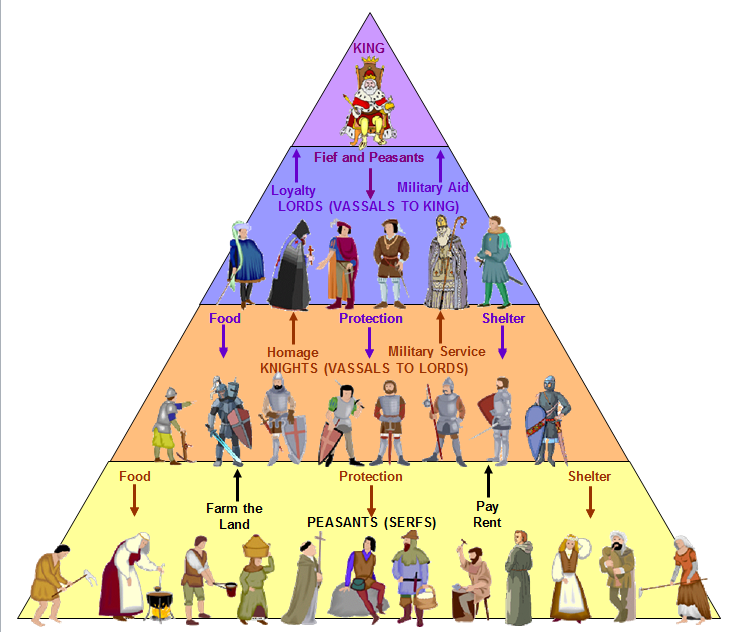
The social structure of medieval France rested upon a hierarchical framework commonly described as feudalism, a system in which political authority, landholding, and social status were closely intertwined. At the apex of this structure stood the king, whose authority theoretically encompassed the entire kingdom but in practice was mediated through networks of noble vassals. These aristocratic elites controlled vast estates and exercised local authority within their territories. Beneath them existed layers of lesser nobles, knights, clergy, townspeople, and the large rural population of peasants whose labor sustained the economic foundations of the feudal order. Although this hierarchy was often presented as a mutually reinforcing system of obligations, the distribution of power and privilege within it remained heavily concentrated among the aristocracy.
Land ownership formed the central pillar of aristocratic authority. Noble families possessed extensive estates that provided both wealth and political influence, enabling them to command labor, collect rents, and exercise jurisdiction over local populations. In return for their lands, nobles owed military service and loyalty to the crown or to higher-ranking lords within the feudal chain. This system of reciprocal obligations structured much of medieval political life, but it also reinforced the social distance between elites and the rural communities that worked the land. The economic productivity of peasant agriculture supported noble households, financed military obligations, and sustained the wider feudal hierarchy.
Peasants occupied the broad base of this social order and carried the greatest share of its economic burdens. Most rural inhabitants were tied to agricultural production through customary obligations that required them to cultivate their own plots while also providing labor or payments to their lords. These obligations might include rents in money or produce, labor services on demesne lands controlled directly by the lord, and a variety of additional fees tied to local customs. In many regions, peasants also faced legal constraints that limited their freedom of movement and reinforced their dependence upon the estates where they lived and worked. Such arrangements ensured a steady flow of resources upward through the feudal hierarchy. Beyond these routine obligations, peasants were also vulnerable to extraordinary demands during periods of war or political crisis. Lords could impose additional levies, requisition supplies, or require transport services to support military campaigns. For peasant households already operating at the margins of subsistence, such demands could disrupt agricultural cycles and strain household economies. The cumulative effect of these obligations reinforced the unequal distribution of power within feudal society, binding rural populations to systems that extracted labor and resources while offering limited protection or political influence in return.
The legal structure of feudal society further reinforced aristocratic privilege. Nobles possessed jurisdictional authority within their territories, allowing them to administer local courts and adjudicate disputes among those living on their lands. These courts governed issues ranging from property conflicts to minor criminal offenses, embedding noble authority within the everyday life of rural communities. In addition to judicial power, aristocrats often controlled key aspects of local economic activity, including access to mills, ovens, and other facilities essential for processing agricultural products. The ability to regulate both law and economic infrastructure strengthened the social dominance of the noble class.
The ideological framework of feudal society presented aristocratic privilege as part of a broader moral and political order. Medieval political thought frequently described society as composed of distinct groups performing complementary roles. The clergy prayed, the nobility fought, and the peasants worked. Within this framework, noble privilege was justified through the expectation that the aristocracy would provide military leadership and protection for the broader population. This conception of social order reinforced the legitimacy of noble authority while also emphasizing the responsibilities associated with elite status. Religious and intellectual traditions reinforced these ideas by portraying the hierarchical organization of society as part of a divinely sanctioned order. Sermons, legal texts, and political writings frequently emphasized stability and obedience as virtues necessary for maintaining social harmony. As a result, the hierarchical structure of feudal society was not only sustained by economic and legal mechanisms but also supported by cultural narratives that framed inequality as both natural and necessary.
Yet the stability of this system depended upon the continued ability of the nobility to fulfill these protective functions. When warfare disrupted rural life and local security deteriorated, the ideological balance that justified aristocratic privilege began to weaken. The devastation produced by the Hundred Years’ War placed extraordinary strain on this arrangement, as peasants experienced increasing taxation and violence while receiving little protection in return. Under such circumstances the hierarchical structure of feudal society appeared less as a system of mutual obligation and more as a mechanism through which rural populations bore the costs of aristocratic power. These tensions formed an important backdrop to the explosive unrest that would erupt in the Jacquerie revolt of 1358.
War and Devastation: The Hundred Years’ War and Rural Hardship
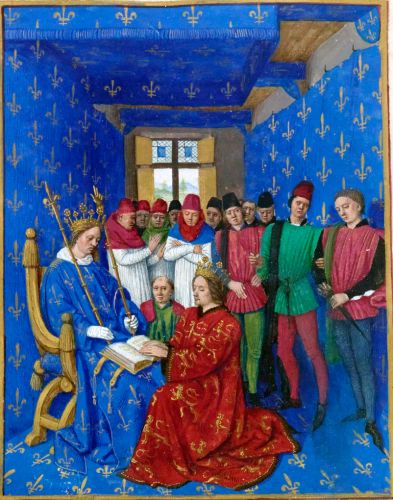
The outbreak of the Hundred Years’ War in 1337 transformed the political rivalry between the English and French crowns into a prolonged military struggle that reshaped life across large areas of northern France. Although royal armies and noble commanders directed the war, the consequences of the conflict fell most heavily upon rural populations whose villages lay directly in the path of military campaigns. Armies moving through the countryside consumed food supplies, seized livestock, and destroyed crops needed to sustain local communities. In many cases the devastation extended beyond the immediate needs of military logistics, as raiding and looting became common practices used to weaken enemy territories and undermine economic stability. The result was a landscape marked by disrupted agriculture, abandoned settlements, and deepening insecurity for rural inhabitants.
Military strategy during the war frequently relied on destructive raids designed to inflict economic damage rather than secure permanent territorial control. English forces in particular conducted large mounted expeditions known as chevauchées, sweeping through French territory while burning villages, destroying harvests, and targeting economic resources that supported royal authority. These campaigns devastated wide areas of the countryside and undermined the capacity of rural communities to maintain stable agricultural production. Unlike traditional sieges that focused on fortified cities or castles, the chevauchée deliberately targeted the rural economy that sustained those political centers. Villages, barns, vineyards, and mills were destroyed in order to weaken the financial base of the French monarchy and its noble supporters. For peasant communities, such raids could erase years of labor in a matter of days, leaving families without crops, livestock, or stored food necessary to survive the coming winter. Even regions not permanently occupied by English forces could suffer severe disruption as armies passed through repeatedly, each movement stripping the countryside of resources and leaving behind damaged infrastructure and exhausted communities.
The presence of armed bands posed an additional threat to rural populations even when major campaigns were not underway. Soldiers who had served in royal armies sometimes formed independent companies that continued to operate during periods of truce or reduced military activity. These groups, often referred to as routiers or free companies, sustained themselves through plunder and extortion, targeting villages, monasteries, and merchant routes. Their activities blurred the boundary between warfare and banditry, making it difficult for local communities to distinguish between official military operations and opportunistic violence carried out by armed groups.
Economic pressures also intensified as the French crown sought to finance the costs of prolonged warfare. Royal officials expanded taxation in order to support military campaigns, ransom captured nobles and maintain defensive infrastructure across vulnerable regions. These fiscal measures placed increasing burdens upon the peasantry, who already faced declining agricultural yields in areas repeatedly damaged by war. The need to raise funds for the ransom of King John II after his capture at the Battle of Poitiers further heightened the financial strain placed upon the kingdom. The scale of the ransom demanded by the English crown required substantial resources, and the responsibility for meeting these financial obligations ultimately filtered down through the layers of French society. Local communities were expected to contribute through increased taxes, special levies, and additional economic demands imposed by both royal officials and local lords attempting to recover their own wartime losses. For peasants already struggling to rebuild after raids and destruction, these financial obligations intensified feelings that the costs of war were borne disproportionately by the rural population.
The cumulative impact of these pressures produced widespread instability in the countryside. Agricultural disruption reduced the availability of food and undermined the economic foundations of rural life. Communities that had once depended on predictable seasonal rhythms found their livelihoods repeatedly interrupted by war, taxation, and insecurity. As economic hardship deepened, resentment toward the nobility intensified, particularly when local lords appeared unable to protect their lands from raids or the depredations of mercenary bands. In many areas castles and fortified towns remained relatively secure while surrounding villages suffered repeated devastation. This contrast heightened the perception that aristocratic privilege insulated elites from the worst effects of warfare while peasants endured its daily consequences. The gap between the promises of feudal protection and the realities of wartime vulnerability became increasingly difficult to ignore.
By the late 1350s these conditions had created an atmosphere of profound tension across parts of northern France. Peasants who had endured years of devastation and financial pressure faced a social order that continued to demand labor, rents, and loyalty while offering diminishing security in return. The hierarchical structures of feudal society appeared less stable than they had in earlier generations. The hardships produced by the Hundred Years’ War formed a crucial backdrop to the Jacquerie uprising, demonstrating how prolonged military conflict could erode the foundations of social order and contribute to explosive episodes of rural revolt.
Political Instability and the Crisis of Authority (1356–1358)
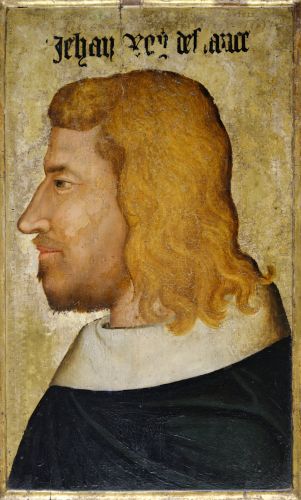
The political instability that followed the Battle of Poitiers intensified the pressures already affecting French society during the Hundred Years’ War. When King John II of France was captured by English forces during the battle, the monarchy suddenly lost its central authority at a moment when the kingdom faced military and economic crisis. The capture of the king created both a symbolic and practical disruption in governance. Royal administration continued under the leadership of the Dauphin, the future King Charles V, but the legitimacy and effectiveness of the monarchy were deeply weakened. In a feudal political system that relied heavily on personal loyalty to the monarch, the absence of the king complicated efforts to coordinate defense, taxation, and political unity.
The royal government faced immediate financial challenges as it attempted to maintain the war effort while negotiating the ransom required for the king’s release. The English crown demanded an enormous payment as part of the negotiations, placing additional strain on the already fragile fiscal system of France. To meet these demands, the monarchy relied increasingly on taxation approved through assemblies of the Estates-General. These assemblies brought together representatives of the clergy, nobility, and urban communities, reflecting the growing role of political consultation during moments of crisis. Yet the debates that occurred within the Estates-General also exposed divisions among the kingdom’s political elites, particularly over questions of taxation, royal authority, and administrative reform. Representatives of towns and cities frequently expressed frustration with what they perceived as ineffective royal leadership and financial mismanagement that had contributed to France’s defeat at Poitiers. They sought greater oversight over taxation and demanded reforms that would allow representatives of the estates to monitor the use of public funds. These demands challenged the traditional structure of royal governance by asserting that the crown should be accountable to broader political interests during moments of national crisis. The resulting negotiations revealed the growing tensions between royal authority and emerging political voices seeking greater participation in the management of the kingdom’s affairs.
One of the most significant political developments during this period involved the leadership of Étienne Marcel, the provost of the merchants of Paris. Marcel became a prominent figure in the reform movement that emerged within the Estates-General, advocating measures intended to increase oversight of royal finances and limit the influence of certain royal advisers. His movement reflected the frustrations of urban elites who believed that mismanagement and corruption within the royal administration had contributed to France’s military failures. Marcel’s influence within Paris allowed him to mobilize urban support for reforms that challenged traditional patterns of royal authority.
These political struggles within the capital unfolded against a wider backdrop of insecurity across the kingdom. While royal officials and urban leaders debated reforms, rural regions continued to suffer from the consequences of warfare, taxation, and economic disruption. The fragmentation of authority made it increasingly difficult to maintain order in the countryside, where local grievances often went unaddressed by distant political institutions. In some areas the weakening of royal power emboldened armed groups and local factions, further undermining the stability of communities already strained by years of conflict.
The convergence of these political tensions produced an atmosphere in which the legitimacy of traditional authority appeared uncertain. Royal leadership was weakened, urban reform movements challenged existing structures of governance, and rural populations faced mounting hardships with little effective protection. The political crises of 1356 to 1358 created conditions in which dissatisfaction could spread across multiple layers of society. Amid this instability, the outbreak of the Jacquerie revolt would soon reveal how fragile the foundations of feudal authority had become during one of the most turbulent moments of medieval French history.
The Jacquerie Uprising: Violence and Rural Revolt
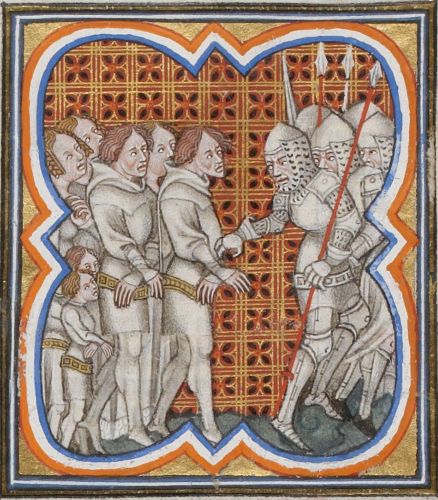
The uprising erupted in the spring of 1358 amid the wider crisis of war and governance that had engulfed northern France. The uprising began in the Beauvaisis region north of Paris, an area that had suffered repeated devastation during the Hundred Years’ War. Rural communities there had endured raids, the destruction of crops, and mounting taxation imposed to finance ongoing military campaigns and the ransom of King John II. In this atmosphere of hardship and insecurity, tensions between peasants and the aristocracy reached a breaking point. What began as localized resistance quickly developed into a broader uprising that spread across parts of northern France.
The term “Jacquerie” itself derived from the nickname “Jacques Bonhomme,” a phrase commonly used by nobles to refer to peasants in a dismissive or mocking manner. Chroniclers adopted the term to describe the revolt, reflecting the social distance and hostility that characterized elite attitudes toward rural populations. Contemporary accounts portray the uprising as a sudden eruption of violence by peasants who had grown resentful of the privileges enjoyed by the nobility. While such descriptions were shaped by the perspectives of aristocratic writers, they nonetheless suggest that the revolt represented a moment when longstanding frustrations within the countryside erupted into open confrontation. The language used by chroniclers also reveals the social attitudes that shaped elite interpretations of the rebellion. By labeling the insurgents collectively as “Jacques,” writers such as Jean Froissart reinforced stereotypes that portrayed peasants as crude, disorderly, and incapable of legitimate political action. This framing allowed aristocratic authors to present the revolt less as a response to structural injustice and more as an irrational outbreak of violence among the lower classes. The persistence of the term in historical writing demonstrates how deeply embedded these social assumptions were within medieval elite culture.
One of the central figures associated with the uprising was Guillaume Cale, sometimes identified in sources as a leader or organizer among the rebels. Cale appears to have emerged as a spokesperson or commander for groups of peasants who had begun to organize armed resistance against noble authority. The rebels gathered in significant numbers and moved through rural districts attacking castles, manor houses, and other symbols of aristocratic power. These actions targeted the physical structures that embodied the stratified order of feudal society, transforming the revolt into a direct challenge to the authority of the noble class.
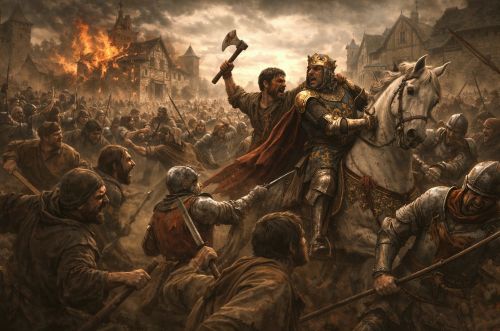
The violence associated with the Jacquerie shocked contemporary observers and became a defining element of how the revolt was recorded in historical chronicles. Noble estates were looted or burned, and members of the aristocracy who fell into rebel hands sometimes faced brutal treatment. Chroniclers such as Jean Froissart described these events with particular horror, emphasizing the perceived savagery of the peasants. These accounts portrayed the uprising as an attack on the natural order of feudal society, reinforcing elite anxieties about the consequences of social upheaval. Froissart’s narrative, written from the perspective of aristocratic society, emphasized the destruction of noble property and the perceived breakdown of hierarchical authority. His descriptions often highlighted acts of violence committed by the rebels while giving less attention to the conditions that had provoked the uprising in the first place. As a result, the chronicle presents the revolt as both a moral and social crisis in which established boundaries between social classes appeared to collapse. Modern historians recognize that these accounts reflect the fears and biases of elite observers, requiring careful interpretation when reconstructing the motivations and experiences of the rural participants.
Despite its rapid expansion, the Jacquerie lacked the political coordination necessary to sustain a prolonged rebellion. Rebel groups operated largely within their local regions and did not establish a unified strategy or leadership structure capable of confronting the organized military forces of the nobility. Nevertheless, the revolt briefly intersected with broader political unrest occurring at the same time in Paris, where urban reformers led by Étienne Marcel challenged royal authority. Although these movements shared a context of crisis and dissatisfaction, the connection between urban political agitation and rural rebellion remained limited and fragile.
The Jacquerie represented both a dramatic expression of rural anger and a reflection of the structural tensions within feudal society during the mid-fourteenth century. The revolt revealed how the combined pressures of warfare, taxation, and social hierarchy could produce explosive resistance when traditional systems of authority faltered. Even though the uprising was short-lived, the scale of the violence and the speed with which it spread demonstrated the depth of resentment that had accumulated among peasant communities during years of war and instability.
Aristocratic Retaliation and the Suppression of the Revolt
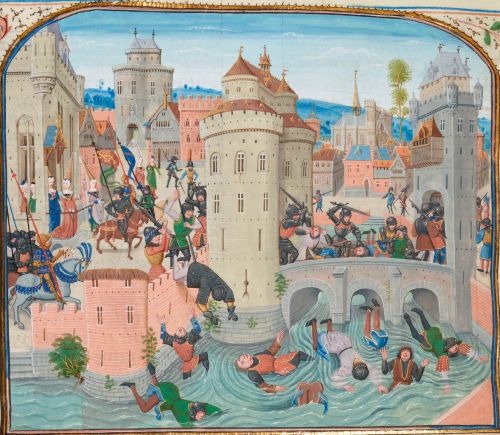
The response of the French nobility to the Jacquerie uprising was swift and decisive. News of attacks on castles and aristocratic estates spread rapidly among noble families, provoking alarm throughout northern France. For the aristocracy, the revolt represented not merely a local disturbance but a direct challenge to the foundations of noble power. Noble leaders quickly organized armed forces drawn from their retainers, knights, and regional allies in order to confront the rebel groups. These efforts reflected a broader sense of solidarity among the aristocratic class, whose members understood that the rebellion threatened the social hierarchy upon which their power and privilege depended.
One of the most significant confrontations between noble forces and the rebels occurred near the town of Mello in the Beauvaisis region. There, the peasant forces led by Cale faced a coalition of aristocratic troops commanded by Charles II of Navarre and several French nobles. Although the rebels had gathered large numbers of participants, they lacked the military training, discipline, and equipment possessed by professional knights and men-at-arms. According to contemporary sources, the encounter quickly turned into a decisive defeat for the peasant forces. Cale himself was captured during the confrontation, and his arrest marked a turning point in the suppression of the uprising. Reports suggest that the nobles employed deception to secure Cale’s surrender, inviting him to negotiations before seizing him and placing him in chains. His capture deprived the rebels of a recognizable leader at a critical moment in the conflict. Without centralized leadership, the already fragmented rebel forces struggled to coordinate their movements or organize an effective response to the advancing aristocratic troops.
Following the defeat of the rebel leadership, noble retaliation intensified across the affected regions. Aristocratic forces moved through rural districts seeking out participants in the revolt and punishing those suspected of involvement. Villages believed to have supported the uprising were subjected to violent reprisals, and many peasants were executed without formal trial. These actions served both as retribution for attacks on noble estates and as a warning intended to discourage further rebellion. Contemporary accounts describe widespread destruction inflicted upon communities suspected of harboring rebels, including the burning of houses and the execution of individuals accused of participating in attacks against noble families. The severity of these reprisals reflected the determination of the aristocracy to reassert control and restore the hierarchical order that had been challenged during the uprising. Such measures also demonstrated how quickly the mechanisms of feudal authority could shift from defensive mobilization to punitive violence aimed at restoring elite dominance.
The suppression of the Jacquerie also revealed the military imbalance between peasant rebels and the professional warrior class that dominated medieval warfare. Knights and noble commanders possessed extensive experience in combat, supported by trained retinues and access to superior weapons and armor. In contrast, most of the rebels were agricultural laborers with limited military preparation. Although their numbers allowed them to inflict localized damage during the early stages of the revolt, they lacked the organizational structure necessary to sustain resistance against coordinated aristocratic forces. Once noble leaders mobilized effectively, the outcome of the conflict became increasingly predictable.
Elite chroniclers described the reprisals with a mixture of approval and caution, often portraying the suppression of the revolt as necessary to restore social order. Some accounts emphasized the brutality of the punishment inflicted upon the rebels, presenting it as a justified response to what aristocratic observers viewed as an attack on the natural hierarchy of society. These narratives also reveal the deep anxieties that the uprising had generated among the noble class. The speed with which the revolt had spread across parts of northern France alarmed many aristocratic observers, who feared that similar uprisings might erupt in other regions. Chroniclers framed the suppression not only as a victory but also as a necessary demonstration of noble authority intended to prevent further unrest. By emphasizing the consequences faced by the rebels, these accounts sought to reinforce the legitimacy of the existing social order and discourage future challenges to aristocratic power.
By the summer of 1358 the Jacquerie had been effectively crushed, and aristocratic control over the affected regions was reestablished. The revolt’s rapid suppression reinforced the resilience of the feudal hierarchy, which remained capable of mobilizing military force to defend elite privilege. Yet the violence required to restore order also highlighted the depth of social tensions that had accumulated within rural society. Although the uprising failed to produce lasting structural change, it revealed the underlying strains within the feudal system and demonstrated how quickly rural unrest could escalate into open rebellion when political and economic pressures reached a breaking point.
Interpreting the Jacquerie: Class Conflict or Crisis Response?
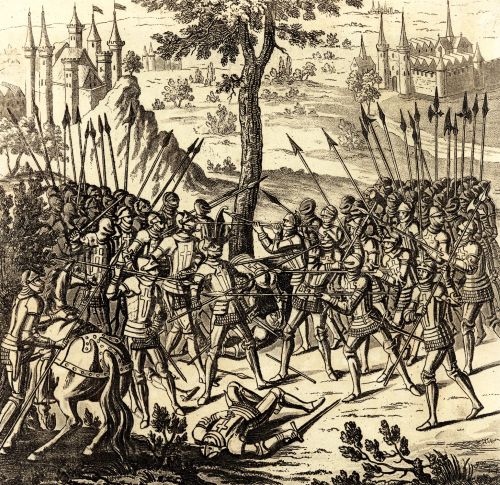
Historians have long debated how the Jacquerie should be interpreted within the broader history of medieval social conflict. Early historical narratives, heavily influenced by aristocratic chroniclers such as Froissart, portrayed the revolt primarily as an outbreak of chaotic violence by peasants who had abandoned the social order that structured medieval society. In these accounts, the uprising appeared less as a political movement than as a dangerous eruption of disorder among rural populations. For centuries this interpretation shaped the understanding of the Jacquerie, reinforcing the idea that peasant revolts were spontaneous and destructive rather than reflective of deeper structural tensions within feudal society.
During the twentieth century, however, historians began to reexamine the Jacquerie through the lens of social and economic history. Scholars influenced by Marxist and materialist approaches interpreted the revolt as a form of class conflict between the rural peasantry and the aristocratic elite. Within this framework, the uprising represented a reaction against the exploitation embedded in feudal relations of production. Peasants, burdened by rents, taxes, and labor obligations, responded to intensifying pressures by attacking the social structures that sustained noble dominance. From this perspective the Jacquerie formed part of a wider pattern of popular resistance that appeared across medieval Europe during periods of economic crisis and social transformation.
Other historians have challenged the notion that the Jacquerie should be understood primarily as a class-based revolutionary movement. They emphasize that the revolt occurred within a specific historical moment shaped by war, political instability, and economic disruption. According to this interpretation, the uprising reflected the immediate pressures created by the Hundred Years’ War rather than a coherent ideological challenge to feudal hierarchy. Rural populations had endured years of devastation, increased taxation, and declining security, and their actions may have represented a desperate response to these conditions rather than an organized attempt to restructure society.
The limited coordination among rebel groups also complicates interpretations that portray the Jacquerie as a unified social movement. Evidence suggests that many participants acted within localized networks rather than under a centralized leadership structure. Attacks often targeted nearby castles or estates associated with specific grievances rather than representing a broader program of political reform. In many cases, the rebels appear to have mobilized quickly in response to local conditions, drawing together villagers and neighboring communities who shared immediate grievances rather than long-term political goals. These actions frequently focused on symbols of noble authority such as manor houses, fortifications, and estate infrastructure, suggesting that the violence carried strong symbolic meaning even when it lacked coordinated strategy. The absence of a broader organizational framework made it difficult for the rebels to sustain cooperation across regions or develop strategies capable of confronting the military strength of the aristocracy. As a result, the uprising remained fragmented and vulnerable once noble forces began to mobilize effectively against it.
Despite these differing interpretations, most scholars agree that the Jacquerie exposed the vulnerability of feudal society during periods of crisis. Whether understood as an expression of class tension or as a response to wartime devastation, the revolt revealed how fragile the balance of medieval social relations could become when economic hardship and political instability converged. The uprising occupies an important place in the study of medieval social conflict, illustrating how structural inequalities within feudal society could generate explosive forms of resistance when traditional systems of authority were weakened.
Memory and Representation of the Jacquerie
The historical memory of the Jacquerie revolt has been shaped largely by the perspectives of the elite chroniclers who recorded the events of 1358. Among the most influential of these writers was Jean Froissart, whose Chronicles provide one of the most detailed surviving narratives of the uprising. Writing from the standpoint of aristocratic society, Froissart depicted the revolt as a terrifying breakdown of the social order. His account emphasized the violence committed by the rebels and portrayed the uprising as a moment when peasants abandoned the norms that structured feudal hierarchy. Because Froissart’s work circulated widely in later centuries, his interpretation strongly influenced how the Jacquerie was remembered in historical tradition.
Elite narratives of the revolt often relied on language that reinforced existing social hierarchies. Peasants were frequently depicted as crude, irrational, or inherently disorderly, while the nobility appeared as defenders of civilization and stability. Such portrayals reflected the broader ideological framework of medieval aristocratic culture, which viewed the hierarchical organization of society as both natural and necessary. By framing the revolt as an eruption of uncontrolled violence, chroniclers helped to justify the harsh reprisals that followed the suppression of the uprising. These accounts served not only as historical records but also as political narratives that reinforced aristocratic legitimacy.
Modern historians have approached these sources with greater caution, recognizing that the perspectives of elite chroniclers inevitably shaped their descriptions of the revolt. Because most surviving written accounts were produced by members of the educated and aristocratic classes, the voices of the peasants themselves are largely absent from the historical record. This imbalance presents significant challenges for scholars attempting to reconstruct the motivations and experiences of those who participated in the uprising. Without letters, testimonies, or written declarations from the rebels themselves, historians must rely on sources that often portrayed the participants through the lens of elite fear and hostility. As a result, interpreting the Jacquerie requires careful attention to the biases embedded in medieval narratives. Scholars often compare different chronicles, analyze the political context in which these accounts were written, and examine economic and administrative records that may shed indirect light on rural conditions. Through such methods historians attempt to reconstruct a more balanced understanding of the revolt, recognizing that the surviving narratives reflect both the events themselves and the anxieties of the aristocratic society that recorded them.
The continuing reinterpretation of the Jacquerie reflects broader changes in the study of medieval history. By combining narrative chronicles with economic records, legal documents, and regional studies, scholars have sought to move beyond the traditional portrayals offered by aristocratic writers. These efforts have produced a more nuanced understanding of the revolt as part of a wider pattern of social unrest within medieval Europe. The memory of the Jacquerie illustrates how historical narratives evolve over time, shaped not only by the events themselves but also by the perspectives of those who record and interpret them.
Conclusion: Feudal Power and the Limits of Rural Resistance
The Jacquerie revolt of 1358 exposed the structural fragility of medieval feudal society under the pressure of war and inequality. In a system where political authority, land ownership, and social privilege were concentrated among the aristocracy, the burdens placed upon rural populations could become increasingly difficult to sustain during periods of crisis. Warfare, taxation, and economic disruption intensified the pressures already embedded in the feudal order. The uprising reflected not merely a moment of rural violence but the cumulative effects of structural inequality and prolonged hardship across large areas of northern France.
The uprising also demonstrated how deeply the stability of feudal society depended upon the perceived legitimacy of aristocratic authority. The noble class justified its privileges through the expectation that it would provide military leadership and protection for the broader population. Yet the devastation caused by the Hundred Years’ War exposed the fragility of this arrangement. When rural communities experienced repeated raids, economic destruction, and rising fiscal demands without adequate protection, the ideological foundations of aristocratic privilege began to erode. Under such conditions the social hierarchy that had long structured medieval life became vulnerable to sudden and violent challenge.
The rapid suppression of the Jacquerie illustrates the limitations of peasant resistance within the political and military realities of the fourteenth century. Although the rebels were able to mobilize large numbers of participants and inflict localized damage upon noble estates, they lacked the organization, leadership, and military resources necessary to sustain a prolonged revolt. Most participants were agricultural laborers with little access to weapons, formal training, or strategic planning. Rebel groups tended to organize around local grievances rather than coordinated regional objectives, which made it difficult to maintain unity once aristocratic forces began mobilizing against them. The absence of fortified positions, supply networks, and experienced commanders further weakened the rebels’ ability to confront professional soldiers. In contrast, the nobility possessed the military infrastructure necessary to restore control, including trained knights, mounted troops, and established systems of command. Once these forces were assembled, the imbalance between the two sides became overwhelming. The rebellion exposed the anger and desperation present within rural communities while simultaneously demonstrating the resilience of the feudal system’s coercive mechanisms.
Despite its brief duration, the Jacquerie remains an important episode in the history of medieval social conflict. The uprising revealed how political instability, economic hardship, and entrenched social hierarchies could combine to produce explosive forms of resistance. The revolt underscored the enduring strength of aristocratic power within the medieval order. By examining both the causes and the suppression of the Jacquerie, historians gain insight into the complex relationship between authority and resistance in medieval Europe and the ways in which rural populations responded to the pressures imposed by feudal rule.
Bibliography
- Bessen, David M. “The Jacquerie: Class War or Co-opted Rebellion?” Journal of Medieval History 11:1 (1985), 43-59.
- Bloch, Marc. Feudal Society. Translated by L. A. Manyon. Chicago: University of Chicago Press, 1961.
- Bois, Guy. The Crisis of Feudalism: Economy and Society in Eastern Normandy c.1300–1550. Cambridge: Cambridge University Press, 1976.
- Cazelles, Raymond. La Société politique et la crise de la royauté sous Philippe de Valois. Paris: Librairie d’Argences, 1958.
- Cohn, Samuel K. Jr. Lust for Liberty: The Politics of Social Revolt in Medieval Europe, 1200–1425. Cambridge, MA: Harvard University Press, 2006.
- Davies, C. S. L. “Peasant Revolt in France and England: A Comparison.” The Agricultural History Review 21:2 (1973), 122-134.
- Duby, Georges. Rural Economy and Country Life in the Medieval West. Columbia: University of South Carolina Press, 1968.
- —-. The Three Orders: Feudal Society Imagined. Translated by Arthur Goldhammer. Chicago: University of Chicago Press, 1980.
- Firnhaber-Baker, Justine. The Jacquerie of 1358: A French Peasants’ Revolt. Oxford: Oxford University Press, 2021.
- —-. “The Social Constituency of the Jacquerie Revolt of 1358.” Speculum 95:3 (2020), 689-715.
- Fourquin, Guy. The Anatomy of Popular Rebellion in the Middle Ages. Amsterdam: North-Holland Publishing, 1978.
- Froissart, Jean. Chroniques. Translated selections in Geoffrey Brereton, Froissart: Chronicles. Harmondsworth: Penguin, 1968.
- Green, David. The Hundred Years War: A People’s History. New Haven: Yale University Press, 2014.
- Hilton, Rodney. Bond Men Made Free: Medieval Peasant Movements and the English Rising of 1381. London: Routledge, 1973.
- —-. Class Conflict and the Crisis of Feudalism: Essays in Medieval Social History. London: Hambledon Press, 1985.
- Nicholas, David. The Later Medieval City, 1300–1500. London: Longman, 1997.
- Reynolds, Susan. Fiefs and Vassals: The Medieval Evidence Reinterpreted. Oxford: Oxford University Press, 1994.
- Rogers, Clifford J., ed. The Oxford Encyclopedia of Medieval Warfare and Military Technology. Oxford: Oxford University Press, 2010.
- Sumption, Jonathan. The Hundred Years War, Volume II: Trial by Fire. Philadelphia: University of Pennsylvania Press, 1999.
- Vale, Malcolm. The Origins of the Hundred Years War: The Angevin Legacy 1250-1340. Oxford: Oxford University Press, 1996.
- Verbruggen, J. F. The Art of Warfare in Western Europe during the Middle Ages. Amsterdam: North-Holland Publishing, 1977.
Originally published by Brewminate, 03.11.2026, under the terms of a Creative Commons Attribution-NonCommercial-NoDerivatives 4.0 International license.
About the Author