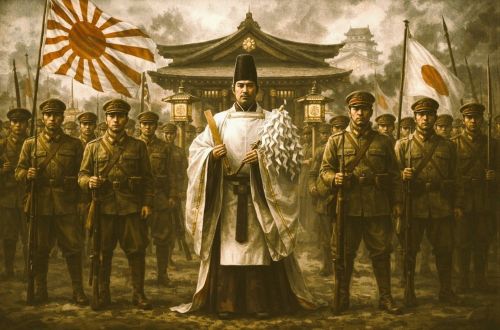
In the nineteenth and twentieth centuries, the Japanese Imperial Army intertwined with State Shinto, fusing militarism, emperor worship, and national identity.

By Matthew A. McIntosh
Public Historian
Brewminate
Introduction: Emperor, Nation, and Sacred Authority
The transformation of Japan in the late nineteenth century was not merely political or economic. It was cosmological. The Meiji Restoration of 1868 reconfigured sovereignty by placing the Emperor at the center of a modernizing state that sought parity with Western powers while preserving indigenous legitimacy. The Tokugawa shogunate had long exercised de facto political control, relegating the Emperor to symbolic status in Kyoto. The Restoration reversed that arrangement, elevating the throne from ceremonial remnant to active locus of authority. In doing so, reformers did not abandon tradition in favor of wholesale Westernization. They reinterpreted tradition as foundation for modernization. The Emperor was presented not simply as constitutional monarch in a European mold but as sacred sovereign whose lineage anchored national identity in antiquity. Industrialization, conscription, centralized bureaucracy, and imperial expansion unfolded within a framework that endowed political authority with religious significance. Modernization and sacralization advanced together, mutually reinforcing rather than mutually exclusive.
State Shinto emerged as a central instrument in this project. Unlike sectarian religious traditions, it was framed as nonreligious civic morality rooted in ancient imperial lineage. Shrine ritual, imperial myth, and national education were integrated into state formation in ways that blurred distinctions between belief and citizenship. The Emperor’s divine descent from the sun goddess Amaterasu, long embedded in mythic tradition, was mobilized as political theology. Loyalty to the throne acquired metaphysical weight. Obedience was not simply constitutional duty. It was filial and spiritual obligation.
This sacralization did not remain confined to ceremonial life. It penetrated institutions, none more consequential than the military. Conscription, introduced in 1873, drew ordinary men into direct relationship with the Emperor as supreme commander. Military service was framed not only as patriotic requirement but as spiritual devotion to a living sovereign whose person embodied the nation. The hierarchy of command mirrored a sacred hierarchy. Ritual observance, recitation of imperial rescripts, and veneration of imperial symbols reinforced ideological alignment. In this framework, loyalty was no longer merely political allegiance. It was participation in a transcendent national community defined through sacred authority.
The Japanese Imperial Army institutionalized this sacralized sovereignty within its structure and culture, embedding State Shinto into daily practice and wartime mobilization. Religious symbolism was not ornamental. It was formative. The Emperor’s divinity functioned as organizing principle for military obedience and national identity. By treating dissent as spiritual deviation and framing warfare as sacred duty, the modern Japanese state intertwined religion and military authority in ways that reshaped civic belonging and justified total war. The Japanese case therefore offers a modern example of how sacralized nationalism can be embedded within a bureaucratic army, transforming loyalty into religious obligation.
The Meiji State and the Construction of State Shinto
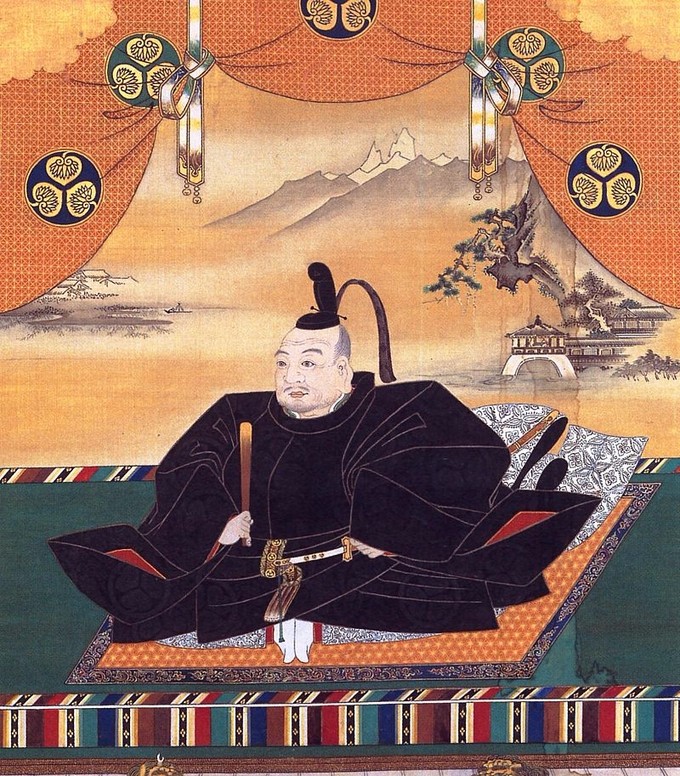
The Meiji Restoration did not simply restore imperial rule. It reengineered the ideological foundations of sovereignty at a moment when Japan confronted unprecedented external pressure and internal transformation. Reformers faced the collapse of Tokugawa authority, the arrival of Western gunboats, and the urgent imperative to centralize power in order to resist colonization. To unify a society long structured around regional domains, hereditary status, and samurai privilege, they elevated the Emperor as symbolic and administrative apex of the state. This elevation required more than constitutional restructuring or bureaucratic consolidation. It demanded cultural reconstruction capable of binding disparate regions into a coherent national body. State Shinto emerged as the mechanism through which imperial authority could be framed as both immemorial and indispensable to modern nationhood. By presenting the Emperor as sacred sovereign whose legitimacy transcended faction and class, Meiji leaders anchored modernization in mythic continuity rather than revolutionary rupture.
Central to this process was the reinterpretation of shrine practice. Shinto, previously a diverse constellation of local rituals and beliefs, was reorganized into a national system under state oversight. The government distinguished between “Sect Shinto,” treated as religion, and shrine observance, presented as civic ritual. By categorizing shrine rites as expressions of public morality rather than private faith, officials insulated State Shinto from constitutional protections of religious freedom. Participation in shrine ceremonies could be mandated as patriotic duty. The state claimed not to impose religion but to cultivate loyalty through shared tradition.
Educational reform reinforced this ideological construction. The Imperial Rescript on Education of 1890 articulated a moral framework grounded in filial piety, loyalty, and reverence for the Emperor. Students memorized and recited its text in classrooms across the country. Portraits of the Emperor and Empress were treated with ceremonial respect, and rituals surrounding their display blurred lines between civic instruction and devotional practice. Through schooling, sacred sovereignty was internalized from childhood. The Emperor was not distant figure of court ritual but moral center of everyday life.
The sacralization of the Emperor drew upon mythic narratives codified in the Kojiki and Nihon Shoki, texts that traced imperial lineage to divine origins. Meiji ideologues selectively emphasized these traditions to reinforce continuity between ancient myth and modern statehood. In official discourse, the Emperor’s descent from the sun goddess Amaterasu was presented not as poetic metaphor but as historical truth embedded in national consciousness. This narrative endowed the throne with cosmic legitimacy, positioning it beyond ordinary political contestation. By grounding sovereignty in sacred ancestry, the state provided metaphysical justification for centralized authority and hierarchical obedience. Myth and bureaucracy operated in tandem. Modern ministries, conscription systems, and parliamentary forms were enveloped within a cosmology that affirmed the Emperor’s unique and transcendent status. The fusion of mythic antiquity with institutional modernization allowed the Meiji regime to claim both timeless continuity and dynamic progress.
Administrative structures ensured that State Shinto remained integrated into governance. The Home Ministry oversaw shrine affairs, and bureaucratic regulation standardized rituals across the country. Local shrines were incorporated into a hierarchical network culminating in the Grand Shrine of Ise, symbolically linking local practice to imperial myth. This system reinforced uniformity while maintaining appearance of cultural continuity. The state’s involvement transformed decentralized ritual into coordinated ideological apparatus.
By the early twentieth century, State Shinto had become foundational to Japanese political identity and civic culture. It offered a framework through which rapid industrialization, imperial expansion, and social transformation could be interpreted as fulfillment of sacred destiny rather than departure from tradition. Loyalty to the Emperor anchored domestic cohesion while legitimating external ambition, presenting expansion abroad as extension of a divinely sanctioned national mission. As the military grew in prominence and Japan asserted itself on the world stage, the sacralized conception of sovereignty shaped the ethos of service, sacrifice, and unquestioned obedience. The construction of State Shinto was therefore not peripheral to modernization. It was central to the creation of a state in which sacred authority infused political power and prepared the ideological terrain upon which militarism would later intensify.
The Imperial Rescript to Soldiers and Sailors: Codifying Sacred Loyalty
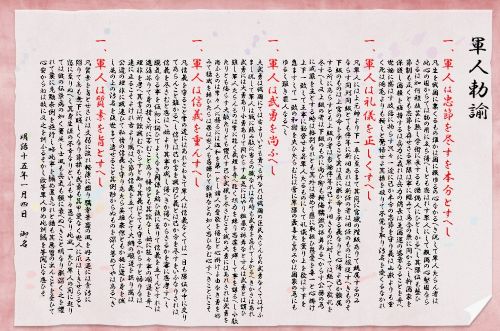
Promulgated in 1882, the Imperial Rescript to Soldiers and Sailors crystallized the fusion of sacred authority and military obedience within the modern Japanese state. Issued in the name of Emperor Meiji at a moment when the armed forces were being reorganized along modern conscript lines, the document sought to stabilize the moral foundations of a rapidly transforming military institution. Japan had adopted Western drill, weaponry, and organizational models, yet its leadership feared that modernization without ideological cohesion would produce a technically competent but spiritually unstable force. The Rescript answered this concern by defining the army and navy as direct instruments of imperial will, bound not merely by regulation but by sacred loyalty. It addressed soldiers as subjects whose primary allegiance was to the Emperor himself rather than to faction, class, or personal advancement. In doing so, it elevated military service from civic duty to moral vocation grounded in reverence for a sovereign presented as divine. Unlike technical military regulations, the Rescript functioned as a moral charter. It framed discipline and obedience not merely as professional requirements but as expressions of devotion toward a ruler whose authority was anchored in sacred lineage.
The language of the Rescript blended Confucian ethics with imperial mythology. Soldiers were instructed to regard the Emperor as parent and to subordinate personal interest to national duty. The chain of command acquired sacred dimension. Obedience to superior officers mirrored obedience to the Emperor, who stood at the apex of both political and cosmic hierarchy. Military discipline was presented as extension of filial piety, transforming hierarchical compliance into moral virtue. In this formulation, insubordination was not simply breach of protocol. It represented deviation from a sacred order rooted in mythic ancestry and moral tradition.
The Rescript’s power derived not only from its content but from its ritualization within the daily life of the armed forces. Copies were distributed to units across the empire, and recitation formed part of military education, ceremonies, and formal gatherings. Officers were expected to internalize its principles and model them before enlisted men, reinforcing a culture in which ethical formation accompanied tactical training. The text was often read aloud on significant occasions, and its physical document was treated with visible reverence, handled with care and stored in designated spaces. This performative dimension embedded sacred loyalty into the institutional rhythm of service. Through repetition and ceremony, abstract ideals were transformed into embodied habits. The Rescript functioned not merely as statement of doctrine but as ritual object that reinforced the perception that imperial command carried transcendent authority. Ritual observance bridged ideology and practice, ensuring that imperial devotion became reflexive expectation rather than abstract aspiration.
Through the Imperial Rescript, sacred sovereignty was codified within institutional structure. The Japanese Imperial Army did not rely solely on mythic narrative transmitted through education or shrine ritual. It formalized loyalty as doctrinal foundation of service. The Rescript linked personal conduct, hierarchical obedience, and national destiny into a unified moral structure. By defining military service as spiritual devotion to the Emperor, it ensured that the armed forces would operate within a sacralized conception of authority that shaped decision-making, discipline, and identity well into the twentieth century.
Ritual, Training, and Daily Military Culture
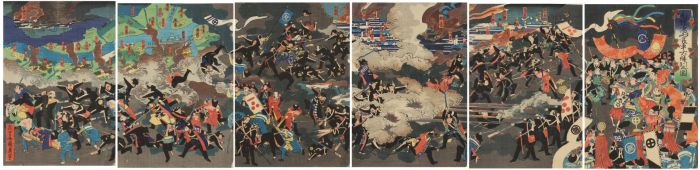
The sacralization of imperial authority did not remain confined to official proclamations or occasional ceremonies. It permeated the daily life of the Japanese Imperial Army. From induction through active service, soldiers encountered a culture structured around ritual observance and symbolic reinforcement. Training did not consist solely of drill, marksmanship, and tactical instruction. It incorporated moral formation grounded in reverence for the Emperor and devotion to the state. Through repetition and ceremony, ideological commitment was woven into the fabric of military routine.
Shrine visits formed a visible component of this culture. Units frequently participated in collective pilgrimages to Shinto shrines, particularly those associated with imperial myth or military valor, such as Yasukuni Shrine. These visits were not casual excursions but carefully choreographed acts of communal reverence that linked the soldier’s present duty to a lineage of sacred sacrifice. At Yasukuni, the spirits of the war dead were enshrined and honored as guardians of the nation, reinforcing the message that those who perished in imperial service achieved spiritual elevation. Participation in shrine rites cultivated emotional continuity between living soldiers and fallen comrades. It also blurred the boundary between religion and patriotism. Ritual purification, offerings, and formal bows affirmed that military identity unfolded within sacred space. The soldier was reminded that service entailed not only risk but potential incorporation into a sanctified national narrative that transcended individual existence.
Training regimes further integrated sacred symbolism into discipline. Recruits were instructed to internalize obedience as moral reflex. The Emperor’s portrait was displayed in barracks and treated with reverence. Ceremonial bows, formal recitations, and observance of imperial anniversaries structured communal life. Instructional materials emphasized endurance, self-sacrifice, and suppression of individual desire in favor of collective duty. The soldier’s body became instrument of imperial will, and the cultivation of resilience acquired spiritual significance. Physical hardship was framed as moral purification aligned with service to the throne.
This ideology extended beyond ceremony into institutional practice. Military education emphasized the virtue of dying for the Emperor, presenting self-sacrifice as highest expression of loyalty and fulfillment of filial obligation. Textbooks, speeches, and regimental traditions underscored that death in battle was not tragic waste but consummation of duty. This ethos was reinforced through stories of heroic last stands and narratives of unwavering devotion under impossible circumstances. It did not emerge suddenly during the militarist expansion of the 1930s and 1940s. It was cultivated over decades of institutional formation that equated devotion with readiness to surrender life. By embedding martyrdom within the moral architecture of service, the army narrowed the space for dissenting interpretations of courage or prudence. Retreat, surrender, or hesitation could be interpreted as spiritual failure rather than tactical calculation. In this environment, willingness to die became litmus test of authentic loyalty.
Institutional reinforcement extended beyond formal training grounds and ceremonial observances. Military publications, patriotic songs, and state-sponsored media amplified narratives that glorified unwavering devotion while casting suspicion on ideological deviation. Newspapers and magazines celebrated exemplary soldiers as embodiments of sacred loyalty, and public commemorations connected battlefield sacrifice to national destiny. The army operated within a broader social environment in which civic rituals echoed military ones. Schoolchildren practiced bowing to imperial portraits just as soldiers did, and educational curricula reinforced themes of filial piety and national unity. National holidays and memorial ceremonies created continuity between civilian life and martial discipline. In this way, the armed forces were not isolated ideological enclave. They were concentrated expression of a society that increasingly understood allegiance to the Emperor as spiritual as well as political obligation.
The Japanese Imperial Army cultivated an environment in which religious-national identity was internalized as personal conviction. Ritual was not decorative accompaniment to military life. It was constitutive element of it. Training, ceremony, and symbolic reinforcement ensured that service to the Emperor was experienced as spiritual vocation rather than contractual obligation. In embedding sacred authority within daily routine, the army institutionalized a culture of obedience that would profoundly shape its conduct during the era of total war.
Total War and Sacred Obligation: 1930s–1945
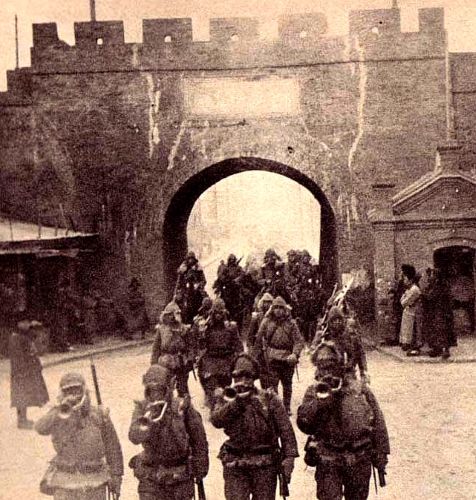
The escalation of Japanese militarism in the 1930s transformed the ideological foundations laid in the Meiji era into instruments of total mobilization. As the army expanded its influence over political decision-making, sacred loyalty to the Emperor became increasingly intertwined with aggressive expansionism. The invasion of Manchuria in 1931 and subsequent war in China were framed not simply as strategic necessities but as fulfillment of national destiny. Imperial rhetoric cast Japan as moral guardian of Asia, and the Emperor’s authority was invoked to sanctify military action. Sacred sovereignty moved from institutional culture into justification of sustained warfare.
The doctrine of kokutai, often translated as “national polity,” provided ideological coherence to this expansion. It defined Japan as unique community unified by unbroken imperial lineage and filial devotion. Within this framework, loyalty to the Emperor transcended political debate. It was ontological commitment embedded in national essence. Military campaigns were presented as expressions of this sacred national character. The boundaries between spiritual identity and geopolitical ambition blurred, allowing expansion to be framed as defense of a divinely ordered polity rather than as imperial conquest.
The intensification of war after 1937 deepened the sacralization of sacrifice. As casualties mounted in China and later across the Pacific, the rhetoric of honorable death gained urgency and prominence within both military and civilian discourse. Soldiers were reminded repeatedly that their ultimate allegiance was to the Emperor, whose will embodied the nation’s survival and whose divine status rendered obedience absolute. Letters home, battlefield exhortations, and state propaganda emphasized that death in service was not meaningless loss but sacred offering. Training manuals and officer speeches underscored that surrender dishonored not only the individual but the imperial line itself. The spiritualization of death functioned as moral architecture that sustained endurance amid brutal conditions and overwhelming odds. Devotion to the throne supplied narrative that transformed suffering into testimony of faithfulness, and martyrdom into proof of belonging within sacred national community.
The phenomenon of the tokko, commonly known as kamikaze, illustrates the culmination of this ideology. Special attack units formed in the final stages of the Pacific War were presented as embodiments of ultimate allegiance. Pilots who deliberately crashed their aircraft into enemy vessels were commemorated as heroes whose deaths purified and strengthened the nation. Ritual preparation, farewell ceremonies, and shrine symbolism accompanied these missions. The act of self-destruction was framed as offering to the Emperor and to Japan. In these practices, sacred obligation and military strategy converged in extreme form.
Total war also required suppression of dissenting spiritual and ideological frameworks. The Peace Preservation Law empowered authorities to prosecute individuals whose beliefs were deemed subversive of the kokutai, and enforcement intensified as conflict expanded. Christians who prioritized ecclesiastical authority, socialists who questioned imperial hierarchy, and adherents of new religious movements that articulated alternative cosmologies faced surveillance, arrest, and coercive reeducation. The state did not tolerate competing spiritual allegiances that might dilute sacred devotion to the Emperor or introduce pluralistic interpretations of loyalty. Police monitoring, public denunciations, and pressure to participate in shrine rites reinforced conformity. Ideological unity was framed as prerequisite for survival in existential struggle. By aligning national security with spiritual uniformity, the regime fused religious orthodoxy and wartime governance into mutually reinforcing system of control.
By 1945, the ideology of sacred obligation had permeated both military structure and civilian mobilization. The Emperor remained symbolic center of resistance even as defeat became imminent. Yet the surrender announcement revealed fragility beneath sacralized command. When Emperor Hirohito addressed the nation to accept Allied terms, the divine sovereign acknowledged limits of power. The war years had demonstrated how deeply religious-national identity could be embedded within military hierarchy. They also exposed the human cost of a system that framed obedience and sacrifice as sacred imperatives within total war.
Suppression, Dissent, and the Limits of Sacred Militarism
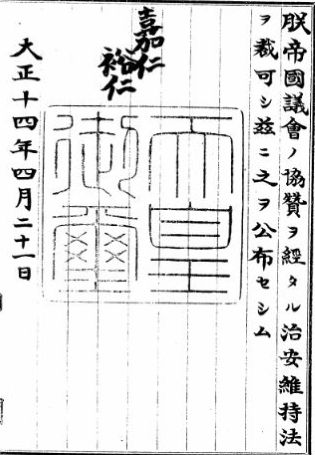
The sacralization of imperial authority required more than ritual reinforcement and patriotic education. It depended upon the active management of dissent. As State Shinto and emperor-centered ideology became embedded within military and civic institutions, the Japanese state expanded mechanisms of surveillance and control. Ideological unity was presented as prerequisite for national survival, especially as war intensified. Divergent spiritual commitments or political critiques were increasingly framed not as alternative viewpoints but as threats to the integrity of the kokutai. In this environment, the boundaries between religious deviation and political subversion narrowed considerably.
Legal structures provided instruments for enforcement. The Peace Preservation Law of 1925, amended in subsequent years, empowered authorities to prosecute those accused of seeking to alter the national polity or abolish private property. Although initially directed against socialist and communist movements, its scope expanded as militarism deepened and anxieties about internal cohesion intensified. The law’s broad language allowed prosecutors to interpret criticism of emperor-centered ideology as attack upon the national essence itself. Special Higher Police units monitored intellectual circles, religious organizations, labor groups, and student associations. Arrests, interrogations, and coerced recantations became tools for reinforcing orthodoxy. Public trials and published confessions functioned as cautionary displays, signaling that deviation from sacred loyalty would carry severe consequences. Through legal codification and administrative practice, the state institutionalized ideological conformity as matter of security rather than opinion.
Religious minorities faced particular scrutiny. Christian organizations were pressured to demonstrate loyalty to the Emperor and to participate in shrine observances, which the state insisted were civic rather than religious acts. Some complied under duress, while others resisted or faced sanction. New religious movements that articulated alternative spiritual hierarchies or eschatologies were monitored and sometimes suppressed. The insistence that shrine worship constituted patriotic duty rather than religious devotion effectively compelled participation in state-defined ritual. In this way, the state circumscribed the space for plural religious expression while maintaining formal claim of religious freedom.
Yet the very intensity of enforcement revealed structural tensions within sacred militarism. Ideology proclaimed unanimous devotion to the Emperor, but the necessity of surveillance indicated that belief could not be presumed. Sacred authority demanded inward conviction, yet the state relied increasingly upon outward compliance enforced by law. As war conditions deteriorated in the 1940s, strain between official rhetoric and lived experience widened. Battlefield losses, material shortages, and growing awareness of strategic vulnerability eroded confidence in narratives of divine destiny. Soldiers and civilians alike encountered dissonance between promises of sacred triumph and realities of hardship. Repression intensified in response, but coercive unity could not fully resolve ideological fatigue. The gap between proclaimed spiritual invincibility and mounting defeat exposed fragility at the core of sacralized nationalism.
The collapse of the wartime regime in 1945 exposed the limits of transcendent kingship. The Emperor’s public renunciation of divinity in the Humanity Declaration of 1946 marked dramatic rupture in the ideological framework that had sustained sacred militarism. Institutions built upon unquestioned reverence were compelled to adapt to constitutional constraints and religious disestablishment. The postwar order revealed that the fusion of religious symbolism and military hierarchy, though powerful, was not immune to political defeat and structural transformation. Sacred militarism proved contingent rather than eternal, its authority dependent upon conditions that total war ultimately undermined.
Collapse and Disestablishment: 1945 and After
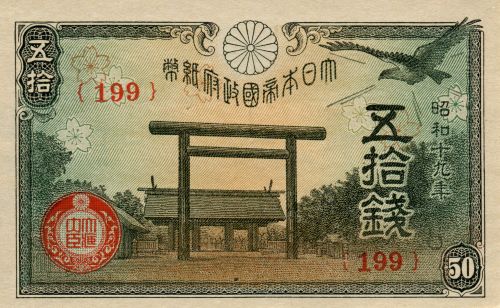
Japan’s surrender in August 1945 did more than end a devastating war. It ruptured the ideological architecture that had joined sacred sovereignty to military authority. The Emperor’s radio address announcing acceptance of Allied terms marked an unprecedented moment in which the voice of the sacralized sovereign acknowledged defeat. For decades, loyalty to the throne had been presented as transcendent obligation immune to historical contingency. Yet the surrender demonstrated that imperial authority operated within political limits. The collapse of wartime mobilization exposed the fragility of a system that had equated sacred devotion with national destiny.
The Allied occupation moved quickly to dismantle the institutional foundations of State Shinto. In December 1945, the Shinto Directive abolished government sponsorship and financial support of shrines, severing formal ties between religious ritual and state administration. This directive prohibited the use of public funds for shrine maintenance, banned compulsory participation in shrine ceremonies, and removed shrine officials from government payrolls. Ritual observance could no longer be framed as civic duty embedded within national education or military life. The constitution of 1947 codified religious freedom and prohibited state involvement in religious activities, establishing legal boundaries that prevented reconstitution of state-managed sacred ideology. These measures transformed Shinto from ideological instrument of governance into voluntary religious practice within pluralist society. The structural separation of shrine and state reversed the Meiji-era construction that had presented ritual as cultural morality rather than religion. By redefining shrine activity as private religious expression, occupation authorities dismantled the legal fiction that had allowed sacred symbolism to permeate military and civic institutions.
Central to this transformation was the Emperor’s Humanity Declaration of January 1946. In it, Emperor Hirohito renounced the notion of divine status, redefining his position as symbolic rather than transcendent. This declaration did not erase centuries of mythic tradition, but it altered the legal and political framework within which imperial authority operated. The Emperor remained figure of continuity, yet his role was recast within constitutional monarchy rather than sacred kingship. Military identity could no longer be grounded in metaphysical obedience to a living deity. The disestablishment of divinity reshaped the symbolic foundations of national identity.
The Japanese armed forces themselves were dissolved under occupation policy. Article 9 of the new constitution renounced war as sovereign right and prohibited maintenance of traditional military forces. Although the Self-Defense Forces would later be established, they emerged within radically altered ideological environment. Service was no longer framed as spiritual devotion to divine sovereign. The military ceased to function as primary institutional carrier of sacred nationalism. Civic identity and religious practice were reconfigured within pluralist constitutional order.
The postwar transformation revealed both the depth and the contingency of sacred militarism. For decades, State Shinto had infused military culture with ritual, myth, and theological justification, embedding sacred loyalty within structures of command and education. Its dismantling required coordinated legal decree, constitutional reform, educational restructuring, and public redefinition of imperial authority. Yet the speed with which institutional disestablishment occurred underscored that sacralized authority depended upon state enforcement and administrative support. Once those supports were withdrawn, shrine networks lost their official status and military institutions were deprived of theological foundation. The Japanese case demonstrates that modern states can construct potent religious-national frameworks within armed forces, shaping identity and obedience through ritual and law. It also demonstrates that such frameworks remain historically contingent, vulnerable to political rupture and structural redefinition. Collapse did not eliminate cultural memory of sacred sovereignty, but it decisively ended the formal intertwining of divine authority and military hierarchy that had defined the imperial era.
Conclusion: Modern Militarism and Civil Religion
The experience of the Japanese Imperial Army demonstrates how a modern bureaucratic state can inscribe sacralized national identity within military hierarchy without formally establishing a theocracy. State Shinto functioned as civil religion that rendered loyalty to the Emperor sacred obligation rather than political choice. Through legal distinction between shrine ritual and private religion, the state constructed system in which participation in imperial devotion could be mandated as civic duty. The army became one of the primary institutions through which this sacred sovereignty was enacted, internalized, and defended.
Unlike earlier historical models in which religious and military authority fused through monastic vows or confessional enforcement, the Japanese case reveals a distinctly modern synthesis shaped by industrial society and centralized administration. Bureaucratic regulation, national education, conscription, and mass media collaborated to create environment in which sacred symbolism permeated everyday service and public life. The Emperor’s divinity did not operate only as mythic claim inherited from antiquity. It was actively cultivated through curriculum, ceremony, and legal definition, weaving reverence into structures of authority. Military training reinforced this framework by linking obedience to imperial lineage and presenting discipline as moral virtue. Expansion abroad and mobilization at home were interpreted through vocabulary of destiny and divine continuity. In this context, military discipline was transformed into spiritual vocation aligned with national essence, and hierarchical command mirrored sacralized order extending from barracks to throne.
The intensification of total war between 1937 and 1945 exposed both the potency and the peril of this alignment. Sacred obligation provided moral language that sustained endurance amid catastrophic loss. At the same time, it narrowed space for dissent and foreclosed alternative interpretations of loyalty. When obedience is sacralized, resistance becomes heresy. The suppression of ideological deviation during the wartime period illustrates how civil religion can evolve into instrument of coercive uniformity when fused with military mobilization.
The disestablishment of State Shinto after 1945 underscores the historical contingency of sacred militarism. Institutions that had presented imperial loyalty as eternal proved dependent upon legal and administrative support. Once those structures were dismantled, the intertwining of religion and military authority dissolved. The Japanese case offers modern example of how civil religion can be constructed, institutionalized, and ultimately undone within framework of national armed forces. It stands as reminder that divinized sovereignty, however powerful, remains product of political design rather than immutable destiny.
Bibliography
- Benesch, Oleg. Inventing the Way of the Samurai: Nationalism, Internationalism, and Bushidō in Modern Japan. Oxford: Oxford University Press, 2014.
- Bix, Herbert P. Hirohito and the Making of Modern Japan. New York: HarperCollins, 2000.
- Breen, John, and Mark Teeuwen. A New History of Shinto. Malden, MA: Wiley-Blackwell, 2010.
- Dower, John W. War Without Mercy: Race and Power in the Pacific War. New York: Pantheon, 1986.
- Drea, Edward J. Japan’s Imperial Army: Its Rise and Fall, 1853–1945. Lawrence: University Press of Kansas, 2009.
- Garon, Sheldon. Molding Japanese Minds: The State in Everyday Life. Princeton: Princeton University Press, 1997.
- Gluck, Carol. Japan’s Modern Myths: Ideology in the Late Meiji Period. Princeton: Princeton University Press, 1985.
- Hardacre, Helen. Shinto and the State, 1868–1988. Princeton: Princeton University Press, 1989.
- Imperial Rescript to Soldiers and Sailors (1882).
- Mitchell, Richard H. Thought Control in Prewar Japan. Ithaca: Cornell University Press, 1976.
- Nakamura, Yoshihisa and Ryoichi Tobe. “The Imperial Japanese Army and Politics.” Armed Forces & Society 14:4 (1988), 511-525.
- Nelson, John. “Social Memory as Ritual Practice: Commemorating Spirits of the Military Dead at Yasukuni Shinto Shrine.” The Journal of Asian Studies 62:2 (2003), 443-467.
- Ravina, Mark. To Stand with the Nations of the World: Japan’s Meiji Restoration in World History. Oxford: Oxford University Press, 2017.
- Shimbun, Yomiuri. “Yasukuni: Behind the Torii: From Government-Run Shrine for War Heroes to Bone of Contention.” Asia-Pacific Journal 3:7 (2005).
Originally published by Brewminate, 02.27.2026, under the terms of a Creative Commons Attribution-NonCommercial-NoDerivatives 4.0 International license.
About the Author