By Nicola-Ann Hardwick
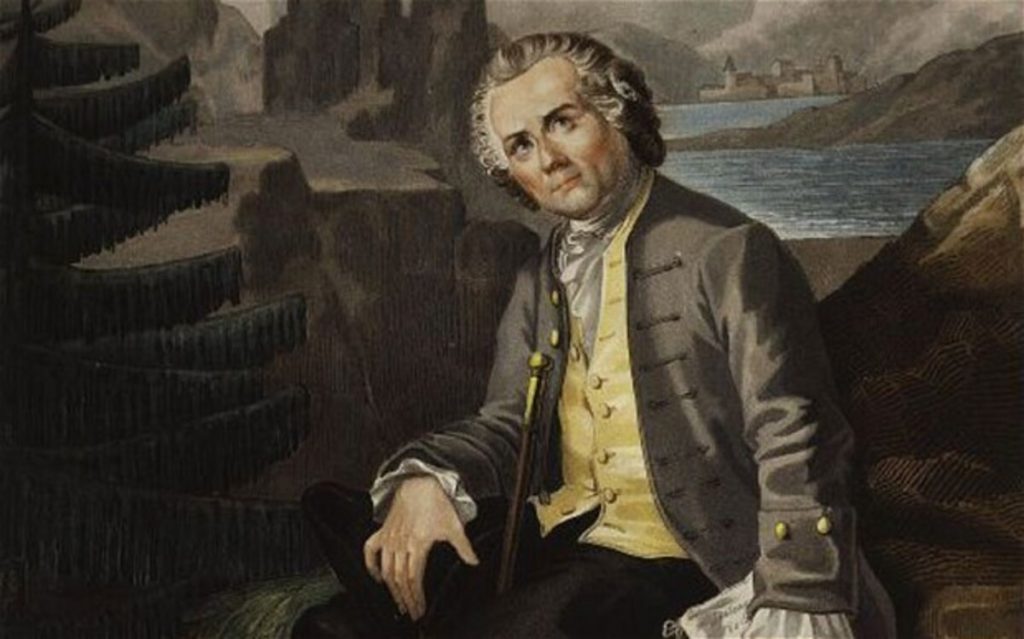
“Man was born free, and everywhere he is in chains” (Rousseau, 20072: 28). This conspicuous paradox between liberty and human oppression is reflected in Rousseau’s entire politico-moral philosophy and so it is no surprise that he has been much criticized for seeming ambiguities within his works (Brown, Nardin, Rengger, 2002: 397). This essay focuses on the apparent contradiction that Rousseau strongly criticizes the social contract tradition and at the same time defends a social contract theory as the only solution to save mankind from corruption and degeneration. Firstly, the meaning of the ‘state of nature’ which is of underlying importance for Rousseau’s whole political philosophy is explored, comparing his ideas to those of the social contract theorists Hobbes and Locke. Next, the essay explains why Rousseau blames society for having transformed and corrupted man, who was originally innocent and how he thus criticizes the social contract tradition. Finally, it briefly analyses his paradoxical solution to end the corruption of mankind through reeducation and the Social Contract emphasizing liberty through the obligation to follow laws and the general will. Thus, three stages described by Rousseau, are investigated: (a) the state of nature, where man is free and independent, (b) society, in which man is oppressed and dependent on others, and (c) the state under the Social Contract, in which, ironically, man becomes free through obligation; he is only independent through dependence on law.
A social contract implies an agreement by the people on the rules and laws by which they are governed. The state of nature is the starting point for most social contract theories. It is an abstract idea considering what human life would look like without a government or a form of organized society (Lloyd, Sreedhar, 2009). For Rousseau, the purpose of studying the state of nature is three-fold: firstly, it is supposed to deliver an account of the original primitive condition of mankind, secondly, it helps identify the main characteristics of human nature in man’s original state, and thirdly, it helps describe and evaluate the ‘new state of nature’ which, in other words, is present-day society (MacAdam, 1972: 308). Rather than emphasizing the historical aspect of the state of nature, Rousseau uses this concept as mind-play picturing an ideal (Cole, 2007: 11).
According to Rousseau, in the state of nature “man is naturally peaceful and timid; at the least danger, his first reaction is to flee; he only fights through the force of habit and experience” (2002: 417). It seems that primitive men “having no moral relations or determinate obligations … could not be either good or bad, virtuous or vicious” (Rousseau, 20071: 113). Man is ‘pre-moral’ and innocent (Brown, Nardin, Rengger, 2002: 384). He is only concerned with his own well-being and happiness, satisfying his personal needs and disregarding “everything he did not think himself immediately to notice” (ibid: 117); he is solitary and independent (Grimsley, 1973: 116). This feeling of self-love termed ‘amour de soi’ can only accidentally be good or bad (Green, 1950:16). Man has not yet discovered reason, knowing no rights and acting upon his instincts (ibid: 15). He does not know the feeling of love and so beauty has no importance to him; nor does wit or cunning (Rousseau, 2007: 117). Therefore, he hardly knows what inequality is except for physical inequality (ibid.). Locke agrees with Rousseau that man is “born equal and free” but believes natural man to already have certain rights, like freedom, as well as some reason to make moral decisions (Grimsley, 1973: 116). “… that being all equal and independent, no one ought to harm another in his life, health, liberty or possessions” (Locke, 1994: 117). While Locke is more positive than Rousseau, Hobbes’ view is filled with pessimism, describing life in the state of nature as “solitary, poor, nasty, brutish and short” and as a war of “every man against every man” (Hobbes, 1968: I. Ch. 13). Though Rousseau accepts that man is irrational (Grimsley, 1973:116), he argues that he is ignorant of the passions, “honour, interest, prejudices and vengeance” (Rousseau, 202: 417); natural law is thus rendered irrelevant (Noone, 1970: 697).
The individual’s first encounter with other men represents a critical juncture in Rousseau’s writings. Man finds out that in certain cases which are of mutual interest, he can cooperate with others and rely on them (Rousseau, 20071: 119). Loose associations are formed, but the absolute turning point is when man begins to live in huts with his family; he starts living in a small society (ibid: 119-120).
Everything now begins to change its aspect. Men, who have up to now been roving in the woods, by taking to a more settled manner of life, come gradually together, form separate bodies, and at length in every country arises a distinct nation… (ibid: 120)

By living with his wife and family, man discovers love and thus develops the ideas of beauty and merit, giving rise to competition, as well as vanity, contempt, shame and envy (ibid.). “With love arose jealousy; discord triumphed, and human blood was sacrificed to the gentlest of all passions.” (ibid.) Man enters an artificial society, thus hoping to be able to produce more through cooperation (Knutsen, 1994: 248). Only from then onwards does he have the ability to act morally and rationally, choosing his own opinions and no longer merely following his instincts, exercising will, reason and conscience (Grimsley, 1973: 116). Through reason a wise man’s ‘amour de soi’ can lead him to humanity and virtue (Voisine, 1996: 32-33). However, constant comparison to others and seeing oneself as ‘above’ others can lead to pride or ‘amour-propre’; man is corrupted by his environment (ibid.). Unlike Hobbes’ and Locke’s atomistic view of mankind, meaning that man is mainly formed before entering society, Rousseau thus depicts man’s psychological transformation in society, emphasizing the importance of his social environment (Chapman, 1968: 98). “I cannot repeat too often, that the error of Hobbes and other philosophers is to confuse natural man with the man before their eyes…” (Rousseau, 2002: 424).
Once man enters society, he enters dependence. The creation of private property and the division of labour generate differences in wealth, power and status (Knutsen, 1994: 249).
The first man who, having bethought himself of saying ‘This is mine,’ and found people simple enough to believe him, was the real founder of civil society. From how many crimes, wars and murders, from how many horrors and misfortunes might not anyone have saved mankind … (Rousseau, 20071: 118)
Thus, Rousseau reasons, inequality is created through the corrupt interdependence that constitutes society. Though man originally thought that society would increase his freedom, he has lost it. “All ran headlong to their chains, in hopes of securing their liberty.” (ibid: 124) By giving up his liberty, Rousseau argues, man does not only degrade his life, he “annuls” it (ibid: 127). “Through some fatal accident, which for the public good, should never have happened” (Rousseau, 20071: 121), man has moved from the original state of nature to a ‘new state of nature’ characterized by oppression (MacAdam, 1972: 308).
Unlike Hobbes and Locke, Rousseau thus doesn’t see a civil society as a necessary advancement from the state of nature. He criticizes the form of society and social contract tradition of his day, which he regards as wretched, as well as the theories of previous important and influential social contract thinkers. Above all, he considers Hobbes’ social contract theory endorsing an absolute sovereign Leviathan a “horrible system” (ibid), as he despises despotism. He also frequently criticizes Grotius for supporting the notion of slavery (20072: 29f.). Society has degenerated man, making him both physically and morally weak and dependent on others, and adding to all this pessimism, Rousseau sees no way back to the state of nature; primitive independence is lost (Levin, 1970: 502).
The new-born state of society thus gave rise to a horrible state of war; men thus harassed and depraved were no longer capable of retracing their steps or renouncing the fatal acquisitions they had made … brought themselves to the brink of ruin. (Rousseau, 20071: 123)
He argues that the rich have become dependent on the poor, as they no longer know how to provide for themselves, while peasants are used to manual labour and could be to some extent self-reliant; a point that differentiates his philosophy from that of Marx (Levin, 1970: 497). Rousseau considers this dependence as the greatest deprivation of freedom (Rousseau, 20072: 28) and thus writes in Émile, that man must be reeducated. He still believes that in essence man is perfectable; education is supposed to create a new man who can fend and think for himself and care “nothing for the weight of popular opinion” (Rousseau, 2004: 248), as well as live in society (Charvet, 1980: 69).

In addition to new forms of education, Rousseau sets out to create a better political system; and acknowledges the possibility of moving on from corruption (Charvet, 1980: 69). “It is my purpose to inquire whether it is possible for there to be any legitimate and certain rule of administration in civil society, taking men as they are and laws as they may be” (Rousseau, 20072: ’28). Confusingly, though he has so far criticized the social contract tradition, he names his solution le contrat social or the Social Contract. It is supposed to make men equal and free; the protection of liberty is most important (Grimsley, 1973: 93).
The problem is to find a form of association which will defend and protect with the whole common force the person and goods of each associate, and in which each, while uniting himself with all, may still obey himself alone, and remain as free as before (Rousseau, 20072: 32)
In order to become free, every individual must give up all his rights to the entire community, creating the same conditions for all and thus equality (ibid: 32-33). “Finally, each man, in giving himself to all, gives himself to nobody” (ibid.). After all, it would not be Rousseau if there weren’t a little paradox. Men are thus all subject to what Rousseau names volonté générale or the general will. It is not the will of all the individuals or of the majority, as even the majority may be mistaken, but it is always to public advantage and for the ‘greater good’ (ibid: 33f.). “Whoever refuses to obey the general will shall be compelled to do so by the whole body. This means nothing less than he will be forced to be free” (Rousseau, 20072: 34). This again reminds us that man is “everywhere in chains”. Man’s freedom is thus relative, he cannot endanger anyone else’s freedom and he must follow the law and above all, the general will, so to maintain an ordered society (Grimsley, 1973: 93). Man is only free by obedience; he must become dependent (on law) in order to be independent (MacAdam, 1972: 309).
In the Social Contract, Rousseau repudiates two traditional features of society (ibid: 92): Firstly, political authority is not to be based on force, as the use of force can never be right. “Since no man has natural authority over his fellow men, and since might in no sense makes right, conventions remain as the basis of all legitimate authority among men” (Rousseau, 2002: 8). Secondly, man has no innate sociability, which means society is not a natural occurrence; but if he decides to, he has the potential to enter into a relationship with his fellows (Grimsley, 1973: 92). Society must thus be formed upon rational choice; oppression is never right (ibid.). This thus rejects the view of Grotius that permanent enslavement of a captive people is acceptable, and certainly that of Hobbes, who advocates absolutism.
Apart from there being an apparent paradox in Rousseau advocating a social contract in the first place, there are several problems that arise when reading the Social Contract (Noone, 1970: 707f.; Bertram, 2010). First of all, he does not specify what the general will is by giving examples (Noone, 1970: 708). How can the general will be found, how do individuals know what it is and know that it is their best (and only) option to follow it, if it is not, as Rousseau writes himself, “formally set forth” (Rousseau, 20072: 32)? At the same time, the rule of the general will almost seems to be an absolute regime in itself, something that Rousseau so thoroughly rejected in Hobbes, as it must always be obeyed. Furthermore, if any of the relations between the Social Contract, obligation, the state of nature and the general will were changed, this would distort Rousseau’s entire political and moral philosophy (Noone, 1970: 708). “The clauses of this contract are so determined by the nature of the act that the slightest modification would make them vain and ineffective” (Rousseau, 20072: 32). In addition, though Rousseau defines political obligation as following laws and the general will, there is no specification of individual obligations (Noone, 1970: 707). Also, while he defines sovereignty as the “exercise of the general will” (Rousseau, 20072: 36), he does not mention specific laws that should be sovereign (ibid.). Other problems are to be found in Émile; though Rousseau despises the rich, Émile would hardly have a private tutor were he not wealthy ((Levin, 1970: 511). Moreover, though Émile is supposed to learn to think for himself, he is under the ‘guidance will’ of his teacher, which in some way is similar to ‘thought control’ (ibid: 512). Again, this leads to our favourite paradox, Émile, while free, is still “in chains”.
In conclusion, Rousseau is in fact both a critic and an advocate of social contract theory. Throughout his work, he considers society to have corrupted mankind and most of all, he rejects Hobbes’ idea of an absolute Leviathan. At the same time, in order to create his own rather different Social Contract which he sees as the only solution to escape corruption, he uses the ideas of the social contract tradition that the people should give up sovereignty to an authority to preserve their freedom; sovereignty lies within the whole, in this case with the general will. Simply by naming his work le contrat social, Rousseau implies that he wants to be understood in the context of contractarianism. He thus makes a transition from ‘old’ to ‘new’ with his conception of society and politics (Cole, 2007: 10).The system Rousseau sees as the solution to overcome corrupt society is at the same time vague and unalterable. This is problematic, as Rousseau fails to give us practical examples of how to apply his Social Contract and it is therefore unclear how it could function in practice. Furthermore, it seems strange that it cannot be changed, considering that he seems to acknowledge that mankind can evolve. On the other hand, it is important not to take him too literally, after all, his method is to create concrete and universal principles from generalizations of the human condition, based less on facts than on political ‘right’ (ibid.).
Bibliography
- Bertram, C. (2010) “Jean Jacques Rousseau”, The Stanford Encyclopedia of Philosophy [online], Edward N. Zalta (ed.), Available: http://plato.stanford.edu/archives/win2010/entries/rousseau/ [Accessed : 5 January 2011].
- Brown, C., Terry Nardin and Nicholas Rengger (2002) International Relations in Political Thought: Texts from the Ancient Greeks to the First World War (Cambridge: Cambridge University Press).
- Chapman, H. P. (1968) Rousseau – Totalitarian or Liberal? (New York: AMS Press).
- Charvet, J. (1980) “Rousseau and the Idea of Community”, History of Political Thought I(1): 69-90.
- Cole, G. D. H (2007) “Introduction” in The Social Contract and Discourses (Middletown, RI: BN Publishing).
- Green, F. C. (1950) Rousseau and the idea of Progress, The Zaharoff Lecture for 1950 (Oxford: Clarendon Press).
- Grimsley, R. (1973) The Philosophy of Rousseau (Bungay, Suffolk: Oxford University Press).
- Knutsen, T. L. (1994) “Re-reading Rousseau in the Post-Cold War”, Journal of Peace Research, 31(3): 247-262.
- Hobbes, T. (1968, ed.: C. B. Macpherson) Leviathan (London: Penguin Books).
- Levin, M. (1970) “Rousseau and Independence”, Political Studies, XVIII(4): 496-513.
- Lloyd, S. A. and Susanne Sreedhar (2009) “Hobbes’s Moral and Political Philosophy”, The Stanford Encyclopedia of Philosophy [online], Edward N. Zalta (ed.), Available: http://plato.stanford.edu/archives/spr2009/entries/hobbes-moral/ [Accessed: 5 January 2011].
- Locke, J. (1994, ed.: David Berman) Two Treatises of Government (London: Everyman).
- MacAdam, J. (1972) “The Discourse on Inequality and The Social Contract”, Philosophy, XLVII(182): 308-321.
- Noone, J. B. (1970) “The Social Contract and Ideas of Sovereignty in Rousseau”, Journal of Politics, XXXII(3): 696-708.
- Rousseau, J. J. (20071) “A Dissertation – On the Origin and Foundation of the Inequality of Mankind” (English Translation) in The Social Contract and Discourses (Middletown, RI: BN Publishing).
- Rousseau, J. J. (20072) “The Social Contract or Principles of Political Right” (English Translation) in The Social Contract and Discourses (Middletown, RI: BN Publishing).
- Rousseau, J. J. (2004) (English Translation) Émile (Whitefish, MT: Kessinger Publishing).
- Rousseau, J. J. (2002) “The State of War” (English Translation) in Brown, C., Terry Nardin and Nicholas Rengger (eds.) International Relations in Political Thought: Texts from the Ancient Greeks to the First World War (Cambridge: Cambridge University Press).
- Voisine, J. “Amour de soi/Amour-propre” in Trousson, R. and Frédéric S. Eigeldinger (eds.) (1996) Dictionnaire de Jean-Jaques Rousseau (Paris: Editions Champion).
Originally published by E-International Relations, 01.10.2011, under a Creative Commons Attribution-NonCommercial 4.0 International license.
About the Author