The consensus around shaken baby diagnoses has cracked.

By Kayla Guo
General Assignment Reporter
The Texas Tribune
Introduction
\When Texas’ highest criminal court stopped Robert Roberson’s execution in 2016, it agreed with his lawyers that there was enough doubt over the cause of his daughter’s death to warrant a second look.
Roberson, who was convicted in 2003 of killing his 2-year-old daughter Nikki, has maintained his innocence during more than 20 years on death row.
To Roberson and his lawyers, the decision was exactly what a groundbreaking Texas statute, dubbed the “junk science law,” was meant to do: provide justice when the scientific evidence that led to a conviction has been discredited.
Now with a chance to exonerate Roberson, his lawyers got to work. They compiled a 302-page filing of new evidence that they said invalidated the finding that his daughter died from shaken baby syndrome.
The filing summarized medical articles on how the consensus around shaken baby diagnoses had cracked, medical records that illustrated Nikki’s illness and medications in the days leading up to her death, and long-lost CAT scans that they said proved she did not die from being violently shaken.
The state, meanwhile, submitted a 17-page filing that argued that the science around shaken baby diagnoses had not changed that much, and that the evidence that pointed to Roberson as his daughter’s killer remained “clear and convincing.”
The trial court signed onto the state’s rationale for why Roberson’s conviction should stand. And, seven years after halting his execution, the state’s highest criminal court agreed and condemned Roberson to die.
He now faces a new execution date of Oct. 17.
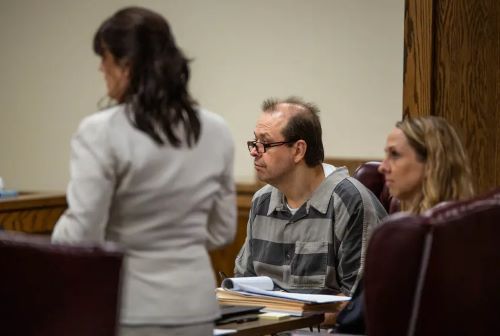
While his lawyers remain optimistic that he will be exonerated, Roberson’s case raises questions about the extent to which the legislative intent of the junk science law — Article 11.073 in Texas’ criminal code — has been fulfilled, and the challenges innocent or wrongfully convicted people face in trying to win relief. His lawyers see his case as an exemplar of the cases the law was meant to target.
“If Mr. Roberson can’t get relief under 11.073, then the statute is not fulfilling what it was intended to,” said Vanessa Potkin, one of his attorneys and the director of special litigation at the Innocence Project. “It is the paradigmatic case for relief under 11.073.”
No one on death row has successfully used the law to obtain a new trial. And in a new report examining junk science petitions filed and ruled upon in the decade since it was codified, the Texas Defender Service found that the statute “is not operating as the Texas Legislature intended.”
The report examined the 74 applications filed and ruled on by the state’s highest criminal court under the junk science law from September 2013 through December 2023, a relatively tiny slice of all post-conviction applications in Texas.
Of those petitions, the Texas Defender Service, a nonprofit working to end the death penalty, found that the Court of Criminal Appeals had applied the law inconsistently, placing a higher burden on convicted people than required by the law, largely ruling against cases with types of flawed evidence other than DNA, and denying relief in all capital cases.
“Individually and cumulatively, these have detrimental effects on justice and mean that the statute is not fulfilling its intended purpose: providing relief to innocent people convicted based on flawed forensic evidence,” the report said.
Nine elected judges sit on the Court of Criminal Appeals, which is the state’s highest criminal court. The Texas Supreme Court hears civil cases.
In a statement, court spokesperson Deana Williamson said that in response to “questions about why or how some defendants get relief and others do not, we will not engage in speculation or discuss specific cases.”
The Junk Science Law, in Theory and in Practice
When the state legislature passed the junk science law in 2013 after two previous failed attempts, the measure was hailed across the nation as the first of its kind, with several states following suit and passing their own version.
The law creates a procedural pathway for convicted people to obtain new trials if they can show that underlying forensic evidence in their case was flawed, and that without that flawed evidence, they likely would not have been convicted. Examples of science that has formed the linchpins of junk science claims include the now-debunked bite mark comparison theory, new DNA evidence and faulty cause-of-death determinations.
“The intention was to accommodate evolving science,” said Bob Wicoff, chief of the wrongful convictions division in the Harris County Public Defender’s Office. “Whereas the criminal justice system demands finality — they want cases to come to a close, and they want a judgment entered and pronounced and finality to be enacted — science keeps evolving.”
Gary Udashen, a criminal appellate lawyer who previously served as board president of the Innocence Project of Texas, said that the law’s broader impact, beyond the number of cases reversed under it, has been to increase awareness of flawed science in criminal cases.
“It made a lot of other states start looking at what was going on in their states,” he said. “It was part of a general assessment around the country of the problems with bad science, and it was one of the things that put Texas out in front.”
But in the decade since legislators codified the pioneering provision, convicted people have struggled to win new trials under the law.
Of the 74 junk science appeals filed and ruled upon by the Court of Criminal Appeals from September 2013 through December 2023, 15 people won relief, according to the Texas Defender Service, whose analysis did not include four successful and expunged appeals.
While people sentenced to death filed just over a third of those appeals, none were successful. And almost 40% of all appeals were denied on procedural grounds without consideration of the substance of the claims.
“The law isn’t working as people believed it would,” said Estelle Hebron-Jones, director of special projects at the Texas Defender Service. “I don’t think it’s something that we can really get a gold star for, even though on paper that’s how it’s been presented.”
One factor, the report found, is that the Court of Criminal Appeals has applied a higher standard of proof than stipulated in the law, requiring that a convicted person prove their innocence to win relief — a much higher bar than proving that a conviction was based on unreliable science, and a duplication of a separate law that allows a conviction to be overturned on the basis of innocence.
Proving innocence, the court said in 2006, is a “Herculean task.” Evidence may have gone stale and eyewitnesses can be missing or unable to recall specific details. And incarcerated people are not well situated to prove their innocence by reconstructing the crime scene, identifying an alternate perpetrator and finding entirely new evidence, according to the report.
“In practice, people seeking relief under 11.073 must go beyond proving the State’s reliance on flawed science — they need to provide evidence affirmatively showing innocence,” the report said. “As a result of the CCA’s interpretation, 11.073 does not do enough to consistently protect all people who have been convicted on false and discredited scientific evidence.”
The Texas Defender Service also found that the court denied at least 38% of appeals on procedural grounds, deciding, for instance, that the new evidence could have been uncovered during a previous appeal or that the evidence would not have changed the jury’s decision.
Denial on procedural grounds then leaves convicted people whose junk science claims were never substantively evaluated, including those on death row, with no other options for relief.
Convicted people without lawyers also fare much worse, the report said, finding them “so disproportionately burdened by the requirements of 11.073 that they are functionally barred from relief.” In non-capital post-conviction cases, Texans do not have a right to counsel under state law.
The kind of evidence raised also matters, with the report concluding that the Court of Criminal Appeals “largely restricts” relief to cases with new DNA evidence, “even though most wrongful convictions are based on other types of flawed forensic evidence.” While DNA claims made up 43% of all junk science appeals, they constituted 73% of those that won relief.
“We have reviewed a number of cases under the provisions of the new science statute,” Williamson, the court’s spokesperson, said. “While many of them involve new DNA evidence, not all of them do.”
So for all the junk science law was intended to rectify, “the justice system has not caught up with the scientific community,” said Judge Elsa Alcala, who sat on the Court of Criminal Appeals from 2011 through 2018, and whose experience on the bench turned her into a death penalty skeptic. “Science has changed, but the judges, I think, are reluctant to undo all of these convictions that occurred with that science.”
She added that the predispositions of the panel’s judges — most of whom are former prosecutors — were a major factor in the court’s rulings on junk science cases.
“If you’re a judge who believes that the system works well, and you’re a judge who believes that most of these people are guilty and have done a lot of other crimes — well, you’re going to be a whole lot less inclined to grant relief,” she said.
Roberson’s Case
The course of Roberson’s appeal has embodied the challenges of winning relief under the junk science law, his lawyers said.
After the Court of Criminal Appeals halted Roberson’s execution in 2016, it was years before the trial court conducted an evidentiary hearing. The court in July then set an execution date without granting him another previously requested hearing.
“It seems like there are just roadblocks at every turn,” Gretchen Sween, his attorney, said. “Everything is fought tooth and nail.”
Roberson’s lawyers have argued that new scientific evidence suggested it is impossible to shake a toddler to death without causing serious neck injuries, which his daughter did not have, and that the symptoms used to diagnose shaken baby syndrome have now been linked to other causes, such as short-distance falls.
Prosecutors, meanwhile, argued that the evidence supporting Roberson’s conviction was still “clear and convincing” and that the science around shaken baby syndrome had not changed as much as his defense attorneys claimed.
In 2023, the court rubber-stamped the prosecution’s argument, Roberson’s lawyers said, denying him a new trial and allowing his execution to move forward.
“If you have a statute that allows you to build this record and then nobody pays attention to the new evidence, what are you supposed to do?” Sween said. “He’s just about the sweetest, gentlest soul I’ve ever met, and it’s this runaway train potentially leading to his execution. It’s just — it’s unbearable.”
Sween described Roberson, who has since been diagnosed with autism, as low-income and “very impaired,” and a father who sought medical treatment for his daughter several times in the days leading up to her death. At the hospital, he “can’t explain her condition, and then he’s treated like the criminal. And really, it’s the system that has been criminal,” Sween said.
Roberson has long asserted his innocence, beyond his junk science claim. His lawyers cited “overwhelming new evidence” that Nikki died not of head trauma, but of “natural and accidental causes” — “severe, undiagnosed” pneumonia that caused her to stop breathing.
Texas is set to execute Roberson on Oct. 17. He has pending litigation at the Court of Criminal Appeals based on developments in a similar case in Dallas County.
“It is heartbreaking,” Sween said. “It’s destabilizing for the entire criminal justice system when you can jump through every hoop, and still, your message is not getting through.”
Originally published by The Texas Tribune, 07.29.2024, republished with permission for non-commercial purposes.
About the Author