Government by the worst people.

Curated/Reviewed by Matthew A. McIntosh
Public Historian
Brewminate
Introduction and Etymology
A kakistocracy is a government run by the worst, least qualified, or most unscrupulous citizens.[1]: 54 [2][3] The word was coined as early as the seventeenth century.[4]
Australian lexicographer Peter Bowler has noted that there is no word for the opposite, a government run by the best citizens,[a] but that aristarchy may be the correct term for that. Still, it conceivably could be a kakistocracy disguised as an aristocracy.[a]
The word is derived from two Greek words, kakistos (worst) and kratos (rule), with a literal meaning of government by the worst people.[5]
History
The earliest use of the word dates to the seventeenth century, in Paul Gosnold’s A sermon Preached at the Publique Fast the ninth day of Aug. 1644 at St. Maries:[4]
Therefore we need not make any scruple of praying against such: against those Sanctimonious Incendiaries, who have fetched fire from heaven to set their Country in combustion, have pretended Religion to raise and maintaine a most wicked rebellion: against those Nero’s, who have ripped up the wombe of the mother that bare them, and wounded the breasts that gave them sucke: against those Cannibal’s who feed upon the flesh and are drunke with the bloud of their own brethren: against those Catiline’s who seeke their private ends in the publicke disturbance, and have set the Kingdome on fire to rost their owne egges: against those tempests of the State, those restlesse spirits who can no longer live, then be stickling and medling; who are stung with a perpetuall itch of changing and innovating, transforming our old Hierarchy into a new Presbytery, and this againe into a newer Independency; and our well-temperd Monarchy into a mad kinde of Kakistocracy. Good Lord![6]
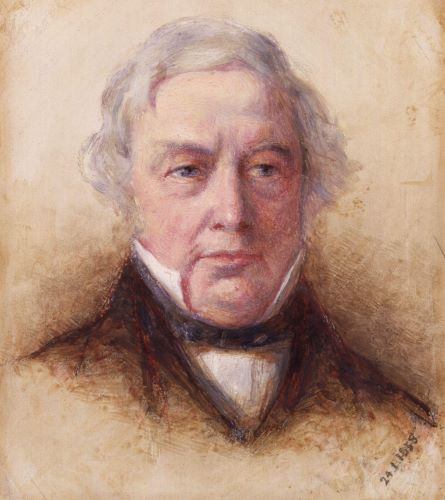
English author Thomas Love Peacock used the term in his 1829 novel The Misfortunes of Elphin, in which he explains that kakistocracy represents the opposite of aristocracy, as aristos (ἄριστος) means “excellent” in Greek.[7] In his 1838 Memoir on Slavery (which he supported), U.S. Senator William Harper compared kakistocracy to anarchy, and said it had seldom occurred:[8]
Anarchy is not so much the absence of government as the government of the worst—not aristocracy but kakistocracy—a state of things, which to the honor of our nature, has seldom obtained amongst men, and which perhaps was only fully exemplified during the worst times of the French revolution, when that horrid hell burnt with its most horrid flame. In such a state of things, to be accused is to be condemned—to protect the innocent is to be guilty; and what perhaps is the worst effect, even men of better nature, to whom their own deeds are abhorrent, are goaded by terror to be forward and emulous in deeds of guilt and violence.
American poet James Russell Lowell used the term in 1876, in a letter to Joel Benton, writing, “What fills me with doubt and dismay is the degradation of the moral tone. Is it or is it not a result of Democracy? Is ours a ‘government of the people by the people for the people,’ or a Kakistocracy rather, for the benefit of knaves at the cost of fools?”[9]
Modern Usage

The term is generally used by critics of a national government. It has been used variously in the past to describe the Russian government under Boris Yeltsin and later, under Vladimir Putin,[10] the government of Egypt under Abdel Fattah Al-Sisi,[11] governments in sub-Saharan Africa,[12] the government of the Philippines under Rodrigo Duterte,[13] and the governments under some United States presidents.[14]
The term saw frequent use about the first presidency of Donald Trump, going viral [4] in 2017 when used by MSNBC host Joy Reid and again, in 2018 when former CIA Director John Brennan used the term.[15] The term also was used by commentators in numerous newspapers,[16][17][18] political publications,[19][20] and books [21][22] to describe the first Trump administration.
After the 2024 election, the term was used again regarding the prospect of nominations Trump began making for offices in his second term, who would have to face review and consent by Congress following inauguration in January 2025. Through comparison to the first administration he had put into place that was criticized as kakistocractic, many initial nominations announced by Trump in November 2024 were characterized as even more significantly kakistocratic.[23]
See endnotes and bibliography at source.
Originally published by Wikipedia, 05.19.2008, under a Creative Commons Attribution-ShareAlike 3.0 Unported license.
About the Author