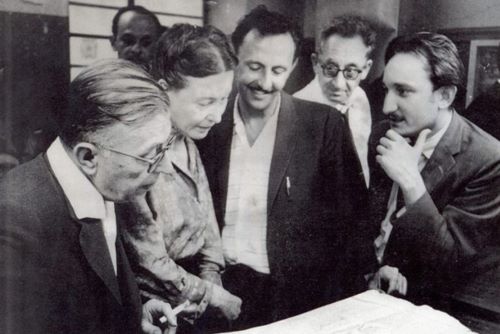
He became the propaganda chief or de facto minister of information of the July 26th Movement.
By Dr. Kenneth Weisbrode
Assistant Professor of History
Bilkent University
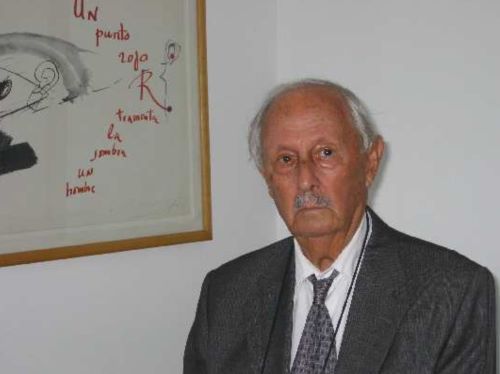
He was, or he appeared to be, the stereotypical “shrewd peasant”: short of height, dark—later gray—hair that covered his head like small tight strings, intense eyes that looked back at one with a hard squint, tan, thick skin. But when he spoke, he became another, maybe a different, person – hard and gentle at the same time, as well as literate, sensitive, eloquent.
It is not possible to know if Carlos Franqui was born shrewd, but he was born a peasant. He attended school for a time but was an autodidact with an autodidact’s determination. That determination brought him to journalism and to Havana, where he joined the fight against the Batista regime and for the Revolution. The Revolution reciprocated, making use of Franqui’s way with words by giving him editorship of its newspaper, Revolución, and direction of Radio Rebelde.
He thus became the propaganda chief or de facto minister of information of the July 26th Movement, and then, once in power, of the new Cuba. In addition to writing many speeches and pamphlets, he oversaw much of what today one would call the Movement’s intellectual and political network, in particular with the European Left: organizing prominent visits to Cuba to pay homage, particularly to Fidel Castro and Che Guevara, who were, for a time, two of the most popular men in the world. Franqui, in other words, was the man who helped turn the Cuban Revolution chic.
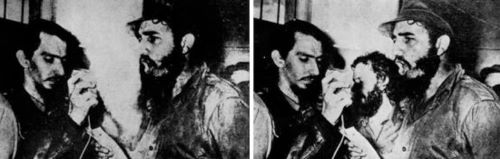
He was also one of the first to bolt, or so it seems in retrospect. At the time it must have seemed to take a long time, about a decade. Like many of his comrades, Franqui fell out with the Castros and the other Revolutionaries after they consolidated power and, step by step, kneeled before the Soviets with cap in hand. For his part, Franqui took with him most of what constituted the Revolution’s archive. Then, once in exile, he published it.
Two of his books – Diario de la Revolución and Retrato de familia con Fidel – give as honest a portrait of the Cuban Revolution from one of its ideologues as one can get. Among other things, they show that the Revolution was won not by bearded, heroic figures pouring down from the mountains ahead of an angry, determined peasantry but instead by middle class young men and women rising up, leading marches and demonstrations, and conducting acts of sabotage, in the cities. Many of these young people were killed early in the Revolution. The names of only a few of them, like Frank País, are remembered.
As it happens I met Franqui, about thirty years ago. My colleagues and I working for a small Washington, D.C. “think tank” were commissioned by some well-meaning private foundations to prepare a contingency plan for the moment that Cuba came in from the cold – which was to say, the moment after Communism’s collapse in Eastern Europe was replicated in the ever-faithful isle 90 miles off the US coast.
That this expectation proved to be a tad bit optimistic didn’t stop us from preparing for the best. In the fashion of the day we recruited a “civil society” advisory group, which was about as diverse a group of Cuban exiles and fellow-travelers that had ever met in a single room. There were about 80 members of the group. One was Franqui.
I had corresponded with him several times and spoke to him on the telephone in Puerto Rico, where he lived. He became animated when I told him that our group would meet in Washington. I did all I could, however, to convince him not to attend in person: I did not want him to be a distraction, and our tiny project budget couldn’t afford the cost of hosting him. He said that he understood.
On the morning of our group’s meeting, my telephone rang. It was a friend of Franqui’s who lived in Washington. He said, “Why didn’t you tell me Franqui was coming here?” “He isn’t,” I said. “Then why is he standing on my doorstep?” I apologized and told the friend that I was sure I had dissuaded Franqui from making the journey, but the man just laughed. “He’s an old Revolutionary. He does what he wants.”
Franqui arrived early to the meeting in a large conference room of a Washington law firm. I remember that he sat in a corner and said nothing to anyone. There were some glares and one or two gasps when some of his fellow Cubans – especially his former enemies who lost nearly all they had in the Revolution – realized who was sitting there. But nobody spoke out against him. He only listened, apart from insisting at one point that the Revolution was never anti-US, at least at the outset.
Later I went to hear him speak to a student group at Georgetown University. The mood there was more volatile because the event was open to the public and a number of Cuban exiles turned up. One of them issued a direct challenge that went something like this: how dare you, Franqui, come here to speak of reconciliation, of rebuilding a free Cuba, when you once did so much to enslave it. How can we believe anything you say?
Franqui leaned forward and gave what I remember to be a monologue as formidable and persuasive as only someone with the gift of thinking and speaking in full paragraphs can deliver. The old wordsmith still had it.
We spent some time together during the next few days; a good deal of that time was spent walking around the city. When we came in sight of the Corcoran museum, Franqui said he wanted to go in because a sign announced an exhibit of a work by Václav Havel.
The work was a transcribed address about the use of words; enlarged to fit several panels extending from floor to ceiling; and translated into several languages. We stood there, alone, because we had arrived just before closing time and remained there for a while once the doors were shut. Franqui said nothing but walked around the room and stared at each of the panels which faced one another in a circle. I remember that at one point he took out a pen and notebook and copied some of what he saw:
In the beginning of everything is the word.
It is a miracle to which we owe the fact that we are human.
But at the same time it is a pitfall and a test, a snare and a trial.
More so, perhaps, than it appears to you who have enormous freedom of speech, and might therefore assume that words are not so important.
They are.
They are important everywhere.
That remains my image of Carlos Franqui, the shrewd peasant, Revolutionary, and propagandist. Silently staring at words about words.
Originally published by History News Network, 01.29.2023, republished with permission for educational, non-commercial purposes.
About the Author