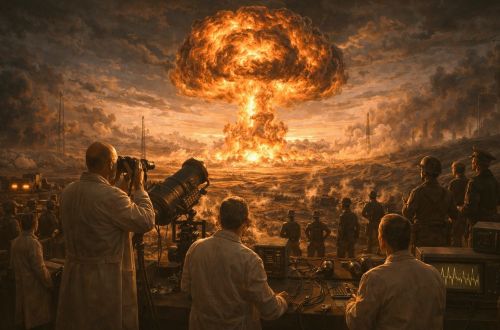
The Manhattan Project transformed American science into a federally controlled enterprise, asserting state authority over nuclear knowledge in an age of total war.

By Matthew A. McIntosh
Public Historian
Brewminate
Introduction: Transformative Knowledge in Total War
The Second World War reshaped the relationship between science and the state in ways unmatched by earlier conflicts. Industrial mobilization had characterized World War I, but the global scale and existential stakes of the 1940s generated unprecedented federal intervention in research and production. Scientific discovery ceased to be an autonomous academic enterprise operating at the margins of political authority. It became a strategic domain. In this environment, knowledge itself acquired military value. The prospect that nuclear fission might yield a weapon of unparalleled destructive capacity transformed theoretical physics into a matter of national survival.
The Manhattan Project emerged within this context of total mobilization. Under the authority of the United States Army Corps of Engineers and the leadership of General Leslie R. Groves, the federal government consolidated control over uranium procurement, laboratory research, industrial construction, and security oversight. Universities such as the University of California were drawn into contractual relationships that subordinated academic research to wartime objectives. Massive federal funding, routed through military channels, sustained facilities at Los Alamos, Oak Ridge, and Hanford. The project’s scale rivaled that of major industrial sectors, consuming billions of dollars and mobilizing tens of thousands of workers. Nuclear research was no longer dispersed inquiry. It became coordinated state enterprise.
What distinguished the Manhattan Project was not merely its size but its structural redefinition of authority over knowledge. Scientific collaboration traditionally relied upon openness, peer exchange, and publication. Wartime atomic research imposed the opposite conditions. Security clearances limited participation. Compartmentalization fragmented information so that many participants understood only isolated components of the broader effort. Secrecy became institutional architecture rather than temporary precaution. The state asserted custodial control over scientific data, transforming intellectual discovery into classified property. Laboratories were physically isolated, correspondence monitored, and movement restricted under military supervision. Even leading physicists were often unaware of parallel developments occurring at other sites. This enforced fragmentation curtailed the normal epistemic culture of science, replacing collegial transparency with hierarchical authorization. Knowledge ceased to circulate freely within scholarly networks and instead moved along controlled channels defined by clearance level and operational necessity. The architecture of secrecy reoriented the practice of research itself, aligning it with strategic containment.
The Manhattan Project represents a decisive moment in the federalization of transformative technology. When nuclear physics promised strategic supremacy, the United States government asserted comprehensive claim over its development, deployment, and dissemination. Scientists such as J. Robert Oppenheimer operated within a framework where participation was practically unavoidable once mobilization began. The project established a precedent in which revolutionary technologies triggered consolidation of federal authority. In the crucible of total war, transformative knowledge did not remain a shared intellectual achievement. It became an instrument of sovereign power.
Federal Mobilization of Academia and Industry
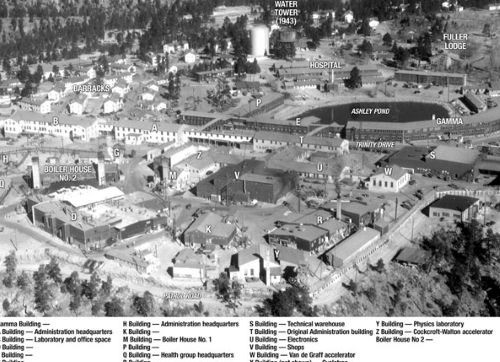
The Manhattan Project fundamentally reorganized the relationship between the federal government, universities, and private industry. Rather than creating an entirely new institutional structure from scratch, the United States government harnessed existing academic and corporate networks and subordinated them to military command. What had previously been a loosely coordinated scientific community became integrated into a centralized wartime apparatus. The Army Corps of Engineers, through the Manhattan Engineer District, became the administrative nucleus of this effort, exercising fiscal and operational authority over a sprawling research enterprise. With Groves’ oversight, federal power extended into laboratories, industrial plants, and university campuses with a degree of penetration unprecedented in American history. Scientific inquiry and industrial production were reoriented toward a single objective defined by wartime urgency: the rapid development of an atomic weapon before Nazi Germany could achieve the same. In practical terms, this meant that questions of funding, staffing, construction, and research direction were no longer governed primarily by academic norms or market incentives. They were governed by military assessment and strategic calculation.
Universities played a central role in this mobilization. The University of California formally administered the Los Alamos Laboratory, even as military oversight determined its operational parameters. Physicists from institutions such as the University of Chicago, Columbia University, and the University of California were drawn into classified research under contractual arrangements that blurred the distinction between civilian scholarship and military service. American science had already grown closer to federal patronage in the interwar period, but the Manhattan Project intensified this alignment dramatically. Academic laboratories ceased to function as independent centers of publication-driven research and became secure sites embedded within a chain of command.
Private industry was mobilized on an equally unprecedented scale. Corporations such as DuPont assumed responsibility for constructing and operating massive production facilities at Hanford, while firms like Union Carbide managed uranium enrichment at Oak Ridge. These arrangements combined federal financing with corporate managerial expertise. The government bore the financial risk and supplied the strategic direction, while industrial partners contributed engineering capacity and organizational experience. Contracts insulated companies from commercial uncertainty yet subjected them to military regulation and secrecy requirements. The project fused public funding with private infrastructure in a manner that reshaped industrial-government collaboration.
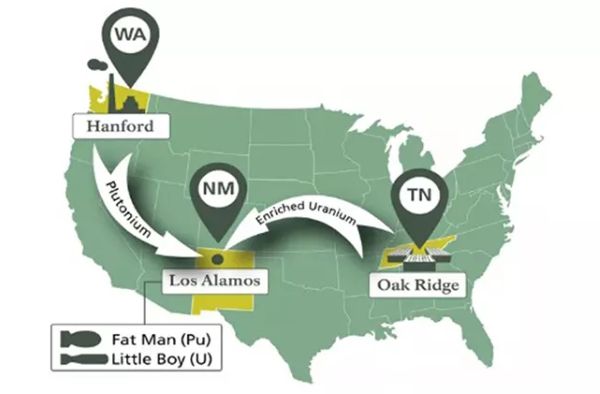
This mobilization required coordination across geographically dispersed sites. Oak Ridge focused on uranium enrichment, Hanford on plutonium production, and Los Alamos on weapon design, each site performing a distinct yet interdependent function within the broader atomic enterprise. The compartmentalization of tasks did not eliminate the necessity of centralized oversight. Materials, technical data, and personnel had to move through carefully controlled channels to maintain both efficiency and secrecy. Groves exercised sweeping authority over budgets, personnel decisions, construction timetables, and security protocols, ensuring that local autonomy never eclipsed federal objectives. The life of Oppenheimer illustrates how even leading scientific figures operated within this hierarchical structure, negotiating intellectual freedom within constraints defined by military command. The federal government did not merely sponsor research. It directed it, allocating resources according to strategic calculation rather than disciplinary curiosity and coordinating disparate institutions into a single wartime network.
The mobilization of academia and industry under the Manhattan Project marked a turning point in American governance of science. Federal authority penetrated institutions that had previously enjoyed substantial autonomy, integrating them into a coordinated war effort. The project demonstrated that transformative research could be organized through contracts, military command, and massive public expenditure. Universities and corporations retained formal identities, yet functioned as components of a unified federal enterprise. In the context of total war, scientific and industrial capacity became instruments of state strategy.
Compartmentalization and the Architecture of Secrecy
The Manhattan Project did not merely centralize scientific authority. It reorganized the internal structure of knowledge itself. Secrecy was not an afterthought appended to research once discoveries emerged. It was built into the architecture of the project from its inception. Military planners understood that the strategic value of atomic research depended upon denying adversaries access to its methods and conclusions. The result was a system in which information was distributed strictly according to operational necessity rather than disciplinary coherence. Compartmentalization became the governing principle of intellectual exchange.
Under General Groves, security procedures extended beyond conventional classification. Personnel underwent background investigations before gaining access to restricted facilities. Even within those facilities, knowledge was segmented. Scientists at Oak Ridge often lacked detailed understanding of developments at Hanford, and many engineers working on enrichment processes were unaware of the precise purpose of their labor. This fragmentation limited the flow of theoretical insight across sites, forcing administrators to balance efficiency against containment. Information traveled upward through controlled channels, but lateral exchange was constrained. The state imposed hierarchical control over epistemic circulation.
This structure altered the culture of scientific practice. Modern physics had developed through international correspondence, conferences, and rapid publication. The Manhattan Project suspended those norms. Researchers who were accustomed to open inquiry who now operated within guarded perimeters and under surveillance. Mail was censored, travel restricted, and conversations monitored. Laboratories became closed communities in which professional reputation could not be built through publication. Instead, recognition depended upon internal evaluation by military and project leadership. Secrecy redefined professional incentives as well as information flow.
Compartmentalization also created paradoxes. On the one hand, it protected the project from espionage and premature disclosure, addressing legitimate fears that German or Japanese intelligence services might penetrate vulnerable channels of communication. On the other, it risked inefficiency by isolating teams whose collaboration might have accelerated progress. Administrators struggled to calibrate the degree of informational restriction necessary to maintain security without crippling innovation. Certain theoretical breakthroughs required integration of data from multiple sites, compelling Groves and Oppenheimer to selectively relax barriers at critical moments. Committees were formed to determine which individuals required broader access, and clearance levels were adjusted in response to evolving technical demands. Secrecy was dynamic rather than static, adjusted in response to perceived risk, technological bottlenecks, and operational urgency. The architecture of compartmentalization functioned less as an absolute wall and more as a set of controlled valves regulating intellectual exchange.
The architecture of secrecy extended beyond the war’s end. Immediately after the bombings of Hiroshima and Nagasaki, the federal government maintained strict classification over technical details, patents, and production methods. Wartime practices of compartmentalization evolved into peacetime regulatory frameworks. Scientific data generated under federal sponsorship became subject to statutory control. The state’s claim over nuclear knowledge persisted, reflecting the belief that atomic technology constituted a permanent strategic asset rather than a temporary wartime innovation.
Compartmentalization was more than a security tactic. It represented a transformation in the governance of transformative knowledge with implications that reached far beyond the Manhattan Project itself. The wartime regime of secrecy established precedents for classification systems, clearance hierarchies, and federal ownership of sensitive research that would shape Cold War science policy. Nuclear information was redefined as “restricted data,” legally separated from ordinary scientific communication and placed under continuing governmental supervision. The Manhattan Project demonstrated that when a discovery promised geopolitical supremacy, the state would reorganize not only funding and institutions but the internal logic of research itself. Secrecy structured authority, distributed information hierarchically, and redefined professional norms across generations of scientists. Knowledge ceased to circulate freely within an international scientific republic and instead became segmented, guarded, and permanently entangled with sovereign power.
Scientists under Military Authority
The Manhattan Project placed scientists within a command structure fundamentally different from the academic environments in which most of them had been trained. Research did not unfold according to faculty governance, peer review, or departmental autonomy. It operated under the authority of the United States Army, specifically through General Groves and the Manhattan Engineer District. Scientific leadership remained visible, particularly in the figure of Oppenheimer at Los Alamos, yet ultimate control rested with military administrators who determined budgets, security policies, personnel appointments, and project timelines. Scientific expertise was indispensable, but it was embedded within a hierarchy defined by strategic objectives.
Oppenheimer’s role exemplifies this tension between intellectual leadership and institutional constraint. As scientific director at Los Alamos, he coordinated theoretical and experimental efforts across multiple divisions, integrating physics, chemistry, metallurgy, and engineering into a coherent research program. Oppenheimer cultivated an atmosphere of intense intellectual engagement, encouraging open technical debate within the confines permitted by security. He recruited leading scientists, mediated disputes, and translated complex theoretical problems into actionable laboratory objectives. Yet his authority was neither absolute nor independent. Groves retained the power to override decisions, enforce security measures, and remove personnel deemed security risks, including individuals with prior political associations that raised suspicion. Budget allocations, facility construction, and strategic priorities were eventually determined by military command. Oppenheimer’s position depended upon his capacity to navigate this dual role: intellectual leader to his peers and reliable administrator to his superiors. Scientific direction unfolded within parameters established by officers whose primary concern was wartime outcome rather than disciplinary integrity.
Participation in the project was rarely framed as optional once recruitment occurred. Many scientists were motivated by fear that Nazi Germany might develop an atomic weapon first, a fear intensified by reports of German advances in uranium research. There was an urgency conveyed by early warnings from émigré physicists such as Leo Szilard and Albert Einstein, which helped catalyze federal involvement. Within this atmosphere, moral reasoning converged with national security concerns. Refusal to participate could be interpreted as indifference to the potential consequences of inaction. Although scientists were not legally conscripted in the traditional sense, the convergence of patriotic obligation, professional expectation, and security clearance procedures created powerful structural pressure. Once individuals accepted positions at Los Alamos or other project sites, withdrawal would not only disrupt research continuity but might also raise suspicions regarding loyalty. The social and institutional environment made dissent difficult to operationalize, even when private doubts persisted about the weapon’s eventual use.
Military authority also shaped daily life within project sites. Los Alamos functioned as a restricted community with controlled access, censored communication, and regulated movement. Researchers navigated an environment in which intellectual debate occurred alongside surveillance and classification protocols. Scientific autonomy persisted within technical discussions, but it was bounded by non-negotiable directives regarding secrecy and schedule. The detonation timeline, determined by wartime strategy rather than scientific caution, imposed pressure on laboratory work. Deadlines reflected military calculation about Japan’s capacity to resist and the broader geopolitical landscape.
Tensions occasionally surfaced between scientific caution and military impatience. Decisions regarding bomb design, testing procedures, and readiness involved negotiation between those concerned with technical uncertainty and those focused on strategic deployment. Moral and strategic debates that intensified as the project neared completion, particularly surrounding the question of whether the bomb should be demonstrated to Japanese officials before being used in combat. Some scientists signed petitions urging reconsideration of immediate military deployment, arguing for alternative approaches that might avoid civilian casualties while still signaling power. Military planners and political leaders, however, prioritized decisive impact and rapid conclusion of the war. These disagreements revealed both the presence of ethical deliberation within the scientific community and the limits of its institutional authority. Final decisions regarding use rested not with laboratory directors but with civilian and military leadership, underscoring the hierarchical structure within which scientific expertise operated.
The experience of scientists under military authority during the Manhattan Project established a template for subsequent defense research relationships. Expertise conferred influence, but not sovereignty. Scientific leaders operated within structures where strategic objectives superseded disciplinary norms. The wartime fusion of intellect and command demonstrated that transformative technology could be developed through collaboration between academic talent and military administration, yet always under ultimate state control. In this configuration, scientific agency remained real but circumscribed, subordinated to national strategy in an era defined by total war.
The Atomic Bomb and the Assertion of Strategic Ownership
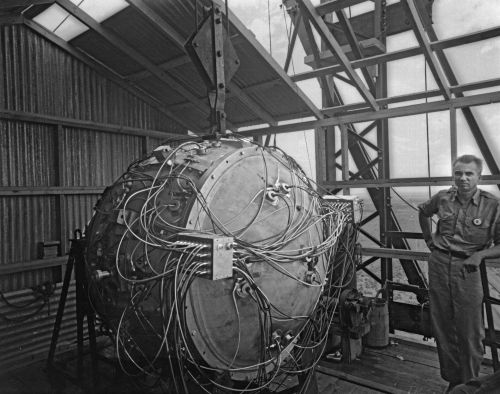
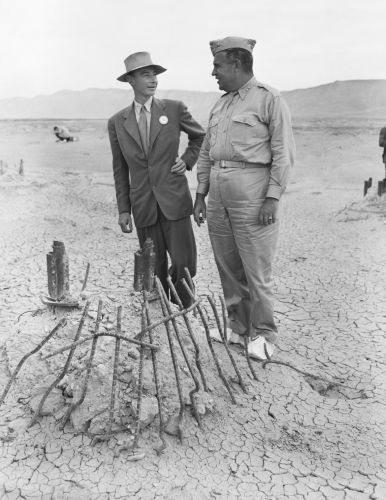
The successful detonation of the Trinity device on July 16, 1945 marked more than a scientific breakthrough. It signified the moment at which nuclear knowledge became an operational instrument of state power. Years of theoretical calculation, laboratory experimentation, industrial construction, and military coordination culminated in a controlled explosion in the New Mexico desert that confirmed the viability of atomic weaponry. The transformation from laboratory research to deployable weapon formalized federal authority over atomic technology in unmistakable terms. Once the bomb proved viable, its strategic implications extended beyond the battlefield to the architecture of international order itself. It embodied a claim of ownership not only over a device, but over the underlying scientific principles that made it possible, including enrichment techniques, reactor design, and explosive assembly. The state’s investment in funding, organization, security, and industrial infrastructure translated into assertion of exclusive control. Trinity demonstrated that transformative knowledge, once militarized, would be governed as sovereign property.
The bombings of Hiroshima and Nagasaki reinforced this consolidation of authority. Decisions regarding use rested with President Harry S. Truman and senior military advisors, not with laboratory scientists. Strategic calculation, diplomatic positioning, and wartime urgency shaped deployment. Once used in combat, the atomic bomb became inseparable from national policy. Nuclear knowledge ceased to function solely as a research accomplishment. It became a geopolitical asset whose possession defined global power hierarchy. The federal government asserted custodianship over both production facilities and technical documentation.
Immediately after the war, this assertion of ownership hardened into legal and administrative policy. The federal government maintained strict classification over design details, enrichment methods, reactor data, and production processes, treating atomic information as uniquely sensitive. Military authorities initially retained direct control over atomic infrastructure while Congress debated postwar governance arrangements. The seizure and classification of patents connected to nuclear processes further reflected this strategic claim, as intellectual property derived from wartime research was subsumed under national security doctrine. Rather than allowing universities or corporations to commercialize discoveries independently, the federal government positioned itself as the ultimate arbiter of access. Scientific findings produced through publicly financed, militarized research did not revert to open academic circulation. They were incorporated into a framework of restricted dissemination that redefined the boundary between public knowledge and classified state asset.
This consolidation also shaped international relations. Atomic monopoly influenced diplomatic strategy toward the Soviet Union in the immediate postwar period. Whether interpreted as deterrence, leverage, or signal, the bomb functioned as an instrument of strategic positioning. The federal government’s refusal to share technical information without strict conditions underscored its claim to exclusive authority. The atomic bomb operated simultaneously as weapon and as symbol of sovereign control over transformative technology.
The assertion of strategic ownership following Trinity and Hiroshima established a precedent for federal dominance in nuclear affairs. Scientific discovery, once transformed into operational capability, became subject to enduring state supervision. Production facilities remained under governmental authority, and dissemination of technical information required formal authorization. The Manhattan Project had centralized nuclear research during wartime. The atomic bomb’s successful deployment ensured that such centralization would not dissolve with victory. Transformative technology, once realized, was absorbed into the architecture of national power.
Postwar Struggle: Civilian vs. Military Control

The end of World War II did not dissolve the centralized authority constructed during the Manhattan Project. Instead, it provoked an intense political debate over who should govern atomic energy in peacetime. The question was not merely administrative. It concerned the balance between democratic oversight and military secrecy, between scientific openness and strategic containment, and between executive power and congressional authority. With the bombings of Hiroshima and Nagasaki complete, the United States confronted a new geopolitical condition in which nuclear capability redefined global hierarchy. Atomic technology could not simply be demobilized like conventional wartime industries. It required institutional governance capable of managing both its destructive potential and its scientific promise. Policymakers recognized that the structures built under emergency conditions had created precedents. The issue was whether those precedents would be normalized or dismantled in the transition to peace.
Initially, control remained in military hands through the Manhattan Engineer District. General Groves oversaw the continued operation of atomic facilities while Congress considered legislative options. Proposals circulated that would have placed atomic energy permanently under War Department authority. Advocates of continued military control emphasized security risks, arguing that premature civilian oversight might expose critical information. Yet critics contended that indefinite military dominance over atomic research threatened democratic accountability and scientific progress.
The Atomic Energy Act of 1946, commonly known as the McMahon Act, represented a compromise shaped by these competing pressures. The legislation dissolved direct military control and established the Atomic Energy Commission (AEC) as a civilian agency. This transition signaled an effort to reconcile national security with republican governance. The AEC assumed authority over nuclear research, production, and regulation, while maintaining strict classification of “restricted data.” Civilian leadership did not imply openness. It formalized federal control within a different institutional framework.
Debate extended beyond domestic administration to international policy. The Baruch Plan, proposed to the United Nations in 1946, sought international control of atomic energy under American leadership, reflecting awareness that nuclear monopoly could not be preserved indefinitely. The proposal envisioned a system of inspections and shared oversight designed to prevent proliferation while maintaining American influence. Tensions with the Soviet Union complicated prospects for cooperative regulation, as mutual suspicion undermined trust in enforcement mechanisms. Soviet rejection of key provisions revealed the emerging contours of Cold War rivalry. When negotiations failed, the United States retained exclusive control over atomic information and infrastructure, reinforcing the strategic claim asserted during the war. The inability to secure international agreement strengthened domestic arguments for continued secrecy and centralized authority. Atomic knowledge remained tightly held, not only as a military asset but as a diplomatic instrument in a rapidly polarizing global environment.
Within the United States, scientists themselves divided over the proper balance between secrecy and transparency. Some advocated international scientific exchange as a safeguard against arms escalation. Others accepted stringent classification as a necessary deterrent. These disagreements unfolded within advisory committees and public discourse. The AEC institutionalized a system in which civilian governance coexisted with pervasive secrecy. Federal authority remained paramount, even as administrative structures shifted from military to civilian hands.
The postwar struggle over control of atomic energy revealed that federal dominance over transformative technology had become entrenched. Wartime mobilization created precedents that peacetime politics did not reverse. Instead, they were codified. Civilian oversight replaced military command, but the principle of centralized control persisted. The Manhattan Project had asserted a strategic claim over nuclear knowledge. The Atomic Energy Act transformed that claim into enduring law. Transformative technology, once absorbed into national security doctrine, did not revert to decentralized management. It remained embedded within the architecture of federal power.
Conclusion: Strategic Claim over Transformative Technology
The Manhattan Project represents a watershed in the history of state authority over scientific innovation. It demonstrated that when a discovery promises existential strategic advantage, governments will not merely fund research. They will organize, contain, and ultimately claim it. Nuclear physics, once an international academic pursuit characterized by open exchange, became embedded within a federal command structure defined by secrecy and military urgency. The transformation was not incidental to wartime pressure. It revealed an underlying principle: transformative technology invites consolidation of sovereign control.
Throughout the project’s development and aftermath, federal authority extended beyond coordination of resources. It reshaped institutional relationships, professional norms, and legal frameworks. Universities were integrated into military administration. Private industry operated under classified contracts. Scientists conducted research within hierarchies that subordinated intellectual autonomy to strategic necessity. After the bomb’s deployment, this pattern hardened into statutory governance under the Atomic Energy Act. Civilian oversight replaced direct military command, yet the principle of centralized control endured. Nuclear knowledge was designated “restricted data,” codifying the state’s custodial claim over its dissemination.
The broader historical significance of this development lies in its precedent. The Manhattan Project established a model in which transformative technologies are treated as matters of national security from inception through deployment. Funding mechanisms, clearance systems, and classification regimes create institutional environments where participation aligns with state objectives and dissent carries structural cost. Scientific innovation continues, but it does so within boundaries shaped by strategic calculation rather than purely disciplinary curiosity. This model influenced subsequent Cold War research structures, including missile development, cryptography, and advanced computing, where federal sponsorship and classification became standard features. The architecture first assembled under emergency wartime conditions evolved into a durable pattern of governance. Transformative research increasingly unfolded within networks defined by contract, clearance, and strategic evaluation. The relationship between knowledge and sovereignty became institutional rather than temporary, embedded in administrative practice and legislative authority.
When transformative technology emerges, governments assert strategic claim over it because the stakes exceed ordinary policy debate. The Manhattan Project did not simply produce an atomic bomb. It redefined the governance of knowledge in the modern state. Nuclear research became inseparable from federal authority, and that alignment persisted into the Cold War and beyond. The lesson is neither celebratory nor condemnatory. It is structural. In moments of technological rupture, sovereignty extends into the laboratory. The state does not relinquish what it perceives as decisive advantage. It incorporates it into the architecture of power.
Bibliography
- Alperovitz, Gar. Atomic Diplomacy: Hiroshima and Potsdam. New York: Simon & Schuster, 1965.
- Bird, Kai, and Martin J. Sherwin. American Prometheus: The Triumph and Tragedy of J. Robert Oppenheimer. New York: Alfred A. Knopf, 2005.
- Forman, Paul. “Behind Quantum Electronics: National Security as Basis for Physical Research in the United States, 1940-1960.” Historical Studies in the Physical and Biological Sciences 18:1 (1987), 149-229.
- Galison, Peter. “Removing Knowledge.” Critical Inquiry 31:1 (2004), 229-243.
- Hasegawa, Tsuyoshi. Racing the Enemy: Stalin, Truman, and the Surrender of Japan. Cambridge, MA: Harvard University Press, 2005.
- Herken, Gregg. Brotherhood of the Bomb: The Tangled Lives and Loyalties of Robert Oppenheimer, Ernest Lawrence, and Edward Teller. New York: Henry Holt, 2002.
- —-. Cardinal Choices: Presidential Science Advising from the Atomic Bomb to SDI. New York: Oxford University Press, 1992.
- Hewlett, Richard G., and Oscar E. Anderson Jr. The New World, 1939–1946: A History of the United States Atomic Energy Commission. University Park: Pennsylvania State University Press, 1962.
- Jones, Vincent C. Manhattan: The Army and the Atomic Bomb. Washington, D.C.: Center of Military History, 1985.
- —-. “Cold War and Hot Physics: Science, Security, and the American State, 1945-56.” Historical Studies in the Physical and Biological Sciences 20:2 (1990), 239-264.
- Kevles, Daniel J. The Physicists: The History of a Scientific Community in Modern America. Cambridge, MA: Harvard University Press, 1978.
- Rhodes, Richard. The Making of the Atomic Bomb. New York: Simon & Schuster, 1986.
- Walker, J. Samuel. Controlling the Atom: The Beginnings of Nuclear Regulation, 1946–1962. Berkeley: University of California Press, 1984.
- —-. Prompt and Utter Destruction: Truman and the Use of Atomic Bombs against Japan. Chapel Hill: University of North Carolina Press, 1997.
- Ward, Wilson. “The Winning Weapon? Rethinking Nuclear Weapons in Light of Hiroshima.” International Security 31:4 (2007), 162-179.
- Wellerstein, Alex. Restricted Data: The History of Nuclear Secrecy in the United States. Chicago: University of Chicago Press, 2021.
Originally published by Brewminate, 03.03.2026, under the terms of a Creative Commons Attribution-NonCommercial-NoDerivatives 4.0 International license.
About the Author