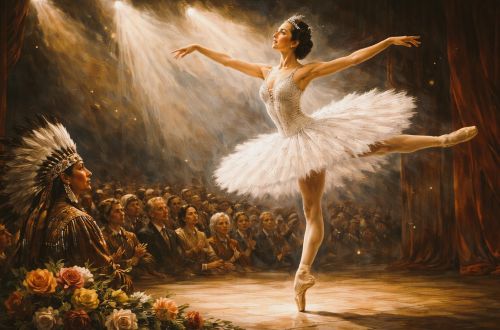
As America’s first prima ballerina, her “steps” included establishing a new American ballet tradition while also reflecting Osage ingenuity and resilience.

By Dr. Shannon Toll
Associate Professor of Indigenous Literatures
Assistant Chair of the Department of English
Film Studies Coordinator
University of Dayton
Introduction
On Nov. 27, 1949, prima ballerina Maria Tallchief waited for her cue in the wings of the City Center in downtown Manhattan, preparing to take the stage in the New York City Ballet’s premiere of “Firebird.”
This production was a reimagining of a famous ballet based on a Russian folktale and featured an Osage ballerina who forced the dance world to reimagine who could be one of their biggest stars. In that moment, Tallchief had no idea that she was about to make history, not only for the New York City Ballet, but in her journey toward becoming America’s first prima ballerina.
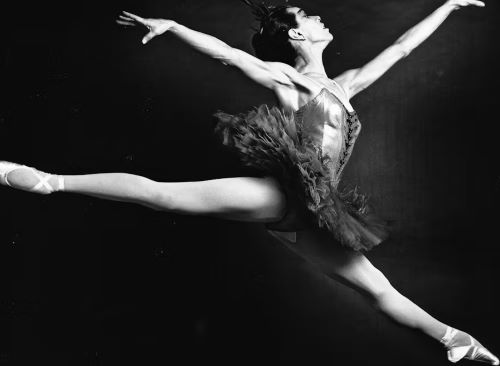
To be a prima ballerina, or the female “first principal dancer” of a company, is to be recognized for one’s superior technique, artistry and stage presence, and Tallchief’s “electrifying appearance” as the Firebird reflected her mastery of these elements.
In my work as a professor of Indigenous literatures and cultures, I often introduce my students to works and artists that they’ve never heard of before, including Maria Tallchief. This November, in honor of Native American Heritage Month and in recognition of the 75th anniversary of the New York City Ballet’s “Firebird” premiere, I want to highlight the integral role that Tallchief played in bringing ballet to the United States.
She and her younger sister Marjorie were both acclaimed ballerinas who dazzled audiences around the globe from the 1940s-1960s, a time when most Americans wrongly assumed that Indigenous people were unable to participate in modern life. During this era, Congress passed legislation aimed at erasing Indigenous nations’ rights of self-governance, and scholars contributed to the stereotype that Indigenous people would lose their cultural and political traditions.
Artists like the Tallchief sisters rejected those stereotypes in vivid motion, pursuing their passion for dance while honoring their shared heritage.
Early Life
Tallchief was born Elizabeth “Betty” Maria Tall Chief on Jan. 24, 1925, in Fairfax, Oklahoma. Her parents were Ruth Porter and Alexander Tall Chief, and she was raised in a prominent family steeped in Osage traditions.
As young girls, Maria and Marjorie both showed an aptitude for dance, and the family decided to move to California to access the best teachers to train them. The Tallchief girls, who by then had joined their two last names, excelled under their new instructors, and Maria would go on to join the Ballet Russe de Monte Carlo, a prestigious dance company that traveled throughout Europe and the United States.
She excelled in Ballet Russe’s corps de ballet (ensemble dancers), mastering the technique and stage presence necessary to earn the rank of soloist. However, there was one practice that other famous dancers had adopted that Tallchief rebuffed, and that was changing her last name to “Tolchieva,” or “Tallchieva” to sound more “Russian,” as Russians were thought to be the most talented dancers. She was proud of her last name and her heritage and refused to bend to company pressure to conform.
Becoming the Firebird
It was during her time with Ballet Russe that Tallchief met the choreographer George Balanchine, who noticed her talent and began to create new roles for her.
After a brief courtship, Balanchine offered Tallchief a dual proposal: become his wife and join his new company that he was establishing in New York. This would be Balanchine’s second attempt at founding a company with the American philanthropist Lincoln Kirstein.
Tallchief’s energetic style and technical brilliance would bring Balanchine’s choreography to life, so she was a key to this endeavor’s success. From their partnership, Ballet Society Inc., later renamed New York City Ballet, was created.
In her memoir “America’s First Prima Ballerina,” Tallchief recalls that the premiere of “Firebird” was a make-or-break moment for the fledgling ballet company, for whom “seasons were brief, [and] money was tight.”
Moreover, while Tallchief was Balanchine’s muse, she did not feel like a source of artistic inspiration that evening. She was recovering from a tonsillectomy, wearing a costume that had only just arrived that morning and preparing to execute a complex jump that she and her partner hadn’t mastered yet.
However, when the curtain rose, Tallchief turned in an electric performance that embodied the magical Firebird of lore, completing the difficult jump with such grace that, as she recounted in her memoir, “an audible sigh rose in the audience.”
Far from being the disaster Tallchief feared, the ballet proved to be one of the company’s greatest accomplishments. She recalled that once the performance concluded, the New York City Center erupted into applause, sounding like a football stadium “after somebody’s made a touchdown.”
‘A New Marvel’
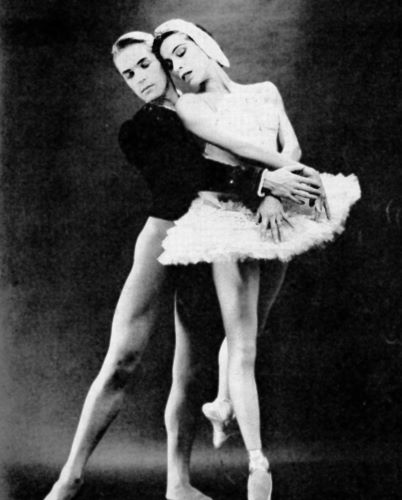
Critics raved about the ballet and Tallchief in particular. Dance critic John Martin of The New York Times declared that Balanchine had choreographed a role perfectly tailored to match Tallchief’s skills, and “she dances it like a million dollars. On second thought, make it two million.”
The composer of “Firebird,” Igor Stravinsky, sent Balanchine a telegram congratulating him on the “new marvel” that he and Tallchief had created with his “old Firbird.” The ecstatic response legitimized the New York City Ballet as a successful company.
Tallchief’s work was not limited to the New York City Ballet, as she headlined a successful tour with American Ballet Theatre to Russia during the Cold War and danced for Presidents John F. Kennedy and Dwight D. Eisenhower during “An American Pageant for the Arts.” In 1954, she rejoined the Ballet Russe for a tour and became the highest-paid ballerina in the world.
Back in Oklahoma, June 29 was dubbed “Maria Tallchief Day,” and the Osage Nation honored her as “Princess Wa-Xthe-Thonba, Woman of Two Standards,” alluding to her status as a prima ballerina and an Osage citizen. Also, as captured in this name, she showed that despite assumptions to the contrary, Indigenous people could both exceed the standards of Western arts and culture, and then set new standards along the way.
We are nearing the centenary anniversary of Maria Tallchief’s birth. Tallchief once said a “ballerina takes steps given to her and makes them her own.” As America’s first prima ballerina, her “steps” included establishing a new American ballet tradition while also reflecting Osage ingenuity and resilience.
Originally published by The Conversation, 11.20.2024, under the terms of a Creative Commons Attribution/No derivatives license.
About the Author