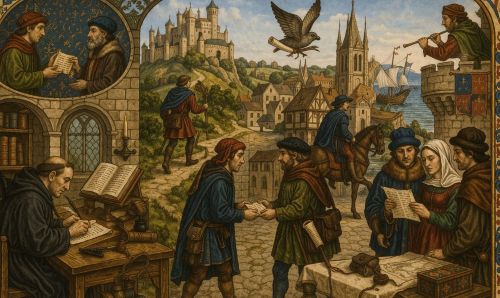
Medieval Europe developed complex communication networks through speech, symbols, and performance, revealing that social media behaviors long predate digital technology and platforms.

By Matthew A. McIntosh
Public Historian
Brewminate
Introduction: Rethinking “Social Media” before Technology
The concept of social media is often treated as inseparable from modern digital technology, as though platforms such as Facebook, Twitter/X, and Instagram represent an unprecedented rupture in human communication. Yet when examined functionally rather than technologically, social media can be understood as a system of networked interaction defined by the rapid exchange of information, participatory engagement, and the formation of shared communities. These characteristics are not exclusive to the digital age. Long before the emergence of the internet, medieval societies developed complex, dynamic systems of communication that fulfilled many of the same roles, albeit through oral transmission, physical proximity, and material culture rather than electronic mediation. To frame social media solely as a product of modern technology is to overlook deeper continuities in how humans construct, share, and interpret information within social networks.
Medieval Europe, far from being an era of communicative isolation, was structured by dense and overlapping channels of information exchange. Oral culture played a central role, enabling news, rumor, and narrative to circulate with remarkable speed within localized environments. Oral societies operate according to principles that privilege memory, repetition, and communal participation as mechanisms of preservation and dissemination. These processes fostered highly interactive environments in which individuals were not merely passive recipients of information but active participants in its transmission, reshaping stories, reinforcing shared knowledge, and contributing to a collective understanding of events. Such dynamics mirror the participatory culture that defines contemporary social media, where users generate, modify, and circulate content within networked communities.
Medieval communication systems were embedded within specific social, institutional, and spatial frameworks that shaped how information moved and who controlled its dissemination. Markets, churches, courts, and itinerant performers each played distinct roles in structuring communication flows, creating both opportunities for widespread circulation and constraints imposed by authority and geography. The shift from memory-based to record-based culture did not eliminate oral exchange but instead produced a hybrid system in which spoken and written forms interacted continuously. This interplay allowed information to move across different media and social strata, reinforcing its authority through repetition while also opening it to reinterpretation. Medieval communication networks were neither primitive nor static but adaptive systems capable of sustaining complex patterns of interaction.
Medieval “platforms” such as marketplaces, sermons, performers, and manuscript culture functioned as analog equivalents to modern social media, shaping identity, authority, and the circulation of information in ways that reveal striking continuities with contemporary digital life. While the scale and speed of modern platforms are unprecedented, the underlying behaviors they facilitate—virality, influence, community formation, and the negotiation of truth—are deeply rooted in earlier historical practices. By examining medieval communication through the lens of social media, we can better understand not only the past but also the persistent human patterns that continue to define how information is created, shared, and contested in the present.
Marketplaces, Taverns, and Church Doors: The Medieval “Newsfeed”
In medieval Europe, the circulation of information depended not on centralized systems but on recurring physical spaces where people gathered, interacted, and exchanged knowledge. Among the most important of these were marketplaces, which functioned as dynamic hubs of both economic and informational activity. Traders arriving from different regions carried not only goods but also news of political developments, conflicts, and social conditions elsewhere. As goods changed hands, so too did stories, rumors, and observations, creating a constantly updating stream of information. This process was not passive. Individuals actively interpreted, reshaped, and retransmitted what they heard, ensuring that the marketplace operated as a continuously evolving communicative environment rather than a static site of exchange.
Taverns played a complementary but distinct role within this network, offering a more intimate and socially fluid setting in which information could be discussed, contested, and elaborated upon. Unlike the marketplace, which was structured around commercial exchange, the tavern fostered extended conversation among patrons from varied backgrounds, including travelers, laborers, and local residents. Here, news was not simply transmitted but debated, embellished, and sometimes distorted. As historians of medieval social life have noted, such environments encouraged the blending of fact and rumor, producing narratives that could spread rapidly beyond the immediate setting. The tavern functioned as both a site of amplification and transformation, where information gained emotional resonance and social meaning before reentering broader circulation.
Church doors and other ecclesiastical spaces served as another crucial node in this decentralized system, operating as points of formal and semi-formal communication. Royal edicts, legal notices, and local announcements were often proclaimed or posted in these locations, ensuring that they reached a wide audience. The church’s centrality within medieval communities meant that such messages carried a degree of authority that distinguished them from the more fluid exchanges of the marketplace or tavern. Yet even here, the boundary between official information and communal interpretation remained porous. Once proclaimed, messages were carried into conversation, where they could be reinterpreted, questioned, or woven into existing narratives circulating within the community.
The effectiveness of these spaces as information networks depended heavily on the mechanisms of oral transmission. Repetition, mnemonic phrasing, and performative delivery enabled messages to be retained and passed along with relative fidelity, even as they adapted to new contexts. Historical analysis of oral culture emphasizes that such systems rely on redundancy and communal reinforcement to sustain information across time and space. In medieval settings, this meant that widely shared news could achieve a form of stability through constant repetition, even as localized variations emerged, shaped by the needs, expectations, and interpretive habits of different audiences. Oral transmission was not merely a method of communication but a cultural practice that embedded information within social relationships, memory structures, and shared linguistic patterns. Speakers often relied on formulaic expressions, rhythmic phrasing, and narrative frameworks to ensure that messages were both memorable and persuasive, while listeners participated actively by recalling, correcting, and retransmitting what they had heard. This collective engagement created a feedback loop in which information was continually reinforced and subtly reshaped, allowing it to persist across time without the need for written preservation. The medieval communicative environment functioned as a self-sustaining system, in which the stability of information depended not on fixed texts but on the ongoing participation of the community itself.
Despite their lack of technological infrastructure, these networks were capable of remarkable speed within their geographic limits. News of significant events such as royal deaths, military campaigns, or natural disasters could travel quickly along established routes of trade and pilgrimage, reaching distant communities through successive acts of transmission. Medieval societies were far more interconnected than once assumed, with regular movement of people facilitating the flow of information alongside goods and services. This interconnectedness created conditions under which certain stories or rumors could achieve a form of regional “virality,” spreading widely within a relatively short period even in the absence of written or printed media.
These systems were inherently bounded by physical and social constraints, producing highly localized information environments. The absence of instantaneous, long-distance communication meant that communities often developed distinct informational landscapes shaped by their immediate networks of interaction. This localization contributed to the formation of what might be termed medieval echo chambers, in which shared beliefs and narratives were reinforced through repeated circulation within a limited audience. In this respect, the medieval “newsfeed” was both dynamic and constrained, capable of rapid dissemination within communities while remaining fragmented across broader regions. It is precisely this combination of immediacy, participation, and limitation that reveals the structural parallels between medieval communication networks and modern social media systems.
Town Criers and Sermons: Authority, Amplification, and Messaging

If marketplaces and taverns formed the decentralized flow of medieval information, then town criers and sermons represented its most visible structures of authority and amplification. These channels did not merely circulate information. They defined it, framed it, and gave it legitimacy. In a world where literacy remained limited and written texts were not universally accessible, the spoken word delivered by recognized figures carried exceptional weight. The town crier, often appointed or sanctioned by local authorities, functioned as a living broadcast system, tasked with delivering official proclamations to the public in a manner that was both audible and memorable. Their presence transformed public space into a site of sanctioned communication, where information was not debated but declared.
Town criers operated at the intersection of governance and communication, ensuring that laws, decrees, and urgent announcements reached a broad audience. Their effectiveness depended not only on volume but on performance. Proclamations were often repeated in multiple locations and delivered with formulaic openings that signaled authority and commanded attention. The reliance on oral proclamation in medieval England persisted even as written records expanded, underscoring the continued importance of voice as a medium of legal and administrative communication. The crier’s role was not simply to inform but to affirm the presence of authority, reinforcing the idea that governance was both heard and witnessed within the community.
Sermons, delivered within churches and other religious settings, operated as a parallel system of mass communication, one that blended spiritual instruction with social and political messaging. The medieval church possessed an unparalleled capacity to reach large audiences on a regular basis, making the sermon one of the most powerful communicative tools of the period. Clergy used sermons to interpret events, instruct behavior, and reinforce moral and doctrinal frameworks, often drawing connections between local circumstances and broader theological narratives. They shaped not only what people knew but how they understood it, embedding information within a moral and interpretive structure that gave it lasting significance. Sermons frequently addressed issues that extended beyond purely spiritual concerns, including social order, justice, obedience to authority, and responses to crises such as famine or disease. By situating contemporary events within a providential framework, preachers transformed immediate experiences into elements of a larger cosmic narrative, reinforcing both the authority of the Church and the coherence of its worldview. This capacity to integrate information, interpretation, and moral guidance made the sermon an especially powerful tool for shaping collective consciousness.
The persuasive power of sermons rested in part on their performative and rhetorical qualities. Preachers employed vivid imagery, repetition, and narrative exempla to ensure that their messages were both memorable and emotionally resonant. Medieval preaching was highly sophisticated, drawing on established rhetorical traditions to engage audiences and guide interpretation. Sermons were not static recitations but dynamic performances, adapted to the needs and expectations of specific communities. This adaptability allowed them to function as a form of targeted messaging, capable of addressing local concerns while reinforcing broader institutional authority. Sermons operated not only as vehicles of information but as instruments of cultural alignment, shaping collective attitudes and reinforcing shared values.
Despite their authoritative nature, both town criers and sermons were embedded within broader networks of communication that complicated their control over meaning. Once delivered, proclamations and sermons entered the same circuits of discussion that characterized marketplaces and taverns, where they could be interpreted, questioned, or reframed. Studies of everyday life in medieval England highlight the extent to which communities actively engaged with official messages, integrating them into existing patterns of belief and conversation. This process created a dynamic interplay between top-down communication and bottom-up interpretation, ensuring that even the most authoritative messages were subject to negotiation within the social fabric.
The comparison to modern social media is particularly striking when considering the role of amplification and authority. Town criers and preachers functioned in ways analogous to verified accounts or institutional broadcasters, capable of reaching large audiences and shaping public discourse. Yet their messages did not exist in isolation. They were taken up, redistributed, and transformed within informal networks, much as official statements today are shared, commented upon, and reinterpreted across digital platforms. The medieval communicative environment reveals a system in which authority and participation coexisted in tension, producing a complex landscape of messaging that was both controlled and contested. Messages delivered from positions of authority could gain rapid acceptance through repetition and ritual, but they could also be subtly reshaped as they passed through layers of communal discussion, acquiring new meanings or emphases that diverged from their original intent. This dual process of amplification and transformation mirrors the dynamics of modern digital platforms, where institutional messaging is both reinforced and challenged by user interaction. It is within this tension that the deeper parallels between medieval and modern information systems become most apparent, revealing that the negotiation of authority and interpretation is not a product of technology but a persistent feature of human communication.
Troubadours and Jongleurs: Influencers and Cultural Virality
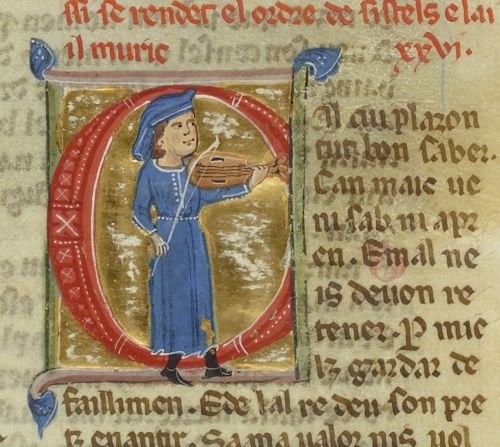
If town criers and sermons represented structured authority in medieval communication, troubadours and jongleurs embodied its more fluid, performative, and socially responsive dimension. These figures operated outside rigid institutional frameworks, yet they wielded considerable influence through their ability to shape narratives, reputations, and cultural tastes. Troubadours, often associated with aristocratic courts in southern France, composed and performed lyric poetry that celebrated themes of love, honor, and patronage. Jongleurs, by contrast, were itinerant performers who moved between communities, carrying stories, songs, and satirical commentary across regions. Together, they formed a network of cultural transmission that relied not on formal authority but on audience engagement, memory, and mobility.
The influence of troubadours was closely tied to systems of patronage, which provided both material support and social legitimacy. Their compositions often praised patrons, reinforced courtly ideals, and contributed to the cultivation of elite identity. Yet this relationship was not one-directional. Troubadours also shaped the reputations of those they served, crafting narratives that could enhance prestige or subtly critique behavior. Medieval lyric poetry was not merely a literary form but a performative act embedded within social relationships, where meaning emerged through the interaction between performer and audience. This dynamic positioned troubadours as cultural intermediaries, capable of both reflecting and influencing the values of their communities. Their role extended beyond entertainment into the realm of social negotiation, where poetic expression could reinforce alliances, mediate tensions, or signal shifts in status and favor. Because their work circulated through performance rather than fixed text, it retained a degree of flexibility that allowed troubadours to adjust tone, emphasis, and content in response to audience reaction, thereby maintaining relevance within changing social contexts.
Jongleurs, less constrained by courtly expectations, played a more expansive role in the dissemination of information and entertainment. Their mobility allowed them to act as conduits between otherwise disconnected communities, carrying stories from one region to another and adapting them to local contexts. They contributed to the spread of widely recognized narratives while also introducing variation and innovation. Stories could change in tone, emphasis, or detail depending on audience reception, creating a process of continual reinterpretation. This adaptability was central to their effectiveness, enabling them to maintain relevance across diverse settings while ensuring that their performances remained engaging and memorable.
The concept of virality must be understood through the mechanics of oral transmission and performance. A particularly compelling song, tale, or satirical piece could be repeated, imitated, and adapted by other performers, allowing it to spread across regions with surprising reach. Unlike written texts, which remained fixed, these performances were inherently flexible, capable of evolving as they traveled. This fluidity did not diminish their impact. On the contrary, it enhanced their ability to resonate with different audiences, ensuring that core elements of the narrative persisted even as details shifted. Medieval performance culture created a form of “viral” content that depended on repetition, variation, and audience participation rather than technological replication.
The influence of troubadours and jongleurs was shaped by the social dynamics of trust, reputation, and credibility. Performers who consistently engaged audiences and delivered compelling content could build a form of recognizable identity that extended beyond individual performances. Their names, styles, and thematic preferences became associated with particular expectations, allowing audiences to anticipate and respond to their work. This process bears a striking resemblance to the development of personal brands in modern digital environments, where creators cultivate distinct voices and followings. Yet medieval performers operated within more immediate and reciprocal contexts, where audience feedback was direct and performance success depended on real-time engagement. Reputation was sustained not through static archives but through repeated encounters and shared memory, meaning that a performer’s influence was continuously negotiated rather than permanently secured. This reliance on ongoing interaction reinforced the importance of adaptability, charisma, and responsiveness, qualities that ensured continued relevance within a competitive and ever-shifting cultural landscape.
The parallels with modern social media influencers are not superficial but structural. Troubadours and jongleurs created, curated, and disseminated content that shaped public perception, influenced cultural norms, and traveled across networks through processes of imitation and adaptation. Their success depended on visibility, memorability, and the ability to connect with audiences, all of which remain central to contemporary forms of digital influence. Their reliance on oral transmission and physical presence imposed limitations that distinguish their world from our own. Content could not be instantly replicated or preserved in fixed form, and its survival depended on continued performance and communal memory. Nevertheless, the underlying dynamics of influence, engagement, and cultural circulation reveal a continuity that challenges the notion of social media as a purely modern phenomenon.
Visual Identity and Symbolic Communication: Medieval “Profiles” and “Memes”

While much of medieval communication relied on oral exchange, visual symbols played an equally powerful role in conveying identity, affiliation, and meaning. In a society where literacy was unevenly distributed, images, emblems, and material markers provided an accessible and immediately recognizable form of communication. These symbols functioned as a kind of visual shorthand, allowing individuals to signal who they were, where they belonged, and what they believed without the need for written explanation. From heraldic devices to pilgrim badges, medieval visual culture created a shared language of signs that could be read across regions and social boundaries.
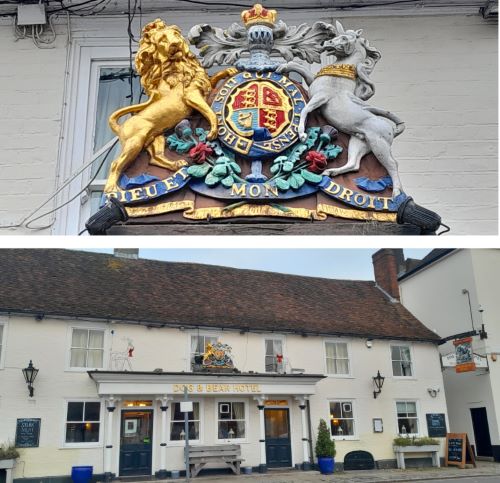
Heraldry represents one of the most formalized systems of visual identity in the medieval world. Coats of arms, with their distinctive colors, patterns, and symbols, served as identifiers for noble families and individuals, allowing them to be recognized in contexts ranging from the battlefield to courtly ceremony. Heraldic imagery was governed by a set of conventions that ensured both clarity and consistency, enabling viewers to interpret these symbols with relative ease. The visual distinctiveness of heraldry functioned much like a modern profile or avatar, presenting a curated representation of identity that was both public and symbolic. Heraldry was not static. Elements could be modified to reflect alliances, inheritance, or shifting status, creating a dynamic system of visual self-representation.
Beyond the aristocracy, visual symbols permeated everyday life through objects such as pilgrim badges, guild insignia, and livery. Pilgrim badges, often purchased at sacred sites, served as tangible markers of religious experience and devotion, signaling participation in a shared spiritual journey. Guild symbols identified membership in professional communities, reinforcing both economic and social identity. Livery, worn by retainers, visually linked individuals to powerful households, making relationships of service and allegiance visible in public space. These markers allowed individuals to carry their affiliations with them, transforming the body itself into a communicative surface upon which identity was displayed and interpreted. In urban environments especially, where different trades and social groups interacted closely, such visual cues provided a rapid means of recognition that did not depend on personal familiarity or verbal introduction. They helped structure social interactions by signaling trust, authority, and belonging at a glance, reducing uncertainty in increasingly complex and populated settings. Visual identity functioned not merely as expression but as a practical tool for navigating social and economic life.
The communicative power of these symbols lay not only in their recognizability but in their capacity for repetition and variation. A familiar emblem could appear in multiple contexts, from clothing to architecture to manuscript illumination, reinforcing its meaning through repeated exposure. Slight alterations could introduce new layers of significance, allowing symbols to evolve while retaining their core identity. This process parallels the way modern visual content, such as memes or logos, circulates and adapts across digital platforms. In both cases, meaning emerges through a combination of stability and change, as audiences recognize familiar elements while engaging with new interpretations.
Visual symbols also played a role in shaping collective memory and shared cultural references. Images associated with saints, rulers, or legendary figures became part of a common visual repertoire that could be invoked across different settings. These representations carried layers of meaning that extended beyond their immediate context, allowing them to function as points of connection within broader cultural narratives. As scholars of medieval visual culture have noted, such imagery often operated within a framework of symbolic association, where meaning was constructed through relationships between images, texts, and established traditions. This interconnectedness enhanced the communicative reach of visual symbols, enabling them to resonate across diverse audiences.
The comparison to modern social media highlights the enduring importance of visual communication in shaping identity and facilitating interaction. Medieval symbols functioned as portable, recognizable markers that could be “read” quickly and shared across social networks, much like profile images, logos, or memes today. While the technologies of production and distribution differ dramatically, the underlying logic remains consistent. Humans rely on visual cues to navigate complex social environments, to signal belonging, and to communicate ideas efficiently. Medieval visual culture reveals not a primitive precursor but a fully developed system of symbolic communication, one that anticipates many of the functions now associated with digital media. The portability of these symbols, whether worn, carried, or displayed, allowed them to circulate widely within and between communities, embedding meaning into everyday interactions and reinforcing shared understandings. Their effectiveness depended on collective recognition, which in turn required repeated exposure and cultural familiarity, much like the iterative spread of visual content in modern networks. This continuity underscores that the human reliance on symbolic imagery as a means of communication is not a recent development but a deeply rooted aspect of social life.
Florilegia and Manuscript Culture: Remixing Knowledge Before Print
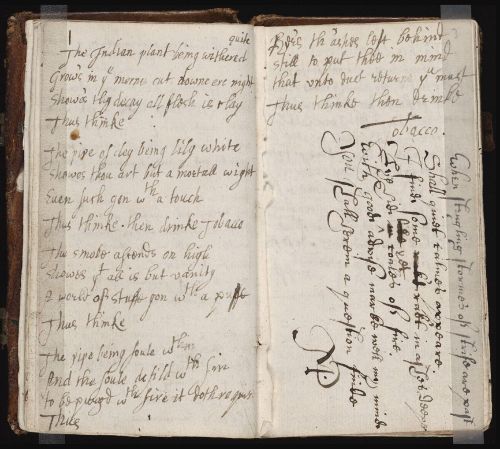
If oral performance and visual symbolism structured much of medieval communication, manuscript culture provided a different but equally important medium through which knowledge was collected, organized, and transmitted. Among the most distinctive features of this culture were florilegia, compilations of excerpts drawn from authoritative texts and arranged according to thematic or moral categories. These collections did not aim to preserve works in their entirety but to distill and reorganize them, selecting passages that could be reused for teaching, preaching, or reflection. Florilegia represent a form of intellectual curation, where knowledge was not simply copied but actively shaped through processes of selection and arrangement.
The creation of florilegia reveals a mode of engagement with texts that differs significantly from modern assumptions about authorship and originality. Compilers operated within a tradition that valued the authority of established sources, particularly classical and patristic authors, yet they exercised considerable agency in determining how those sources were presented. By extracting passages from their original contexts and placing them within new frameworks, they created layers of meaning that reflected contemporary concerns and interpretive priorities. Medieval readers approached texts as reservoirs of usable knowledge, to be reorganized and redeployed as needed rather than preserved in fixed form. This practice blurred the boundary between reading and writing, transforming both into acts of composition.
Manuscript culture more broadly reinforced this dynamic through its material and social conditions. The production of manuscripts was labor-intensive, requiring time, skill, and resources, which encouraged selective copying and the prioritization of material deemed most valuable or relevant. Monastic scriptoria and later university settings became centers of textual activity, where copying, annotating, and compiling took place within collaborative environments. Marginal notes, glosses, and commentaries further contributed to the layering of texts, allowing readers to engage directly with what they encountered. These additions were not merely supplementary. They became integral to the transmission of knowledge, shaping how texts were understood and used by subsequent readers. Manuscripts accumulated layers of interpretation that reflected the intellectual priorities of different communities, turning them into living documents rather than static artifacts. The presence of glosses and commentary also created a dialogic structure within the text itself, where multiple voices coexisted and interacted across generations. This cumulative process allowed knowledge to evolve incrementally, with each act of copying or annotation contributing to an ongoing conversation that extended beyond any single author or moment of composition.
The parallels with modern digital culture are particularly striking when considering the processes of excerpting, recombination, and thematic organization that define florilegia. Much like blogs, curated feeds, or platforms such as Tumblr, medieval compilers gathered fragments from diverse sources and arranged them to create new, coherent wholes. Meaning emerged not only from the original texts but from their juxtaposition and reinterpretation within the collection. This form of “remix” culture demonstrates that the reconfiguration of existing content into new formats is not a product of digital technology but a longstanding feature of intellectual practice. The difference lies in scale and speed, not in the underlying logic of composition.
Manuscript culture imposed constraints that shaped how such remixing could occur. The physical nature of manuscripts limited the number of copies that could be produced and circulated, while access to texts remained restricted to specific institutional or social contexts. These limitations did not prevent the development of extensive networks of textual exchange. Communities of interpretation formed around shared texts, linking readers across distances through common frameworks of understanding. Within these communities, florilegia and other compilations functioned as tools for organizing knowledge and facilitating communication, demonstrating that even in the absence of print or digital media, complex systems of intellectual exchange could flourish.
Performance and Virality: Songs, Stories, and the Spread of Culture
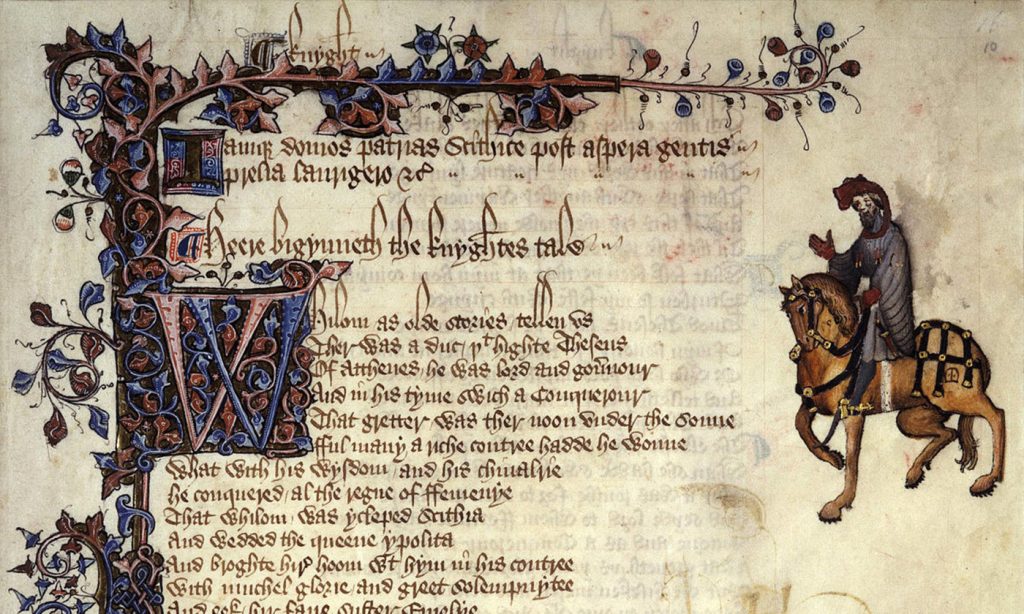
The spread of songs and stories in medieval Europe reveals a communicative dynamic that closely resembles what is now described as virality. Without the aid of digital reproduction, certain narratives nevertheless achieved wide recognition across regions, circulating through repeated performance and communal participation. These cultural forms were not transmitted as fixed texts but as living expressions, shaped by the voices and memories of those who performed them. A compelling melody, a memorable tale, or a sharply delivered satire could travel from one town to another, carried by performers, travelers, and audiences themselves. Virality in the medieval world depended not on technological speed but on the capacity of content to be remembered, repeated, and adapted. What made certain pieces “spread” was not merely their initial performance but their ability to embed themselves within collective memory, to be taken up by others, and to resonate across different social contexts. This process reveals that virality is fundamentally rooted in human cognition and social interaction, emerging wherever communication systems allow for repetition, variation, and shared participation.
Central to this process was the role of performance as both medium and mechanism of transmission. Songs and stories were designed to be heard, internalized, and reproduced, often employing rhythmic structures, repetition, and familiar narrative patterns to facilitate recall. Oral poetry exists within a performative framework in which each rendition is both a continuation and a re-creation of the work. This meant that no two performances were identical, yet each retained enough recognizable elements to sustain continuity across time and space. The act of performance became a form of replication, allowing content to spread through successive iterations that balanced stability with variation.
The movement of performers and audiences played a crucial role in extending the reach of these narratives. Pilgrimages, trade routes, and seasonal fairs created opportunities for interaction between otherwise distant communities, enabling songs and stories to cross geographic and cultural boundaries. A tale heard in one setting could be retold in another, modified to suit local sensibilities while preserving its core structure. This process of diffusion was neither linear nor uniform. Some narratives gained widespread popularity and endured over long periods, while others remained localized or disappeared entirely. The factors that contributed to this differential spread included emotional resonance, thematic relevance, and the adaptability of the material to different contexts.
The variability inherent in oral transmission introduced a level of instability that distinguished medieval virality from its modern counterpart. Without a fixed reference point, stories could change significantly as they circulated, accumulating new details or losing elements over time. This fluidity did not necessarily undermine their effectiveness. On the contrary, it allowed narratives to remain responsive to the needs and expectations of different audiences, ensuring their continued relevance. Variation is not a flaw but a defining characteristic of oral cultures, reflecting the active role of communities in shaping the content they transmit. Medieval virality was both participatory and adaptive, grounded in the collective engagement of performers and listeners.
The comparison to modern digital virality highlights both continuity and transformation. Like viral content today, medieval songs and stories spread through networks of connection, gained momentum through repetition, and depended on audience engagement for their survival. Yet the absence of instantaneous replication and global distribution imposed constraints that shaped how this process unfolded. Transmission required physical presence and human memory, making it slower and more contingent than digital sharing. Despite these limitations, the underlying dynamics of cultural spread remain strikingly similar, suggesting that virality is not a product of modern technology but a fundamental feature of human communication.
Universities, Monasteries, and Intellectual Networks: Medieval Forums

While marketplaces and performances facilitated the broad circulation of information, universities and monasteries created more structured environments for sustained intellectual exchange. These institutions functioned as hubs within wider networks of learning, bringing together scholars, students, and religious communities who engaged in the production, interpretation, and dissemination of knowledge. Monasteries, particularly in the early and high medieval periods, served as centers of preservation and copying, maintaining classical and theological texts that might otherwise have been lost. Universities, emerging more prominently in the twelfth and thirteenth centuries, built upon this foundation to create spaces dedicated to teaching, debate, and scholarly inquiry. Together, these institutions formed a framework within which ideas could be shared, contested, and refined.
The communicative practices within these environments were highly interactive, despite the absence of modern communication technologies. Lectures, disputations, and commentaries provided structured opportunities for engagement, allowing participants to respond to arguments, raise objections, and develop alternative interpretations. The scholastic method emphasized dialectical reasoning, encouraging the systematic exploration of questions through the presentation and resolution of opposing viewpoints. Such practices contributed to the formation of interpretive communities, in which shared texts and methods created a common intellectual framework that extended beyond individual institutions. This framework allowed scholars in different locations to participate in a broader conversation, linked by shared modes of analysis and reference.
Manuscripts played a central role in sustaining these networks, acting as both repositories of knowledge and vehicles of communication. Texts circulated between monasteries and universities, often accompanied by glosses and commentaries that reflected the perspectives of different readers. These layers of annotation transformed manuscripts into sites of ongoing dialogue, where ideas could be revisited and reinterpreted. The movement of texts was not random but followed established routes of exchange, facilitated by scholars, clerics, and students who traveled between centers of learning. Intellectual networks were maintained through a combination of material circulation and personal mobility, creating connections that extended across regions.
The structure of these networks imposed certain limits on participation, as access to education and texts was restricted by social, economic, and institutional factors. Universities were not open to all, and monastic life required specific commitments that excluded much of the population. Yet within these boundaries, the level of engagement could be intense and far-reaching. Debates within one institution could influence discussions elsewhere, as ideas were transmitted through teaching, correspondence, and the circulation of manuscripts. This selective but interconnected system bears comparison to modern online forums or academic networks, where participation is often shaped by access and expertise, yet discussion can extend across considerable distances.
The norms governing intellectual exchange in medieval institutions shaped the nature of the discussions that took place. Authority played a significant role, with certain texts and figures regarded as foundational, yet this did not preclude critical engagement. Scholars were expected to grapple with authoritative sources, identifying tensions and seeking resolution through reasoned argument. This balance between respect for tradition and openness to debate created a dynamic intellectual environment in which ideas could evolve within established frameworks. The emphasis on method and structure ensured that discussions were not merely conversational but aimed at producing coherent and defensible conclusions. Disputations formalized this process by requiring participants to articulate objections, respond to counterarguments, and synthesize positions into a reasoned outcome, reinforcing habits of structured debate that extended beyond individual classrooms. These practices fostered a culture in which intellectual authority was not simply inherited but continually tested, negotiated, and reaffirmed through argumentation. This contributed to the development of shared standards of reasoning and evidence, allowing scholars across different institutions to engage with one another within a recognizable framework of discourse, even when they disagreed on specific conclusions.
The comparison to modern digital forums highlights both similarities and differences in how intellectual communities are organized and sustained. Medieval universities and monasteries provided spaces for focused, sustained engagement, where participants could develop arguments within shared frameworks of knowledge. While the scale and accessibility of modern platforms far exceed those of the medieval world, the underlying principles of community formation, debate, and knowledge exchange remain consistent. These institutions demonstrate that even in the absence of digital technology, complex networks of communication and collaboration could emerge, supporting the circulation of ideas across both space and time.
Echo Chambers, Authority, and Misinformation in the Medieval World
The following video discusses medieval Frankish propaganda:
The decentralized yet tightly bounded nature of medieval communication networks created conditions in which information was both rapidly shared and selectively reinforced. Communities relied heavily on familiar sources of authority such as clergy, local elites, and trusted members of society, which meant that information tended to circulate within relatively closed social loops. These loops functioned in ways comparable to modern echo chambers, where repeated exposure to the same ideas strengthens belief and limits engagement with alternative perspectives. In medieval contexts, this effect was intensified by geographic constraints and limited access to competing sources of information, ensuring that once a narrative took hold within a community, it could become deeply entrenched.
Authority played a central role in shaping these informational environments. Messages delivered through sermons, proclamations, or other institutional channels carried significant weight, often being accepted as truthful without direct verification. The reliance on authority was not merely a matter of deference but a practical necessity in a world where independent access to information was limited. The credibility of a message was closely tied to its source, and challenges to that authority could be difficult to sustain. This dynamic created a system in which official narratives could dominate, even when they were incomplete, biased, or incorrect, reinforcing the power of institutions to shape collective understanding.
The fluidity of oral transmission introduced opportunities for distortion and reinterpretation. As information moved through marketplaces, taverns, and other social spaces, it was subject to embellishment, omission, and transformation. Rumors could emerge from partial truths, misunderstandings, or deliberate manipulation, spreading quickly through networks of interpersonal communication. The absence of standardized records or rapid verification mechanisms meant that such narratives could persist and evolve, gaining credibility through repetition rather than accuracy. In many cases, the authority of a rumor derived not from its origin but from the number of times it was heard and retold, creating a sense of familiarity that reinforced belief. Stories could also be shaped by emotional intensity, with fear, outrage, or moral concern amplifying their impact and increasing the likelihood of transmission. This interplay between emotional resonance and repeated circulation allowed misinformation to take on a life of its own, embedding itself within communal discourse even when its factual basis was weak or nonexistent.
The interplay between authority and informal transmission further complicated the informational landscape. Official messages did not remain confined to their original contexts but entered broader networks of discussion, where they could be reinterpreted or contested. Conversely, rumors and unofficial narratives could influence how authoritative messages were received, creating feedback loops that blurred the distinction between formal and informal knowledge. As historians of medieval society have observed, this interaction produced a dynamic environment in which information was constantly negotiated, rather than simply transmitted. The result was a system in which truth was often constructed collectively, shaped by the interplay of authority, experience, and communal interpretation.
These dynamics could have significant social and political consequences, particularly in moments of crisis or uncertainty. Periods of famine, disease, or conflict often generated heightened levels of rumor and speculation, as communities sought to explain and respond to events that were not fully understood. In such contexts, misinformation could spread rapidly, influencing behavior and reinforcing existing fears or prejudices. The tendency to interpret events within established frameworks of belief, whether religious, cultural, or social, further contributed to the persistence of certain narratives, even in the face of contradictory evidence. For example, unexplained calamities might be attributed to divine punishment, foreign threats, or internal wrongdoing, depending on prevailing assumptions within the community. These interpretations were not merely abstract but had tangible consequences, shaping responses that could include social exclusion, collective rituals, or political action. Misinformation was not only a matter of incorrect knowledge but a force that actively structured social behavior and reinforced existing hierarchies and tensions.
The comparison to modern social media highlights both continuity and difference in the operation of echo chambers and misinformation. While digital platforms amplify these processes through scale and speed, the underlying mechanisms of repetition, trust, and selective exposure remain consistent. Medieval communication networks demonstrate that the formation of echo chambers and the spread of misinformation are not products of technology alone but emerge from fundamental aspects of human social behavior. Understanding these historical dynamics provides valuable insight into the persistence of such patterns in contemporary contexts, reminding us that the challenges associated with information and truth are deeply rooted in the structures of communication themselves.
Comparison with Modern Social Media: Continuity and Transformation
The comparison between medieval communication systems and modern social media reveals both striking continuities and fundamental transformations. At their core, both systems are shaped by human behaviors that transcend technology, including the desire to share information, to influence others, and to participate in collective discourse. Medieval marketplaces, sermons, performances, and manuscripts all facilitated forms of interaction that parallel the functions of contemporary platforms. They enabled the rapid circulation of ideas within networks, encouraged participation through repetition and reinterpretation, and contributed to the formation of shared identities and communities. Modern social media can be understood not as a radical departure from the past but as an extension and amplification of long-standing communicative practices.
The scale and speed of modern digital platforms represent a significant transformation in how these processes operate. Medieval communication was inherently local, constrained by physical movement and the limits of oral and manuscript transmission. Information could travel across regions, but it did so gradually and often unevenly. In contrast, modern social media enables near-instantaneous global dissemination, allowing content to reach vast audiences within seconds. This expansion of scale alters not only the reach of communication but its intensity, as the rapid accumulation of responses, shares, and reactions creates feedback loops that can accelerate the spread of information in ways that have no direct medieval equivalent.
Another key difference lies in the role of technological mediation. Medieval communication depended on human memory, performance, and material artifacts, which introduced variability and required active participation for information to persist. Modern platforms, by contrast, rely on digital storage and algorithmic systems that preserve, organize, and prioritize content. Algorithms play a crucial role in shaping what users see, effectively curating individualized “feeds” that influence perception and engagement. As Marshall McLuhan argued, the medium itself fundamentally shapes the nature of communication, and in the digital age, this shaping occurs through complex systems that filter and rank information according to criteria that are often opaque to users. Contemporary scholars have further emphasized that platforms are not neutral conduits but active participants in the organization of public discourse, embedding values and priorities within their design. This represents a profound shift from medieval systems, where mediation was primarily social and cultural rather than technological, and where the visibility of information depended on physical presence, repetition, and communal interaction rather than algorithmic selection.
Despite these differences, the underlying dynamics of influence and community formation remain consistent. Both medieval and modern systems produce environments in which certain voices gain prominence, whether through institutional authority, performative skill, or algorithmic visibility. The emergence of influencers, the formation of echo chambers, and the spread of viral content all reflect patterns that can be traced across historical contexts. What changes is not the existence of these phenomena but the mechanisms through which they are amplified and sustained. The continuity of these patterns suggests that technology shapes the expression of communication rather than its fundamental nature.
Ultimately, the relationship between medieval communication networks and modern social media underscores the importance of viewing technological change within a broader historical framework. While digital platforms have transformed the scale, speed, and structure of information exchange, they have not altered the basic human impulses that drive communication. By recognizing the continuities between past and present, we can better understand the forces that shape our current media environment and approach its challenges with a deeper awareness of their historical roots.
Conclusion: Ancient Walls and Modern Screens
The examination of medieval communication systems through the lens of social media reveals a fundamental continuity in how humans create, share, and interpret information. Far from being isolated or primitive, medieval networks of communication demonstrate a sophisticated interplay of oral exchange, visual symbolism, performance, and textual transmission. Marketplaces, sermons, performers, and manuscripts each contributed to a dynamic environment in which information circulated, evolved, and acquired meaning through collective participation. These systems were shaped by their material and social constraints, yet they fulfilled many of the same functions now associated with digital platforms, including the rapid dissemination of ideas, the formation of communities, and the negotiation of authority. Rather than viewing medieval communication as a precursor awaiting technological fulfillment, it is more accurate to understand it as a fully realized system in its own right, operating according to principles that remain recognizable today. The absence of digital infrastructure did not limit the complexity of these interactions but instead grounded them in forms of engagement that were immediate, embodied, and deeply embedded within social life.
What distinguishes modern social media is not the existence of these processes but the scale and mechanisms through which they operate. Digital technologies have accelerated the speed of communication, expanded its reach to a global level, and introduced new forms of mediation through algorithms and data-driven systems. These changes have intensified the effects of patterns that were already present in earlier periods, amplifying both the potential for connection and the risks associated with misinformation, echo chambers, and the concentration of influence. The medieval world, with its localized yet highly interactive networks, offers a valuable point of comparison that highlights both the novelty and the familiarity of contemporary communication dynamics.
The medieval experience underscores the importance of recognizing the social foundations of communication. Information does not exist independently of the communities that produce and interpret it. Whether conveyed through spoken word, symbolic imagery, or digital code, it is shaped by the relationships, expectations, and values of those who engage with it. Medieval communication systems illustrate how meaning emerges through interaction, how authority is constructed and contested, and how narratives gain strength through repetition and shared belief. These insights remain directly relevant to the modern world, where the structures of communication continue to evolve but the underlying human behaviors remain remarkably consistent. The persistence of these patterns suggests that technological innovation does not replace earlier forms of communication but rather builds upon them, layering new capabilities onto existing social dynamics. The study of medieval communication is not merely an exercise in historical comparison but a means of understanding the enduring frameworks that continue to shape how information is experienced and interpreted.
By situating modern social media within this broader historical context, we gain a clearer understanding of both its possibilities and its limitations. The technologies that define the present may appear unprecedented, yet they operate upon patterns that have deep roots in the past. Recognizing this continuity allows for a more nuanced perspective on the challenges of the digital age, encouraging approaches that account for the enduring dynamics of human communication. The walls of medieval towns and the screens of modern devices are not as distant from one another as they might seem, each serving as a surface upon which the enduring patterns of social interaction are inscribed.
Bibliography
- Camille, Michael. Image on the Edge: The Margins of Medieval Art. Cambridge, MA: Harvard University Press, 1992.
- Carruthers, Mary. The Book of Memory: A Study of Memory in Medieval Culture. 2nd ed. Cambridge: Cambridge University Press, 2008.
- Clanchy, M. T. From Memory to Written Record: England 1066–1307. 3rd ed. Oxford: Wiley-Blackwell, 2012.
- d’Avray, David L. The Preaching of the Friars: Sermons Diffused from Paris before 1300. Oxford: Clarendon Press, 1985.
- Gaunt, Simon, and Sarah Kay, eds. The Troubadours: An Introduction. Cambridge: Cambridge University Press, 1999.
- Gillespie, Tarleton. Custodians of the Internet: Platforms, Content Moderation, and the Hidden Decisions That Shape Social Media. New Haven: Yale University Press, 2018.
- Hanawalt, Barbara A. The Ties That Bound: Peasant Families in Medieval England. New York: Oxford University Press, 1986.
- Haskins, Charles Homer. The Rise of Universities. Ithaca: Cornell University Press, 1923.
- Le Goff, Jacques. Intellectuals in the Middle Ages. Oxford: Blackwell, 1957.
- McLuhan, Marshall. Understanding Media: The Extensions of Man. New York: McGraw-Hill, 1964.
- Ong, Walter J. Orality and Literacy: The Technologizing of the Word. London: Routledge, 1982.
- Paden, William D., ed. The Voice of the Trobairitz: Perspectives on the Women Troubadours. Philadelphia: University of Pennsylvania Press, 1989.
- Pastoureau, Michel. Heraldry: Its Origins and Meaning. London: Thames and Hudson, 1997.
- Rouse, Richard H., and Mary A. Rouse. Preachers, Florilegia and Sermons: Studies on the “Manipulus florum” of Thomas of Ireland. Toronto: Pontifical Institute of Mediaeval Studies, 1979.
- Spufford, Peter. Power and Profit: The Merchant in Medieval Europe. London: Thames and Hudson, 2002.
- Stock, Brian. The Implications of Literacy: Written Language and Models of Interpretation in the Eleventh and Twelfth Centuries. Princeton: Princeton University Press, 1983.
- Vansina, Jan. Oral Tradition as History. Madison: University of Wisconsin Press, 1965.
- Wickham, Chris. Medieval Europe. New Haven: Yale University Press, 2016.
- Zumthor, Paul. Oral Poetry: An Introduction. Minneapolis: University of Minnesota Press, 1983.
Originally published by Brewminate, 04.06.2026, under the terms of a Creative Commons Attribution-NonCommercial-NoDerivatives 4.0 International license.
About the Author