The growth in tonnage during the Hellenistic period is due to developments in both ship and harbour technologies.

By Dr. Emmanuel Nantet
Professor of Archaeology
University of Haifa
Introduction
During the Hellenistic period, various kinds of evidence demonstrate the existence of many large ships whose tonnage was greater than one hundred tonnes and could even reach several hundred tonnes. However, the accurate evolution of their tonnage is more complicated to determine for ships that sailed in the Eastern Mediterranean. It seems that an initial increase occurred in the first part of the second century BCE all over the Mediterranean. This particularly affected wheat and stone, since these goods required large ships. The increase in tonnage during this period was due to a desire for more prestige, influenced by political and military factors, and less to do with a desire for increased profits.
A second rise seems to have occurred from the end of the second century to the beginning of the first century BCE. However, this growth was restricted to particular routes in the Mediterranean, and only to ships carrying very valuable merchandise, such as wine or works of art. In fact, the development in tonnage was obviously the result of the significant changes in maritime trade caused by Roman rule.
Beyond these factors, the growth in tonnage during the Hellenistic period is due to developments in both ship and harbour technologies. Of course, the economic background—the growth of cities in the Hellenistic world—helped stimulate the demand for big ships.
From the end of the sixth to the fourth century BCE, tonnage increased considerably. In the Archaic period, tonnage was limited to a few dozen tonnes,1 but it reached one hundred tonnes and even more in the Classical period. How did the situation develop in the Hellenistic period? Was it the same in the entire Mediterranean? Did changes in tonnage occur when Rome took control of the Eastern Mediterranean?
The Sources
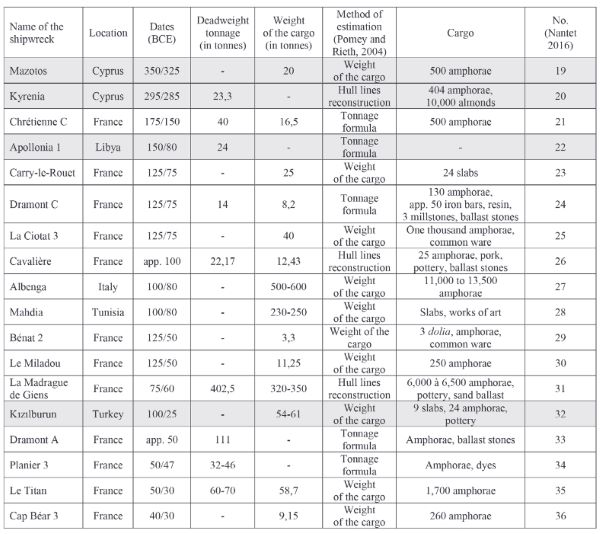
Shipwrecks are our most accurate sources for answering these questions. However, the tonnage of most shipwrecks is often difficult to determine. Only the shipwrecks whose tonnage can be calculated according to the three methods suggested by Patrice Pomey can be compared.2 Currently, we have results from eighteen shipwrecks matching Pomey’s criteria (Table 1). Thus, the evolution of tonnage in this period can be represented on a graph (Fig. 1).
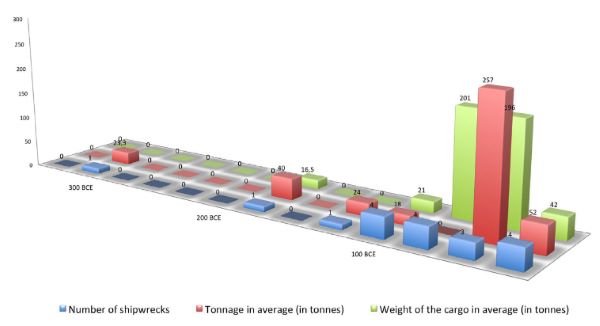
Of course, it is debatable how representative this list is of the historical reality. It does not include some well-known shipwrecks, such as the Antikythera shipwreck,3 but the tonnage of the latter is extremely uncertain.
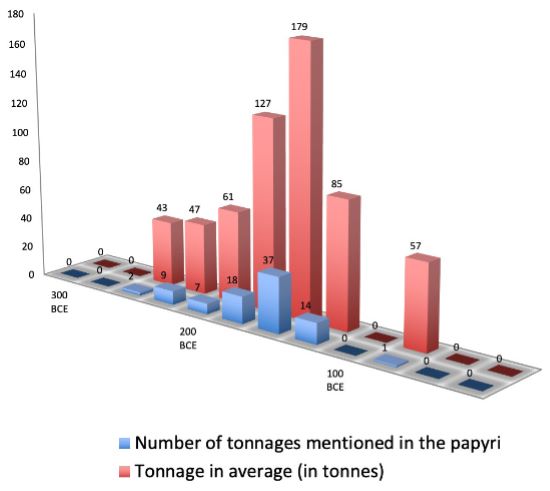
Most of the shipwrecks included in the list are located in the Western Mediterranean. We only know a few Hellenistic shipwrecks in the Eastern Mediterranean whose tonnage can be estimated,4 such as Mazotos,5 Kyrenia,6 Apollonia 1 and Kızılburun.7 Nevertheless, it should be emphasised that some of the most interesting shipwrecks from the Late Republican period that lie in Western waters actually originated from ports in the Aegean Sea, such as the Mahdia shipwreck.8 This archaeological evidence must be compared with evidence from papyri. Indeed, the Ptolemaic administration produced an abundance of documentation in order to manage the grain supply of Alexandria.9 These papyri often mention the tonnages of the ships involved in this enormous task.10 It seems that most of the ships mentioned in the papyri, such as the kerkouroi, studied by Pascal Arnaud, were sailing not only along the Nile, but also in the Mediterranean.11 Papyri have been collected that document the period between the third and the first centuries BCE; they mention eighty-eight different tonnages.12 The evolution of the tonnage can thus be represented on another graph (Fig. 2).
The epigraphical evidence, even though it relies only on a few documents, includes an inscription from Thasos about harbour regulations, first published by Marcel Launey.13 The shape of the letters shows that this stela must have been produced during the third century BCE.
Harbour regulation of Thasos
(Third century BCE)
IG XII, Suppl. 348
Launey 1933, ed.[πλ]οῖον μὴ [ἀ]νέλκειν ἐν τοῖς τῶν ..ρ̣γ̣… τοῦ μὲν π̣ρ̣ώ̣τ̣ου
ἐλά̣[σσω φόρ]-
[τον ἄγον τρ]ισχι[λ]ίων ταλάντων, τοῦ <δὲ> δευτέρο[υ] ἐλάσσω
ἄγο[ν] πεντα[κ]ισ-
χ[ιλίων] τ̣α̣[λάντω]ν.It is forbidden to haul a ship inside the limits, the first ones if the ship has a capacity of less than 3000 talents [about 61 tonnes], the second ones if the ship has a capacity of less than 5000 talents [about 102 tonnes].
This regulation reveals that there were three parts to the harbour of Thasos:14
- one for the ships of lower tonnage, of a capacity less than 3000 talents, or 61 tonnes;
- one for the ships of average tonnage, of a capacity between 3000 and 5000 talents, or 102 tonnes;
- one for the ships of larger tonnage, of a capacity beyond 5000 talents, or 102 tonnes.
The inscription was studied by several scholars.15
These sources provide evidence of the evolution in tonnage, which increased during this period. Nevertheless, it is hard to say whether this was a continuous rise or if it can be broken down into several sequences—although it seems possible to distinguish at least two different episodes.
An Initial Rise in the First Part of the Second Century?
During the Early Hellenistic period, the tonnages mentioned in the papyri seem to be low enough. Only three kerkouroi that were mentioned ranged from 5000 artabae (114 tonnes) to 10,000 artabae (227 tonnes)—most of the tonnages remained at less than 5000 artabae during most of the third century BCE. This is more or less the same as the tonnage of the ships used in Athens to transport grain during the fourth century.16 It corresponds to higher level named in the third-century harbour stela of Thasos (5000 talents, i.e.102 tonnes), which allowed the bigger ships to moor in a deeper basin. Thus, in the third century, the tonnages would have been quite similar to those of the Classical period.
However, it appears that an increase occurred in the first half of the second century BCE, despite the fact that, as Claire Préaux has argued, the economy collapsed in Egypt during this period.17 Nevertheless, the papyri show that the tonnage increased considerably. This rise cannot be observed via the shipwrecks, because shipwrecks were a rarity in the Eastern Mediterranean.
It is more surprising that only a few shipwrecks are known to have occurred in the Western Mediterranean during the first half of the second century, because there were plenty of them during the following centuries. Could the lack of shipwrecks in Western waters during this period mean that shipbuilding might have been delayed in the Eastern area? Could Eastern fleets have included bigger ships than Roman ones? Could there have been a difference in the tonnage of ships between the two parts of the Mediterranean?
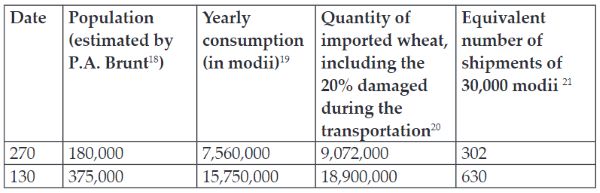
Actually, the lack of shipwrecks in the Western Mediterranean in the first half of the second century should not be exaggerated (Table 2). It seems that the population of Rome reached nearly 200,000 inhabitants in the beginning of the third century, and twice more one-and-a-half centuries later. These rough estimations should be considered very cautiously—but no doubt the grain supply required by such a population came to several hundred shipments per year.
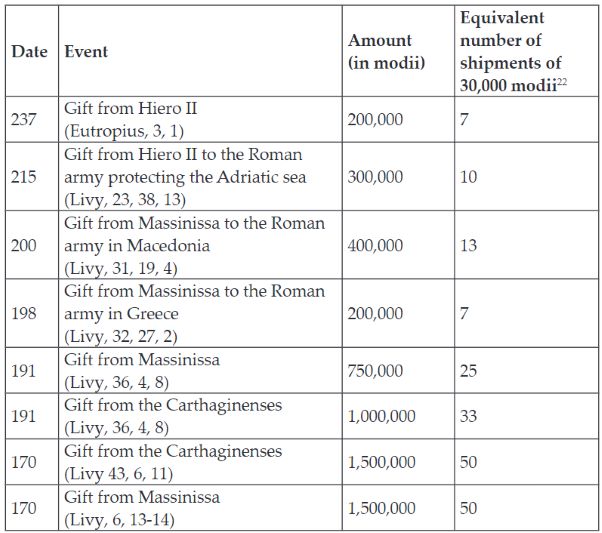
The importance of the grain supply is confirmed by the many gifts offered to the Romans by the Hellenistic kings of the Western Mediterranean, such as HieroII and Massinissa (Table 3). These gifts must also have required a high number of large ships. Thus, the evidence shows that the increase in tonnage was not restricted to the Eastern Mediterranean. Many large ships were sailing on the Western waters too. Thus, there was an overall growth in tonnage throughout the Mediterranean.
That initial overall rise indicates the importation of wheat and stone above all. An enormous volume of wheat would have been shipped in order to supply the cities, like Rome or Alexandria, which were becoming bigger and more populous. Stone, like wheat, also required big ships. During the Hellenistic era, cities built porticoes and fortifications, which both demanded large amounts of stone. Both wheat and stone were shipped in huge quantities.
As in former centuries, wine was still a very sought-after commodity. But cargoes of wine were usually very small, no more than a few dozen tonnes. Other kinds of merchandise, such as copper, oil, and even wool, were also shipped in limited quantities and were therefore not conveyed in large vessels.
Thus, these big ships were built essentially to carry grain and stone, heavy goods whose value was lower than wine. That first rise in tonnage was not caused by a desire to make money. Instead, it was connected to efforts to gain more prestige, as well as to political and military issues. It should be noted that this growth only happened when the three main Hellenistic kingdoms declined, and before Roman rule.
A Second Rise from the End of the Second Century to the Beginning of the First Century?
A second increase occurred from the end of the second century to the beginning of the first century BCE, and this rise was confined to the Western Mediterranean. Indeed, the Albenga (500–600 tonnes),23 the Madrague de Giens (402.5 tonnes)24 and Mahdia (230–250 tonnes)25 shipwrecks are all large ships. Their tonnages were far beyond those of former centuries, and they were evidently owned by the biggest merchantmen of their age.26
However, we lack papyrological evidence for this period.27 It would be tempting to conclude that tonnage dropped suddenly in Egypt during the first century. But the lack of papyri does not mean that there were no longer any ships on the Nile. It is possible that no papyri originating in this period were found because of the timing of the discoveries. However, it is notable that the vast majority of the edited papyri date from the Late Hellenistic or the Roman era. So how could the lack of papyri from the first century BCE be explained? The transportation of the wheat may have been organized differently during this time, although the only papyrus from this period in our list, the SB 5 8754, does not seem to show this. It could also be that this lack of papyri might have been the result of a change in the Ptolemaic administration, which managed the grain supply. The Ptolemaic authorities might have systematically ceased producing these documents for some unknown reason. So far, we have only conjecture, and no definite answers have been established.
Nevertheless, it should be noted that absolutely no sources in the Eastern Mediterranean show an increase in tonnage, whether they be literary, epigraphical, or even archaeological. The Doric capital and the eight column drums of the Kızılburun shipwreck did not weigh much more than 50 tonnes.28 However, this does not necessarily mean that there were no large ships sailing in the Eastern Mediterranean. It seems that the biggest ships sailed on only a few key routes, such as that from Greece to the Western Mediterranean, in order to convey works of art (including marble stones). For instance, the cargoes of the Mahdia or Antikythera shipwrecks were among the biggest of that period.
The other main route was from Italy to Gaule in order to sell wine. Strabo tells us that a slave could be bought only for an amphora.29 Many ships subsequently wrecked, especially the Madrague de Giens, were involved in that trade. In fact, even the smallest ships carried wine. The vessel that sank off CapBénat carried no more than three pithoi, i.e. 3.3 tonnes,30 but the wine trade in that area was so successful that Roman merchants used large vessels, called dolia, to carry larger containers than amphorae.31
Although the data are patchy, there might have been more of these routes. For instance, the hulls found in Caesarea32 and Antirhodos33 almost certainly belonged to medium-sized or, perhaps, even large ships. They can likely be dated to the first century CE. However, we cannot totally rule out the possibility that both of these shipwrecks were from earlier or later. No definite date can be asserted as long as no dendrochronological analysis has been published.
Contrary to the first rise in tonnage that we have considered in this chapter, the second increase did not concern only the transportation of cargoes such as grain or stone, but also wine or works of art, whose value was much higher. This increase was made possible by the considerable wealth of the Roman elites (and maybe some vassal princes of Rome)—the routes related to this second rise were all connected to the city. Such evidence reveals the significant changes to maritime trade caused by Roman rule.
The Common Reasons for the Two Increases
Thus these two changes were caused by different factors, but both originally had the same roots. Above all, new techniques allowed the construction of bigger ships,34 even giant ones, such as the Syracusia.35 Nonetheless, one of the major obstacles to the increase in tonnage was the lack of deep harbours. The Syracusia, which could load up to 2580 or 2706 tonnes,36 could not enter many harbours because her draft was too large. Thus, she was useless in this capacity and Hiero II gave her to Ptolemy III. This demonstrates how restrictive the harbour depth could be for boats like these.
The authorities undertook to dredge their harbours in order to make them as deep as they could. During the digging of the tube station Piazza Municipio in Naples, an excavation led to the discovery of an ancient harbour, which included several shipwrecks, including Napoli A, Band C. But there were some strange marks on the bottom, as if the harbour base had been scratched. These marks were made by a dredger between the fourth and second centuries BCE.37
It was not easy for the authorities to reserve the deepest parts of the harbour for the bigger ships. The regulations in Thasos reveal that the many small ships were cluttering the harbour and that they were docked in the deepest areas, which were the only places the bigger ships could dock. Actually, the first harbour regulations seem to be linked to the need to preserve the depth of the harbour for the bigger ships.
The technical developments of both ship and harbour technologies allowed the increase in tonnage. They made the growth possible. But the root of the increase is located in the development of cities in the Hellenistic world. Those cities became more populated, and more people meant more producers, more consumers, and more trade. This trade required more ships to supply these cities with wheat and stone. Not only did the population grow, but grain and stone had to be transported across longer distances. Trade was no longer limited to the Aegean Sea or to any other part of the Eastern Mediterranean. From then on, certain ships sailed through many seas in the whole Eastern Mediterranean, and sometimes beyond, as shown by the Mahdia and Antikythera shipwrecks. In other words, the organization of trade on a much larger scale than before led to the rise in tonnage.
Conclusion
There was a notable increase in tonnage throughout the Mediterranean over a period of several centuries. At the beginning of the Late Hellenistic period, that increase occurred across the entire Mediterranean. From the end of the second century to the first century BCE, there was a second rise, which was restricted to specific parts of the Mediterranean.
The situation changed in the Imperial period. Even though it seems that large ships may have continued to carry large amounts of wine over the seas during the first century CE, they may have been less numerous in the following centuries. On the contrary, wheat and stone cargoes were conveyed by ships that became larger and larger. Indeed, the supply of grain to Rome became a major issue for the emperors who wished to watch over the situation in the streets of the capital city. Moreover, they wanted to provide Rome with the most impressive monuments and therefore required large quantities of marble.
Appendix
Endnotes
- Nantet 2016.
- Pomey and Rieth 2004; Nantet 2016, 2017.
- Weinberg et al. 1965; Christopoulou et al. 2012; Kaltsás et al. 2012.
- The next four shipwrecks are briefly presented in Nantet 2016, n°19, 20, 22 and 32.
- Demesticha 2011.
- Steffy 1985.
- Carlson and Aylward 2010.
- Hellenkemper Salies 1994.
- Thompson 1983.
- Hauben 1971, 1978, 1997; Meyer-Termeer 1978; Nantet 2016, 574–84.
- Arnaud 2015.
- For a full list of the papyri used for this study, see Nantet 2016, 575–79.
- Launey 1933.
- It is assumed here that a talent weighed 20.46 kg, see Nantet 2016, 573, note 29. Note that the level of 3000 talents has been debated because it is not legible. But it seems to be the most relevant suggestion.
- Casson 1971; Houston 1988.
- About these ships, which were carrying 3000 medimnoi (about 90–117 tonnes), see the honorific decrees studied by Lionel Casson: Casson 1956–1957; 1971, 183–84. For a discussion about these inscriptions, see Nantet 2016, 116–17.
- Préaux 1939, 137.
- Brunt 1971, 69.
- A.Tchernia considers an annual consumption of 42 modii, i.e., 286kg, for one person. Tchernia 2000.
- Tchernia 2000.
- The amount of 30,000 modii (204 tonnes) has been chosen, because it is very close to the amount of 10,000 artabae (227 tonnes), which was probably the common tonnage during this period.
- See Table 2, note 21.
- The cargo has been estimated at between 11,000 and 13,500 amphorae, i.e. 500–600 tonnes, by Pomey and Tchernia 1978.
- Tchernia et al. 1978; Pomey 1982.
- Hellenkemper Salies 1994.
- Pomey and Tchernia 1978.
- Hauben’s most recent list, which is not focused on ships but on owners, shows the same lack of papyri for the first century.
- Carslon 2010.
- Diodorus Siculus, 5.26.3.
- Joncheray 1997.
- Marlier 2008; Heslin 2011.
- Fitzgerald 1994, 1995.
- Sandrin et al., 2011.
- See the contribution by Pomey.
- Athenaeus, 5.206d–209b.
- For more information about the estimation of her tonnage, see Nantet 2016, 126–31; Nantet forthcoming.
- Giampaola et al. 2004, 2005. For more information about harbour maintenance, see Nantet 2016, 223–28.
Bibliography – Primary Sources
- Bird,H. W., ed. 1993. Eutropius: The Breviarum ab urbe condita of Eutropius: The Right Honourable Secretary of State for General Petitions, Dedicated to Lord Valens, Gothicus Maximus & Perpetual Emperor. Liverpool: Liverpool University Press.
- Gulick, C. B., ed. 1957. Athenaeus. The Deipnosophists. Cambridge, MA: Loeb Classical Library.Moore, F. G., ed. 1951. Livy. History of Rome. Cambridge, MA: Loeb Classical Library.
- Oldfather, C. H., ed. 1962. Diodorus of Sicily. Cambridge, MA: Loeb Classical Library.
Bibliography – Secondary Sources
- Arnaud P. 2015. ‘La batellerie de fret nilotique d’après la documentation papyrologique (300 avant J.-C.–400 après J.-C.).’ In La Batellerie égyptienne, Archéologie, histoire, ethnographie, edited by P. Pomey, 99–150. Études Alexandrines 34. Alexandrie: Centre d’Études Alexandrines.
- Carlson, D. N. and W. Aylward. 2010. ‘The Kızılburun Shipwreck and the Temple of Apollo at Claros.’ American Journal of Archaeology 114:145–59. https://doi.org/10.3764/aja.114.1.145.
- Casson, L. 1956. ‘The Size of Ancient Merchant Ships.’ In Studi Aristide Calderini e Roberto Paribeni, vol.1. Milan: Ceschina, 231–38.
- Casson, L. 1971. Ships and Seamanship in the Ancient World. 2nd ed. Ann Arbor, MI: Princeton University Press.
- Christopoulou, A., A. Gaolou, and P. Bougia, eds. 2012. The Antikythera Shipwreck: The Technology of the Ship, the Cargo, the Mechanism. Athens: National Archaeological Museum.
- Demesticha, S. 2011. ‘The 4th-Century-BC Mazotos Shipwreck, Cyprus.’ IJNA 40:39–59. https://doi.org/10.1111/j.1095-9270.2010.00269.x.
- Fitzgerald, M. A. 1994. ‘ChapterVI: The Ship.’ In The Harbours of Caesarea Maritima. Results of the Caesarea Ancient Harbour Excavation Project (1980–85) vol. 2, edited by J. P. Oleson, 163–223. Oxford, Bar International Series 594.
- Fitzgerald, M. A. 1995. ‘A Roman Wreck at Caesarea Maritima, Israel: A Comparative Study of its Hull and Equipment.’ PhD diss., Texas A&M University.
- Garnsey, P. 2009 [1988]. Famine and Food Supply in the Graeco-Roman World: Responses to Risk and Crisis. Cambridge: Cambridge University Press.
- Giampaola, D., V. Carsana, and G. Boetto. 2004. ‘Il mare torna a bagnare Neapolis. Parte II: dalla scoperta del porto al recupero dei relitti.’ L’Archeologo Subacqueo 10: 3:15–19.
- Giampaola,D., and V.Carsana. 2005. ‘Neapolis. Le nuove scoperte: la città, il porto e le macchine.’ In Eureka! il genio degli antichi, catalogo della mostra, Museo Archeologico Nazionale di Napoli, 11 luglio 2005–9 gennaio 2006, edited by E.LoSardo, 116–22. Naples: Electa Napoli.
- Hauben, H. 1978. ‘Nouvelles remarques sur les nauclères d’Egypte à l’époque des Lagides.’ Zeitschrift für Papyrologie und Epigraphik 28:99–107.
- Hauben, H. 1997. ‘Liste des propriétaires de navires privés engagés dans le transport de blé d’état à l’époque ptolémaïque.’ Archiv für Papyrusforschung und verwandte Gebiete 43:31–68.
- Hellenkemper Salies, G., ed. 1994. Das Wrack: der antike Schiffsfund von Mahdia. 2 vols. Cologne: Rheinland-Verl.
- Heslin, K. 2011. ‘Dolia Shipwrecks and the Roman Wine Trade.’ In Maritime Archaeology and Ancient Trade in the Mediterranean, edited by D. Robinson and A. Wilson, 157–68. Oxford Centre for Maritime Archaeology monograph 6. Oxford: Oxford Centre for Maritime Archaeology, Institute of Archaeology.
- Houston, G. W. 1988. ‘Ports in Perspective: Some Comparative Materials on Roman Merchant Ships and Ports.’ American Journal of Archaeology 92:553–64.
- Joncheray, J.-P. 1997. ‘Bénat 2, une épave à dolia du Ier s.av. J.-C.’ CAS 13:97–119.
- Kaltsás, N. E., E. Vlachogianni, and P. Bougia, ed. 2012. The Antikythera Shipwreck: the Ship, the Treasures, the Mechanism: National Archaeological Museum, April 2012–April 2013. Athens: Kapon Editions.
- Launey, M. 1933. ‘Inscriptions de Thasos.’ Bulletin de correspondance hellénique 57:394–415.
- Marlier, S. 2008. ‘Architecture et espace de navigation des navires à dolia’. Archaeonautica 15:153–73. https://doi.org/10.3406/nauti.2008.920.
- Meyer-Termeer, A. J. M. 1978. Die Haftung der Schiffer im griechischen und römischen Recht. Zutphen: Terra.
- Nantet, E. 2016. Phortia. Le tonnage des navires de commerce en Méditerranée du VIIIe siècle av.l’è.chr. au VIIe siècle de l’è.chr. Rennes: Presses Universitaires de Rennes.
- Nantet, E. 2017. ‘The accuracy of the tonnage formula, and the correcting coefficient.’ In Baltic and Beyond: Change and Continuity in Shipbuilding: Proceedings of the Fourteenth International Symposium on Boat and Ship Archaeology (Gdansk 2015: ISBSA, 14), edited by J. Litwin and W. Ossowski, 165–170. Gdańsk: National Maritime Museum. http://opac.regesta-imperii.de/id/2427830.
- Nantet, E.. ‘The Tonnage of the Syracusia: a metrological reconsideration.’ In ‘Under the Mediterranean’: The Honor Frost Foundation Conference on Mediterranean Maritime Archaeology (20th – 23rd October 2017), Short Report Series.
- Pomey, P. 1982. ‘Le navire romain de La Madrague de Giens.’ Comptes rendus des séances de l’Académie des inscriptions et belles-lettres (Paris) 126 (1):133–55.
- Pomey, P. and É. Rieth. 2005. L’Archéologie navale. Paris: Errance.
- Pomey, P. and A. Tchernia. 1978. ‘Le tonnage maximum des navires de commerce romains.’ Archaeonautica 2:233–251.
- Sandrin, P., A.Belov, and D.Fabre. 2013. ‘The Roman Shipwreck of Antirhodos Island in the Portus Magnus of Alexandria, Egypt.’ IJNA 42:44–59. https://doi.org/10.1111/j.1095-9270.2012.00363.x.
- Steffy, J. R. 1985. ‘The Kyrenia Ship: An Interim Report on its Hull Construction.’ American Journal of Archaeology 89:71–101.
- Tchernia, A., P. Pomey, and A. Hesnard. 1978. ‘L’épave romaine de la Madrague de Giens (Var).’ Gallia Suppl. 34. Paris: Éditions du Centre National de la Recherche Scientifique.
- Tchernia, A. 2000. ‘Subsistances à Rome: problèmes de quantification.’ In Mégapoles méditerranéennes: géographie urbaine rétrospective: actes du colloque, Rome, 8–11 mai 1996, edited by C. Nicolet, 751–60. Paris: Maisonneuve et Larose.
- Thompson, D. J. 1983. ‘Nile Grain Transport Under the Ptolemies.’ In Trade in the Ancient Economy, edited by P. Garnsey, K. Hopkins, and C. R. Whittaker, 64–75. London: Chatto and Windus.
- Weinberg, G. D., V. R. Grace, G. R. Edwards, and H. S. Robinson. 1965. The Antikythera Shipwreck Reconsidered. Philadelphia: American Philosophical Society.
Chapter 5 (75-89) from Sailing from Polis to Empire: Ships in the Eastern Mediterranean during the Hellenistic Period, edited by Emmanuel Nantet (Open Book Publishers, 08.05.2020), published by OAPEN under the terms of a Creative Commons Attribution 4.0 International license.
About the Author