Artists, writers, and cultural workers.

By Julia Luz Betancourt
Independent Writer and Journalist
Introduction
Nasreen Abd Elal vividly remembers a time when the Palestinian struggle against the state of Israel was not widely recognized as resistance to settler colonialism and genocide. Now a graphic designer, Elal first became active in the movement as a Columbia University student in 2016. “The language the student movement uses has shifted tremendously [since then],” she says. “As Palestinians within the movement, we have understood and had this analysis for decades. It seemed so far off that people would accept this framework.”
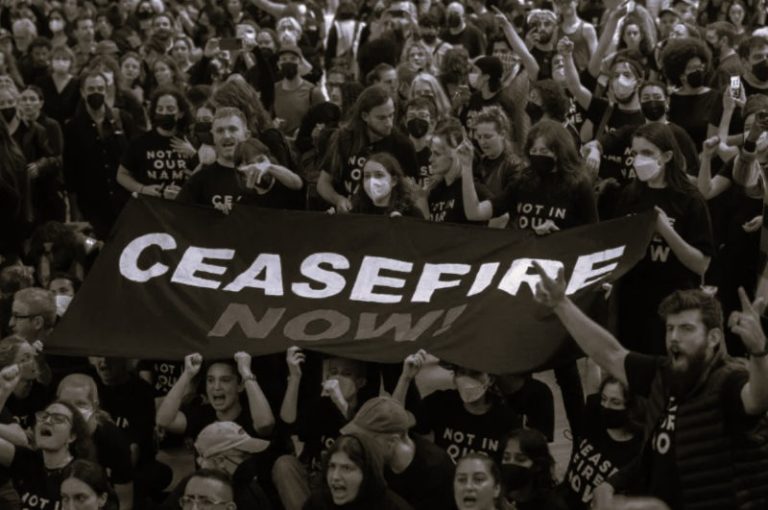
Now, more than one year since the world started watching the genocide in Gaza—a reality Palestinian journalists have been trying to broadcast for generations—the general public is finally sharing in the Palestinian resistance. People around the globe have blocked highways, chained themselves to weapons carriers, rallied despite violent assaults by police, and orchestrated legal campaigns to call for the liberation of Palestine. “Israel can no longer coast on this idea of being this beacon of democracy in the Middle East,” Elal says. “People understand intuitively [that] this is a colonial situation.”
But as solidarity with Palestinians grows, so too does repression. In the United States, lawmakers have tried charging protesters with domestic terrorism, while university administrators have made “Zionist” a protected class, fired professors who’ve advocated for Palestine, and banned protest encampments. Mainstream media outlets publish inaccuracies dehumanizing Palestinians, while politicians maintain the claim that Israel has a “right to exist” and “defend itself.”
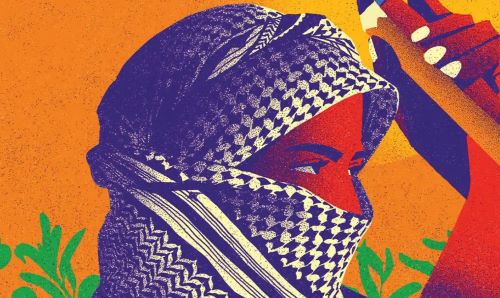
Yet as those in power continue to attempt to crush the Free Palestine Movement, artists, writers, and other cultural workers are using creative practices to resist. They’ve organized to fight censorship, exposed the propagandist nature of mainstream media, and asserted Palestinians’ rights to their land and lives. They’ve refused to accept genocide and colonialism as normal. “That, I think, is actually what preserves your humanity and your sanity,” Elal says. “The fate of Palestinians is bound up in your own, whether you like it or not.”
Narrative Resistance
Since Israel’s inception 76 years ago, government and media institutions have continuously worked to control the public’s collective memory of Palestine. In 1969, Israel’s prime minister denied that Palestinians existed before their land was violently colonized. After Hamas carried out Operation Al-Aqsa Flood in October 2023, tearing down walls that helped make Gaza an open-air prison, media outlets described the attack as “unprovoked.” When Israel’s defense minister announced its food and water blockade on Gaza days later, he called it a fight against “human animals,” further dehumanizing Palestinians and their resistance against occupation.
“Narratives are used to justify systems of domination,” Elal says. “Palestinians want liberation, freedom, the right to live in their homes and return to their homes, just like any other people. It requires this enormous apparatus of narrative to dehumanize and delegitimize Palestinian claims to the right of return, sovereignty, living free from violence, on a land where they aren’t second-class citizens subjected to genocide.”
But now that Israel has killed more than 42,000 Palestinians, according to the Gaza Health Ministry (scholars estimate total deaths to be in the hundreds of thousands—attempts to rationalize the Israeli government’s murderous impulse are proving ineffective. Polls across the West show that an increasing number of people disapprove of their governments sending weapons to Israel, and young people in the U.S. are more likely to sympathize with Palestinians than older generations are. “This didn’t start last October,” says Elal. “The roots of what we’re seeing now with this genocide are structural, historical, and political.”
Since 2021, Elal has worked as the information designer for Visualizing Palestine, an organization founded in 2012 that uses data imagery to communicate the experiences of Palestinians and disrupt colonial narratives. The organization’s infographics, interactive visuals, and posters have been circulated all over the world, published by major media outlets, posted on subway billboards, and translated into multiple languages.
“We see our role in the movement in terms of how we can intervene in narrative and media discourse around Palestine,” says Elal. “Especially since the start of the genocide, we’ve seen how rampant this dehumanization is, how distorted the Palestinian narrative is, how there’s not a lot of grappling with the deep history of the legacy of colonialism in Palestine.”
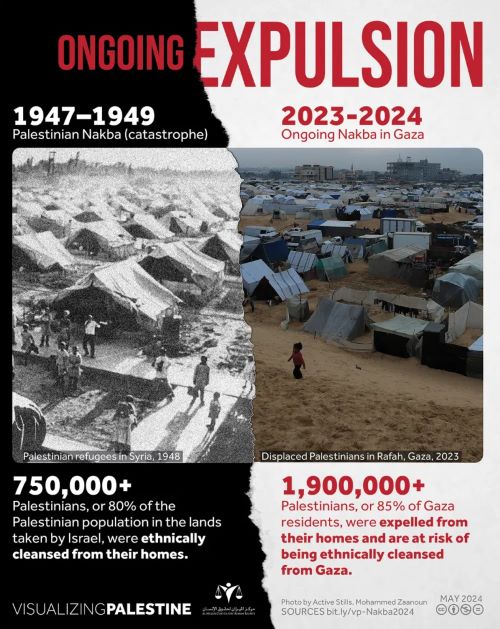
Visualizing Palestine works with partner organizations, including some in Palestine, to turn research reports into accessible visual resources. For instance, its “Ongoing Expulsion” infographic presents side-by-side images from the 1948 Nakba and the current genocide in Gaza to show how the latter is an extension of the previous catastrophe. Another project called “Stop Killer AI” demonstrates how Israel uses artificial intelligence programs to surveil and kill Palestinians.
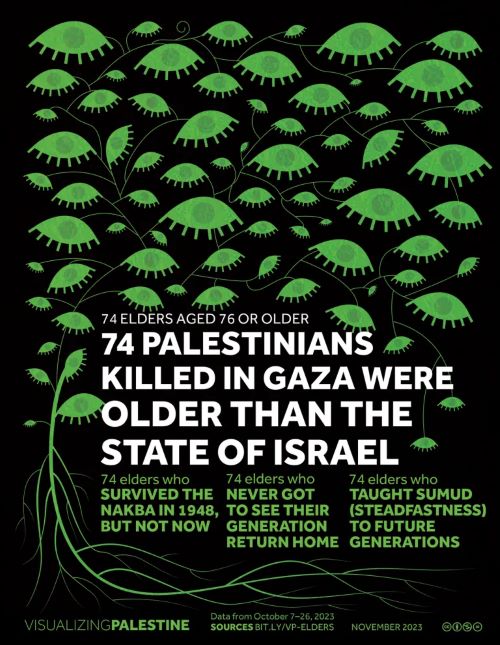
Other visuals aim to expand the documentation of Israel’s brutality beyond statistics, including its impact on those who survive. “Four Wars Old” takes the form of a child development chart that illustrates how children born in Gaza in 2007 have lived through four wars before turning 18, suffering compounded trauma. “74 Elders” memorializes Palestinians who survived the 1948 Nakba to later be killed by Israel in 2023. “These people are older than the state that is killing them,” Elal explains. “[Palestinians] aren’t numbers. Each one of these people who has been killed [is] an entire world.”
The collective’s new book, Visualizing Palestine: A Chronicle of Colonialism and the Struggle for Liberation, spotlights more than 200 visuals created in the past decade, alongside essays on humanizing data and provoking narrative change. Elal believes putting this resource in people’s hands can help organizers, advocates, and educators “build the kind of people power we need.”
The Role of the Artist
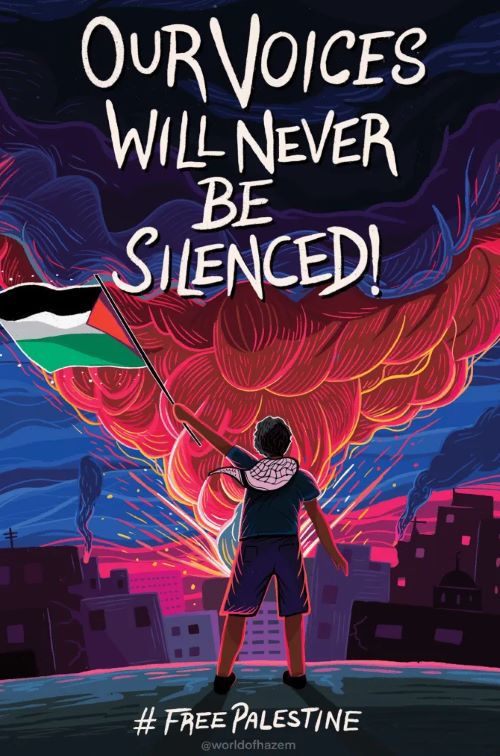
When Israel began bombing Gaza in October 2023, Hannah Priscilla Craig was among the group of artists who decided to launch Artists Against Apartheid, a movement using art and culture as “tools of liberation in the struggle for sovereignty, dignity, and self-determination.” They released a solidarity statement, which received more than 8,000 signatures in the first few days. Soon after, Artists Against Apartheid transformed into a network that encourages artists to embed themselves in organizing and activism. “It’s not just we as individuals [who] are dedicating ourselves to Palestine,” Craig explains. “It’s actually a recognition of the practice of the artwork as part of the overall strategy toward liberation.”
Craig, who serves as the director of arts, culture, and communications for the People’s Forum—the community space in New York City where Artists Against Apartheid originated—sees how integral cultural production is to raising awareness about the plight of Palestinians. “People are consuming culture almost every moment of every day … whether we consciously realize it or not,” she says. “It’s important for us, on the side of justice [and] liberation, to take up that tool—and take it more seriously than our enemies.”
Artists Against Apartheid offers six toolkits to help artists create banner drops, public art installations, film screenings, street theater, and more to bring the Palestinian liberation movement into their communities. Artists have performed the Gaza Monologues (theatrical testimonies written by Palestinian youth), created protest puppets of President Joe Biden and Israeli Prime Minister Benjamin Netanyahu for the annual March on Washington, and developed more than 6,000 poster designs. Craig says the posters have been pasted around Barcelona, Spain; exhibited in galleries in Arizona; and made into stickers circulated throughout the U.S.
Artists Against Apartheid draws inspiration from the Medu Art Ensemble, a group of cultural workers who organized against apartheid in South Africa in the 1970s and later inspired an international boycott that helped undo apartheid policies. Craig also highlights the John Reed Clubs, which were first formed in 1929 by artists, writers, and journalists to advocate for better working conditions during the Great Depression.
“Those histories are often ignored, forgotten, and left out of the history books because they are so dangerous to the ruling class,” Craig says. Artists Against Apartheid works to “reinvigorate and bring back to the forefront the way that artists and cultural workers are part of political [and liberation] movements.”
The number of signatories on Artists Against Apartheid’s statement has nearly doubled in the year since it was released, with prominent musicians including Kehlani, Macklemore, and Noname signing on and using their art to raise money for Palestinian organizations. “Musicians are ready to take on the charge and the task of speaking clearly and with conviction about the need to take seriously the political situation in the world,” Craig says. “It’s really showing that these cultural spaces, these social spaces, are also spaces of political struggle.”
Ultimately, Artists Against Apartheid calls on artists of all media to use creative intervention as a strategy for mobilization. “The reality is that struggle happens everywhere,” she explains. “We have to fight back in all of the spaces that are available to us.”
Do Not Consent
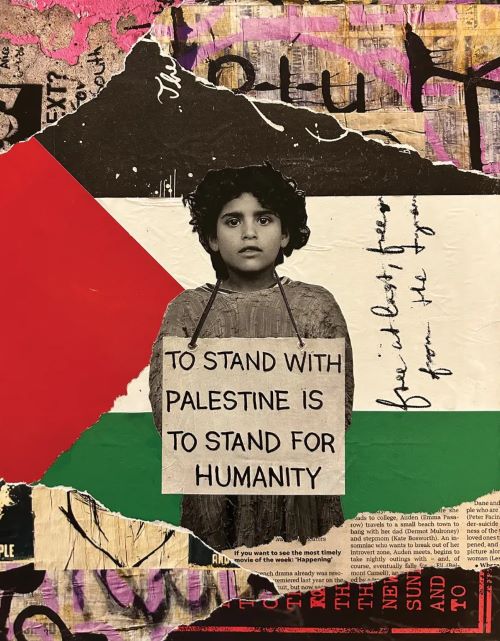
While artists continue to envision an end to the U.S.-backed genocide, Writers Against the War on Gaza (WAWOG) are disrupting the media apparatus that defends it. After releasing an open letter in October 2023, the coalition of media, cultural, and academic workers has engaged in a series of actions to call out national media outlets over their coverage of Israel and Palestine, including The New York Times.
“[The Times] is considered the paper of record in the U.S. [and] in the West,” says Nour, a writer and member of WAWOG. (Nour requested to be identified by first name only and emphasized that the coalition acts as a collective.) But The Times has been “manufacturing consent for a genocide.”
Some writers resigned from their positions at The Times after it cracked down on its own journalists for publicly supporting Palestine. Others, including Nour, occupied the lobby of the outlet’s New York headquarters in November 2023 to protest its coverage, carrying agitprop newspapers titled The New York War Crimes. “The Times is equivalent to an arms manufacturer, but in the cultural space,” says Naib, a journalist and writer who is also part of WAWOG and has asked to be identified by first name only out of concern for retaliation. The paper represents, in theory, “both objectivity [and] the high-minded, liberal elite of America.”
Following the protest, the coalition evolved the agitprop into a digital and print movement newspaper, debunking the false notion of objectivity and critiquing and analyzing The Times’ coverage of Israel. In the article “There’s a Word for That,” the paper provides a style guide demonstrating how The Times’ word choice, syntax, and passive voice push the narrative that Israel is fighting a “just war.” Another New York War Crimes article revealed that The Times quoted Israeli and American sources following Oct. 7, 2023, more than three times as often as Palestinian sources, and U.S. officials more than all of its Palestinian sources combined. The New York Times did not respond to a request for comment.
Naib says mainstream reporters use other rhetorical tools to “create empathy amongst American audiences for Israel and not for Palestine.” For example, when a story describes occupational violence against Palestinians, it doesn’t specify that it was done by Israel or the Israeli military. “It’s ‘a strike killed Palestinians,’ not ‘an Israeli strike,’” he explains, referencing coverage of the ongoing air strikes. “In almost all media, any discussion of Palestine will always come with, ‘These events started on October 7.’ … We always have to acknowledge what happened on October 7, [but never what happened] before October 7.”
WAWOG is also committed to shining a light on the humanity of Palestinians. Through more than a dozen issues of The New York War Crimes, the coalition has published the words of Palestinian writers and organizations; spotlighted Black, Kashmiri, and queer solidarity; and uplifted the voices of those participating in the student intifada (uprising). They’ve also inspired the birth of similar publications such as The Harvard Crimeson.
The coalition also encourages audiences to collectively hold establishment media accountable. “We think so much about what is happening in the writing itself, but being an observer, a reader, [or] in the audience is not a passive activity,” Naib says. “You are actively legitimizing the organization by consuming what they’re producing.”
Nour adds that audiences can “refuse to be part of the New York Times narrative” by boycotting publications complicit in their coverage of Palestine, while motivating media workers to organize within their workplaces. “If we refuse to write the way they want us to write, we can actually do something,” she says.
The network’s plan to build a “cultural front for a free Palestine” also includes a course syllabus that covers organizing history in both Palestine and the U.S., touching on the Black Panther Party as well as movements formed during the Vietnam War and the AIDS crisis. “Culture is oftentimes the strongest tool in maintaining the status quo,” Naib says. “Our role as cultural workers isn’t only to produce culture; it’s to take action.”
A Dance for Palestine
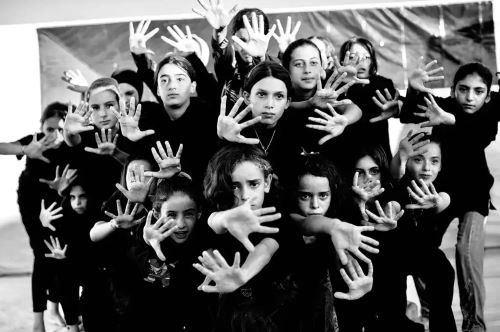
“It is the right of children in Gaza to be joyful,” says Bashar Al-Bilbisi, a 24-year-old Palestinian dancer, theater artist, pharmacist, and head of the Al-Fursan Arts Ensemble. Since 2016, the troupe of young people has performed and trained others throughout Gaza in dabke, a traditional and Indigenous Palestinian dance.
When Al-Fursan first launched, Al-Bilbisi used dance to address issues such as COVID-19, gender-based violence, and youth emigration. The group performed at the Palestine International Festival and toured around France. Their performances even contributed to the registering of dabke as “intangible heritage” to be protected under UNESCO guidelines.
But everything changed when Israel began relentlessly bombing Gaza and destroying theaters and cultural spaces. Now, Al-Bilbisi and his fellow dancers mainly teach dabke to children in displacement camps across the region. “We face lots of trauma, lots of wars, and we need a tool such as dance to get that out,” says Al-Bilbisi, whose responses have been translated from Arabic to English.
Sometimes that means encouraging children to “forget about the external world and to enjoy themselves” during training. Other times, it’s leaving space for them to grieve. During one exercise, a young girl suddenly began to cry. Her two brothers had been taken by Israeli forces, and she no longer knew where they were or if they were alive. “I left her alone to cry as much as she wanted,” Al-Bilbisi says. Afterward, she began talking more openly about her brothers’ capture and became more involved with the group. “That’s why I would work on the training of dabke. It helps them express themselves,” he adds. “It’s not just about movement or choreography; it’s what’s beyond the performance.”
Al-Fursan trainers are located throughout the Gaza Strip, including in heated war zones where, Al-Bilbisi says, “the only thing between them and death is a coincidence.” Two trainers were bombed by Israel at the Church of Saint Porphyrius; another in North Gaza trained children whose parents were killed in yet another Israeli bombing, Al-Bilbisi says. “Whenever we go to train children, there is always somebody targeted and killed as we go.”
At the time of this writing, Al-Bilbisi is based in a supposed safe zone. He plans to continue the work, saying, “The risks are enormous … but we believe in a mission and a vision, and we would like to fulfill it.”
Though the genocide has yet to end, he is firm in the role the ensemble will play in rebuilding Gaza and all of Palestine. “If houses are demolished, they can be rebuilt,” he says. “What’s more difficult is to rebuild people psychologically and to rebuild humanity.”
That’s why the ensemble also works to deepen the world’s understanding and awareness of what it’s like to be a Palestinian in Gaza. In 2023 the group released Trying to Survive, an award-winning film directed by Al-Bilbisi that focuses on how artists’ lives changed throughout the last year of occupation. It has been shown at film festivals across the world. “The message—as a group, as an ensemble, as trainers, as artists, as children whom we work with, and as a community in Gaza—is that we would like war to stop and that we love life,” Al-Bilbisi says.
Underneath it all, he believes it is his duty to create not only artists, but human beings who belong to their land. “When we are in one line, holding each other’s hands, it gives the sense of solidarity, that we are all together,” he continues. “It also shows how rooted we are, touching the land or the floor. We’re there, strongly. We’re there.”
Originally published by Yes! Magazine, 11.18.2024, under a Creative Commons Attribution-NonCommercial-NoDerivatives 4.0 International license.
About the Author