Exploring caves of the Italian Renaissance and their reception abroad.

By Dr. Laura Tradii
Research Officer
Department of Anthropology
The London School of Economics and Political Science
This article, Petrified Waters: The Artificial Grottoes of the Renaissance and Beyond, was originally published in The Public Domain Review under a Creative Commons Attribution-ShareAlike 3.0. If you wish to reuse it please see: https://publicdomainreview.org/legal/
Idling alongside the waters of artificial grottoes, visitors found themselves in lush, otherworldly settings, where art and nature, pleasure and peril, and humans and nymphs could, for a time, coexist. Laura Tradii spelunks through the handmade caves of the Italian Renaissance and their reception abroad, illuminating how these curious spaces transformed across the centuries.
For centuries after their appearance in Renaissance Italy, artificial caves were staples of garden architecture across Europe, and the subject of much fascination. Far from being mere kitsch divertissements, or uninventive copies of natural caves, grottoes existed at the crossroads of multiple traditions. Classical mythology, Arcadian idylls, occult speculation, and an interest in cultural curiosities coexisted in the grotto, allowing for the playful exploration of a new tension emerging between Nature and Artifice. Understanding the grotto’s popularity in Italy and beyond requires unpicking the wondrous universe that was conjured by these complex garden features. Their symbolic vocabulary evolved over the centuries, from a Renaissance model of the cosmos, where the mutable shapes of grottoes offered a chaotic counterpoint to the formal grace of gardens, toward a Romantic staging of the Sublime, accessed through increasingly naturalistic replicas of caves.
Historical and archaeological evidence suggests that, in ancient Greece, caves dedicated to deities and divinities were decorated with inscriptions and statues.1 Greek mythology frequently figures natural grottoes as the abodes of nymphs and other (sometimes dangerous) beings. In the Odyssey, for example, both the cyclops Polyphemus and the nymph Calypso inhabit caves that imprison Odysseus — the former by force, the latter with enchantment — while Homer’s description of the naiads’ lair on Ithaca led Porphyry, the third-century Tyrian philosopher, to declare with awe how “in the most remote periods of antiquity, [caves] were consecrated to the Gods”.2 Replicas of such places, later referred to as nymphaea (singular: nymphaeum), became part of the urban infrastructure in ancient Rome, where they served as monumental exedras housing public fountains.3 Through both their sacred and mundane forms, artificial grottoes provided “a means to create and manipulate the most precious element — water — to regulate and recycle it, to worship and display it”, writes Naomi Miller.4 The symbolic association between divine nymphs, caves, and aqueous bodies was reprised in the Renaissance, when garden grottoes, usually supplied with running water, were coveted among the wealthy families of Europe. The frenzy began in Italy, where aristocrats, merchants, popes, and cardinals started to incorporate grottoes into their gardens and palaces.


In his monumental 1615 treatise L’Idea della Architettura Universale (The Idea of a Universal Architecture), architect Vincenzo Scamozzi described fountains in what he called “grotto porticos” (Grotti Portici), which could be found “below and above the ground”, and were decorated with “pebbles [and] tuff and other materials petrified in various shapes of nature. . . and then decorated here and there with niches, with statues of stone and sometime of metal”.5 Elsewhere he points to a “cryptoporticus underground” at Tivoli’s Villa D’Este, with “various fountains which murmur loudly”. He instructs that “grotto-porticos, so called because of their resemblance with caves [grotte], shall be in fresh and shaded places”.6 They should not receive much light, and their “ornaments shall be fountains, niches, and tableaus with statues, inscriptions, and such things”. “The Ancients would [decorate them with] extravagant and ridiculous paintings . . . . And because such paintings were found in some places [resembling] caves, for this they call them grottesche.”7
Here, Scamozzi is referring to the grotesques or grottesche, fanciful and often humorous decorative motifs that became ubiquitous in the Renaissance, both in the creation of grottoes and as a wider visual style, after similar motifs had been discovered in the cave-like, underground ruins of Nero’s Domus Aurea. The frescoes of Domus Aurea depicted ornate extravaganzas of harpies, festoons, plants, and masks, inspired by Ovid’s Metamorphoses — a poetic collection of classical myths and legends narrating the transfiguration of humans and gods into plants, animals, and more. A major influence on Renaissance literary and visual arts, Ovidian metamorphosis manifested in this period’s garden grottoes too, where visitors encountered a mysterious universe of mutable forms and half-petrified, often amphibious creatures.


While varying in shape and form, grottoes tended to share a few common features. First, niches or vaults, evoking the curved ceilings of natural caverns. Second, the movement of water, ranging from simple mechanisms (trickling down rocky walls) to the elaborate and ornate (musical automata).8 Third, and most importantly, rugged, “rusticated” surfaces, imitating the uneven texture of stone, and sometimes featuring icicles or stalactites. In The Lives of the Artists (1550), Renaissance artist and historian Giorgio Vasari dedicates a brief chapter to the practice of beautifying fountains with “various rustic things” as well as incrustations of “petrified waters” from which condensation would drip.9 He also describes rustic grottoes in which vegetation sprouts on “spongy rocks”, where what “appears disorder[ly] and wild” is made to appear “more natural and real”. Stalactites were only one of the many decorative possibilities, and grottoes were often adorned with artfully arranged shells, corals, pebbles, mosaics, or paint. Statues of nymphs, tritons, dolphins, and other amphibious creatures emerging from rocks were common, and the algae and moss growing on these surfaces would enhance the fusion of natural and artificial elements. Rather than aiming to accurately represent caves in naturalistic detail, many grottoes reinterpreted the Roman nymphaeum, with or without a distinctly cave-like space. Take for example a creation at Villa di Mondragone in Frascati. While conceived as a “grotto”, it is far from resembling a cave.

In the sixteenth century, artificial caves became a status symbol in the gardens and palaces of Italy’s wealthier classes, who invested significant resources to provide their abodes with grottoes and nymphaea.10 This was the case, for example, with Cardinal Ippolito II d’Este who hired architect Pirro Ligorio to design the gardens of his Villa D’Este, earning Scamozzi’s praise. The gardens boasted numerous grottoes and water games, and soon became a major attraction: images were circulated in countless drawings, prints, and etchings, doing much to popularise the Italian garden across Europe.


In Villa d’Este and beyond, grottoes were more than mere water features providing freshness and shelter from the heat of Mediterranean summers. They were also embedded in complex symbolism and meaning-making. Renaissance gardens were conceived as models of the cosmos, places where the tension between Artifice and Nature — and the triumph of the former over the latter — could be explored and staged.11 With its multimedial dimensions, the grotto enabled and embodied the encounter between the natural and human-made worlds. If gardens represented an ordered cosmos, in which Man played the role of Creator, grottoes animated a primigenial, subterranean world where “elements . . . coagulate into changing forms”, enabling contemplation regarding the mysteries and origins of life.12
With this emphasis on primordial, fluid forms, it is not surprising that amphibious creatures like the nymphs featured so prominently in grotto decoration. Their liminal status between the divine and human realms, liquidity and solidity, and their potentially dangerous sexual lure made them particularly suited for the mysterious and mutable aquatic universe conjured by grottoes.13
The contemplation of nature’s variety was also reflected in the grotto’s decoration with rare and precious materials. Burnished with lavish arrangements of mother-of-pearl and corals, some grottoes were similar to Wunderkammer, the cabinets of curiosities that were becoming popular in the homes of wealthy European families.14 And like in these cabinets, the encounter between nature and art was explored and celebrated with automata, playful masterpieces of ingenuity.15 In Villa D’Este, water-powered birds sang in the grotto-like Fontana della Civetta (Fountain of the Owl). Inside a nymphaeum in Frascati’s Villa Aldobrandini, a fountain represented Mount Parnassus, with figures forming a musical symphony.

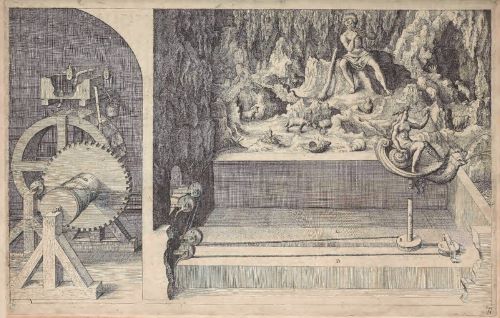
A number of grotto designs for hydro-powered musical automata are also illustrated in Salomon de Caus’ Les Raisons des Forces Mouvantes (1626), where Orpheus-like figures tame wild animals with wind and string instruments. Depictions like these were a favourite motif because their arcadian themes suited idyllic gardens, recasting what Miller describes as “the mysterious, numinous, and erotic” associations of the classical grotto.16 Musical machines were also popular in “water theatres” (teatri d’acque). Villa Aldobrandini, for example, had a number of rusticated niches with statues, each of which produced different sounds, timbres, and water displays. One fountain of Atlas produced “whirlwinds of waters, with thunder”,17 while, in others, Polyphemus and centaurs play wind instruments, as a deluge drenched “those who climb the stairs”.18

The performance-like aspects of nymphaea betray the importance of the theatre, a major influence on Mannerist garden architecture, in the design and mechanics of grottoes.19 Intermezzi — extravagant theatre and dance performances between the acts of plays — relied on elaborate machinery, stage sets, and props. As in artificial caves, writes Gordon Campbell, they privileged “pastoral, mythological, and allegorical scenes”.20 And indeed, grottoes and their associated aesthetics and paraphernalia figured prominently in such intermezzi. Consider for example this intermezzo, one of the many staged to celebrate the wedding of Ferdinando de’ Medici and Christine of Lorraine in 1589. In the words of contemporary Bastiano de’ Rossi:
the scene was all covered in sea cliffs, and the stage became a rolling sea, surrounded by those rocks, which looked like mountains [in ruins], among which . . . crystalline fountains gushed. . . . [A] niche in the colour of mother-of-pearl began emerging from the sea, five arms long, and pulled by two dolphins which, moving in leaps (as dolphins do in the sea) spouted scented water. . . . Once all the niche had emerged from the water, one could see [sea goddess] Amphitrite sitting in it, dressed of a garment so [tight], and so similar to the colour of skin, [that she looked naked].21
Sequined with corals, nacre, and various “maritime jewels”, Amphitrite was followed by a cortege of nymphs and tritons. The latter creatures’ heads were covered in bushy “light blue hair, and garlands of marsh reeds” from which, “as they began to emerge”, “abundant water” “rained down their face”.22

With its elaborate mechanisms, rustic mountainous surfaces, corals and pearls, gods and sprites covered in vegetation, this intermezzo deploys the symbolic and iconographic repertoire of the grotto. And the intersections between garden architecture and the theatre were seemingly limitless. Renaissance stage designer Bernardo Buontalenti planned the grottoes of the Boboli Gardens, which can still be visited today in Florence, as well as the park of Villa di Pratolino, home to some of the most famous caves and automata of the time. The French philosopher Montaigne, who toured the garden during its construction, found himself ambushed by the mischievous waterworks:
At one single movement the whole grotto is full of water, and all the seats squirt water on your buttocks; and if you flee from the grotto and climb the castle stairs and anyone takes pleasure in this sport, there come out of every other step of the stairs, right up to the top of the house, a thousand jets of water that give you a bath.
Although little of the original garden survives, the park of Pratolino is known to this day for the grotesque Colossus of Appennino, a gigantic figure that symbolises the surrounding mountainous region.23 A masterpiece of Renaissance sculptor Giambologna, the Colossus, covered in artificial encrustations, was hollowed out on the inside to contain fountains and a network of grottoes painted with scenes of “shepherds, mining, and metallurgy”.24 The presence of this gigantic, grotesque figure amid a formally poised Italian garden highlights how Renaissance gardens were at once, writes Luke Morgan, “places of pleasure and peril, order and confusion”.25

From the gardens of Italy, the grottoes travelled far. Wealthy tourists, inspired by their visits to Italian villas, copied these designs in their gardens back home, often adapting and reinventing them to suit local tastes. In France, for example, one of the first grottoes was built in the palace of Fontainebleau as early as the 1540s. The Grotto of the Pines resembles a portico, its façade supported by rusticated telamons imprisoned in stone pillars.26 The grotto fashion spread in Germany too, resulting in a multitude of diverse designs. The Castle of Heidelberg’s garden, Hortus Palatinus, boasted several grottoes (designed, like the aforementioned automata, by Salomon de Caus).27 In Potsdam, the New Palace (built between 1763 and 1769) had a Grottensaal (Grotto Hall), an imposing, vast room decorated with multicoloured marble and thousands of shells. The majestic Hall could not be more different from the luminous Neptune Grotto — a rococo gem, located in the gardens of the palatial complex.28

While grottoes and nymphaea remained popular through the Baroque period, evolving sensitivities in garden design, and sea-changes in the philosophical conception of nature, altered the appearance of artificial caves. The eighteenth century saw the emergence of the English landscape garden, which preferred a naturalistic emulation of the countryside’s variety over formalised designs.29 As a character laments in Tom Stoppard’s Arcadia, a play centred on the transformation of an Italian-style garden into the English vogue: “By 1760 everything had gone — the topiary, pools and terraces, fountains, an avenue of limes” — the whole geometry of the garden “ploughed under by Capability Brown.”30 Indeed, the primacy of the “picturesque” in these English gardens meant that grottoes receded from the fore to join a wealth of other features (temples, hermitages, bridges, follies, statues), artfully disposed across the landscape to construct pleasing views. The inner marvels of the grotto were no longer the main event. In this new context, as Naomi Miller writes in her seminal Heavenly Caves, the grotto “became a symbol of the forces of nature, or a retreat to spur lofty poetic sentiments”.31
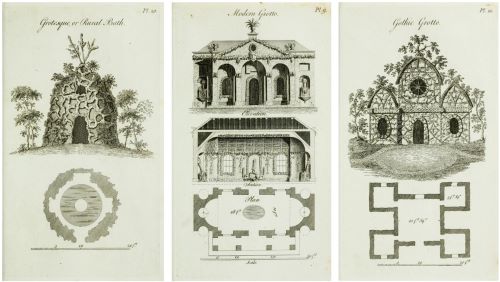
This new treatment of the grotto is evident in William Wrighte’s delightfully titled Grotesque Architecture : Or, Rural Amusement, Consisting of Plans, Elevations, and Sections, for Huts, Retreats, Summer and Winter Hermitages, Terminaries, Chinese, Gothic and Natural Grottos, Cascades, Baths, Mosques, Moresque Pavilions, Grotesque and Rustique Seats, Green Houses, &c . . . (1767).32 While little is known about its author, this successful pattern book provides insights into how grottoes were refashioned to suit the English landscape.33 Consider the design for a “Rural Grotto”, which Wrighte’s caption suggests should be:
built of large rough stones rudely put together, so that the building may as near as possible imitate the beautiful appearance of nature. If the dome was to be richly ornamented with pendentive shell and frosted work, it would look very elegant. In the middle niche is Neptune on a rock, pouring out water, which descends under the pavement through an arch, and forms a running stream. The side niches are ornamented with satyrs and other grotesque figures. The situation should be in a morass, near some water.34
While this grotto still presents itself as a rusticated portico, its inclusion in a catalogue alongside hermitages and shepherd’s huts reframes it as a rural retreat. Here the emphasis is not so much on the decoration of grottoes with natural ornament, but on their harmony with the surrounding landscape. This is underscored by the building materials suggested by Wrighte for the various designs, which now include “large rough stones”, “rude and irregular flints”, as well as “irregular rude branches and roots of trees”, like in the “Rustic Seat”. Wrighte’s enclosures have much more in common with garden follies: those eye-catchers that dotted English landscape gardens, often “in the form of a sham ruin, a Classical temple, oriental tent, Chinoiserie pagoda”.35


Around the same time William Wrighte published his Grotesque Architecture, one of the most famous grottoes in the world, or rather its valuable content, underwent a transformation emblematic of the aesthetic shift away from the Renaissance grotto. The Grotto of Thetis in the Versailles gardens, completed in the 1670s, boasted a majestic centrepiece: a statue of Apollo bathed by the Nymphs. Decorated with precious stones, enamels, and mirrors, it punctuates a narrative arch that traced the daily journey of the sun, rising from the Basin of Apollo in the Versailles gardens and setting in the Grotto of Thetis. The marvels of the Grotto of Thetis were short-lived, however, and the building was demolished just a decade later to make place for the extension of the château’s north wing. Toward the end of the eighteenth century, the preserved Apollo centrepiece found a new home as part of an English-style garden at Versailles designed by painter Hubert Robert — in a grotto framed by artificial cliffs, cascades, and greenery. Now housed within bare and rugged walls, and to be experienced at a distance, the scene’s aesthetic value lay not in precious and elaborate interiors, but rather in the interaction between the statues, cave, and their surrounding landscape.


This shift towards more naturalistic-looking caves reflected the influence of Romantic aesthetic sensitivities. These were characterised by a preoccupation with mankind’s insignificance before grandiose natural phenomena, eliciting a “sublime” sense of awe and terror that sparked artistic inspiration and creation. If Renaissance grottoes had toed the line between playfulness and mystery, it is the latter that took hold in this period, as gardens at large became enveloped in an aesthetics of ruination, melancholy, and sublimity. Artifice — in particular as mechanisation and automation — acquired increasingly negative connotations for distancing mankind from the idyllic state of nature. Automata, which had been so prominent in Renaissance grottoes, fell from favour, and were thought of as disquieting, uncanny, and even demonic.36
With their dark, mysterious interiors and craggy walls, caves figured prominently in Romantic art and literature, and naturalistic grottoes were therefore particularly suited to elicit “sublime” feelings. As Edmund Burke wrote in his Philosophical Enquiry into the Origin of Our Ideas of the Sublime and Beautiful (1757), “all edifices calculated to produce an idea of the sublime, ought rather to be dark and gloomy . . . darkness is more productive of sublime ideas than light”.37 The affecting potential of subterranean environments was exploited in the garden of Villa Pallavicini, located in Pegli (Genoa, Italy). Inaugurated in 1846, this English-style Romantic garden was the brainchild of Ignazio Alessandro Pallavicini (1800–1871), an aristocrat, politician, and mason well-versed in esoterism. Here a Romantic sensitivity fuses with the theatricality and occult symbolism that once populated many Renaissance gardens. The architect Michele Canzio, stage designer of the Carlo Felice theatre, arranged the landscape as a circuit of spiritual transformation. At the end of the itinerary, dedicated to Catharsis, the visitor must navigate through pitch-black caves before emerging in a paradisiac grove with a temple rising from tranquil waters.

Amerigo Gassarini, Canzio’s contemporary, described the experience of entering the caves:
Let us bravely enter in . . . this cave, where thick darkness surrounds us, scarcely transfixed by the weak rays which penetrate through the rare openings in the ceiling. . . . Which mortal could have arranged with such artfulness the natural stalactites which decorate in enormous masses [en masses énormes] the grand vaults of this cave? – Bizarre . . . calcarean formations are piled up above our heads; and because it must be acknowledged that Man . . . arranged them this way, we must not forget that we have, under our eyes, the slow and progressive work of past centuries.38
Gassarini narrates hearing “the sinister lapping of water” and feeling “the almost complete obscurity which reigns in this place.”39 While boating in the caverns, visitors could contemplate the interiors as well as “the infinite price that this grotto must have cost to Monsieur Marquis Pallavicini”.40 At this point in the narrative, it becomes hard to hear Gassarini’s irony — or its lack. Emerging into the light, the visitor is struck “by all the magnificence of the tableau which, all of a sudden, unfolds under our eyes”, prompting the writer to wish he could sing “an hymn in honour of Nature and Art, which held hands to make us experience the most delightful emotions”.41
Villa Pallavicini, and Gassarini’s description and illustration, vividly conjure the continuities and disparities between Renaissance and Romantic interpretations of the cave. Despite changes in their designs and symbolic underpinnings, grottoes remained for centuries places where the tensions between Artifice and Nature could be experienced, whether through the surprising symbiosis of playful automata, lavish shellwork, and morphing forms in Renaissance gardens, or through the awful, sublime powers of nature, as staged in the otherworldly darkness of Villa Pallavicini’s caves. While grottoes eventually fell from favour in garden architecture, this complex history — and the layered symbolism adorning the walls of artificial caves — remind us that a rich cultural universe lies beyond the grotto’s contemporary status as a “kitsch” or “bizarre” curiosity.
Appendix
Endnotes
- Patrick Bowe “The Garden Grotto: Its Origin in the Ancient Greek Perception of the Natural Cave”, Studies in the History of Gardens & Designed Landscapes 33, no. 2 (2013): 128–38.
- Porphyry, On the Cave of the Nymphs, trans. Thomas Taylor (Grand Rapids: Phanes Press, 1991), 42–43.
- Susan E. C. Walker, “Nymphaeum”, in Oxford Classical Dictionary (Oxford: Oxford University Press, 2016): online. Walker also writes that “The modern term nymphaeum applied to [particular fountains in ancient Rome] derives from late antique usage; in the early empire urban fountains were called munera, onerous burdens to those who held public office”.
- Naomi Miller, Heavenly Caves: Reflections on the Garden Grotto (London: George Allen & Unwin, 1982), 12.
- Vincenzo Scamozzi, Dell’idea della architettura universale, vol. 1 (Venice, 1714), 344.
- Scamozzi, 328.
- Scamozzi, 329.
- See, for example, Anatole Tchikine, “Giochi D’acqua: Water Effects in Renaissance and Baroque Italy”, Studies in the History of Gardens & Designed Landscapes 30, no. 1 (2010): 57–76.
- This and the following quotation can be found in Giorgio Vasari, Le Vite de’ più eccellenti architetti, pittori, et scultori italiani (Turin: Einaudi, 2018), 42–43.
- See Stephanie Hanke, “The Splendour of Bankers and Merchants: Genoese Garden Grottoes of the Sixteenth Century”, Urban History 37, no. 3: 399–418.
- Antonio Pinelli, La bella Maniera: Artisti del Cinquecento tra regola e licenza (Torino: Einaudi, 2003).
- Lauro Magnani, Tra Magia Scienza e “Meraviglia” (Genoa: Palazzo Bianco, 1984), 7.
- The presence of nymphs in grottoes also reflected the popularity of both in Renaissance art and literary production. See Karl A. E. Enenkel and Anita Traninger (ed.), The Figure of the Nymph in Early Modern Culture (Leiden: Brill, 2018).
- Hanke, “The Splendour of Bankers and Merchants”, 412. On cabinets of curiosity and “wonders”, see Paula Findlen, Possessing Nature: Museums, Collecting, and Scientific Culture in Early Modern Italy (Berkeley and London: University of California Press, 1994), 20.
- For an introduction to automata, see Jessica Riskin’s Public Domain Review article: “Frolicsome Engines: The Long Prehistory of Artificial Intelligence”.
- Miller, Heavenly Caves, 20.
- Giovanni Battista Falda, Le fontane di Roma, part II (Rome, 1691), 6.
- Falda, 8.
- Caroline van Eck and Stijn Bussels (ed.), Theatricality in Early Modern Art and Architecture (Malden, Mass.: Wiley-Blackwell). See also “Garden and Theatre” in John Dixon Hunt, Garden and Grove: The Italian Renaissance Garden in the English Imagination, 1600–1750 (Philadelphia: University of Pennsylvania Press, 2016).
- Gordon Campbell, “Intermezzo”, in The Oxford Dictionary of the Renaissance (Oxford: Oxford University Press, 2005), online.
- Bastiano De’ Rossi, Descrizione dellapparato, e degl’intermedi : fatti per la commedia rappresentata in Firenze (Florence, 1589), 55.
- De’ Rossi, 55–56.
- For an overview of grotesque elements in Renaissance gardens, see Luke Morgan, The Monster in the Garden: The Grotesque and the Gigantic in Renaissance Landscape Design (Philadelphia: University of Pennsylvania Press), 2015.
- Morgan, 12.
- Morgan, 34.
- Flaminia Bardati, “La Grotte des Pins a Fontainebleau”, in Artifici d’acque e giardini: la cultura delle grotte e dei ninfei in Italia e in Europa, ed. Isabella Lapi Ballerini and Litta Medri (Florence: Centro Di, 1999).
- Luke Morgan, Nature as Model: Salomon de Caus and Early Seventeenth-Century Landscape Design (Philadelphia: University of Pennsylvania Press, 2007).
- Miller, Heavenly Caves, 101–102.
- For a detailed and critical account of this transition, see Chapter 11 of Hunt’s Garden and Grove.
- Tom Stoppard, Arcadia (London: Faber and Faber, 1993), 23.
- Miller, Heavenly Caves, 78.
- William Wrighte, Grotesque Architecture : Or, Rural Amusement (London, 1790).
- “Wrighte, William” in The Oxford Dictionary of Architecture (Oxford: Oxford University Press, 2021), online.
- Wrighte, Grotesque Architecture, 8.
- James Stevens Curl, “Folly”, in A Dictionary of Architecture and Landscape Architecture (Oxford: Oxford University Press, 2006), online.
- Minsoo Kang, Sublime Dreams of Living Machines the Automaton in the European Imagination (Cambridge, Mass.: Harvard University Press, 2011).
- Cited in Miller, Heavenly Caves, 88.
- Amerigo Gassarini, Souvenir du Jardin Pallavicini de Pegli (Imprimerie des frères Ferrando, 1857), 56.
- Gassarini, 56.
- Gassarini, 57.
- Gassarini, 57.
Public Domain Works
- Les raisons des forces mouvantes, Salomon de Caus (1615)
- Le Fontane di Roma, Giovanni Battista Falda (1691)
- Grotesque Architecture, William Wrighte (1790)
Further Reading
- The Genius of the Place: The English Landscape Garden 1620–1820, Edited by John Dixon Hunt and Peter Willis
- A Cultural History of Gardens in the Renaissance, Edited by Elizabeth Hyde
- The Monster in the Garden: The Grotesque and the Gigantic in Renaissance Landscape Design, By Luke Morgan
About the Author