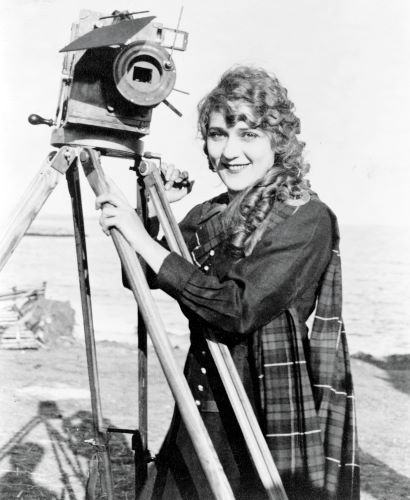
The darling of the silent-film industry led the way on many cinematic innovations of the era.
By Victoria Cooney
When Mary Pickford began acting in movies during the spring of 1909, performers’ names were not even released to the public. Movie actors were simply considered one of many moving parts in a medium suited only for immigrant masses who couldn’t afford actual theater performances. But “The Girl With the Golden Curls,” who caught the public’s attention before they even knew her name, helped change that.
As movies shifted from jerky, 6-minute shorts to sophisticated, 130-minute features, Pickford’s fame guaranteed box-office hits for any studio lucky enough to have her (and willing enough to pay her). “Meanwhile, her widely heralded acting prowess advanced the medium’s quest for respectability,” writes Christel Schmidt, editor of Mary Pickford: Queen of the Movies, a collection of essays. (NEH awarded Schmidt fellowships in 2000 and 2004, which she acknowledges as having “provided essential assistance that made all my subsequent Pickford endeavors possible.”)
Pickford was at the forefront of nearly every innovation in filmmaking for well over a decade, rejecting the histrionics popular in nineteenth-century melodramas and championing a natural style that audiences found believable and relatable.

“She invented acting for film,” says film historian Tino Balio. “She understood that you have a close, intimate relationship with [the] camera and more subtle, naturalistic gestures would be very effective.”
Not to say that Pickford was incapable of flying into the arm-waving rampages frequently associated with silent movies—she was the acknowledged queen of comedic fits of rage and frequently portrayed scrappy, underdog characters known for beating villains, oppressors, and unwanted suitors to the ground.
Because of Pickford’s talent, her choice of likable characters, and carefully cultivated public image, “the whole world wanted to put its arms around her,” says film historian Robert Cushman, “and, in a way, it did.”
The close-up was introduced to American cinema in the 1910s, suddenly making every sideways glance, sigh, and eye-roll visible. Audiences were able to feel they had a personal connection with Pickford, referring to her as “our Mary.”
This unprecedented degree of affection resulted in a Pickford mania that lasted over a decade. On her honeymoon in Europe, adoring fans mobbed her, forcing her husband, Douglas Fairbanks, to carry the petite actress to safety. She sold a single curl for five thousand dollars while selling bonds for the war effort. In 1926, when a London schoolgirl was asked what “MP ” stood for, she promptly responded, “Mary Pickford!” (correct answer: Member of Parliament).

In addition to acting in an estimated 210 movies, Pickford became an innovative producer and a Hollywood powerbroker. In 1916, she forced Paramount Pictures to create a new method of film distribution that allowed theaters to acquire film rights separately, upsetting the system of “block booking” that previously characterized distribution.
Three years later, she founded the United Artists film company along with Fairbanks, Charlie Chaplin, and D. W. Griffith, establishing the only studio model that survived World War II.
Pickford’s home in Beverly Hills, Pickfair, became “the nation’s second White House”—invitations were sought after by guests including the Queen of Siam, Albert Einstein, Amelia Earhart, Lord and Lady Mountbatten, and King Alfonso VIII of Spain.
From a nameless, wide-eyed beauty who caught the imagination of a country, Mary Pickford became a magnate who shaped the movie industry.
*This article was updated on September 3, 2013.
Originally published to the public domain by Humanities, the Magazine of the NEH 34:5 (September/October 2013).
About the Author