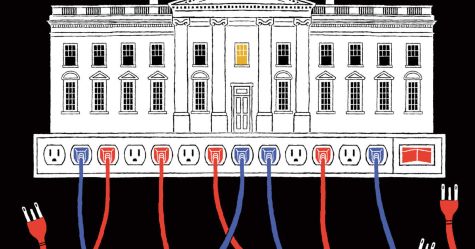
When Donald Trump was campaigning for president, he all but promised to be a rule-breaking, norm-busting leader. During the Republican National Convention, he announced, “I alone can fix it.” More than two years into his presidency, many remain laser-focused on the ways he has sought to expand presidential powers relative to the coordinate branches and historical baseline.
Though his approach is decidedly unconventional, Trump is far from alone among presidents in his desire and efforts to exercise greater control over events, says Professor Noah Feldman. “Most presidents try to [expand their powers] incrementally, and Trump has tried to do it non-incrementally.”

At the same time, an array of formal and informal checks, developed over time, have curbed some presidential efforts.
Feldman and a range of other scholars on the Harvard Law School faculty, some of whom have served in recent presidential administrations, suggest that the shifting strength of presidential power over time is a response to the times themselves, the person in office, and public perceptions. The three most recent presidents have cannily learned from their predecessors—and have used lessons from the past as blueprints to expand their capacities.
‘They just couldn’t have contemplated any of this’
Long before presidents were using various levers to maximize their powers, the framers of the Constitution were creating the structures that would allow for—and limit—the options that were available to them.

The framers were particularly focused on constraining presidents, says Professor Mark Tushnet, whose research focuses on legal history as well as constitutional law and theory. “The starting point was that we’d gone through a revolution against monarchical power,” he says. “Nobody wanted the chief executive to have the kinds of power the British monarch had.”
In addition to separating the government’s legislative, executive and judicial branches, the framers imposed a range of other limitations. For example, presidents had to get re-elected, they had relatively short terms, and they could be impeached.
But what the framers could not have foreseen was the dramatic way that the world—and the United States’ role in it—would be transformed in the centuries to come. Those changes almost necessarily have led to presidents with more influence and control than the framers could have imagined.
Professor Michael Klarman notes that America had an isolationist approach early on: George Washington laid it out explicitly in his farewell address. But by the end of World War II, the United States was the world’s greatest power. After the Cold War, it was the only superpower left. “It’s a vastly different role for the United States to play,” he says. “As a country takes on a greater international role, it’s not surprising that the president would become more powerful.”
The president’s role also changed as the government started to regulate an increasingly complex economy in the swiftly growing nation, says Klarman. By the mid-20th century, for example, the expanding number of administrative agencies, from the Federal Communications Commission to the Environmental Protection Agency, were all, in varying degrees, under the president’s control. The leaders a president chose for the agencies effectively allowed for high-level control of the policies likely to come out of them.
So if it seems as if more recent presidents have had more power than even Washington or Lincoln, it’s not an illusion. “The nature of the government at the federal level has changed so dramatically that [the framers] just couldn’t have contemplated any of this,” says Klarman, a legal historian whose most recent book is “The Framers’ Coup.” “The world has changed.”
Why timing is everything
A president’s ability to control the levers of power can be augmented—or constrained—by the historical moment. During a crisis, presidents often find ways to rapidly increase their authority, whether those approaches are constitutional or not.
An early example of this growth can be seen in Lincoln’s administration, says Klarman. Lincoln may not have had any specific ambitions to expand the relatively modest presidential powers when he arrived. But when the Civil War broke out, he didn’t hesitate to push the limits of those powers, if not defy them entirely.
Lincoln called for 75,000 military volunteers after Confederates fired on Fort Sumter, and he later suspended habeas corpus—seemingly both congressional powers. He also authorized military trials of civilians. “He did all sorts of things that were constitutionally dubious,” Klarman says. “But during wartime, people expect the commander in chief to win the war. They don’t care that much about constitutional niceties.”
Eighty years later, during World War II, Franklin D. Roosevelt also expanded his reach and control. Through a pair of War Powers Acts, for example, Roosevelt increased his authority to reorganize vast swaths of the executive branch and independent government agencies to support the war effort, says Klarman. He gave himself the authority to censor mail. He also cracked open previously confidential information from the census, which ultimately led to Japanese American internment.

More recent presidents have also used cataclysmic events—most notably, the attacks of Sept. 11—to leverage significant power. Professor Jack Goldsmith, who served as an assistant attorney general in the Office of Legal Counsel in the George W. Bush administration and is co-founder of the Lawfare blog, says that expansions of presidential powers linked to 9/11 have generally come with congressional support and have spanned the presidencies of George W. Bush, Barack Obama ’91, and Donald Trump. “[Presidents have] been detaining enemy combatants at the Guantánamo Bay detention center without trial for more than 18 years,” Goldsmith says. “The executive branch’s powers of secret surveillance in the domestic realm are super broad as a result of congressional authorizations.”
While wars may be among the more common points at which presidents expand their authority, they are not the only moments. Economic crises can also lead to scenarios in which presidents can vastly increase their powers.
During the Great Depression, for example, FDR’s wide-ranging New Deal programs designed to improve consumer confidence and support workers also strengthened his ability to regulate the economy, says Feldman, whose book “Scorpions” focuses on FDR and his Supreme Court.
Even if times of crisis open up new opportunities for presidents to take decisive, meaningful action with fewer constraints, limits do remain. FDR, who often seemed to increase his powers with impunity, was occasionally checked by the judicial branch. During the Depression he issued an executive order that prohibited hoarding gold and demanded that all people and companies deposit their gold with the Federal Reserve just weeks before abandoning the gold standard entirely. He invalidated contracts written specifically to avoid legal and economic consequences of the order. Later, however, in the Gold Clause cases, the Supreme Court struck down some of FDR’s actions, notes Feldman.
Unwritten rules are made to be broken
The remarkably brief section of the Constitution that lays out the powers and responsibilities of the president, Article II, leaves wide swaths of open space in which presidents can flexibly interpret their powers. (Perhaps not surprisingly, presidents typically do so in their own favor.) Often, a president’s power is prescribed not explicitly by Article II, but by the norms created over the course of two centuries of history.
For example, Washington famously insisted he wouldn’t serve for more than two terms, despite those who wanted to see him in office for life. That two-term limit wasn’t written into the Constitution, but it was observed by every president who followed—until FDR stayed at the helm for four terms, says Klarman.

Assistant Professor Daphna Renan, who served in the Obama Justice Department and whose scholarship includes a focus on executive power, says an important question—beyond the breach itself—is what reaction it provokes. “Presidents have broken norms, and then the question is how others have responded,” she says.
In the case of four-term presidencies, it took just two years after Roosevelt’s death for Republicans to draft—and for Congress to pass—what would become the 22nd Amendment, limiting presidents to two four-year terms.
Another norm that has been stress-tested is the idea of investigatory independence, says Renan. Though the FBI might technically be within the president’s purview, after Nixon and the Watergate scandal, presidents have generally treated individual investigatory decisions, especially where investigations touch on White House activity or personnel, as outside of the president’s direct control. And individual administrations have adopted specific policies and procedures to limit White House contacts with the Justice Department (including the FBI) about specific investigatory matters.
President Trump hasn’t embraced this norm. He’s publicly criticized the FBI’s leaders and threatened to “get involved” in investigations. But then-Attorney General Jeff Sessions’ recusal from the Russia investigation and the decision of then-Deputy Attorney General Rod Rosenstein ’89 to appoint a special prosecutor, among other moves, suggest how countervailing forces can help a norm prevail. “When others react negatively to the norm break—and even take measures to reinforce or shore up the norm—then the norm itself can be further entrenched,” says Renan.
Still, other norms have fallen away, she says. For example, the framers—particularly concerned with the idea of a demagogue coming into power—were not enthusiastic about presidents’ addressing the people directly. In general, presidents were expected to share policy positions with Congress in writing.
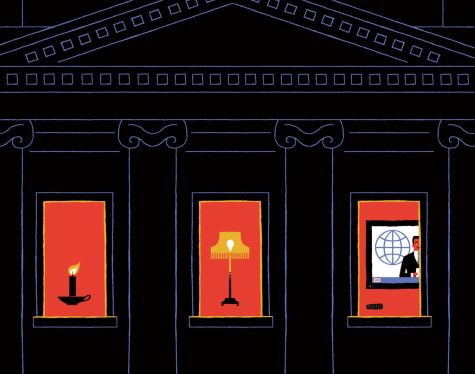
President Andrew Jackson pushed against these norms. Presidents Teddy Roosevelt and Woodrow Wilson went on to shatter them by regularly engaging with the public, says Renan. Later, FDR used fireside chats to captivate a nation and persuaded the public to get behind some of his grandest policies. Plenty of presidents have drawn from this playbook since then, with examples ranging from Kennedy’s knockout television performances to Obama’s early use of social platforms including Facebook to Trump’s use of Twitter as a primary mode of presidential communication.
Klarman says the value of “the rhetorical presidency” is significant: “I don’t think FDR could’ve had the power he did if he didn’t have the ability to do his radio chats, and Trump wouldn’t be president if it weren’t for Twitter and his ability to reach tens of millions of people directly.”
The rise and fall (but mostly rise) of presidential power
The last three presidents in particular have strengthened the powers of the office through an array of strategies.
One approach that attracts particular attention—because it allows a president to act unilaterally, rather than work closely with Congress—is the issuing of executive orders. “All presidents act in some measure by executive order,” says Neil Eggleston, who served as White House counsel from 2014 to 2017 and teaches a course at HLS on presidential power. He notes that most presidents issue hundreds of them during their time in office, and few merit much notice. “That said, you can predict when they’re going to be controversial.”

Eggleston says that Bush used executive orders to establish the Guantánamo Bay detention camp despite significant protest. Obama used executive orders to expand immigration protections for immigrants who arrived in the United States as children through DACA. (His order for the parents of these children, DAPA, was blocked in federal court.)
Eggleston adds that Trump has pursued his own controversial executive orders, among them the travel ban, which suspended the issuance of visas for people from seven countries—five with Muslim majorities. Today, a portion of an adapted order continues to stand.
Presidents are often particularly assertive about pushing the limits of power when it comes to pursuing the promises on which they staked their campaigns. Tushnet says that as Obama worked to get pieces of the Affordable Care Act funded, he adopted aggressive interpretations of existing statutes in order to accomplish his goals. Whether Trump’s power move in February—calling a national emergency in order to move forward with the construction of a border wall, even without explicit congressional support—will succeed remains unclear. But the result will certainly help inform future presidents about the likely ways they can or cannot exercise their authority.
As the United States has grown larger, more complex and more powerful, so too have the powers that presidents wield. And while presidents today may hold far more power than they did when the Constitution was written, the powers of institutions that have the ability to curb them have grown as well.
For Feldman, the question is not whether a given president has too much power or not enough, but whether—using the metaphor of Oliver Wendell Holmes’ living Constitution—they are right for the time. “The question we should ask is whether, in a given moment, the president’s expansion of executive power is necessary to the survival and flourishing of the body,” Feldman says. That remains an eternal question of U.S. constitutional law.
Originally published by Harvard Law Bulletin, Summer 2019, republished with permission for educational, non-commercial purposes.
About the Author