Faith and reason are often treated as opposites. Some philosophers believe they can only strengthen each other.

By Dr. Randy L. Friedman
Associate Professor of Judaic Studies
Binghamton University
State University of New York
Introduction
I teach a philosophy of religion seminar titled “Faith and Reason.” Most students who register arrive with a mistaken assumption: that the course explores the differences between the two.
“Faith” is often defined as belief in a supernatural God that transcends reason – and belief that science can only go so far to explain the fundamental mysteries of life. Reason, meanwhile, means inquiry that draws on logic and deductive reasoning.
It seems like a stark choice, an either-or – until we read Maimonides. For Maimonides, a 12th century theologian, philosopher, rabbi and physician, there is no true faith without reason.
Maimonides’ full name was Rabbi Moses Ben Maimon, and he is often referred to by the abbreviation “Rambam.” His writings spurred centuries of conflict and were even banned in some Jewish communities. Yet he also penned one of the most famous guides to Jewish law and still stands as one of the most influential rabbis to have ever lived.
It is surprising for many students to learn that Maimonides, who lived in present-day Spain, Morocco and Egypt, embraced reason as the only way to make sense of faith. In this rabbi’s view, the idea of a battle between faith and reason sets boundaries where none need exist.
Faith must be grounded in reason, lest it become superstition. This synthesis is at the heart of Maimonides’ most famous philosophical work, “The Guide for the Perplexed.”
Jerusalem and Athens

Treating faith and reason as if they are at odds is nothing new. Some philosophers have described them as two different cities, as when University of Chicago professor Leo Strauss wrote of “Jerusalem and Athens.”
Both cities love wisdom, Strauss wrote, but attribute it to different things. In “Jerusalem,” where life is grounded by faith in God, “the beginning of wisdom is fear of the Lord,” Strauss wrote in 1967, quoting the biblical books of Proverbs and Job. In “Athens,” on the other hand, symbolized by the ancient Greek philosophers, “the beginning of wisdom is wonder” – the wonder of inquiry and reason.
Almost 800 years before, however, Maimonides was arguing that true religion, true wisdom, requires both.
Rambam was deeply steeped in Jewish learning. As a doctor, astronomer and philosopher, however, he was just as knowledgeable about the science of his day. He ostensibly wrote “The Guide to the Perplexed” to help his student Joseph Ibn Aknin navigate between the truths of philosophy, natural science and revelation.
Maimonides’ understanding of God and the universe mostly agreed with Aristotle’s . In Part II of his “Guide,” Maimonides credits Aristotle with helping to prove three key principles about God: God is incorporeal, without a physical body; God is one; and God transcends the material world. Yet God created the world and set it in motion, Maimonides asserts, and everything in it depends on God for its existence.
Science and Scripture
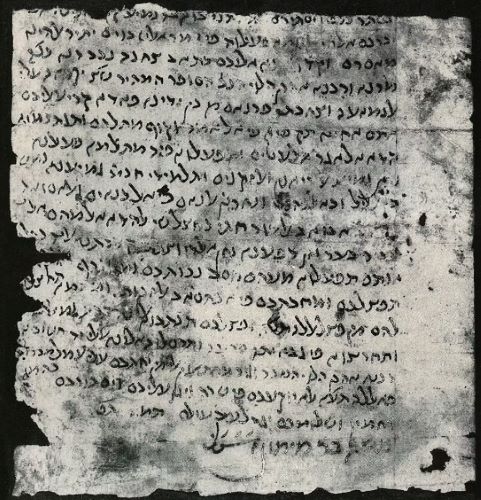
Throughout these chapters, the rabbi does not turn to scripture to prove or disprove philosophical propositions, although he notes that Aristotle’s opinion may be “in accordance with the words of our prophets and our theologians or Sages.”
This does not mean that Maimonides does not care about sacred texts – far from it. Rather, he argues that the truths of science and philosophy must inform how people interpret the Bible.
Many people of faith have read the Book of Genesis’ story of creation literally. For them, God’s creation of humanity “in our image and likeness” means both that God must have a body and that humanity shares much in common with God.
For Maimonides, however, language like these passages in Genesis was allegorical. If reason teaches that God is incorporeal, this means that God has no body; God does not physically see, nor do people see God. God does not speak, sit on a throne, stretch out an arm, rest or become angry. Reading these passages literally misunderstands the nature of God.
It is hard to overstate the significance of this claim. In Maimonides’ view, saying that God has a body is not just incorrect but blasphemous and idolatrous. He sees God as unique and transcendent, irreducible to anything human or material. And if God does not literally speak, then the Bible cannot be the literal word of God.
Maimonides insists that the Bible be appreciated as an esoteric text. Any part of the revealed text that does not fit with a true understanding of God and the universe must be read allegorically.
Reason does not eliminate his faith in God, or the power of scripture. Instead, reason protects people from believing something incorrect about God’s nature. Maimonides insists that we have faith in reason and that reason ground our faith.
The Palace of God

Maimonides’ philosophical writing is filled with debate and disagreement between him, fellow rabbis, Jewish philosophers and the Kalam, a medieval tradition of Islamic theology. Reason was the tool needed to make sense of sacred texts, and philosophical inquiry was the process needed to get it right. The goal was truth, not mere obedience.
Toward the end of his “Guide for the Perplexed,” Maimonides lays out what he believes are different levels of enlightenment. The allegory centers on a king’s palace: Only a select few, those who pursue truest wisdom grounded in philosophy and science, will reach the room where the king – God – resides. People guided by faith alone, who accept scripture literally and unquestioningly, and believe that faith transcends reason, on the other hand, “have their backs turned toward the king’s palace,” moving further and further away from God.
Maimonides is considered one of the greatest rabbinic authorities of all time. And his resolution to the debate between faith and reason could not have been clearer: There should be no true conflict. Both reason and revelation are our guides.
Originally published by The Conversation, 02.16.2024, under the terms of a Creative Commons Attribution/No derivatives license.
About the Author