On the St. Louis theme park that never made it past the drawing board.

By Devin Thomas O’Shea
Writer, Editor, Public Speaker
The new highways first attracted Walt Disney’s attention. St. Louis’ downtown interstate system was the last of three transformations that attempted to fill the void of a dead riverboat economy. A fourth effort was Walt’s idea: a Disney theme park he christened “Riverfront Square.”
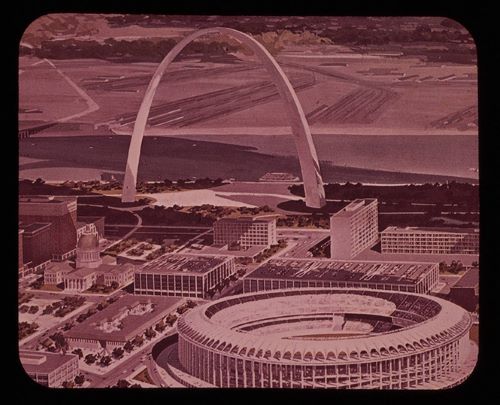
1939 kicked off St. Louis’ demolition spree, with 219 buildings leveled to make way for the Gateway Arch. The Arch’s construction drew protests for the planning committee’s refusal to hire Black workers, but urban renewal continued unrelentingly. Whole blocks were cleared in a panic to “save the city” from blight, defacing St. Louis history forever. The city demolished its Chinatown, as well as historically critical buildings like the former Lynch’s slave pen, to build a new baseball stadium for the Cardinals and Browns. The goal was to turn downtown into a historically important tourist destination while incinerating whole neighborhoods of historically important riverfront architecture, clearing away structures of pride and shame.
Four interstate highways converge in downtown St. Louis: 44, 64, 70, and 55. They were constructed and expanded throughout the 1950s, with Highway 64 barreling through the African American neighborhood of Mill Creek Valley, displacing 20,000 people. Walt Disney decided this version of downtown St. Louis, newly shorn of some visible history, offered an attractive chance to propagate his brand.
Disney was drawn to St. Louis for sentimental reasons. He’d spent critical years of his childhood in Marceline, Missouri, a small coal-mining railroad town two hours from Kansas City. Much of Walt’s biography consists of self-reported just-so stories, with Missouri playing a key role. The Matterhorn Bobsled roller coasters in Disneyland are said to have been inspired by Walt’s view of the Marceline coal mine. The Santa Fe line, which ran through town, is echoed in the railway that encircles the Anaheim theme park. Walt wanted Lady and the Tramp to take place in Marceline, and modeled the shopping strip leading up to Cinderella’s castle in Disneyland — Main Street, U.S.A. — off a paved version of Marceline’s Kansas Avenue.
Disney was not the only rich guy in the hometown preservation game. Henry Ford bought his childhood home outside of Dearborn, Michigan, and grew Greenfield Village into a semi-utopian Pleasantville, going so far as to acquire and move whole buildings to Greenfield, like the Wright Brothers’ bicycle shop and Thomas Edison’s Menlo Park laboratory. When Disneyland, which combined elements of Greenfield with Marceline, opened in Anaheim in July 1955, it was as much a theme park as it was an experimental urban design hodgepodge — a dreamland heavily influenced by Midwestern Taylorism, folklore, nostalgia, and American CEO mythos.
St. Louis approached Disney in the early 1960s with an “Old St. Louis” entertainment district pitch, complete with a 360-degree theater. The city was inviting his company to create a local history-themed film for that space, but Walt saw St. Louis instead as a potential second theme park destination. According to corporate lore, Anheuser-Busch CEO August Busch Jr. derailed the St. Louis park over questions of beer. After a press conference, the Budweiser king was rumored to have loudly announced, “Any man who would build something like [Riverfront Square] and then not serve beer and liquor inside, is crazy!”
Walt took the sober position — his park would be a family destination, and therefore would not serve alcohol. Newspapers ran with the story of Busch’s role, but behind the scenes, Disney was also asking a lot of the city. The plan was for St. Louis to foot the bill for the $30-50 million construction of the park (equivalent to about half-a-billion today), and it also included plenty of tax incentives for the company. Constructing the arch and baseball stadium had already drained city resources, and in 1965, the project was canceled.
Disney World in Florida was already underway, made possible by super-cheap swampland and the four-lane highways intersecting southwest of Orlando. A year after construction began, Walt died of lung cancer. The possibilities of Midwestern mythmaking were no longer one of the foremost concerns of his company.
Although the Riverfront Square project fizzled, Disney and his Imagineers — the research and development team for his theme parks — had thought deeply about how to marry local history with Disney’s already ingrained traditions. The St. Louis plans were thought to be locked away in the infamous Disney vault, but a batch came to auction in 2015. As Stefene Russell noted in a 2018 St. Louis Magazine article, the first set of original blueprints “fetched $27,000, [and] were believed to be the only ones in existence.” Then in 2017, a Los Angeles auction house revealed that a second bundle had survived. The documents give us a glimpse into an alternate 1970s where a Disney park would flank the Cardinals’ stadium, in the shadow of the Gateway Arch, a few blocks west of the Mississippi.
“Missouri and the history of Missouri are important to me,” Walt had said in explaining the Manifest Destiny theme of his St. Louis park. “The square would be oriented toward the family and prices at restaurants and exhibits would be compatible with average family incomes. The exhibits would be built around the history of St. Louis,” Walt said, “and its role as the Gateway to the West,” which was a history being told again and again for the benefit of white audiences. Noble savages, dignified slavery, and myths of an untouched virgin heartland were not only sold to suburbanizing Americans as their dignified, moral, past — Disneyfied stories of brave, civilizing, frontiersmen erased ugly foundational truths. What happened to those who lived in Missouri before Laclède and Chouteau arrived went unremarked upon, and any mention of the slave economy that built the nation from its beginnings was paved over.
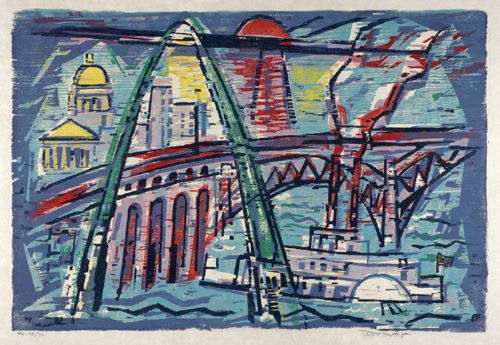
The main vessel of Walt’s project would have been a gigantic indoor attraction — four stories up, with several levels underground so that visitors “may be 40 feet underground, but they won’t know it.” This central building would feature a haunted house and two “Circarama 360” movie theaters. The room’s patented projectors would surround visitors in Disney movies, immersing them in a moving panorama. The planned exhibits cross-pollinated American history with fairy tales. One ride was dedicated to the real-life pirate Jean Lafitte. It was set beside a Snow White-themed coaster. Ramp walkways took visitors up and down the building as if following the Mississippi River. A “stretch room elevator” returned visitors to the street, and featured the ghostly illusions of a haunted house. The park was originally envisioned as a smaller version of Disneyland, but ballooned in scope to 11 buildings in total, with an exterior Main Street, U.S.A. entrance, and New Orleans-themed plazas.
The Midwest winters were a primary concern of Riverfront Square’s planners. The indoor park would have its “own sky and complete control of the weather.” Outside the main building, there would be a Meramec Caverns attraction in honor of the famous subterranean system in Missouri’s Ozark Mountains, a pirate ship, a wishing well, and an outdoor theater built to resemble a Mississippi River showboat. There would also be a ride based on the Lewis and Clark expedition.
Much of what is on the Riverfront Square blueprints ended up in other theme parks. The Circarama 360 theatres played patriotic films like America the Beautiful for visitors of the Experimental Prototype Community of Tomorrow (EPCOT) Center. The “Western Riverboat” combined an indoor boat ride and runaway mine train, which would go on to become Big Thunder Mountain Railroad in Orlando. According to Walt Disney’s Missouri, Walt “speculated about a historical exhibit that might include ‘Audio Animatronics’ figures of Thomas Jefferson, Napoleon, and others involved in expansion”; some of these animatronics would end up in the Hall of Presidents at Disney World.
Since the mid-1940s, Neal Gabler writes in his Disney biography, “Walt had flirted with the idea of doing an animation on Davy Crockett, the Tennessee Indian fighter and frontiersman who later died defending the Alamo in Texas.” When the first Disneyland was in its planning stages, “Walt was urging the Frontierland unit to come up with stories of American heroes,” and they selected, “by dumb luck,” Davy Crockett. He became an enormously popular, and equally derided, constellation in the 1950s Disney zodiac. In 1955, Harper’s and Saturday Review ran articles titled “The Embarrassing Truth about Davy Crockett” and “The Two Davy Crocketts” which debunked Disney’s folklore hero. “There were actually six different Davy Crocketts,” wrote John Haverstick in the Saturday Review. “One real, and the rest built on top of that one by Davy’s political backers and by his political opponents — some of whom praised and some of whom damned the original Davy during his lifetime.”
Riverfront Square also planned rides revolving around Davy Crockett lore. But if Crockett is a clear embodiment of white supremacist frontier myth, the planned St. Louis shrine to Mike Fink, “the king of the keelboatmen,” blows Davy out of the water.
Born sometime in the 1770s, Mike Fink was a Mississippi River boatman who eventually became the stuff of legend. He worked keelboats — which were used to sail the Mississippi River before the invention of steamboats — and Fink was renowned for practical jokes and protecting keelboat cargo with his sharpshooting.
As noted in Paul O’Neil’s Rivermen, a Time-Life book of Mississippi lore, Fink was a hothead, proclaiming he could, “out-run, out-hop, out-jump, throw-down, drag out, and lick any man in the country,” and was willing to fight anyone who was not amused. Fink was said to wear a red feather in his cap — a symbol that he had defeated “every strong man up and down the Mississippi.” Fink’s ornery ways got him killed in 1822 after accompanying a fur trade expedition up the Missouri River. Fink murdered a fellow traveler, and was murdered, in kind, himself.
Fink is memorialized as an “Alligator Horse” in 19th-century song and dime store novels; an Alligator Horse, per historian Ann Ostendorf, is an animalization used in the American West to “denote the great strength and amphibious attributes of the Mississippi Valley hunters, Indian fighters, soldiers, rivermen, and squatters.” The first printed reference to him is in the 1821 farce, The Pedlar, by Alphonso Wetmore, in which Fink is cast as an unrefined singing braggart, who then evolved into a renegade policeman of the Mississippi.
The waterways of America have always signified an escape route to freedom, and runaway slaves were hunted as they traversed rivers. To make it through the St. Louis gateway — the northwest outpost of the South — meant Canada wasn’t far. In an 1829 story, Mike Fink shoots the “protruding heel” of an enslaved man. When Fink is hauled into court after mutilating this person, the keelboater plays innocent. The “joke” of the story centers on Fink “helping” the slave with a deformed foot fit more “fashionable shoes.” In an 1854 story, titled “Mike Fink’s Great Shot,” the protagonist shoots the scalp lock off the head of a “vagrant” Indigenous man. Fink set fire to his own wife, Peg, for the crime of winking at another man, per Half Horse Half Alligator, edited by Walter Blair and Franklin J. Meine. He was said to have thrown a live dog into a stew kettle at a New Orleans Mardi gras, just to trick his friends into eating it.
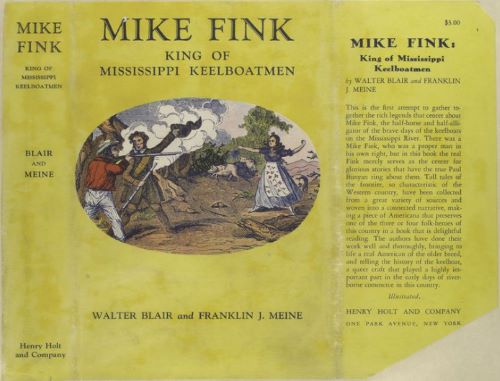
By the 1850s, Fink had settled into the role of a villain — a punching bag for stronger characters to pulverize in the name of justice. Fink was said to have never really died, and instead “disguised himself as a big cat fish which stirs up storms by lashing the waters,” causing floods as “the immortal water demon who hates all humanity.” His myth began as a fantasy of violence used to protect capital flows and oppress the enslaved, displaced, and brutalized. Ultimately he became the prototype of extrajudicial violence pioneered by the pioneers and seized upon by plantation owners and Klansmen.
But by the time Fink appeared in Disney’s 1955 Davy Crockett miniseries, he was playing the bumbling Goofus to Crockett’s Gallant. Fink’s brutality was submerged. According to the blueprints, his place in the Riverfront Square theme park would have been “Ride #16” on the mezzanine level of the “Fun Town Plaza.” If built, the Mike Fink ride would surely have located his legend in the embarrassing Disney canon alongside Song of the South, a 1946 musical drama that perpetuated the idea of the idyllic master-slave relationship. Song is considered a Lost Cause narrative and is locked away inside the Disney “vault” alongside other controversial animations, like the Dumbo crows.
Keelboats named after Fink did end up at several Disney parks for a while. They were infamous for dumping guests and Disney cast members into the water, and were phased out starting in the 1990s.
When Riverfront Square died, Anheuser-Busch was already attempting to capitalize on St. Louis’ nostalgia tourism with Grant’s Farm, which was acquired by the Busch family in 1903 as a private deer park. It opened to the public in 1954 as an animal reserve that could be toured via tram. Walt’s downtown project would have challenged Busch’s petting zoo, which offered guests the chance to enjoy a beer while gazing upon buffalo, emus, camels, and the Budweiser Clydesdales. Ulysses S. Grant resided on the property that would become Grant’s Farm between the Mexican and Civil War. The land was a wedding present from his wife Julia Dent’s family, who lived next door at a plantation called White Haven, which now houses the Ulysses S. Grant National Historic Site.
Disney and Busch are far from the only powerful people to try and make the American frontier uncomplicated and fun. But histories paved over or buried beneath entertainment have a tendency of resurfacing, thanks to those who refuse to forget what was demolished in the first place.
Originally published by History News Network, 04.30.2024, republished with permission for educational, non-commercial purposes.
About the Author