Coal’s presence in Roman Britain reveals a provincial landscape shaped by environmental opportunity rather than imperial design.

By Matthew A. McIntosh
Public Historian
Brewminate
Introduction: Coal in the Environmental Economy of Roman Britain
Coal occupies a minor yet revealing place in the environmental history of Roman Britain. The province offered a geological landscape in which coal seams often lay exposed at the surface, a condition not found in most other regions of the empire. Roman writers noted Britain’s unusual minerals, and Julius Solinus spoke of the island’s “black stones” used for fuel.1 Although wood and charcoal remained the primary energy sources across Roman industry, Britain’s natural outcrops allowed coal to slip into the everyday routines of heating, metalworking, and regional trade. Archaeological discoveries at Bath, Wroxeter, Aldborough, and the forts along Hadrian’s Wall confirm that coal appeared in domestic hearths, hypocaust systems, and ironworking centers.2 These patterns show a provincial economy shaped by local geology rather than uniform imperial practice.
Roman Britain’s coal is best understood through the interaction of textual testimony and material evidence. Solinus provides the only known literary reference, but excavations have traced coal in contexts ranging from civilian baths to military sites.3 The evidence is strongest in northern and eastern Britain, where coalfields lie close to Roman settlements and industrial installations. Fuel remains recovered from hypocausts, hearths, and smithing floors demonstrate that coal served practical purposes in regions where its accessibility offset its disadvantages compared to charcoal. The combination of textual description and archaeological material allows historians to reconstruct a provincial energy system that differed in significant ways from those in Italy or Gaul.
Despite this evidence, the use of coal never displaced the dominance of wood and charcoal in Roman metallurgical and domestic life. Charcoal’s superior heat output made it essential for smelting, and coppiced woodlands provided a renewable supply for most industrial centers. Coal remained a flexible alternative rather than a transformative innovation, a resource adopted when environmental conditions and local needs aligned. Scholars emphasize that Britain’s coal use reflects adaptation rather than technological advance, a provincial solution rather than an imperial standard.4
The study of coal in Roman Britain reveals broader themes about resource exploitation, identity, and environmental adaptation in the empire. The Romans did not arrive with a fixed economic template. Instead, they incorporated local materials when these proved useful. Britain’s coal, visible in shallow seams along its northern and eastern landscapes, became one such material. Its presence in baths, workshops, and coastal trade underscores the practical decisions made by communities navigating the realities of climate, geology, and supply. Understanding this modest but distinctive fuel illuminates the ways provincial environments shaped Roman practice and how Britain’s industrial landscapes diverged from those of the wider Mediterranean world.5
Literary and Archaeological Evidence for Coal Use in Roman Britain

Roman Britain is unusual within the empire for providing both literary testimony and physical evidence for coal use. The most explicit written reference appears in the work of Julius Solinus, who described the island as possessing black stones that could be burned for heat.6 Although brief, his description confirms that Roman observers knew of a combustible mineral in Britain that differed from the fuels common in the Mediterranean. Solinus wrote centuries after the initial conquest, yet his account reflects a tradition of provincial knowledge that circulated among Roman elites. Other classical writers referred broadly to Britain’s minerals, but none identified coal directly, which makes Solinus particularly valuable for linking textual description to material remains.7 His note stands as the only known literary witness to Roman-era coal use, though archaeological finds give the statement broader interpretive weight.
Archaeological evidence provides a more sustained picture of coal within Roman Britain’s daily life. Excavations at major urban sites such as Bath and Wroxeter have recovered coal fragments in layers datable to the Roman period.8 In Bath, coal appears in deposits associated with heating systems, an observation that aligns with Solinus but must still be treated with caution because the hypocausts were designed primarily for wood. The presence of coal in these contexts does not suggest wholesale substitution, but it does support the notion that inhabitants of the region used whatever combustible resources lay readily at hand. Wroxeter offers similar patterns, with coal discovered in domestic and industrial areas. These finds strengthen the argument that coal was integrated into household and workshop routines whenever geographical proximity made it practical.
Evidence from the northern frontier gives even clearer support for systematic coal use. Excavations near the forts along Hadrian’s Wall, supported by British Geological Survey studies, document coal in military and civilian layers that correspond to Roman occupation phases.9 The Wall region lies close to several surface coal seams, and many fragments appear in hearth and refuse deposits that indicate regular use rather than accidental introduction. The material suggests that garrisons adopted coal as a matter of convenience. Soldiers and civilian workers were stationed in a landscape where coal required little extraction effort, and the fuel’s presence in waste layers reflects this pragmatic adaptation to local geology.
Industrial sites provide another strand of evidence. In Yorkshire, coal residues appear in association with smithing and metalworking debris at Aldborough and related sites.10 These discoveries indicate that coal served as a heat source in secondary ironworking processes. Scholars caution that coal’s properties made it unsuitable for smelting, but its use for forging and reheating is archaeologically attested in multiple northern locations. The pattern reveals a technological landscape shaped by resource availability. Where charcoal remained abundant, it dominated industrial activity. Where coal could be gathered from surface exposures without significant labor, it entered the fuel economy as a useful supplement.
The literary reference of Solinus and the archaeological distribution of coal across several regions form a coherent picture. The material record shows that coal appeared most often in areas near natural outcrops, which indicates opportunistic use rather than the emergence of a new imperial standard. The textual record, though sparse, confirms contemporary recognition of this distinctive provincial resource. These bodies of evidence allow historians to reconstruct a provincial energy regime that diverged from Mediterranean norms.11
Coal and Industry: Forging, Smithing, and Metallurgical Production
Roman industrial activity in Britain developed within a landscape where coal often lay close to the surface, a condition that shaped decisions about fuel use in workshops and production centers. Archaeological evidence demonstrates that coal appeared most frequently in areas where coalfields intersected with established Roman settlements. This pattern is especially clear in Yorkshire, where industrial debris has been found alongside coal fragments in contexts indicating active use during the Roman period.12 Scholars emphasize that this reflects regional adaptation rather than technological innovation. The Romans did not import new metallurgical methods from the continent that relied on coal, but instead took advantage of resources that were locally abundant and easy to exploit.
The most substantial evidence for coal in industrial processes appears at Aldborough, a major Roman settlement in the territory of the Brigantes. Excavations documented coal residues within smithing hearths and working floors, a pattern consistent with the reheating and forging of iron rather than primary smelting.13 Coal’s combustion characteristics made it a feasible fuel for maintaining moderate temperatures needed for shaping metal, though it lacked the stability and heat intensity required for smelting. The Roman preference for charcoal in smelting remained unchanged throughout the province, but coal offered a practical supplement for workshops that needed sustained heat for secondary stages of production. This dual system reflects the flexibility of Roman industry when confronted with distinctive provincial resources.
Industrial zones in northern Britain provide further examples of coal used in smithing operations. Sites along the eastern coalfields, including smaller rural workshops, have produced hearth remains that contain coal embedded within slag deposits.14 These contexts suggest that local smiths integrated coal into their routines whenever it offered fuel efficiency or convenience. Wood and charcoal still dominated industrial use throughout most of the province, but in these northern environments coal could be gathered from exposed seams with minimal labor. The archaeological distribution of coal in such contexts matches broader settlement patterns near coal-bearing landscapes, reinforcing the idea that industrial fuel choices were shaped by proximity and availability.
The relationship between coal use and industrial production also intersects with broader environmental considerations. Charcoal production required extensive woodland management, and Roman Britain retained large, forested regions capable of sustaining such systems. Yet woodland resources varied significantly across the province. Areas where forests were sparse, or where military activity created sustained demand for timber, relied more heavily on alternative fuels.15 In those regions coal became an attractive source for regulating heat in workshops without taxing local wood supplies. This interplay of forest ecology and mineral access shaped a distinctive industrial adaptation that can be traced archaeologically through the distribution of coal residues.
Romans stationed in the northern frontier zones engaged in continuous repair and manufacture of tools, weapons, and domestic items, and the evidence of coal in smithing contexts near Hadrian’s Wall aligns with the logistical demands of these garrisons. British Geological Survey studies note that surface coal seams were abundant in this region, and the ease with which coal could be gathered likely influenced its incorporation into industrial routines.16 The evidence reveals a pragmatic approach rather than a formal change in imperial production standards. Artisans adopted fuels that required the least effort to obtain, especially in areas where transport of charcoal from wooded landscapes would have been inefficient or costly.
The industrial record shows that coal never replaced charcoal in the metallurgical hierarchy of Roman Britain, yet it played a meaningful role in workshop practices that relied on moderate and sustained heat. Its presence at Aldborough, throughout Yorkshire, and in the northern frontier illustrates how Roman industry adapted to local conditions without altering its fundamental technological principles.17 Coal functioned as a regional solution to the environmental and logistical realities of Britain, creating an industrial landscape that differed from those in provinces where traditional fuels were more abundant.
Bathing Culture and Domestic Heating: Coal in Civil and Military Life
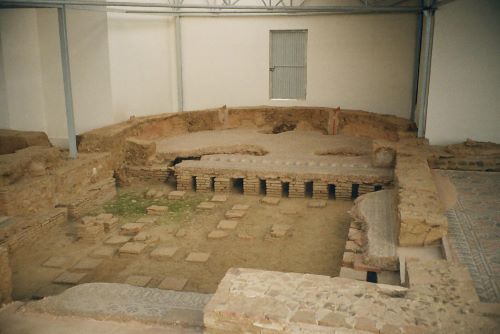
Coal entered the domestic and public heating systems of Roman Britain in ways that reflect both the province’s geology and its cultural incorporation into Roman daily life. Heating needs were substantial in Britain’s colder climate, and archaeological deposits suggest that inhabitants drew upon local fuels whenever practical. Excavations at Bath reveal coal fragments within layers associated with the operation of the bathing complex, although wood and charcoal remained the primary fuels for hypocausts.18 The appearance of coal in these deposits suggests that attendants may have used whatever combustible materials were available, especially in periods when local supplies of wood were strained. Scholars caution that coal was not the dominant fuel for large civic bathhouses, but its presence confirms that provincial adaptation sometimes influenced the operation of urban amenities.
Domestic contexts provide even clearer evidence of coal use in households located near coal-bearing landscapes. At sites across Yorkshire and the northeast, coal appears in hearth deposits within Roman period strata, indicating that residents incorporated it into cooking and heating routines.19 These deposits range from villas to modest rural dwellings, and the distribution reflects the same pattern seen in industrial settings. Where coal could be gathered from exposed seams with little labor, it became part of the household fuel economy. In regions farther from coalfields, domestic contexts yield little or no coal, a distribution that underscores the role of geography rather than cultural preference in shaping provincial habits.
Military sites along Hadrian’s Wall offer some of the most consistent evidence for coal in everyday use. Excavations near several forts reveal coal embedded in ash layers, hearth debris, and midden deposits associated with Roman occupation levels.20 These finds are especially concentrated in zones where coal seams approached the surface, which suggests that soldiers relied on locally available resources to meet their heating needs. The garrisons required constant fuel for personal warmth, cooking, and occasional workshop use, and the ease of collecting coal likely made it an attractive supplement to transported wood. The integration of coal into frontier life highlights a practical response to environmental constraints and the demands of cold northern winters.
Bathing facilities within military zones also show traces of coal use. Smaller bath suites, which served auxiliary forts and civilian communities around the Wall, sometimes contain coal residues within furnace and waste deposits.21 Although the scale of these facilities differed from urban bath complexes, their fuel requirements remained substantial. Coal appears to have served as a supplemental resource in the operation of these installations, reflecting the flexible strategies adopted by local attendants. The presence of coal does not indicate a technological shift in the design or function of hypocausts, but it demonstrates that fuel choices evolved in response to landscape conditions.
Elite domestic structures provide another angle for understanding coal’s place in civilian life. Some villa sites in northern Britain have produced coal fragments in contexts associated with heated rooms and ancillary structures.22 These discoveries suggest that landowners with access to coalfields incorporated the material into their heating systems. Villas located in forested regions of the south and west rarely show such evidence, which aligns with the broader environmental pattern of regional fuel selection. Coal was not a marker of status or innovation, but rather one element in a varied provincial resource regime shaped by proximity and convenience.
The evidence across civilian, military, and elite settings forms a coherent picture of coal as a supplemental fuel integrated into provincial routines. It did not replace wood or charcoal in the heating of public baths or large domestic structures, yet it filled a practical role in regions where it was easy to obtain.23 The archaeological record across northern and eastern Britain shows how Romans adapted their heating strategies to local conditions, revealing a provincial energy landscape that balanced traditional imperial practice with the realities of Britain’s geology and climate.
Extraction Methods and Settlement Patterns around Coalfields

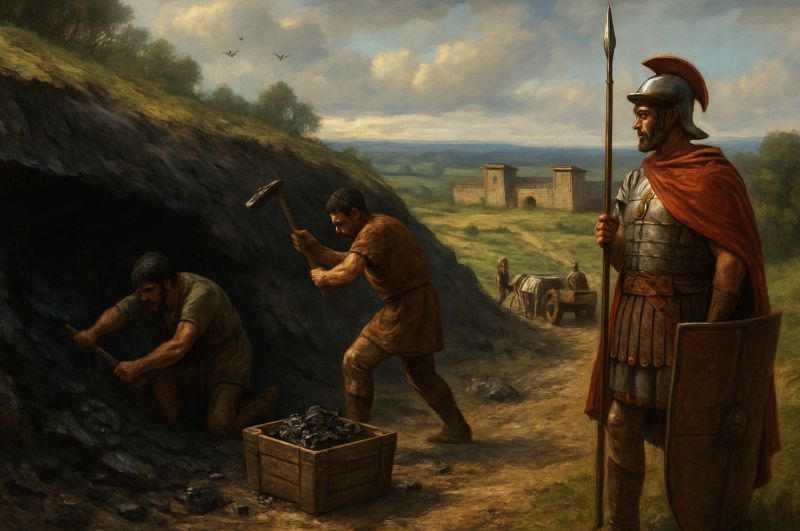
Roman coal extraction in Britain relied on simple techniques that made use of the island’s distinctive geology. Many British coal seams outcropped at the surface, especially in the northeast and along portions of the Yorkshire and Derbyshire landscapes. Archaeological studies and geological surveys indicate that inhabitants accessed these seams through shallow pits and open exposure rather than through deep mining.24 These methods required minimal labor and equipment and stand in contrast to the more complex mining operations the Romans developed in provinces such as Dacia or Hispania. The simplicity of extraction in Britain meant that communities could incorporate coal into their fuel economies without significant investment or technological change.
The shallow workings associated with Roman activity have been identified primarily through patterns of surface disturbance rather than through preserved mining installations. Many of these pits were later obscured by medieval or modern industrial extraction, but geological mapping and archaeological reports confirm the presence of Roman period debris near early coal exposures.25 The evidence suggests opportunistic gathering rather than organized mining on an imperial scale. Britons and Romans alike exploited exposed seams that could be harvested seasonally or intermittently. This pattern fits the broader provincial profile in which coal served as a supplemental resource rather than a primary driver of industrial production.
Settlement patterns in coal-bearing regions support the interpretation that resource availability influenced Roman decisions about habitation and land use. Sites in Yorkshire, including Aldborough and surrounding rural settlements, lie within close reach of surface coal deposits.26 Their proximity allows for a plausible integration of coal into domestic and industrial routines, as evidenced by archaeological finds of coal residues within associated occupation layers. The relationship between settlements and resources also appears along Hadrian’s Wall, where forts and civilian communities were positioned near outcrops that could be accessed without extensive transport networks. This spatial correlation underscores the practical considerations that shaped the provincial landscape.
Roman roads and navigable rivers further structured how coal was gathered and moved within local regions. While there is little evidence for large scale transport of coal across long distances within Britain, the placement of settlements along established routes would have facilitated the movement of small quantities of fuel from nearby outcrops to towns or forts.27 Such transport likely occurred in short hauls rather than in the bulk movements seen in the shipment of stone or grain. The pattern reflects a decentralized system in which households and workshops met their own fuel needs through local collection rather than relying on wider commercial distribution.
Taken together, the extraction methods and settlement distribution in Roman Britain show a landscape shaped by opportunistic use of natural resources. Coal was gathered from shallow pits near domestic, industrial, and military sites, and its availability influenced where communities were most densely established in parts of the north and east.28 These practices illustrate the flexibility of Roman provincial adaptation. The empire did not impose standardized mining systems in Britain for fuels that served only regional needs. Instead, local populations engaged with coal as one component of a broader resource economy shaped by geography, ecology, and the everyday demands of life in the province.
Transport and Trade: The Coastal Coal Market in Roman Britain
Coal circulated within Roman Britain through small scale coastal and regional movements that reflected the province’s distinctive geography. Evidence for these exchanges appears most clearly along the northeastern shoreline, where communities lay close to exposed coal seams and navigable inlets. Archaeological studies indicate that coal was gathered near these outcrops and transported short distances to nearby settlements.29 These movements were modest compared to the trade in grain or pottery, yet they reveal a pattern of fuel exchange shaped by local need and practical access to maritime routes. Coal’s low value and bulk made it unsuitable for long distance transport, but regional coastal traffic could sustain limited distribution.
Scholars have identified coal deposits at continental sites that appear to originate from British coalfields, a discovery that suggests a small but notable export trade. Finds along the Rhineland have been linked petrographically to coal sources in northeastern Britain, although the quantities are minimal.30 The presence of British coal in these contexts indicates that traders occasionally carried small consignments across the North Sea, likely as supplementary cargo rather than primary freight. The scale of this export remained far below that of metals or ceramics, yet it points to the permeability of maritime networks that connected Britain to northern Europe.
Along the British coast, coal moved between settlements through short coastal voyages that took advantage of natural harbors and the established patterns of Roman coastal shipping. Ports along the Humber, Tyne, and Tees offer plausible points of embarkation for coal loaded from nearby outcrops.31 Vessels engaged in routine supply activities could transport coal alongside building stone, salt, or agricultural goods. These trips linked small communities in patterns that supplemented overland transport, which was less efficient for bulk materials. The archaeological record supports a decentralized system in which coastal traffic served as an extension of local collection rather than a formalized trade.
The internal distribution of coal also depended on river routes that connected inland settlements to the coast. Rivers such as the Tyne and Tees allowed small cargoes to reach industrial zones farther inland, where workshops could incorporate coal into their activities.32 The movement along rivers was likely intermittent and responsive to seasonal conditions, reflecting the broader logistical flexibility of the province. Coal was not an essential commodity that required systematic transport. Instead, it traveled when demand aligned with opportunity, creating a sporadic but functional distribution network.
Coal entered regional trade in Roman Britain without transforming into a major commercial resource. Its movement along the coast and into continental Europe illustrates how local abundance allowed for limited distribution within established shipping patterns.33 The trade remained small because coal did not hold significant economic value beyond its utility as a local fuel. Yet these exchanges highlight the adaptability of Roman logistical systems and the capacity of provincial communities to integrate modest resources into broader networks of movement and exchange.
Ecological and Economic Context: Why Coal Never Became Rome’s Primary Fuel

The limited role of coal in Roman Britain becomes clearer when viewed through the broader ecological patterns of the province. Britain possessed extensive woodland resources during the Roman period, and these forests could be managed through coppicing to produce regular supplies of charcoal.34 This renewable system provided a stable fuel source for smelting, domestic heating, and public infrastructure. Charcoal’s superior heat output and controlled burning characteristics made it essential for metallurgical processes, particularly in the production of iron. Even in regions where coal lay close to the surface, charcoal retained technological advantages that allowed it to dominate industrial production.
Economic considerations also shaped fuel selection. The production and distribution of charcoal fit easily within existing networks of rural labor and estate management. Landowners could oversee woodland resources and maintain predictable supplies through seasonal cutting cycles.35 Coal, by contrast, required reliance on the geography of outcrops and occasional shallow extraction pits that did not offer the same level of oversight or control. Although coal could be gathered with minimal effort, its availability varied from region to region and could not be standardized across the province. This uneven accessibility limited its integration into broader economic systems and reinforced the dominance of charcoal as the preferred industrial fuel.
Cultural perceptions played a subtle but meaningful role in restricting coal’s use. Ancient authors occasionally remarked on the smoke and odor produced by burning certain mineral fuels, and these observations shaped attitudes toward materials that behaved differently from traditional combustibles.36 While Solinus recorded British coal as a curiosity, such recognition did not translate into widespread acceptance across the empire. Roman heating and industrial systems had developed around wood and charcoal, and communities continued to depend on fuels that aligned with familiar practices. Coal’s distinct sensory qualities may have discouraged its adoption in settings where alternatives remained abundant.
Coal’s position in Roman Britain reflects a combination of ecological abundance, technological preference, and cultural habit. The province’s varied landscapes allowed for opportunistic coal use in regions where outcrops occurred, yet these local adaptations did not alter the overarching structure of Roman energy consumption.37 Coal remained a supplemental resource, valuable in some environments but unsuited to displacing the systems that sustained imperial industry. Its presence in the archaeological record offers insight into the flexibility of provincial economies, revealing how Roman Britain incorporated new materials while retaining established methods of production and daily life.
Conclusion: Resource Use, Provincial Identity, and the Place of Coal in Roman Britain
Coal’s presence in Roman Britain reveals a provincial landscape shaped by environmental opportunity rather than imperial design. The combination of surface coal exposures and Britain’s cooler climate encouraged local communities to adopt this resource whenever its use aligned with practical needs. Archaeological deposits at Bath, Aldborough, and the northern forts demonstrate how coal entered domestic, industrial, and military contexts as a supplemental fuel. These patterns show a province negotiating the realities of its terrain, climate, and resource distribution while functioning within the broader framework of Roman economic life. Coal did not transform fuel systems across Britain, but its appearance in diverse settings illustrates the flexibility that characterized provincial adaptation.38
The integration of coal into daily routines highlights a pragmatic engagement with the natural environment. Communities along the northeastern coalfields used what lay close at hand, and their choices reflect a rational assessment of labor, availability, and utility. Industrial workshops, frontier garrisons, and household hearths incorporated coal when it offered convenience or efficiency, yet charcoal remained dominant where its technological advantages proved decisive. This coexistence of fuels demonstrates that Roman Britain was not governed by a single energy model. Instead, it developed a regionalized system shaped by ecological diversity and the varied demands of settlement, industry, and military life.39
Understanding coal’s role in Roman Britain enriches our picture of how the province functioned within the empire. The archaeological and textual evidence places coal within a mosaic of resource use that balanced innovation with continuity. Britain adopted coal not as a revolutionary technology but as one more material embedded in the rhythms of local life. These regional adaptations reveal a province that navigated its environment with practical intelligence, incorporating distinctive resources without abandoning the traditions that anchored its economic and social systems. Coal’s modest but durable presence offers insight into the broader dynamics of Roman provincial identity, where environmental constraints and everyday decisions shaped the contours of life at the empire’s northern edge.40
Appendix
Footnotes
- Julius Solinus, Collectanea rerum memorabilium, ed. Theodor Mommsen (Berlin: Weidmann, 1895), 22.
- A. W. Parker, “Coal in Roman Britain,” Britannia 7 (1976): 28-36.
- Peter Salway, Roman Britain (Oxford: Oxford University Press, 1981), 234.
- David J. Mattingly, An Imperial Possession: Britain in the Roman Empire (London: Penguin, 2006), 216.
- Barry Cunliffe, Iron Age Communities in Britain, 4th ed. (London: Routledge, 2005), 512.
- Julius Solinus, Collectanea rerum memorabilium, 22.
- Tacitus, Agricola, ed. and trans. Michael Grant (London: Penguin, 1970), 12.
- Parker, “Coal in Roman Britain,” 334.
- British Geological Survey, “Coal Mining History,” accessed 2024.
- Parker, “Coal in Roman Britain,” 29.
- Salway, Roman Britain, 233–235.
- Parker, “Coal in Roman Britain,” 29.
- Parker, “Coal in Roman Britain,” 29-30.
- Cunliffe, Iron Age Communities in Britain, 512.
- Mattingly, An Imperial Possession, 214–216.
- British Geological Survey, “Coal Mining History,” accessed 2024.
- Salway, Roman Britain, 235.
- Parker, “Coal in Roman Britain,” 31.
- Cunliffe, Iron Age Communities in Britain, 512.
- British Geological Survey, “Coal Mining History,” accessed 2024.
- Parker, “Coal in Roman Britain,” 34.
- Salway, Roman Britain, 235.
- Mattingly, An Imperial Possession, 216.
- British Geological Survey, “Coal Mining History” accessed 2024.
- Parker, “Coal in Roman Britain,” 33-34.
- Salway, Roman Britain, 233–235.
- Mattingly, An Imperial Possession, 214–216.
- Cunliffe, Iron Age Communities in Britain, 512.
- Parker, “Coal in Roman Britain,” 36.
- Martin J. Dearne and Keith Branigan, “The Use of Coal in Roman Britain,” The Antiquaries Journal 77 (1995): 71-105.
- Parker, “Coal in Roman Britain,” 36.
- Salway, Roman Britain, 233–235.
- Mattingly, An Imperial Possession, 216.
- Cunliffe, Iron Age Communities in Britain, 510–512.
- Mattingly, An Imperial Possession, 214.
- Parker, “Coal in Roman Britain,” 33.
- Salway, Roman Britain, 235.
- Parker, “Coal in Roman Britain,” 33-43.
- Mattingly, An Imperial Possession, 214–216.
- Salway, Roman Britain, 233–235.
Bibliography
- British Geological Survey. “Coal Mining History.” Accessed 2024.
- Cunliffe, Barry. Iron Age Communities in Britain. 4th ed. London: Routledge, 2005.
- Dearne, Martin J. and Keith Branigan. “The Use of Coal in Roman Britain.” The Antiquaries Journal 77 (1995): 71-105.
- Mattingly, David J. An Imperial Possession: Britain in the Roman Empire. London: Penguin, 2006.
- Parker, A. W. “Coal in Roman Britain.” Britannia 7 (1976): 28-36.
- Salway, Peter. Roman Britain. Oxford: Oxford University Press, 1981.
- Solinus, Julius. Collectanea rerum memorabilium. Edited by Theodor Mommsen. Berlin: Weidmann, 1895.
- Tacitus. Agricola. Edited and translated by Michael Grant. London: Penguin, 1970.
Originally published by Brewminate, 12.04.2025, under the terms of a Creative Commons Attribution-NonCommercial-NoDerivatives 4.0 International license.
About the Author