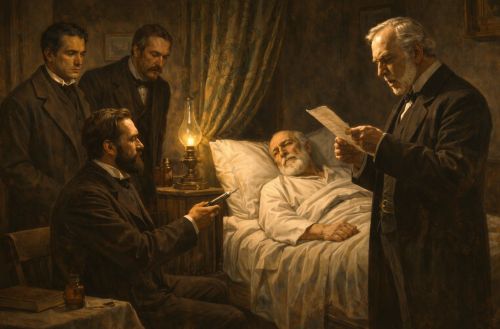
In 1873, Samuel Williams ignited debate over “mercy killing,” exposing Victorian anxieties about medical authority, morality, and the limits of compassion.

By Matthew A. McIntosh
Public Historian
Brewminate
Introduction: A Public Proposal in an Age of Moral Certainty
In 1870, at a meeting of the Birmingham Speculative Club, the schoolmaster Samuel D. Williams delivered a paper that would reverberate far beyond its modest venue. Titled “Euthanasia,” the address proposed that physicians, under strict safeguards and at the request of the patient, should be permitted to hasten the death of those suffering from incurable and agonizing disease. The suggestion was neither flippant nor inflammatory in tone. Williams framed his proposal as an extension of compassion and medical responsibility. Yet the mere articulation of the idea in public challenged entrenched assumptions about the moral boundaries of life and death in Victorian Britain.
The shock that followed reveals how firmly those boundaries were held. In a culture still deeply shaped by Christian moral theology, life was commonly regarded as a sacred trust under divine sovereignty. The deliberate hastening of death, even for reasons of mercy, was widely equated with murder. Victorian public discourse treated suicide as both moral failure and social tragedy, and the criminal law reflected this moral condemnation. Within such a framework, Williams’ proposal did not appear as a technical adjustment to medical practice but as a direct affront to the prevailing moral order.
The late nineteenth century was marked by profound transformation. Medicine was undergoing professional consolidation, scientific authority was expanding, and questions once governed primarily by clerical interpretation increasingly entered secular debate. The rise of medical societies, professional journals, and standardized training strengthened physicians’ claims to specialized expertise. Clinical observation and therapeutic intervention began to supplant purely pastoral frameworks in the care of the dying. Hospitals increasingly became sites where life and death decisions unfolded under professional supervision rather than exclusively within family and parish structures. In this shifting landscape, authority over suffering and its alleviation became contested terrain. Williams’ argument positioned the physician not merely as healer but as moral agent, capable of weighing the burdens of terminal illness and acting to relieve them. His proposal reflected a broader realignment in which medical judgment began to compete with theological doctrine as a source of ethical guidance in matters of mortality.
The 1870 controversy marks an early turning point in the evolution of voluntary death discourse. Although his suggestion was met with strong resistance, it introduced themes that would later define right-to-die arguments: regulated medical authority, patient consent, and the mitigation of suffering. By examining Williams’ address within its historical context, the controversy that followed reveals the moment at which voluntary death began to be framed not solely as sin or crime, but as a question of medical ethics and individual agency.
Samuel Williams’ 1870 Essay: Argument and Safeguards
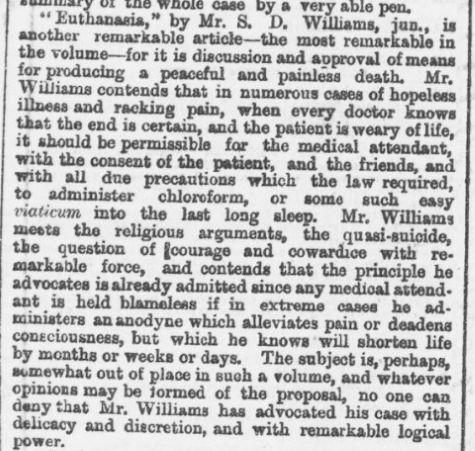
In his 1870 essay “Euthanasia,” Williams did not advocate indiscriminate killing nor propose the casual termination of life. Rather, he framed his argument narrowly, focusing on cases of terminal illness accompanied by severe and unrelievable suffering. Williams contended that when recovery was medically impossible and pain relentless, it would be both humane and rational to allow a physician, at the explicit request of the patient, to administer a means of peaceful death. His proposal rested on the conviction that prolonging agony in the absence of hope served neither moral nor medical ends.
Williams’ reasoning was heavily centered around the concept of consent. He insisted that euthanasia should occur only upon the voluntary and deliberate request of the individual whose condition could no longer be relieved. The patient’s agency, rather than the physician’s authority alone, was to be decisive. This emphasis distinguished his proposal from coercive or paternalistic models that might empower doctors to judge the worth of a life independently of the patient’s expressed will. Williams was careful to avoid framing euthanasia as a discretionary act of medical benevolence imposed from above. Instead, he positioned it as a response to autonomous appeal, one grounded in rational reflection rather than impulsive despair. Consent was to be informed, deliberate, and free from external pressure. In elevating the patient’s request to the center of the proposal, Williams articulated one of the earliest public formulations of voluntary death grounded explicitly in personal agency rather than social utility.
Williams also outlined procedural safeguards designed to prevent abuse. He suggested that euthanasia be confined to clearly diagnosed terminal cases and subject to medical oversight rather than private discretion. The decision was to follow professional assessment, ensuring that no realistic prospect of recovery remained. By embedding the act within medical regulation, he sought to differentiate mercy killing from murder. The emphasis on structure and review reveals that Williams understood the dangers inherent in his proposal and attempted to mitigate them through institutional constraint.
Williams presented euthanasia as an extension of existing medical practice. Physicians already administered opiates and sedatives to ease suffering, sometimes with the foreseen consequence of shortening life. He argued that openly acknowledging and regulating such actions would be more honest than maintaining a moral fiction in which life-prolonging intent was always presumed. By situating euthanasia within the continuum of pain management, Williams challenged the rigid moral distinction between allowing death and hastening it. He implied that medical compassion already operated in gray areas and that bringing these practices under transparent guidelines would enhance ethical accountability rather than undermine it. By bringing the issue into public discourse, Williams sought clarity rather than concealment. His argument implied that ethical integrity required confronting the realities of dying rather than obscuring them behind theological prohibition.
The essay’s tone remained measured and rational rather than incendiary. Williams appealed to compassion, medical expertise, and reasoned debate rather than to radical social reform. Yet beneath this moderation lay a profound shift. By proposing that physicians might lawfully hasten death under specific conditions, he relocated authority over dying from exclusively divine jurisdiction to regulated human judgment. The safeguards he described were intended to preserve moral seriousness, but the proposal itself marked the emergence of a new ethical language in which voluntary death could be discussed as policy rather than solely as crime or sin.
Medical Professionalization and Secular Authority
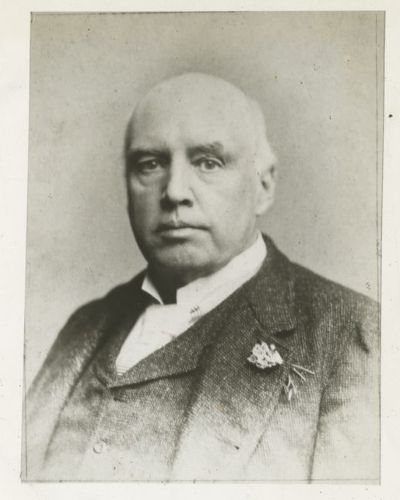
Williams’ proposal did not emerge in isolation. It appeared at a moment when British medicine was consolidating professional authority and redefining its social role. The nineteenth century witnessed the strengthening of medical institutions, the expansion of licensing requirements, and the growth of specialized training. Legislative reforms earlier in the century had begun to standardize medical credentials, while hospitals increasingly functioned as centers of instruction and clinical observation. Physicians and surgeons sought to distinguish themselves from irregular practitioners and to claim recognized expertise grounded in scientific method. As professional identity solidified, so too did the expectation that medical practitioners would exercise judgment not only in matters of cure but in the broader management of bodily life. Illness, suffering, and death were progressively interpreted through clinical categories rather than exclusively theological ones. Within this environment, questions about the end of life became susceptible to medical framing.
The professionalization of medicine altered the locus of ethical deliberation. As scientific methods gained prestige, physicians positioned themselves as interpreters of bodily truth. The authority to diagnose, prognosticate, and manage terminal illness rested increasingly in professional hands. This shift did not erase religious influence, but it introduced a competing source of legitimacy. When Williams argued that physicians might responsibly hasten death in cases of incurable suffering, he appealed to the expanding moral credibility of medical expertise. The claim assumed that clinical judgment could be trusted to assess hopelessness and to distinguish compassion from harm.
Secularization further reinforced this transformation. Victorian Britain remained religiously vibrant, yet public discourse increasingly accommodated arguments grounded in reason, utility, and humanitarian concern rather than solely in scriptural command. The language of suffering, relief, and humane intervention resonated within reform movements addressing poverty, public health, and penal conditions. Williams’ proposal drew upon this broader humanitarian ethos. By invoking compassion and medical oversight, he framed euthanasia as a rational response to observable pain rather than as a rebellion against divine law. The debate revealed the gradual emergence of a secular moral vocabulary operating alongside, and sometimes in tension with, theological doctrine.
The widening scope of clinical jurisdiction generated unease. If physicians possessed the power to diagnose and treat, could they also claim authority over the timing of death? Critics feared that professional consolidation might slide into unchecked control. The question was not merely whether euthanasia was permissible, but whether medicine itself should hold such jurisdiction. Williams’ address intersected with larger anxieties about expertise, governance, and the boundaries of professional power. The controversy surrounding his proposal reflected a society negotiating the shifting balance between sacred tradition and secular authority in matters of life and death.
Religious Backlash and the Charge of “Playing God”

The response to Williams’ proposal was swift and morally forceful. Religious critics regarded the suggestion not as compassionate reform but as a dangerous transgression of divine order. In Victorian Britain, Anglican theology and broader Christian moral teaching continued to exert significant influence over public ethical discourse. The sanctity of life doctrine held that human life was a gift entrusted by God and that its termination lay within divine, not human, authority. To sanction euthanasia, even under restrictive safeguards, appeared to substitute human judgment for divine sovereignty.
Clerical commentators drew upon long-standing theological arguments condemning suicide as sin. Christian moral tradition had treated self-killing as violation of both natural law and divine command, a rejection of providence and an injury to the community. Patristic authorities such as Augustine had insisted that even extreme suffering did not justify self-inflicted death, grounding their reasoning in the commandment against killing and in the belief that life’s duration rested in God’s hands. Medieval scholastic thinkers, including Thomas Aquinas, elaborated this position by arguing that suicide offended against self-love, harmed the community to which one belonged, and usurped divine authority. Although Williams distinguished voluntary euthanasia from suicide by emphasizing medical oversight and terminal illness, critics perceived little difference in moral substance. In their view, intention rather than circumstance defined the act. To willfully hasten death, regardless of motive, constituted an assault upon God’s prerogative over life and death and disrupted the moral order that Christian teaching sought to preserve.
The rhetoric of ‘playing God’ gained force in public discussion. By granting physicians authority to determine when suffering justified death, Williams appeared to elevate medical judgment above theological constraint. Opponents feared that such authority would erode the boundary between healing and killing, transforming the physician’s vocation in ways incompatible with its moral foundations. If doctors could intentionally end life in certain cases, critics argued, the ethical identity of medicine itself would be destabilized. The physician, traditionally regarded as guardian of life and instrument of divine providence, risked becoming arbiter of its termination. This shift provoked anxiety not merely about isolated cases of mercy killing but about the reconfiguration of moral hierarchy. The fear was that once sacred limits were subordinated to professional discretion, no clear principle would prevent further encroachment upon sacred limits.
Religious objections also emphasized the redemptive dimensions of suffering. Within Christian thought, pain and affliction were not devoid of meaning. They could be interpreted as participation in Christ’s suffering, occasions for spiritual growth, or trials that tested faith. To eliminate suffering prematurely risked foreclosing its potential spiritual value. Williams’ argument, grounded in humanitarian relief, clashed with theological narratives that ascribed moral or salvific significance to endurance. The debate exposed competing interpretations of suffering’s role within human life.
Public discourse amplified these concerns into broader moral alarm. Newspapers and periodicals echoed fears that legalizing euthanasia would weaken respect for life and open the door to abuse. If exceptions were permitted in extreme cases, critics warned, boundaries might gradually erode. The slippery-slope argument became a recurrent feature of opposition. Religious leaders portrayed the proposal as the first step toward moral chaos, framing resistance as defense of civilization’s ethical foundation.
Yet the intensity of the backlash also reveals the fragility of moral certainty in an age of transition. The very need to denounce Williams so vigorously suggests that secular reasoning had gained sufficient traction to warrant rebuttal. Religious critics were compelled to articulate their objections in public debate rather than rely solely on inherited consensus. The controversy illustrates not simply unyielding orthodoxy but a society negotiating the limits of divine and human authority. In confronting the prospect of medically regulated voluntary death, Victorian Britain wrestled openly with the boundaries between compassion, sovereignty, and moral law.
Public Moral Panic and Victorian Sensibilities

Beyond clerical denunciation, Williams’ proposal entered a broader public sphere shaped by Victorian anxieties about order, vulnerability, and the maintenance of moral boundaries. The late nineteenth century was an era deeply concerned with social stability and moral cohesion. Rapid industrialization, urban expansion, shifting class relations, and the growth of mass print culture intensified awareness of social fragility. Public debates frequently centered on crime, poverty, sexuality, and institutional reform, reflecting fear that established norms might erode under rapid social change. Within such a climate, the suggestion that physicians might intentionally end life appeared not as a narrow medical reform but as a destabilizing innovation touching the most fundamental moral line. Public debate reflected concern that once the inviolability of life was breached, no clear line would prevent further erosion of ethical restraint.
Newspapers and periodicals amplified these anxieties. Editorial commentary framed euthanasia as a dangerous precedent capable of undermining respect for human life. Critics imagined scenarios in which the elderly, the disabled, or the impoverished might feel subtle pressure to request death. The specter of coercion loomed large. Even though Williams emphasized voluntary consent and terminal illness, opponents questioned whether true freedom could exist in contexts of dependency and suffering. The fear was less about the immediate proposal than about its potential expansion beyond carefully circumscribed cases.
Victorian sensibilities also linked euthanasia to broader debates about social worth and productivity. Industrial society increasingly measured individuals in terms of economic contribution, efficiency, and usefulness, and critics worried that legalizing mercy killing might encourage utilitarian calculations about whose lives were burdensome. Concerns about pauperism, workhouse reform, and public expenditure on institutional care already animated social policy discussions. Against this backdrop, the idea that certain lives might be deemed “hopeless” raised unsettling implications. Although Williams grounded his argument in compassion rather than economic utility, public imagination connected euthanasia to fears that vulnerable individuals could be regarded as expendable. The emerging language of medical prognosis risked being conflated with judgments about social value, intensifying suspicion toward proposals that appeared to place life within evaluative frameworks.
The Victorian household retained strong symbolic significance. Death was often imagined as a domestic and religious event, accompanied by ritual, prayer, and familial presence. The intrusion of clinical authority into this intimate sphere provoked unease. If physicians could authorize death, then the locus of moral decision-making would shift from family and clergy to professional oversight. Public anxiety reflected not only theological conviction but also attachment to familiar patterns of dying that euthanasia threatened to disrupt.
Concerns about abuse were intensified by mistrust of institutional power. The expansion of asylums, workhouses, and hospitals had already generated debate about oversight, discipline, and the treatment of marginalized populations. Reports of neglect or administrative rigidity circulated widely, shaping public perception of institutional authority. Granting physicians legal authority to hasten death appeared, to some observers, as an extension of bureaucratic control over vulnerable bodies. Critics feared that once the state or its licensed agents acquired such power, oversight might prove insufficient to prevent error or exploitation. The Victorian imagination, attuned to scandals and reform campaigns, readily envisioned worst-case scenarios in which compassion masked coercion. The moral panic surrounding euthanasia was intertwined with broader unease about centralized authority and the expanding reach of professional governance.
Yet the very breadth of public engagement indicates that the issue resonated beyond isolated moral outrage. The debate revealed a society grappling with modernity’s pressures: scientific authority, shifting family structures, and the redefinition of suffering. Williams’ proposal forced Victorians to confront whether compassion might justify actions previously unthinkable. Public alarm exposed the tension between emerging humanitarian sensibilities and entrenched moral frameworks. In this confrontation, voluntary death became a site upon which broader anxieties about progress, authority, and human dignity were projected.
Consent, Suffering, and the Emergence of Autonomy

At the center of Williams’ proposal lay a concept that would later become foundational in modern bioethics: individual consent. Although Victorian moral discourse did not yet employ the language of “autonomy” in its contemporary philosophical sense, Williams’ insistence that euthanasia occur only at the patient’s request introduced a nascent articulation of bodily self-determination. The individual experiencing terminal suffering, rather than clergy, family, or state, was positioned as the primary moral agent. This move marked a significant departure from earlier frameworks in which life and death were governed by divine command or social duty rather than personal choice.
Williams’ emphasis on incurable pain further reshaped the moral terrain. In traditional Christian ethics, pain could be interpreted through spiritual categories that emphasized endurance, redemption, or submission to providence. Suffering might serve as moral trial, occasion for repentance, or participation in sacred narrative. By contrast, Williams treated prolonged, incurable agony as a problem demanding humane intervention grounded in observable reality rather than theological meaning. He described suffering in clinical and experiential terms, focusing on its intensity, duration, and the absence of hope for recovery. This shift displaced metaphysical interpretations with empirical assessment. Pain became measurable, describable, and subject to professional judgment. In reframing suffering as harm rather than spiritual opportunity, Williams altered the moral calculus surrounding death. Compassion, in his formulation, required confronting the lived experience of the patient rather than abstract appeals to providential design.
The convergence of consent and suffering generated a new ethical configuration. If a competent individual, fully informed and free from coercion, judged continued existence intolerable due to unrelievable pain, Williams argued that medical assistance in dying could be justified. The physician’s role was not to override the patient’s will but to evaluate prognosis, confirm incurability, and ensure that established safeguards were satisfied. This arrangement implied a reciprocal relationship between expertise and agency. Clinical knowledge established the boundaries of medical possibility, while the patient’s expressed wish supplied moral authorization. Such reasoning subtly reoriented authority away from purely external command toward negotiated deliberation. Though tentative and controversial in 1870, this framework anticipated later developments in informed consent, where voluntary agreement and professional assessment became intertwined in legitimizing medical action. It marked a step toward viewing the patient not merely as recipient of care but as participant in determining the course of treatment and, in extreme cases, its termination.
Critics challenged this development by questioning the reliability of consent under conditions of extreme distress. They argued that suffering might cloud judgment or produce despair incompatible with rational choice. Such objections highlighted tensions inherent in grounding ethical legitimacy in subjective experience. Nevertheless, the very framing of the debate around the authenticity and freedom of the patient’s decision indicated a shift. Rather than debating solely whether euthanasia violated divine law, participants increasingly asked whether the individual’s will could confer moral permission.
In retrospect, Williams’ essay can be seen as an early articulation of themes that would later crystallize into formal principles of autonomy within bioethics. Although the term itself would gain prominence in the twentieth century, the conceptual groundwork was visible in his insistence on voluntary request and regulated oversight. Consent, suffering, and professional responsibility were brought into a single argumentative structure. In doing so, the debate over euthanasia moved beyond theological prohibition toward a framework in which individual agency and experiential harm became central to ethical evaluation.
From Victorian Debate to Modern Right-to-Die Discourse
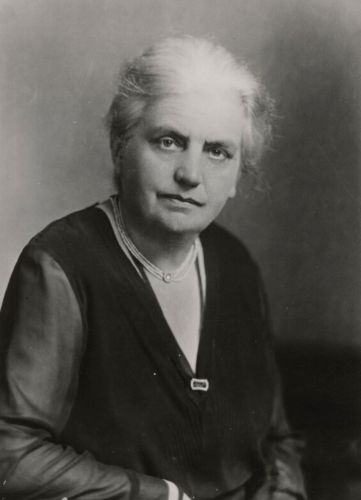
Although Williams’ 1870 proposal was rejected by most of his contemporaries, it did not vanish without trace. The very fact that euthanasia had been publicly debated in a respectable intellectual forum established a conceptual precedent. Voluntary death moved from moral taboo to contested public issue. In subsequent decades, reformers and medical commentators revisited the issue intermittently, often citing the need for clearer distinctions between mercy, murder, and medical judgment. Williams’ address occupies a formative place in the genealogy of modern right-to-die discourse, even if immediate legislative change did not follow.
By the early twentieth century, organized euthanasia movements began to emerge, particularly in Britain and the United States. These groups sought to present voluntary euthanasia as a rational, compassionate response to terminal suffering under legal safeguards. The vocabulary of consent and medical oversight that Williams had sketched reappeared with greater institutional ambition and political coordination. Advocacy organizations drafted model legislation, circulated pamphlets, and attempted to shift public opinion through appeals to humanitarian reform. Campaigners emphasized patient choice, incurable illness, and professional regulation, seeking to differentiate voluntary euthanasia from both suicide and capital punishment. In doing so, they attempted to stabilize the meaning of euthanasia around voluntariness and strict procedural control. The debate increasingly unfolded within legal and legislative arenas rather than solely in intellectual societies, signaling a maturation of the discourse from philosophical proposal to organized reform effort.
The term “euthanasia” acquired darker associations through its appropriation by coercive state policies in the twentieth century. The involuntary killing of vulnerable populations under totalitarian regimes profoundly altered public perception of the concept. Distinguishing voluntary, consent-based euthanasia from coercive programs became essential for reform advocates. This historical rupture complicated efforts to sustain Williams’ original humanitarian framing. The language of mercy was now shadowed by memories of abuse, reinforcing demands for stringent safeguards and transparency.
In the latter half of the twentieth century, advances in medical technology further intensified debate. Mechanical ventilation, artificial nutrition, and other life-sustaining interventions prolonged biological existence in cases that would previously have resulted in death, creating ethical dilemmas unforeseen in Williams’ time. Questions surrounding withdrawal of treatment, do-not-resuscitate orders, and palliative sedation entered both courtrooms and clinical guidelines. Legal cases concerning the right of competent adults to refuse treatment gradually clarified the boundaries of patient autonomy. In some jurisdictions, the debate extended to physician-assisted dying under narrowly defined statutory conditions. The principles of informed consent and bodily self-determination, once tentative and controversial, became formalized within bioethical discourse and embedded in professional codes. What began as a provocative Victorian essay evolved into a sustained legal and ethical framework grappling with technological capability and human vulnerability.
Yet continuity with the Victorian debate remains visible. Contemporary right-to-die arguments still invoke themes of compassion, relief of suffering, and regulated medical oversight. Religious objections continue to appeal to sanctity-of-life doctrine and warnings against moral erosion. Slippery-slope concerns persist in public discourse, echoing nineteenth-century fears of boundary collapse. The core tension between individual agency and perceived moral absolutes has not disappeared, though it now operates within a more secularized legal framework.
Tracing the arc from Williams’ address to modern policy debates reveals both transformation and persistence. The vocabulary has evolved, protective conditions have grown more detailed, and legal mechanisms more precise. Public deliberation now incorporates clinical data, jurisprudence, and bioethical theory alongside theological reflection. Nonetheless, the fundamental question first publicly raised in 1870 endures: under what conditions, if any, may deliberate assistance in dying be considered morally and legally legitimate? The Victorian moment did not resolve the issue, but it inaugurated a mode of discussion that continues to shape contemporary discourse on voluntary death, demonstrating the enduring influence of that early public proposal.
Conclusion: The Modernization of Voluntary Death
The Victorian debate sparked by Williams’ 1870 essay marks a decisive moment in the historical evolution of voluntary death. For the first time in a modern public forum, euthanasia was framed not solely as sin or crime but as a matter of structured clinical judgment and individual consent. Williams’ proposal did not overturn prevailing law or theology, yet it altered the terms of discussion by situating the relief of suffering within professional responsibility and patient request. The controversy that followed revealed how deeply entrenched theological assumptions remained within British moral culture, especially regarding divine sovereignty and the sanctity of life. It demonstrated that new forms of reasoning grounded in compassion, clinical expertise, and experiential harm had gained sufficient legitimacy to demand serious engagement. Voluntary death had entered the sphere of public policy, not as clandestine act but as explicit ethical question subject to debate.
This transition did not entail the disappearance of religious authority, nor did it produce immediate legal reform. Instead, it inaugurated a layered discourse in which sacred doctrine, secular humanitarianism, and emerging professional ethics contended for interpretive dominance. The language of suffering and consent began to supplement, though not replace, the vocabulary of sanctity and divine sovereignty. In this coexistence of moral frameworks, a new framework for debating voluntary death took shape. The question was no longer simply whether life belonged to God, but whether human judgment might legitimately intervene under defined conditions.
Subsequent developments in medical technology and legal doctrine expanded the terrain first opened in 1870. As life-prolonging interventions grew more powerful, the management of dying became increasingly technical and institutional. The formalization of informed consent and the articulation of patient rights embedded autonomy within medical ethics. Yet the tensions identified in the Victorian debate persisted. Concerns about coercion, moral erosion, and the limits of professional authority continue to animate contemporary policy discussions. The modernization of voluntary death did not resolve ethical conflict; it restructured it within new institutional settings.
Seen in historical perspective, Williams’ proposal represents not an isolated provocation but the beginning of a conceptual shift. Voluntary death moved from the margins of moral discourse into structured debate shaped by law, medicine, and public reasoning. The transformation was gradual and contested, yet enduring. By tracing this trajectory, the transformation of voluntary death emerges as a story of competing authorities, evolving vocabularies, and the persistent human effort to reconcile compassion with moral restraint.
Bibliography
- Aquinas, Thomas. Summa Theologiae, II–II, q. 64, a. 5.
- Augustine. The City of God, Book I.
- Brown, Callum G. The Death of Christian Britain: Understanding Secularisation, 1800-2000. London: Routledge, 2001.
- Digby, Anne. Making a Medical Living: Doctors and Patients in the English Market for Medicine, 1720–1911. Cambridge: Cambridge University Press, 1994.
- Dowbiggin, Ian. A Merciful End: The Euthanasia Movement in Modern America. Oxford: Oxford University Press, 2002.
- Emanuel, Ezekiel J. “The History of Euthanasia Debates in the United States and Britain.” Annals of Internal Medicine 121:10 (1994).
- Faden, Ruth R., and Tom L. Beauchamp. A History and Theory of Informed Consent. Oxford: Oxford University Press, 1986.
- Grego, Kim. “From ‘Dying Well’ to ‘Inducing a Good Death’: Euthanasia in the British Press (1864-1949).” Token: A Journal of English Linguistics 8 (2019), 191-213.
- Kemp, N. D. A. ‘Merciful Release’: The History of the British Euthanasia Movement. Manchester: Manchester University Press, 2002.
- Keown, John. Euthanasia, Ethics and Public Policy: An Argument Against Legalisation. Cambridge: Cambridge University Press, 2002.
- MacDonald, Michael. Mystical Bedlam: Madness, Anxiety, and Healing in Seventeenth-Century England. Cambridge: Cambridge University Press, 1981.
- Porter, Roy. The Greatest Benefit to Mankind: A Medical History of Humanity. New York: W. W. Norton, 1997.
- Reeves, Nancee. “Euthanasia and D(Evolution) in Speculative Fiction.” Victorian Literature & Culture 45:1 (2017), 95-117.
- Williams, Samuel D. “Euthanasia.” Fortnightly Review 7 (1870): 212–218.
Originally published by Brewminate, 02.25.2026, under the terms of a Creative Commons Attribution-NonCommercial-NoDerivatives 4.0 International license.
About the Author