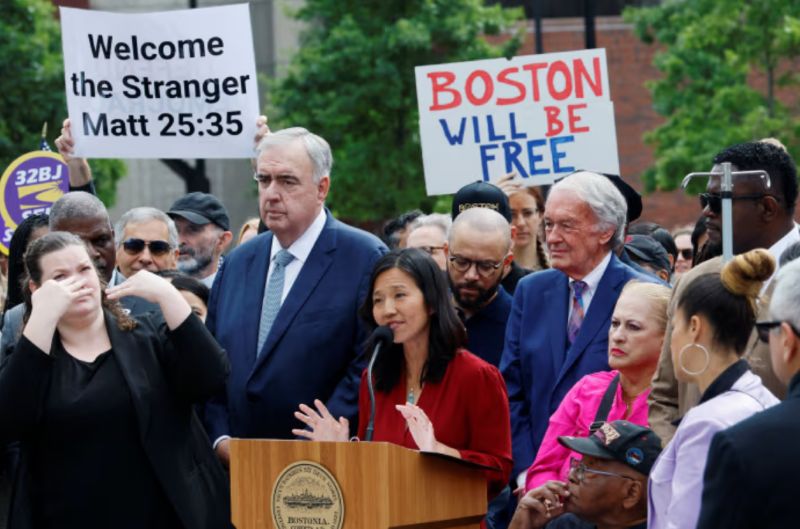
This standoff is a constitutional, political and moral showdown unfolding on city hall steps, state capitols and in courtrooms.

By Matthew A. McIntosh
Public Historian
Brewminate
A Growing Constitutional Clash in Real Time
The conflict unfolding between Attorney General Pam Bondi and Democratic-led cities and states is not merely political theater. It is a substantive confrontation about authority, responsibility and the shape of federalism in America. Bondi’s letters demanding sanctuary jurisdictions abandon their policies or face funding cuts have sparked defiance in places like Boston, New York, California and Oregon. Their responses reach into the heart of how local governance defines its role in protecting community trust and basic constitutional principles.
In Boston, Mayor Michelle Wu took the stage with purpose. At a recent press conference she declared that “Boston will not back down” and framed the federal ultimatum as coercive overreach that distracts from pressing issues like housing and health care. Her statement landed with force, positioning sanctuary policies not as soft law or moral vanity but as a pillar of civic integrity.
Voice of Defiance: Beyond Mere Refusal
Far from a rhetorical flourish, the resistance from sanctuary capitals is rooted in rigorous legal conviction and democratic accountability. Washington state’s Governor Bob Ferguson responded to Bondi’s threat not with alarm but with defiance. “Washington State will not be bullied or intimidated by threats,” he said in a sharply worded letter, adding that attempts to punish jurisdictions for holding firm on sanctuary legal norms “embarrasses and disgraces the office” initiating them. “If you choose to challenge me and my state,” he warned, “be advised that we will defeat you and seek all appropriate costs and fees.”
Seattle’s Mayor Bruce Harrell likewise stressed that “immigration enforcement is the exclusive responsibility of the federal government,” casting Bondi’s directive as a fundamental breach of federalist balance. In Oregon, Governor Tina Kotek underscored that the state’s 1987 sanctuary law, one of the oldest in the country, is not simply a matter of policy but a reflection of long-standing state identity.
Legal Resistance and the Politics of Enforcement
This impasse is now before the courts. A coalition of 20 state attorneys general and the District of Columbia have filed suit challenging the administration’s attempt to condition Victims of Crime Act funds on local compliance with immigration detainer requests. Their argument rests on the Tenth Amendment’s anti-commandeering principle, which has been reaffirmed in rulings dating back to Printz v. United States (1997). Early hearings have leaned toward skepticism of federal authority, with judges questioning whether threatening unrelated grant funding exceeds executive discretion.
Other cases are emerging. California is preparing to invoke its precedent from United States v. California (2019), where courts upheld parts of its sanctuary framework. Meanwhile, New York City’s legal team is drafting briefs aimed at protecting confidentiality ordinances that bar city officials from sharing immigration status with federal authorities. Each case underscores that the sanctuary fight is not rhetorical but constitutional, shaping the limits of federal power in daily governance.
Electoral Stakes and Political Theater
The sanctuary confrontation is also seeping into electoral politics. For Republicans, the White House ultimatum is a rallying cry designed to paint Democratic strongholds as lawless and unpatriotic. Trump has invoked “sanctuary chaos” in stump speeches, framing the refusal of cities like Boston and Seattle as evidence that Democrats prioritize “illegal aliens” over American citizens.
Democrats, in turn, are reframing the issue as one of democracy and local control. Boston’s mayor has turned her defiance into a broader message about protecting urban autonomy against federal intrusion, a message resonant in a year when mayors are increasingly seen as frontline actors in safeguarding rights. In California, Governor Gavin Newsom has sharpened his profile as a defender of sanctuary values, linking immigration protections to broader battles over healthcare, reproductive rights and environmental policy.
Polls reflect the polarization. An NPR/IPSOS poll conducted in February 2025 found that 68 percent of Republican voters favored stripping federal funds from sanctuary jurisdictions, while 71 percent of Democrats supported legal resistance to federal mandates. Independents leaned against funding cuts, suggesting that while Bondi’s threats play well within the GOP base, they carry risks in swing states where voters prize local control.
A Civic Showdown in the Making
This standoff is a constitutional, political and moral showdown unfolding on city hall steps, state capitols and in courtrooms. Calls from federal authorities for alignment with immigration enforcement clash directly with local leaders’ mandate to serve and protect all residents. The confrontation unfolds not in abstract legal memos but in press conferences, lawsuits and electoral campaigns.
Mayor Wu’s vow that “Boston will not back down” resonates because it is rooted in lived governance, not theory. Governor Ferguson’s defiant letter carries weight because it is backed by legal action, not empty posturing. What is at stake is not only the future of immigration enforcement, but the balance of federalism and the moral compact between local governments and their constituents.
The fight over sanctuary policies has moved beyond symbolic resistance. It is now a defining struggle over who governs, how constitutional boundaries are drawn, and what democratic accountability means in an era of deep national division.
FAQ: Sanctuary Policies and Federal Power
What are sanctuary jurisdictions?
Sanctuary jurisdictions are cities or states that limit cooperation with federal immigration authorities, especially on detainer requests, to protect community trust and constitutional rights.
Can the federal government force states or cities to enforce immigration laws?
No. Under the Tenth Amendment and the Supreme Court’s anti-commandeering doctrine (Printz v. United States), the federal government cannot compel local officials to carry out federal immigration enforcement.
Why is the Department of Justice threatening sanctuary jurisdictions?
Attorney General Pam Bondi has warned that cities and states may lose federal grant funding if they maintain sanctuary policies. Local leaders argue this is unconstitutional coercion.
Have sanctuary policies been upheld in court before?
Yes. In United States v. California (2019), parts of California’s sanctuary framework were upheld, affirming states’ rights to set their own limits on cooperation with federal immigration authorities.
How does this issue affect elections?
Republicans frame sanctuary cities as dangerous and lawless, while Democrats argue they embody local control and constitutional integrity. Polls show the debate is polarizing but could sway independent voters.
Originally published by Brewminate, 08.25.2025, under the terms of a Creative Commons Attribution-NonCommercial-NoDerivatives 4.0 International license.
About the Author