How can an industry experiencing systemic failure get back on its feet?

By Dr. Rodney Benson
Professor of Media, Culture and Communication
New York University

By Dr. Victor Pickard
Associate Professor of Communication
University of Pennsylvania
Introduction
For the journalism industry, 2024 is off to a brutal start.
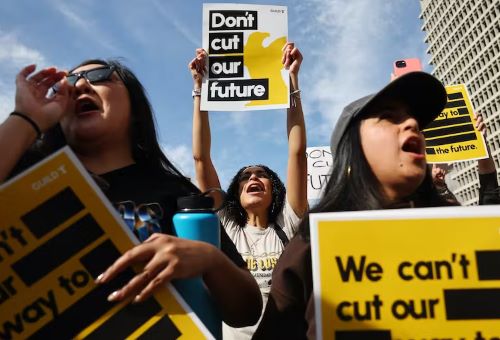
Most spectacularly, the Los Angeles Times recently slashed more than 20% of its newsroom.
Though trouble had long been brewing, the layoffs were particularly disheartening because many employees and readers hoped the Times’ billionaire owner, Patrick Soon–Shiong, would stay the course in good times and bad – that he would be a steward less interested in turning a profit and more concerned with ensuring the storied publication could serve the public.
According to the LA Times, Soon-Shiong explained that the cuts were necessary because the paper “could no longer lose $30 million to $40 million a year.”
As one X user pointed out, Soon-Shiong could weather US$40 million in annual losses for decades and still remain a billionaire. You could say the same of another billionaire owner, The Washington Post’s Jeff Bezos, who eliminated hundreds of jobs in 2023 after making a long stretch of steady investments.
Reports say LA Times is losing $40 million a year. Its owner, Patrick Soon-Shiong, has an estimated net worth of about $5 billion. Even if he never makes another penny he could cover those losses every year for a century and still have more than $1 billion left over in the bank.
— Christopher Ingraham🦗 (@_cingraham) January 23, 2024
Of course, it helps if your owner has deep pockets and is satisfied with breaking even or earning modest profits – a far cry from the slash-and-burn, profit-harvesting of the two largest newspaper owners: the hedge fund Alden Global Capital and the publicly traded Gannett.
Yet, as we’ve previously argued, relying on the benevolence of billionaire owners isn’t a viable long-term solution to journalism’s crises. In what we call the “oligarchy media model,” it often creates distinct hazards for democracy. The recent layoffs simply reinforce these concerns.
Systemic Market Failure
This carnage is part of a longer story: Ongoing research on news deserts shows that the U.S. has lost almost one-third of its newspapers and nearly two-thirds of its newspaper journalists since 2005.
It’s become clear that this downturn isn’t temporary. Rather, it’s a systemic market failure with no signs of reversal.
As print advertising continues to decline, Meta’s and Google’s dominance over digital advertising has deprived news publishers of a major online revenue source. The advertising-based news business model has collapsed and, to the extent it ever did, won’t adequately support the public service journalism that democracy requires.
What about digital subscriptions as a revenue source?
For years, paywalls have been hailed as an alternative to advertising. While some news organizations have recently stopped requiring subscriptions or have created a tiered pricing system, how has this approach fared overall?
Well, it’s been a fantastic financial success for The New York Times and, actually, almost no one else – while denying millions of citizens access to essential news.
The paywall model has also worked reasonably well for The Wall Street Journal, with its assured audience of business professionals, though its management still felt compelled to make deep cuts in its Washington, D.C., bureau on Feb. 1, 2024. And at The Washington Post, even 2.5 million digital subscriptions haven’t been enough for the publication to break even.
To be fair, the billionaire owners of The Boston Globe and the Minneapolis Star Tribune have sown fertile ground; the papers seem to be turning modest profits, and there isn’t any news of looming layoffs.
But they’re outliers; in the end, billionaire owners can’t change these inhospitable market dynamics. Plus, because they made their money in other industries, the owners often create conflicts of interest that their news outlets’ journalists must continually navigate with care.
The Way Forward
While the market dynamics for news media are only getting worse, the civic need for quality, accessible public service journalism is greater than ever.
When quality journalism disappears, it intensifies a host of problems – from rising corruption to decreasing civic engagement to greater polarization – that threaten the vitality of U.S. democracy.
That’s why we believe it’s urgently important to grow the number of outlets capable of independently resisting destructive market forces.
Billionaire owners willing to release their media properties could help facilitate this process. Some of them already have.
In 2016, the billionaire Gerry Lenfest donated his sole ownership of The Philadelphia Inquirer along with a $20 million endowment to an eponymously named nonprofit institute, with bylaws preventing profit pressures from taking precedence over its civic mission. Its nonprofit ownership model has enabled the Inquirer to invest in news at a time when so many others have cut to the bone.
In 2019, wealthy businessman Paul Huntsman ceded his ownership of The Salt Lake Tribune to a 501(c)(3) nonprofit, easing its tax burden and setting it up to receive philanthropic funding. After continuing as board chairman, in early February he announced that he was permanently stepping down.
And in September 2023, the French newspaper Le Monde’s billionaire shareholders, led by tech entrepreneur Xavier Niel, officially confirmed a plan to move their capital into an endowment fund that’s effectively controlled by journalists and other employees of the Le Monde Group.

On a smaller and far more precarious scale, U.S. journalists have founded hundreds of small nonprofits across the country over the past decade to provide crucial public affairs coverage. However, most struggle mightily to generate enough revenues to even pay themselves and a few reporters a living wage.
Donors Can Still Play a Role
The crucial next step is to ensure these civic, mission-driven forms of ownership have the necessary funding to survive and thrive.
One part of this approach can be philanthropic funding.
A 2023 Media Impact Funders report pointed out that foundation funders once primarily focused on providing a bridge to an ever-elusive new business model. The thinking went that they could provide seed money until the operation was up and running and then redirect their investments elsewhere.
However, journalists are increasingly calling for long-term sustaining support as the extent of market failure has become clear. In a promising development, the Press Forward initiative recently pledged $500 million over five years for local journalism, including for-profit as well as nonprofit and public newsrooms.
Charitable giving can also make news more accessible. If donations pay the bills – as they do at The Guardian – paywalls, which limit content to subscribers who are disproportionately wealthy and white, may become unnecessary.
The Limits of Private Capital
Still, philanthropic support for journalism falls far short of what’s needed.
Total revenues for newspapers have fallen from a historic high of $49.4 billion in 2005 to $9.8 billion in 2022.

Philanthropy could help fill a portion of this deficit but, even with the recent increase in donations, nowhere near all of it. Nor, in our view, should it. Too often, donations come with conditions and potential conflicts of interest.
The same 2023 Media Impact Funders survey found that 57% of U.S. foundation funders of news organizations offered grants for reporting on issues for which they had policy stances.
In the end, philanthropy can’t completely escape oligarchic influence.
Public Funds for Local Journalism
A strong, accessible media system that serves the public interest will ultimately require significant public funding.
Along with libraries, schools and research universities, journalism is an essential part of a democracy’s critical information infrastructure. Democracies in western and northern Europe earmark taxes or dedicated fees not only for legacy TV and radio but also for newspapers and digital media – and they make sure there’s always an arm’s-length relationship between the government and the news outlets so that their journalistic independence is assured. It’s worth noting that U.S. investment in public media is a smaller percentage of GDP than in virtually any other major democracy in the world.
State-level experiments in places such as New Jersey, Washington, D.C., California and Wisconsin suggest that public funding for newspapers and online-only outlets can also work in the U.S. Under these plans, news outlets prioritizing local journalism receive various kinds of public subsidies and grants.
The time has come to dramatically scale up these projects, from millions of dollars to billions, whether through “media vouchers” that allow voters to allocate funds or other ambitious proposals for creating tens of thousands of new journalism jobs across the country.
Is it worth it?
In our view, a crisis that imperils American democracy demands no less than a bold and comprehensive civic response.
Originally published by The Conversation, 02.12.2024, under the terms of a Creative Commons Attribution/No derivatives license.
About the Author