He was a man of insatiable curiosity and a hallmark of modern multidisciplinarity.

By Dr. José Viosca
Spanish Association for Science Communication (AECC)
Spanish Association of Medical Writers (AERTeM)
Spanish Association of Health News professionals (ANIS)
He was a man of insatiable curiosity and a hallmark of modern multidisciplinarity. Yet he was born on an April day six centuries ago.
He never attended university, and still he authored masterpieces in the history of art and cultivated a broad range of interests and skills. Distant domains such as painting, sculpture, technology and science were all under his scope. Human anatomy and neuroscience were also included, fields in which he made outstanding, albeit less famous, contributions. He was Renaissance in its pure state.
At a time in which little was known about the organ of the mind, he dared propose mechanisms to explain our mental realm. “His vision was anatomically correct, unparalleled, and inspiring”, comments by email Jonathan Pevsner, a neuroscientist with a long-term interest in our protagonist´s legacy.1 “He pioneered the attempt to explain brain function using detailed physical laws”, agrees Javier DeFelipe, a brain anatomy expert, and fan of aesthetic aspects of the brain.2
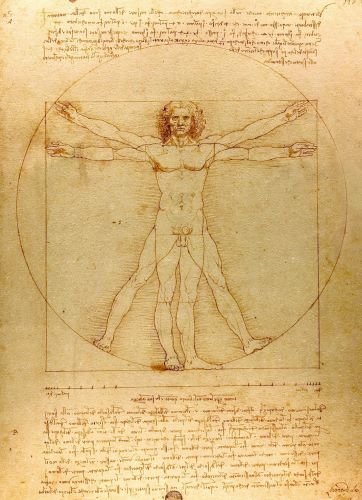
Our character´s portfolio is filled up with incredibly vivid human sculptures famous for their precise geometrical proportions. It was his pursuit of an exact depiction of human physiognomy what nurtured his genuine interest in anatomy. Like the water and light that foster sprouts to flower.
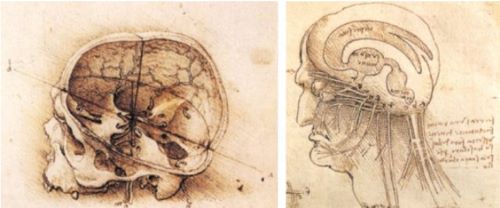
Beginning at the age of 35, he made dozens of anatomical drawings portraying the multitude of body organs from various perspectives, including the skull and the brain.3 He was the first to define the olfactory nerve as one of the cranial nerves (which emerge directly from the brain and not from the spinal cord). Also, he made one of the earliest naturalistic depictions of the optic chiasm (the point where the two optic nerves that leave each eye in their paths to the brain meet).
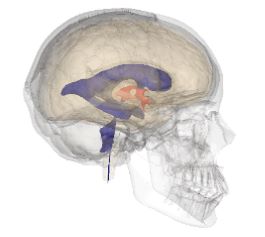
The best was still to come as he dived in the intimate corners of the nervous system. “A great neuroscience achievement [of our character] is his measurement of the size and position of the cerebral ventricles”, thinks Pevsner. Building upon his sculpting skills, he used for the first time solidifying masses to study the internal cavities of the brain.
Cavities that, we know today, play a supportive role in brain function – a point with which our character would have hardly agreed in his times. Here, in the ventricles, it would be where the major mental functions resided – in his view. The senso comune (which literally means “common sense” in Latin) rested concretely at the third ventricle, near the confluence point of the senses (see image). The other cavities gave shelter to memory and cognition, working altogether in a framework defined by four physical laws: movement, weight, force and percussion.
Vision was a special sense linked to the emergence of the artistic skills, in our character´s view. “During centuries, a multitude of philosophers and scientists have tackled the pressing issue of defining, explaining and locating [in the body] the diverse aspects of human cognition, including the artistic talent”, explains DeFelipe. “The eye is the chief organ whereby the senso comune can have the most complete and magnificent view of the infinite works of nature”, our character wrote.
He always gave the highest credit to his own witness and intuition, to the point of disputing established knowledge – as it happened with the sense of vision. “His mind was free enough to set aside the very heavy weight of authority”, points Pevsner.
During centuries, scholars had defended that vision happened because of a visual power emanating from the eye outward. Our character, after devoting entire notebooks to the study of light and the eye´s anatomy, reached a different conclusion. We see objects because of light that comes to the eye. Here he hit the truth.
It is also in his legacy where we can grasp a glimpse of how scientific knowledge evolves, with its successes and pitfalls. Mental processes – we think today- depend causally on the surrounding brain tissue, not the ventricles. “Complexity is a great challenge. Gathering precise knowledge on the nervous system requires tools and concepts that were almost absent at his times”, points DeFelipe.
Our character was born in Vinci (Italy), on April 15th, 1452, and authored the “Mona Lisa” and “The last supper”. He was Leonardo da Vinci, an eternal painter, sculptor, inventor, and scientist. And these above are some of his contributions to neuroscience.
Endnotes
- Pevsner, J. (2002): Leonardo da Vinci’s contributions to neuroscience. TRENDS in Neurosciences, 25(4) 171-222.
- DeFelipe, J. (2014): El Jardín de la neurología. Sobre lo bello, el arte y el cerebro. Agencia Estatal BOE; CSIC.
- A journey on da Vinci´s anatomical drawings at The Royal Collection
Originally published by Mapping Ignorance, 04.04.2016, under the terms of a Creative Commons Attribution-NonCommercial-NoDerivatives 4.0 International license.
About the Author